How to Cite Sources Properly in Your Dissertation Learn the importance of proper citation in your dissertation, how to choose the right citation style, and tips for ensuring consistency and accuracy throughout your work
 : 301
: 301
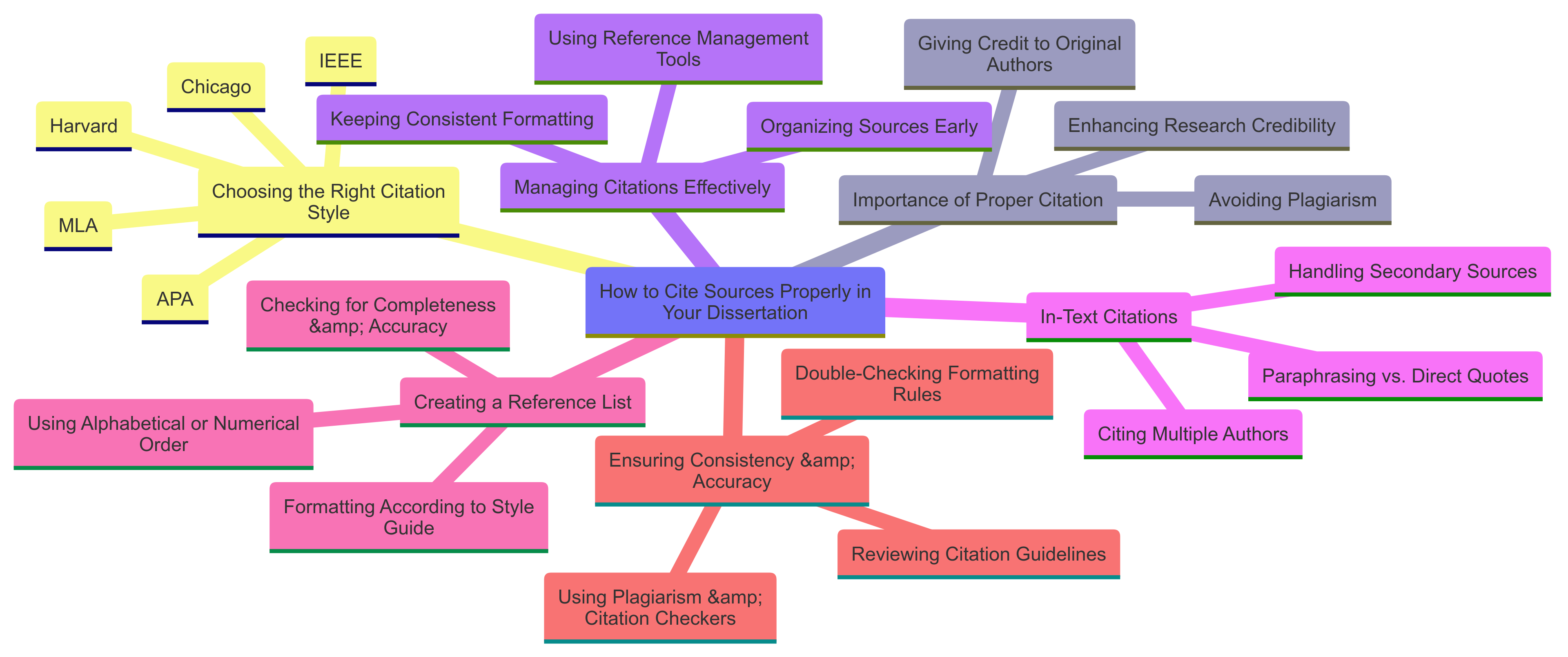
Proper citation is a cornerstone of academic integrity and a critical element of your dissertation. Accurately citing your sources not only gives credit to the original authors but also strengthens your arguments, demonstrates your engagement with the scholarly community, and enables readers to verify and build upon your work. This comprehensive guide will help you understand the importance of proper citation, choose the right citation style for your dissertation, and provide practical tips for ensuring consistency and accuracy throughout your document.
1. The Importance of Proper Citation
Citing sources correctly is more than a formal requirement—it’s an ethical and scholarly imperative. Here are several key reasons why proper citation is essential:
-
Academic Integrity:
Proper citations acknowledge the intellectual contributions of others and help you avoid plagiarism, which is considered a serious academic offense. -
Credibility and Authority:
By citing reputable sources, you bolster the strength of your arguments. Your dissertation becomes more credible and persuasive when your claims are supported by evidence from peer-reviewed literature and established research. -
Enabling Verification:
Accurate citations allow readers to trace your research path. They can verify your sources, follow your line of inquiry, and further explore the subject matter if desired. -
Building a Scholarly Conversation:
Citations situate your work within the broader academic community. They demonstrate that you are aware of current debates, theories, and findings, and they show how your research contributes to ongoing scholarly discussions. -
Professionalism:
Consistent and accurate citations reflect attention to detail and a high level of academic professionalism, which can positively impact how your work is perceived by examiners, peers, and future employers.
Understanding these benefits underscores why proper citation is not just a technical task but a vital aspect of scholarly research.
2. Choosing the Right Citation Style
Different academic disciplines prefer different citation styles, and the choice of style can impact the overall presentation of your dissertation. Here’s how to choose the right style for your work:
A. Common Citation Styles
-
APA (American Psychological Association):
Widely used in the social sciences, education, and psychology, APA emphasizes the date of publication and is known for its concise in-text citations and detailed reference list. -
MLA (Modern Language Association):
Preferred in the humanities, particularly in literature and cultural studies, MLA focuses on author-page citations and a Works Cited page. -
Chicago/Turabian:
Common in history and the arts, the Chicago style offers two systems: Notes-Bibliography (which uses footnotes or endnotes) and Author-Date (similar to APA). -
Harvard:
Popular in many academic fields, Harvard style uses in-text author-date citations and a comprehensive reference list. -
Other Styles:
Disciplines such as law, medicine, and engineering may require specific styles (e.g., Bluebook for legal citations or Vancouver for medical research).
B. Factors to Consider When Choosing a Style
-
Departmental Guidelines:
Always start by reviewing your institution or department’s guidelines. Many universities specify a particular citation style for dissertations. -
Disciplinary Norms:
Consider the citation practices common in your field. Using the preferred style demonstrates your familiarity with disciplinary standards. -
Publication Goals:
If you plan to publish parts of your dissertation as journal articles, choose a style that aligns with the requirements of your target journals.
C. Consistency is Key
Once you select a citation style, use it consistently throughout your dissertation. Inconsistencies can distract readers and undermine the professionalism of your work. Create a style guide for yourself if needed, noting key rules and examples for quick reference.
3. Essential Components of a Citation
Regardless of the citation style, there are several core elements that you must include when citing sources:
A. In-Text Citations
-
Purpose:
In-text citations provide brief information about a source within your text, allowing readers to locate the full reference in your bibliography. -
Key Elements:
- Author’s Last Name:
Identifies the source’s author. - Publication Year/Page Number:
Depending on the style, include the year of publication (APA) or page number(s) (MLA) to help pinpoint the source material. - Placement:
In-text citations should be placed immediately after the referenced information or at the end of the sentence before the punctuation.
- Author’s Last Name:
B. Reference List/Bibliography
-
Purpose:
The reference list (or bibliography) provides full details for every source cited in your text, allowing readers to find the original materials. -
Key Elements:
- Author(s) or Editor(s):
Full names of authors or editors. - Publication Year:
The year the work was published. - Title of the Work:
The title of the article, book, or paper. - Publication Information:
Details such as the journal name, volume, issue, page numbers, or publisher and place of publication. - Digital Object Identifier (DOI) or URL:
If applicable, include a DOI or URL for online sources.
- Author(s) or Editor(s):
C. Other Citation Components
-
Footnotes or Endnotes:
Some citation styles, like Chicago’s Notes-Bibliography system, require footnotes or endnotes. These provide additional context or comments on the source. -
Multiple Authors:
Know how to format citations when a source has multiple authors. Different styles have specific rules for listing authors (e.g., “et al.” usage).
Paying close attention to these components will ensure that your citations are complete and accurate.
4. Tips for Ensuring Consistency and Accuracy
Consistency and accuracy in citation are critical to avoid plagiarism and to maintain the professionalism of your dissertation. Here are some practical tips:
A. Use Reference Management Software
-
Zotero, EndNote, Mendeley:
These tools allow you to store and organize your references, automatically generate in-text citations, and create bibliographies in your chosen style. -
Benefits:
- Efficiency: Save time by automating citation formatting.
- Consistency: Maintain uniformity across your entire document.
- Collaboration: Easily share references with peers or collaborators.
B. Keep a Detailed Record of Sources
-
Organize Your Research:
As you gather sources, maintain a digital or physical log that includes all relevant details. This practice minimizes errors later on. -
Update Regularly:
Periodically review your reference list to ensure all sources are accurately recorded and formatted.
C. Consult Style Guides
-
Official Manuals:
Use official style manuals (e.g., the APA Publication Manual, MLA Handbook, Chicago Manual of Style) as primary references. These guides provide definitive rules and examples. -
Online Resources:
Many reputable websites offer quick citation guides and examples. Bookmark a few trusted sources for easy reference during the writing process.
D. Proofread Your Citations
-
Double-Check Each Entry:
Go through your reference list carefully to ensure that every in-text citation has a corresponding entry and vice versa. -
Peer Review:
Ask a peer or advisor to review your citations. A fresh set of eyes can catch mistakes you might have missed.
E. Be Consistent with Formatting
-
Uniform Appearance:
Ensure that punctuation, capitalization, and formatting (e.g., italics, bold) are consistent throughout your citations. -
Templates:
Use citation templates provided by your reference management software and adjust them to fit your institution’s guidelines.
By employing these tips, you can maintain a high standard of accuracy and consistency in your citations, which is crucial for academic integrity.
5. Handling Different Types of Sources
Different sources require different citation formats. Here are some common source types and tips for citing them correctly:
A. Books and Monographs
-
Key Elements:
Author(s), publication year, title (italicized), edition (if applicable), publisher, and place of publication. -
Example (APA):
Smith, J. A. (2020). Understanding Academic Writing. Oxford University Press. -
Tip:
For edited volumes, include the editor’s name followed by “(Ed.)” or “(Eds.)” as appropriate.
B. Journal Articles
-
Key Elements:
Author(s), publication year, title of the article, title of the journal (italicized), volume, issue, page range, and DOI (if available). -
Example (APA):
Doe, J., & Roe, A. (2019). Advances in data analysis. Journal of Research Methods, 15(2), 123-145. https://doi.org/10.1234/jrm.2019.5678 -
Tip:
Ensure you include DOIs for articles whenever possible, as they provide a persistent link to the source.
C. Online Sources
-
Key Elements:
Author(s), publication year (if available), title, website name, and URL. Include the date of access if the content is likely to change. -
Example (APA):
National Institute of Health. (2021). Health statistics overview. Retrieved March 15, 2022, from https://www.nih.gov/statistics -
Tip:
Verify the credibility of online sources and prefer those from reputable organizations or institutions.
D. Conference Papers and Theses
-
Key Elements:
Author(s), year, title, conference name or institution, location (if applicable), and URL or DOI (if available). -
Example (APA):
Lee, S. K. (2018). Exploring new methods in qualitative research [Conference paper]. Proceedings of the International Conference on Research Methods, Berlin, Germany. -
Tip:
For unpublished theses or dissertations, note the type of work (e.g., “Unpublished doctoral dissertation”) and the institution.
Understanding the nuances of citing various types of sources ensures that you capture all necessary information accurately.
6. Addressing Common Citation Challenges
Even experienced researchers can encounter challenges when citing sources. Here are some common issues and how to resolve them:
A. Handling Multiple Authors
-
Challenge:
Different styles have different rules for citing sources with multiple authors. -
Solution:
Consult your chosen style guide for specific instructions. For instance, APA uses “et al.” for in-text citations after the first author when there are three or more authors, while MLA lists all authors for works with fewer than three authors.
B. Citing Secondary Sources
-
Challenge:
When you reference a source that is cited within another source, it can be tricky to cite correctly. -
Solution:
Where possible, locate and cite the original source. If that’s not feasible, clearly indicate that you are citing a source as cited in another work (e.g., “Smith, 2015, as cited in Jones, 2020”).
C. Updating and Correcting Citations
-
Challenge:
Managing a large number of citations increases the risk of errors. -
Solution:
Regularly update your reference management database and cross-check your citations during revision. Use software tools to generate citations and verify them against official style guides.
D. Inconsistent Citation Styles
-
Challenge:
Switching between different citation styles can lead to inconsistencies in formatting. -
Solution:
Decide on one citation style at the beginning of your project and apply it consistently throughout your dissertation. Use citation management software to maintain uniformity.
Addressing these common challenges proactively will help you maintain a high standard of citation throughout your work.
7. The Long-Term Impact of Proper Citation
The benefits of proper citation extend well beyond the immediate requirements of your dissertation:
A. Academic Integrity and Reputation
-
Credibility:
Accurate citations build your credibility as a researcher and demonstrate your commitment to academic honesty. -
Avoiding Plagiarism:
Properly citing all sources prevents plagiarism, protecting your academic reputation and ensuring that your work is respected within the scholarly community.
B. Facilitation of Future Research
-
Resource for Others:
Well-documented references provide a valuable resource for future researchers who may wish to build on your work. -
Network Building:
Citing influential sources and engaging with existing literature helps establish your position within the academic community and fosters collaboration.
C. Professional Development
-
Transferable Skills:
Mastery of citation styles and reference management is a valuable skill that extends into your professional career, enhancing your ability to produce clear, credible reports and publications. -
Reproducibility:
Clear citations make it easier for others to replicate your study, contributing to the reliability and progression of research in your field.
The long-term impact of proper citation underscores its importance not only for your dissertation but also for your future academic and professional endeavors.
8. Final Thoughts: Mastering the Art of Citation
Proper citation is a critical skill that underpins the quality and integrity of your dissertation. By choosing the right citation style, using effective tools, and maintaining consistency and accuracy, you ensure that your work is credible, transparent, and accessible to the academic community.
Key takeaways include:
-
Recognize the Importance:
Proper citations uphold academic integrity, enhance your credibility, and facilitate scholarly communication. -
Choose the Appropriate Style:
Base your citation style on departmental guidelines, disciplinary norms, and your target audience. Consistency is essential. -
Utilize Technology:
Leverage reference management software like Zotero, EndNote, or Mendeley to automate and streamline the citation process. -
Document Thoroughly:
Keep detailed records of all your sources and regularly update your citations to ensure they remain accurate. -
Proofread and Review:
Regularly review your citations against official style guides, and seek feedback from advisors or peers to ensure accuracy and consistency.
Mastering the art of citation is not just about following rules—it’s about embedding your work within the broader tapestry of scholarly research. Accurate and consistent citations lend authority to your arguments, demonstrate your respect for academic contributions, and provide a solid foundation for your own research.
At DissertationAssist.com, we’re dedicated to helping you succeed on your dissertation journey. Whether you need expert advice on citation styles, tips for managing references, or guidance on maintaining academic integrity, our resources and support are here to empower you every step of the way.
Good luck on your dissertation journey. With careful attention to detail and a commitment to best practices, your citations will not only support your research but also leave a lasting impression of scholarly excellence.