The Importance of a Strong Dissertation Hypothesis Learn how to create a focused, testable dissertation hypothesis that guides your research, providing direction and a clear framework for your study’s objectives.

 : 437
: 437
The Importance of a Strong Dissertation Hypothesis
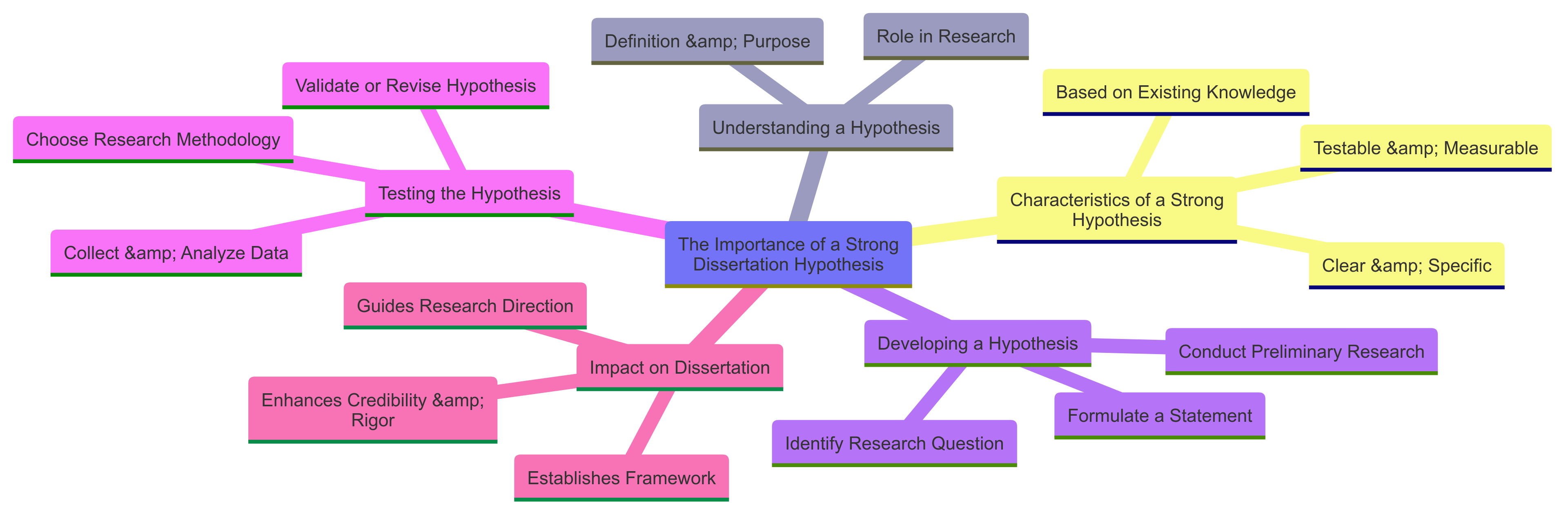
A robust dissertation hypothesis is the cornerstone of any impactful research project. It not only guides your investigation by providing a clear direction but also serves as the framework upon which your study’s objectives are built. In this comprehensive guide, we will explore the importance of a strong dissertation hypothesis, discuss how to craft a focused and testable hypothesis, and outline strategies to ensure it remains central to your research process. By the end of this guide, you will understand why a well-formulated hypothesis is critical for producing high-quality, meaningful research.
1. Defining a Dissertation Hypothesis
At its core, a dissertation hypothesis is a clear, concise statement that predicts the relationship between variables in your study. It is more than just an educated guess—it is a testable proposition that drives your research design, data collection, and analysis.
- Focused: Your hypothesis should be narrowly tailored to address a specific research question.
- Testable: It must be structured in a way that allows you to gather evidence either supporting or refuting it.
- Directional: Often, a strong hypothesis indicates the expected direction of the relationship (e.g., positive, negative, or neutral).
A well-crafted hypothesis sets the stage for a systematic inquiry and underpins the overall structure of your dissertation.
2. Why a Strong Hypothesis Matters
A strong dissertation hypothesis is essential for several reasons:
A. Provides Clear Research Direction
A focused hypothesis offers a roadmap for your study. It tells you exactly what you are investigating and helps you decide which methodologies and data collection techniques are most appropriate. With a clear hypothesis, every step of your research process—from literature review to data analysis—remains aligned with your central research question.
B. Establishes a Framework for Objectives
Your dissertation’s objectives should flow naturally from your hypothesis. When your hypothesis is well-defined, it creates a solid foundation for establishing the specific aims and goals of your study. This framework helps maintain coherence and ensures that your research efforts are targeted and meaningful.
C. Enhances the Testability of Your Research
A testable hypothesis is one that can be empirically verified or refuted. This scientific rigor not only lends credibility to your research but also helps in refining your theoretical framework. If your findings do not support your hypothesis, you gain valuable insights that can lead to further inquiry or theoretical development.
D. Improves Focus and Efficiency
Without a strong hypothesis, your research can become unfocused, leading to wasted time and resources. A clear hypothesis keeps your work on track, ensuring that every chapter, analysis, and discussion directly contributes to answering your research question.
E. Facilitates Critical Thinking and Analytical Rigor
Formulating a hypothesis requires a deep engagement with existing literature and theoretical frameworks. This process of critical analysis not only strengthens your understanding of the subject but also enables you to identify gaps in the literature. Ultimately, this intellectual rigor elevates the quality of your research.
3. Crafting a Focused and Testable Hypothesis
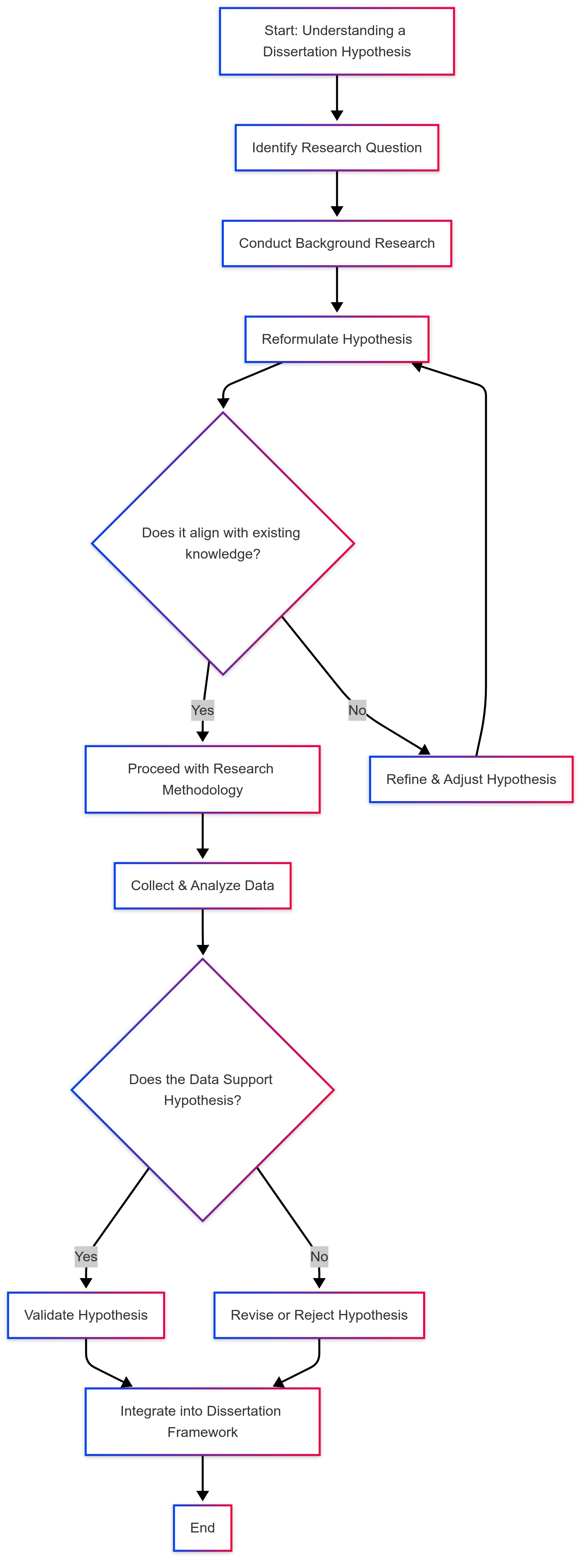
Developing a strong hypothesis is both an art and a science. It involves synthesizing theoretical insights, empirical evidence, and logical reasoning. Here are the steps to craft a hypothesis that will serve as the backbone of your dissertation:
A. Start with a Clear Research Question
Your hypothesis should emerge from a well-formulated research question. Ask yourself:
- What specific issue or gap in the literature am I addressing?
- What are the key variables or factors involved?
- What kind of relationship do I expect between these variables?
For example, if your research focuses on the impact of remote work on employee productivity, your research question might be: “How does remote work affect employee productivity in the technology sector?”
B. Conduct a Thorough Literature Review
A comprehensive literature review is essential to understand the current state of research in your field. This process will help you identify:
- Existing theories and models related to your topic.
- Empirical findings that support or contradict various perspectives.
- Gaps or inconsistencies in the literature that your research can address.
By engaging deeply with existing studies, you can refine your research question and develop a hypothesis that is both innovative and grounded in scholarly work.
C. Identify Your Variables
Distinguish between the independent and dependent variables in your study:
- Independent Variable (IV): The variable you manipulate or consider as the cause.
- Dependent Variable (DV): The variable that is affected by the IV.
For instance, in a study on remote work and productivity, remote work (or the degree of flexibility in remote work) could be the independent variable, while employee productivity could be the dependent variable.
D. Formulate a Clear Statement
A strong hypothesis is stated as a clear, concise sentence that predicts the expected outcome. Consider the following template:
- “If [independent variable], then [dependent variable] will [expected outcome].”
Using our remote work example, a hypothesis might be:
- “If employees have flexible remote work options, then their productivity levels will increase due to improved work-life balance and reduced commuting stress.”
E. Ensure Testability and Measurability
Your hypothesis should be testable through empirical data. Ask:
- How will I measure the variables?
- What instruments or methods will I use to collect data?
- What constitutes evidence for or against my hypothesis?
Ensure that the operational definitions of your variables are clear. For example, define how you will measure “productivity” (e.g., output per hour, quality of work, or performance evaluations) and what constitutes “flexible remote work.”

4. Types of Hypotheses
Understanding different types of hypotheses can help you choose the best approach for your research:
A. Directional Hypotheses
These hypotheses predict the direction of the expected relationship between variables. They are commonly used in studies where previous research or theory suggests a specific outcome.
- Example: “If flexible remote work options are implemented, then employee productivity will increase.”
B. Non-Directional Hypotheses
Non-directional hypotheses predict a relationship between variables without specifying the direction. They are used when there is uncertainty about the direction of the effect.
- Example: “There is a significant relationship between flexible remote work options and employee productivity.”
C. Null Hypotheses
The null hypothesis (H₀) states that there is no relationship between the variables. It is often used in statistical testing to determine whether any observed effect is due to chance.
- Example: “There is no significant difference in employee productivity between those who work remotely and those who do not.”
Choosing the right type of hypothesis depends on your research objectives and the existing literature. In many cases, both the null and an alternative (directional or non-directional) hypothesis are stated, with the null hypothesis serving as a baseline for statistical analysis.
5. Aligning Your Hypothesis with Study Objectives
A strong hypothesis should serve as the guiding star for your dissertation, aligning perfectly with your study’s objectives. Here’s how to ensure that alignment:
A. Consistency with Research Questions
Your hypothesis should directly answer or relate to your central research question. Each objective or research aim should have a corresponding element in your hypothesis that is testable.
B. Integration into the Methodology
The methods you use to test your hypothesis should be explicitly linked to its formulation. For example:
- If your hypothesis involves measuring productivity levels, ensure that your methodology includes reliable instruments for tracking performance metrics.
- If you hypothesize a causal relationship, consider using experimental or quasi-experimental designs that allow for control and manipulation of variables.
C. Driving Data Analysis
Your hypothesis should inform your data analysis techniques. Clearly outline in your methodology how you will test the hypothesis statistically or qualitatively. This might involve:
- Choosing appropriate statistical tests (e.g., t-tests, regression analysis) for quantitative data.
- Using thematic analysis or content analysis methods for qualitative data.
- Establishing criteria for accepting or rejecting the hypothesis based on your findings.
By ensuring that your hypothesis is integrated into every stage of your research, you create a coherent and unified study that systematically addresses your research questions.
6. The Role of a Hypothesis in Shaping the Literature Review
A well-defined hypothesis not only guides your empirical research but also shapes the structure of your literature review. Here’s how:
A. Identifying Relevant Literature
With a clear hypothesis in hand, you can target your literature review more precisely. Look for studies that:
- Support the theoretical framework behind your hypothesis.
- Offer empirical evidence related to your independent and dependent variables.
- Identify gaps that your hypothesis aims to address.
B. Structuring the Review
Organize your literature review around the key themes and constructs present in your hypothesis. This might include:
- Theoretical perspectives that explain the relationship between the variables.
- Empirical findings that corroborate or challenge your predicted outcome.
- Methodological approaches used in previous studies, which can inform your research design.
A focused literature review not only strengthens the rationale behind your hypothesis but also provides a clear context for your study.
7. Testing and Refining Your Hypothesis
The process of developing a hypothesis is iterative. As you progress in your research, you may need to refine or adjust your hypothesis based on new insights or preliminary data.
A. Pilot Studies
Conducting a pilot study can provide valuable feedback on the viability of your hypothesis. Small-scale studies allow you to:
- Test the feasibility of your research methods.
- Identify potential issues with your operational definitions.
- Gather preliminary data that can either support or prompt revisions to your hypothesis.
B. Seeking Expert Feedback
Consult with your advisor, committee members, or peers to obtain feedback on your hypothesis. Their insights can help:
- Identify any ambiguities or gaps in your formulation.
- Suggest alternative perspectives or additional variables to consider.
- Ensure that your hypothesis is both theoretically sound and practically testable.
C. Revising Based on Findings
If your pilot study or initial data analysis suggests that your hypothesis needs adjustment, be prepared to refine it. Revising your hypothesis is a natural part of the research process and demonstrates your commitment to scientific rigor.
8. Common Challenges in Formulating a Dissertation Hypothesis
Even seasoned researchers may encounter challenges when developing their hypothesis. Understanding these challenges and how to overcome them is crucial for creating a strong foundation for your study.
A. Overly Broad or Vague Hypotheses
- Challenge: A hypothesis that is too broad can lead to ambiguous results, making it difficult to draw meaningful conclusions.
- Solution: Narrow your focus by specifying the variables and expected relationship. Use precise language and clearly define all terms.
B. Lack of Theoretical Foundation
- Challenge: A hypothesis developed without a solid theoretical background may lack credibility.
- Solution: Ground your hypothesis in established theories and empirical studies. Ensure that your literature review supports your proposed relationship between variables.
C. Inadequate Testability
- Challenge: If your hypothesis cannot be empirically tested, it undermines the entire research process.
- Solution: Refine your hypothesis to ensure that it is measurable and that you have access to the necessary data and methods to test it effectively.
D. Confusing Correlation with Causation
- Challenge: Mistaking a correlational relationship for a causal one can lead to incorrect conclusions.
- Solution: Be clear about the nature of the relationship you are hypothesizing. If you are testing for causality, ensure that your research design allows you to control for confounding variables.
9. Practical Examples of Strong Dissertation Hypotheses
Examining examples from various disciplines can illustrate the principles of a strong hypothesis. Here are a few examples:
A. Social Sciences
- Example Hypothesis: “If social media usage increases, then political engagement among young adults will also increase due to enhanced access to political information.”
- Explanation: This hypothesis is directional, testable, and based on the relationship between two clearly defined variables: social media usage and political engagement.
B. Health Sciences
- Example Hypothesis: “Patients receiving cognitive-behavioral therapy (CBT) for depression will exhibit a significant reduction in depressive symptoms compared to those receiving standard care.”
- Explanation: This hypothesis sets a clear comparison, is grounded in clinical research, and specifies both the independent (type of therapy) and dependent (reduction in symptoms) variables.
C. Business and Economics
- Example Hypothesis: “If companies implement flexible work arrangements, then employee job satisfaction will increase, leading to lower turnover rates.”
- Explanation: This hypothesis connects organizational practices with measurable outcomes and provides a framework for examining the impact of flexible work on employee retention.
These examples highlight how a focused and well-defined hypothesis can shape research in diverse fields.
10. The Long-Term Impact of a Strong Hypothesis
A strong dissertation hypothesis is not merely a starting point for your research—it has long-term implications for the overall impact and quality of your study.
A. Enhancing Research Credibility
When your hypothesis is grounded in solid theory and tested rigorously, it enhances the credibility of your entire dissertation. Peer reviewers, committee members, and future researchers will recognize the careful thought and methodological rigor that went into your hypothesis formulation.
B. Guiding Future Research
A well-articulated hypothesis can pave the way for future studies. It not only addresses existing gaps in the literature but also generates new questions and avenues for further investigation. Your dissertation may become a foundational reference for other scholars, sparking ongoing academic dialogue.
C. Informing Policy and Practice
In many fields, strong empirical research informs policy decisions and practical applications. A robust hypothesis that is thoroughly tested and supported by data can lead to actionable insights, influencing practice in industry, healthcare, education, and beyond.
D. Personal and Academic Growth
Developing a strong dissertation hypothesis is a challenging process that fosters critical thinking, analytical rigor, and scholarly independence. These skills are invaluable not only during your doctoral studies but throughout your academic and professional career.
11. Final Thoughts: Crafting Your Dissertation Hypothesis
The journey to developing a strong dissertation hypothesis is iterative and demanding—but it is also immensely rewarding. As you refine your research question, delve into the literature, and design your study, remember that your hypothesis is the beacon that guides your entire research process. It provides clarity, focus, and direction, ensuring that every aspect of your dissertation is purposeful and interconnected.
To summarize, here are the key steps to crafting a strong dissertation hypothesis:
- Start with a clear research question that addresses a specific gap or issue.
- Conduct an extensive literature review to build a solid theoretical foundation.
- Identify and define your variables clearly, ensuring a focused relationship.
- Formulate a precise, testable statement that predicts the expected outcome.
- Choose the appropriate type of hypothesis (directional, non-directional, or null) based on your research objectives.
- Align your hypothesis with your study’s objectives and methodology, ensuring consistency throughout your dissertation.
- Test and refine your hypothesis through pilot studies and expert feedback.
- Integrate your hypothesis into every aspect of your dissertation, from the literature review to data analysis and conclusions.
By following these guidelines, you create a strong foundation that will not only enhance the quality of your dissertation but also contribute significantly to your field of study.
At the end of the day, a well-crafted hypothesis is more than just a statement—it is a commitment to rigorous, systematic inquiry. It challenges you to think deeply, test thoroughly, and contribute meaningfully to the academic community. Embrace the process, seek feedback, and be open to refining your ideas. In doing so, you will not only produce a high-quality dissertation but also develop the skills and mindset essential for a successful academic career.
Good luck on your dissertation journey. May your hypothesis be sharp, your research rigorous, and your contributions impactful.