 : 412
: 412
A RESEARCH
AGENDA TO REDUCE RISK IN NEW PROJECTS
DEVELOPMENT THROUGH KNOWLEDGE MANAGEMENT: A PRACTITIONER PERSPECTIVE
Table of Contents
1.2. Motivations for the research
1.3. The significance of the study
1.7. Expected findings and applications
2.2. Concept
of new product development
2.4. Model of risk breakdown structure
2.6. Concept
of knowledge management systems
2.7. Concept of Just in Time (JIT)
3.3 Analysis on research design
3.5. Secondary data collection
3.6. Inclusion and exclusion criteria
Chapter 4: Analysis of the Research Data
4.3.1 Project
Difficulties during Product Development
4.3.2
Identification of Risks In Terms Of Project Development
4.3.3
Utilization of Knowledge Management in Product Development
4.3.4 Mitigation of Risk Using Knowledge Management
during Project
Chapter 5:
Conclusion and recommendations.
5.2 Motivation and significance of the thesis
5.3 Findings and discussion of the research questions
5.4 The contributions of the study
5.5 Future research and limitations of the study
Chapter 1: Introduction
1.1
Introduction
Controlling and regulating knowledge
can be a significant challenge for business organisations as it helps them to
stay ahead of other businesses within the market. Efficient utilisation of
knowledge and talent within organisations can lead to companies gaining an edge
over others and can reduce risks. While developing new projects, an important
agenda for stakeholders of companies is to reduce risks. Since life cycle of
products has become shorter due to a shortening of the interval for the
technical innovation cycle, emergence of risks has increased. Moreover, customer needs have diversified
following which rapid improvements within products are being made every day. In
this research project to reduce risk in new projects development through
knowledge management: a practitioner perspective is discussed. In research
methodology positivism theory is used and in research approach deductive theory
is used. In this project researcher used explanatory rules for research design. Researcher used
secondary data collection method to collect data; they took help from academic
journal from Google scholar and Proquest. They also
used other website, webpage, books for this research project.
1.2. Motivations for the research
The
researcher desires to delve into various ways of knowledge so that valuable
insight is gained into methods and procedures of product development. Often
when new products are being developed, project managers and product development
managers encounter a wide range of risks like risks in implementation, risk in
design and risk in layout. Hence, it is necessary that risks be recognised
before the initiation of the project so that losses are minimized within the
development process. Not only do risks occur during initiation, risks may occur
at various stages of product development like implementation, testing and so
on. A major motivation for the researcher therefore is to find ways in which
risks can be reduced while developing new products.
Another
priority for the researcher is to find ways in which ways in which the
production process can be optimised. Since lifecycle of new products have been
drastically reduced, it is necessary that quality of these products be
maintained. Given the diversification of needs of customers, products that are
currently developed within the markets serve multiple purposes. It is therefore
necessary that organisations employ adequate knowledge procedures to develop
these products. A second motivation of the researcher is to therefore be to
examine various acknowledgement models and theories that aid development of new
products.
Risk reduction in new project
development through knowledge management is topic where the researcher has
discussed how to reduce risk in a new project with help of knowledge management
1.3. The significance of the study
In current
markets, competition is very high and in order to stay afloat within the
market, it is required that companies develop and release new services and products
that are not only innovative but also functional. Reasons such as corporate
survival and increased organisational performance , companies have to
consistently work on moulding new products (Deligianni
et al. 2017). However,
as per the findings of Spring et al. (2017),
it has been reported that the rate of projects dealing with development of new
products or services is remarkably low. According to the findings of Maylor and
Turner (2017) in his study, about 70% of global projects that deal with the
formation of new products fail before reaching the stage of completion. On the
other hand, among the number of projects that are completed, about 20% of them
fail to give any kind of valuable return on investment and become profitable
(Linnenluecke, 2017).
Some of the
main reasons why a lot of companies fail in their attempts to incur profits
while developing new products are a consistent increase in time in each of
stages of development, an increase in costs for each stage and other technical
difficulties. Other difficulties include mismanagement of activity schedules,
problems in constructing step-by-step procedures and obstacles in forming plans
for distribution (Voxeu.org, 2019). Lack of a
succinct decision-making body also hinders efficient assessment of risks during
product development (Fran a et al. 2017).
Therefore, it is extremely necessary that the researcher find out ways to
minimize risks during product development stages since awareness of risks will
allow speedy risk management and risk mitigation.
This research signifies that risk of a project can
be reduced by using knowledge management technique. Knowledge management is a
process to create, use, share and manage knowledge in an organization (Donate and Pablo, 2015). Importance
of this project is that the researcher analyzes collected data and has given
overview, how to implement this theory and conclusion about risk management.
1.4 Research Question
1.4.1. Research Aim
The aim of
the research is to reduce the risk agenda in the new projects with the help of
knowledge management. This research will be done based on a practitioner
perspective.
1.4.2. Research Objectives
To identify the obstacles and
difficulties in new projects
To find whether there is any loopholes in the risk identification procedure
To analyse the concept of knowledge
management in a new project
To recommend possible ways by which
risk can be reduced through knowledge management
1.4.3. Research question
●
What are the obstacles and
difficulties that are often encountered while developing new products or
services?
●
Are there any loopholes within the
process of risk identification?
● What is the
significance of knowledge management in a new project?
● What are the
possible ways by which knowledge management can be used to reduce risks during
a new project?
Subsection:
● What is meant by risk in knowledge
management?
● What can be the types of barriers
faced by the business management in providing limitations?
● What are the effective areas in
the business to maintain risk?
1.5. Research Design
Research
design helps to provide a systematic pathway for researchers to go about the
process of research and make the study more insightful. In other words, the aim
of the research design is to lay out the fundamental framework for the research
so that the process of research is conducted in an ethical and systematic
procedure.
In terms of
research approach, it can be said that there are mainly two kinds of approaches
used by researchers all over. As influenced by the opinions of Flick (2018), it
can be stated that two major approaches to research are inductive and
deductive. Within the current context, the researcher will use the deductive
research approach so that the researcher can compare data from
contrasting theories and perspectives of other researchers to analyse data. As
per Walliman (2017), the aim of deductive research approach is to investigate
research questions via comparative analysis of data and evaluation of existing
theories. Within the context of the current research, the researcher will need
to deduce facts by consulting with previous research papers on NPD cycles of
processes of development of new products (Trieu,
2017). Other than this, the researcher will also have to
consult secondary data regarding various risk factors that have previously
cropped up during production processes.
In terms of
research philosophy, the researcher will be using post-positivism because
the context if the current research demands that the researcher work on
effective interpretation of data through the help of logical arguments. As per
the ideas of Walliman (2017), it can be stated that post-positivism is one of
the three research philosophies existing within research methodology and that
it focuses on an accurate utilisation of differing points if view of other
researchers.
On the other
hand, the researcher will be using secondary data for the current
research because the researcher will need to refer to various books, journals,
and online articles for making a comparison between different product
development processes (Walliman 2017). Other than this, the researcher will
also have to make a note of various risk management techniques that have been
used by organisation in the past to identify risks while developing new
products. In order to do this, the research will be following a secondary
qualitative analysis so that the researcher can make a thematic
comparison of differing viewpoints and ideas (Flick, 2018). Within secondary
qualitative analysis, the researcher will be utilising thematic analysis to
generate adequate and relevant themes relating to the topic for a better
understanding of ideas related to product development and knowledge management.
Other than this, the researcher will be using a descriptive research design because
the researcher will need to effectively describe various strategic processes
and techniques used by organisations to recognise risks within the product
development cycle.
While
selecting secondary data, the researcher will be utilizing the inclusion
and exclusion criteria technique. As has been pointed out by Walliman
(2017), utilizing inclusion and exclusion criteria helps in selection of only
relevant journals and articles by the researcher and helps the researcher to
eliminate materials that contain vague information or data unrelated to the
topic.
Researcher has applied explanatory
rules in this research method and positivism philosophy has been used in this
project. Deductive research approach has been used by researcher because it
helps modify the design of the approach for exact theory to test the
hypothesis.
|
Research
Approach |
Deductive
Research Approach |
|
Research
Philosophy |
Post-Positivism |
|
Research
Data |
Secondary
Data |
|
Research
Design |
Descriptive
Research Design |
|
Research
Analysis |
Secondary
Qualitative Analysis (Thematic Analysis) |
Table 1:
Research Design
1.6. Theoretical orientation
Assumptions within the research:
●
It has been assumed by the
researcher that most projects that involve development of new products do not
reach the stage of completion without a major risk in implementation
●
Assumptions regarding probability of
risks happening mostly after initiation of product development is also assumed
by the researcher
●
Lack of time and lack of adequate
back up plan in the event of a major risk during product development is also
assumed since most projects fail due to this particular reason
●
Lastly, it has been assumed by the
researcher that there is a lack of knowledge management techniques followed by
organisations in developing new products
Apart from
this, relevant theories in relation to the topic that shall be used by the
researcher are:
Fuzzy model
Fuzzy
modelling techniques are those where a combination of deduction procedures and
human knowledge is utilised. As per the findings of Maylor
and Turner (2017) in his study, in fuzzy modelling approaches, complex
tasks are managed by dynamic systems and control paradigm.
Hierarchical
Risk Breakdown Structure (HRBS)
The Hierarchical Risk Breakdown
structure is a framework that systematically performs evaluation of risks and
analyses their sources within various projects (Voxeu.org,
2019). This model effectively locates factors that cause
and finds out their sources.
In this research paper on how to reduce risk in a
new project using knowledge management, researcher used Hierarchical Risk
Breakdown Structure (HRBS) and Fuzzy model. In Fuzzy model human knowledge and
deduction theory both are combined and control paradigram and system of dynamic
manage complex tasks (Grover and Froese, 2016). Hierarchical Risk Breakdown
Structure identifies risk within source and analyzed the source of the risk.
1.7. Expected findings and applications
An
application of the AHP method, especially the fuzzy theory helps to effectively
assess and examine impacts of risks on new product development. Besides, the
application of fuzzy theory, application of the Hierarchical Risk Breakdown
Structure (HRBS) will yield valuable results on kind of risks that usually
comes up within the life cycle of product development. Hence some of the
findings include:
●
Methods or frameworks that are
traditionally applied for analysing risks are not suitable enough for
identifying all kinds of risks since application of these frameworks are very
limited and restrained. The main areas where traditional methods focus are research
and development and finances. This limitation creates obstacles in laying out
scope and extent of risks within the NPD cycle
●
Application of models like the fuzzy
model or the HRBS framework will be suitable for categorizing risks and this
will, in turn lead towards the development of a better framework or structure
for assessing risks. The AHP model, in addition to the fuzzy model will aid in
determining levels of risks based on their priorities, costs required to handle
risks and so on.
●
AHP models also help to determine
pathways of other related activities that help in the reduction or lessening of
costs. Time required for mitigating risks is also lessened and this in turn
leads to towards an optimisation of the overall required costs for a given NPD
cycle.
Applications
●
AHP models, especially fuzzy models
can be applied by various industries while initiating new projects so that all
risk factors are considered before initiating the cycle of product development.
●
The HRBS framework may be utilised
by business organisations to locate underlying risks within product development
stages, to set scope of risks and their causes. Based on the results of risk
analysis, companies and business organizations can determine whether they want
to go ahead with the project or not.
●
Apart from these uses, application
of frameworks like AHP models, fuzzy models and HRBS framework might help
companies to create databases consisting of risks, their factors, sources of
risks and their classifications. Not only this, existing databases also be
updated once new risks are located by organisations.
This
research project gives the solution of risk in a new developed project. In this
project researcher has shown how to reduce risk in a new project by using
knowledge development.
1.8. Structure of thesis:
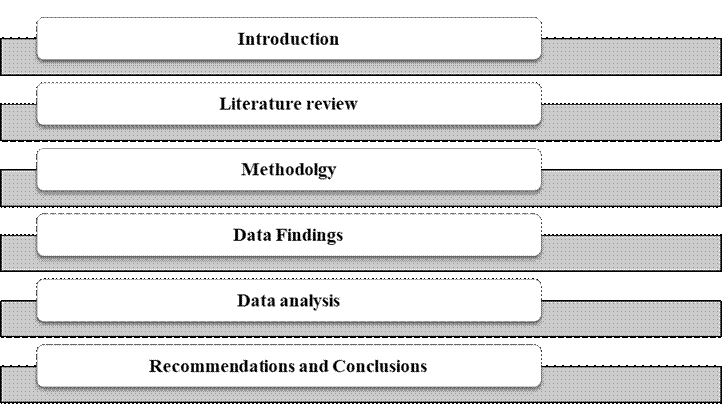
Figure 1: Structure of dissertation
(Source: self developed)
In structure of thesis five different
topic is used which are introduction, literature review, methodology, data
collection and conclusion.
The purpose of the current research
proposal is to find ways in which risks can be identified and reduced. Focus is
laid on the AHP model especially the fuzzy model and the Hierarchical Risk
Breakdown structure (HRBS) as agents to detect risks during development of new
products. Apart from this, the proposal will also highlight anticipated
findings and applications within the context of the research
1.9 Conclusion
In order to
locate and identify risks during the development of new products, organisations
use various frameworks for risk reduction, but due to the volatile nature of
risks, these frameworks often fall short of expectations. Besides, emergence of
new and unprecedented risks, project developers also face shortages of time and
money while developing new projects, and due to these reasons, projects never
reach the completion stage. It is here that organisations should think of
utilising approaches of knowledge management so that adequate ideas can be used
to support ways of dealing with risks. Since risks can always be of a dynamic
nature when it comes to new product development, organizations must choose
approaches like acknowledgement in order to develop risk free products and be
competitive within the market.
The researcher has concluded that
knowledge management is process to create, share and use the information and
this process can be implemented in a new project to reduce the risk of the
project. Deductive research approach has been used in this research and
researcher also used post positivism research philosophy. They used descriptive
research design and secondary data collection method.
Chapter 2: Literature review
2.1. Introduction
Systems of knowledge management play
a vital role to reduce risk while developing new projects. It is important in
establishing programs of cross-training, content systems to
enhance knowledge of business, creating document systems of management like Box
to retrieve documentation of a company. Tools of social networking such as Workplace
are vital to increase communication and collaboration. It shares enough
space to cope up with risk in new project.
The present research has shed light
on discussion of literature review chapter to include basic concepts, theories,
and models, which are necessary to understand present topic. Concept
of Just in Time (JIT), fuzzy model, importance of risk breakdown structure
and much more would be involved to know how they manage to mitigate risk in
project development.
2.2. Concept of new product development
Introduction introduced this concept as
fundamental capability to respond to creation of new product development such
that it can able to diverse demands of work environment. Through this concept, new
project can realize strategic flexibility by generating new ideas of
services as well as products to sensed opportunities. According to Gutierrez-Gutierrez, Barrales-Molina & Kaynak
(2018, pp.43-66), concept of development of new product (NPD)
establishes idea screening from both strategic and tactical decisions to
support and understand opportunities or threats of new project. Moreover, concept
development, development of business strategy and
product
development implement quality management to promote NPD and align it
with goods between market and technological state concerning new project.

Figure 2.1: Model of NPD
(Source:
Business.qld.gov.au 2019)
Knowledge
of teamwork
is gained from NPD concept through test marketing, which helps to increase
individual creativity in order to bring success in projects of NPD. NPD
is also important to produce approach of problem solving which
would lead into improvement of existing products and services of new projects.
Furthermore, commercialization of NDP organizes empowerment to strengthen
channels of communication thereby promoting autonomy, self-evaluation
and so on. As a result, it would minimize restrictions which are
responsible for caused by aspects of technical field and would foster capacity
to create path-breaking products (Cagliano, Grimaldi & Rafele 2015,
pp.232-248). Thus, this concept can be able to find out obstacles and other
relatable difficulties with help of aforementioned approaches of NDP.
2.3. Fuzzy model
This model is considered a method
of risk evaluation as it provides strategic making of decision in
presence of production networks (GPNs). As cited by Niknejad & Petrovic (2016, pp.44-58), Fuzzy
Inoperability Model of Input and Output (Fuzzy DIIM) is defined as knowledge
model which aims to reduce uncertainties that may appear due to random
events nature while preparing a new project. Medium reliability concerning high
substitutability is modeled as parameters of fuzzy in order to track
region of uncertainties in new project. Hence, this theory helps to manage
lucrative relationship between uncertainties outcomes and parameters of input.
This
model considers economic factors like profit, income of new project
development to determine level of interdependencies on basis of statistical
data. For example, while preparing this new project, manager concern with it
can make relevant decision by depending upon subjective judgment as well as
expertise. This would help to express conveniently with help of linguistic
terms such as fuzzy numbers, arithmetic sources and so on. They assist
to build suitable structure with effective data model that would later
correspond to operations of arithmetic. Apart from this, dependency criteria of fuzzy
model help in determining interdependency between nodes, dependent,
nodes of supporting. In this regard, trade volume; inventory as if
dependency criteria are well addressed which can create direct relationship to
ensure high outputs in return.
Fuzzy
model standardizes substitutability of product by replacing product, which can
create barrier in new project. Thus, it helps to search barriers thereby
mitigating it to some extent. Supporting node like substitutability of new product
supplier would be replaced by partner to maintain interdependency level
such that it can lessen risks. Collaboration agreement provides
sufficient flexibility to underpin dependent node thereby lowering
interdependency. Information transparency of new project is shared by supporting
node with help of fuzzy model, which offer chances to face possible disruptions
whenever appear. Physical distance between observer and project manager is also
maintained by this model which help to create direct relationship between them
(Winch & Leiringer 2016, pp.271-281). Thus, it can be delivered during
devising the new project such that risk factors can be recognized to eliminate
them.
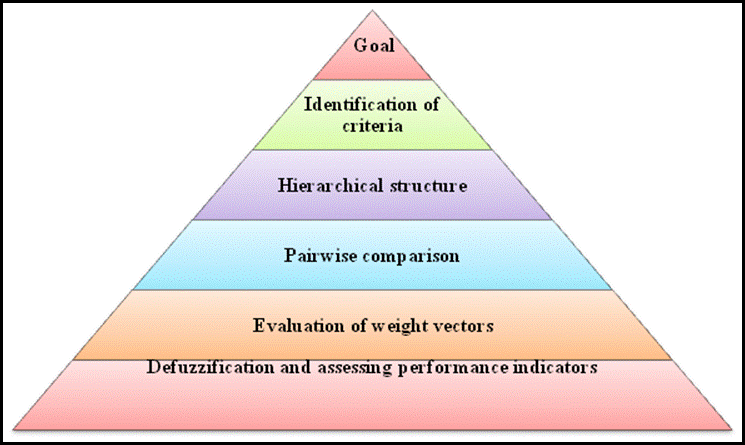
Figure 2.2: Fuzzy Model
(Source:
Created by author)
Besides
this, evaluation of new product system of service (PSS) is
measured and gained through fuzziness or randomness of this model. For
instance, service depends on skills of staffs, which is required for
cooperation with customers. It would determine weights like AHP,
ANP, and much more to leverage unique capabilities with respect to
development of new project. On the other hand, deployment of quality function
(FQFD) of fuzzy is evaluated with help of fuzzy multigroup as it
introduces to an appropriate decision making. This is useful in evaluating
indicators of key performance such as productivity, profit and lead
production of time (Chen et al. 2015,
pp.1123-1141). Hence, this technique
would manage to conduct and combine deduction procedures by utilizing
knowledges of human to control and escape from risks in a dynamic way. [Referred
to Appendix 1]
2.4. Model of risk breakdown structure
Risk relates to uncertain event that
may include positive and negative effects of a concerned project. Under
condition of negative impact, risk breakdown structure put support by
determining success factors of project. For example, it increased attention of
actual quality, performance of cost and time to reduce risk of time-oriented
and costs in new project. It acts as powerful agenda to eliminate loopholes
whenever present within risk identification procedure. Framework measures risks and analyzes sources regarding new project. As opined
by Cagliano, Grimaldi &
Rafele (2015, pp.232-248), different phase of risk management is stated to
derive life cycle of project and corporate maturity on risk. Technical,
external, organizational and project management is the field
which is devised from this model. Technical aspects help to manage
risks related to requirements, technology, complexities, quality and
performances of new project.
External
aspects eliminate risks of regulatory, market and suppliers of new project. Organizational
level manages to escape risks, which are associated with project
resources, funding, and prioritization. Finally, risks of project management
include planning risks, estimating risks and risks related to controlling and
communication respectively. Apart from this, this model helps to provide strategies,
which can eliminate risky events such as Expected value of money, analysis
of What-if and much more. Cause & effect diagram is also
established to analyze risks, which are aforementioned above. Besides this, knowledge
is the fundamental element concerning attitude towards risk management that
limits qualitative investigation by reducing risks in a new project. Rational
risk is maintained by this model, which help to improve and promote
communication by managing uncertainty. Innovation degree of new products
connects new phases of project cycle by interpreting and managing risks
(Cagliano, Grimaldi & Rafele 2015, pp.232-248).
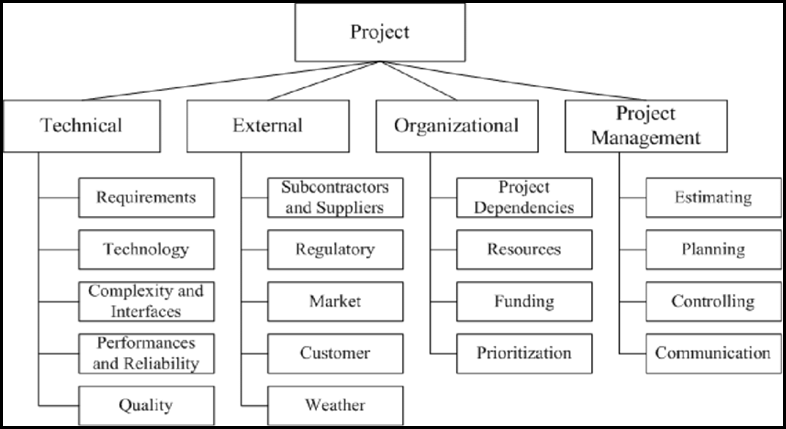
Figure
2.3: Model of Risk Breakdown Structure
(Source: www.risktools.com.au 2018)
2.5. Model of AHP
AHP stands for analytical process of
hierarchy, which is used to construct a new project by avoiding risks and
issues related to it. It is used to enhance attention in management of
construction in order to analyze situations of complexities to make sound
decisions. According to Darko
et al. (2018, pp.1-17), AHP acts as
method of decision making which involve three defined steps to exit risks in
creating new project. First step of this model states formation of hierarchy, which
helps to make goal of decision along with identification of sub-criteria to
reach the goal of decision. Pairwise comparisons are the next step,
which refers to decision-makers who are necessary to compare and complete
hierarchical elements of projects. Final step is to verify consistency, which
includes expertise and their judgments to ensure relative importance of project
criterion. Therefore, this enables to gain optimized outcome in new project. In
addition, computation concerning consistency ratio is also performed by this
model to revise decision-making process in an effective way.
AHP
idea provides simple and easy calculation procedure, which can easily be
accessible by agenda or manager like people while handling this new project. In
term of contribution of PSS, it is noted that this model establishes requisite
design approach which can maintain fuzziness whenever to appear during
assessment of new project. It also supports to choose proper leader to analyze
new project. Therefore, this project can be able to organize new leader to rule
the project in a successive way. On the other hand, AHP model structured
decision modeling by acknowledging nature, judgements, opinions, and
needs of new project. It would help to establish newly criteria thought
which would act as an option of alternative to make changes or delete from
present situations. In this perspective, risks can be treated as one of
alternative option, which can be removed or reduced to a certain extent.
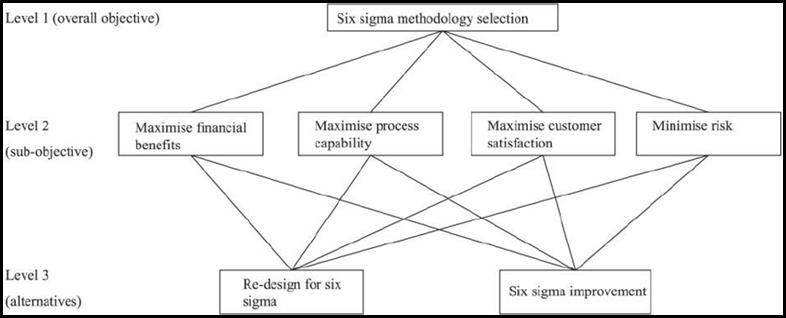
Figure 2.4: AHP model in six-sigma
formation
(Source:
Todorović et al. 2015,
pp.772-783)
Apart
from this, AHP model is treated as six sigma model which subjects to make
financial benefits in maximum amount thereby maximizing capability of
new project process. In this concern satisfaction of customer is met by
fulfilling gaps of knowledge as well as risk management (Darko et al. 2018, pp.1-17). This model minimizes
risk by identifying them and hence it can be said that it recognizes
drawbacks in new project. Finally, after this analysis, it aims to redesign
which is termed as alternative source as mentioned before. Main purpose
of this level of AHP model is to do improvement of six sigma stages thereby
mitigating issues, which are available to new project.
2.6. Concept of knowledge management systems
Systems of knowledge management are
a concept of knowledge, which improves collaboration and locates sources of
knowledge to repost hidden knowledge. Knowledge transfer is satisfied in
competitive work environment and for this training of e-learning is necessary
to estimate requisite skills of new project. In particular, it would judge s
risks to reduce them. Knowledge management concept produces high accessibility
to analyze decision required for new project. Designing framework and
implementing technical programming is also possible with the help of this model
to standardized knowledge flows in efficient way (Gutierrez-Gutierrez,
Barrales-Molina & Kaynak (2018, pp.43-66). However, in perspective of new
project, this system adopts, accepts and assimilates characteristics of project
process. It is influenced by designs and attitudes knowledge, which ensure use
of technology towards effective performance. Thus, concept of knowledge
management can be understood along with its benefits to prepare a new project without
any risks.
This concept helps to establish
different skills of project strategy, which are essential to undertake new
projects such as leadership skill, skills of strategic thinking, industry
knowledge and many more. Management skills like team building, measurement of
risk analysis and its values, people management, mapping of project process can
also be outlined with the help of this concept. Another benefit of this concept
is that it performs mentoring and design problem solving like approaches
through means of intellectual learning skill which deals with ambiguity in
devising new project. According to Todorović et al. (2015,
pp.772-783), communication interpersonal attributes are also achieved when this
concept is used to deal with new project. For example, listening, working with
team, consulting and so on is organized via this knowledge management system.
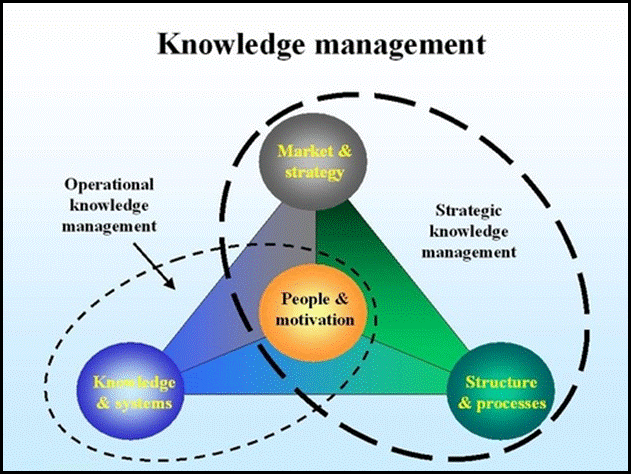
Figure 2.5: Model of Knowledge Management
System
(Source: Business.qld.gov.au 2019)
From
aforementioned statement, it is therefore evident that knowledge management
would enable workers of new project to possess not only factual but also
theoretical knowledge. Motivation is also enforced among workers who are
involved in new project to maintain each intellectual capability of
individuals. Knowledge systems customize traditional learning to promote
accessibility through approaches of multimodal. Besides this, recognition is
also accounted by this concept, which proves certification of individuals who
would be involved in new project analysis. Hence, identification of risks is
possible to know concerning new project.
2.7. Concept of Just in Time (JIT)
JIT concept is regarded as
management approach, which aims to raise productivity sources by minimizing
waste formation in a project. It is operational approach, which is needed to
promote performance through means of waste reduction. Therefore, it processes
to meet ultimate goal concerning new products and services of a new project.
Besides this, JIT is also considered as integrated and problem-solving method
as it facilitates timeliness in production, level of supply and distribution
effort. It gained interest of individuals by delivering products of high quality
and services. This concept devised dimensions of performances which underpin
philosophical elements by maintaining system flexibility in new project (Asri et al. 2016, p.71).
Value of logistics is addressed by
JIT from viewpoint of acquisition of raw materials which manages to include
services of customer, order processing, management of inventory and
transportation. This concept manages to produce good customer services by delivering
right product, which would be used by right customer under right place and at
right quantity. Order processing of products of new project is also enforced by
certain activities, which would include collecting of raw products, entering,
transmitting of it with requisite information source. With this approach,
financial planning, scheduling, logistics of operations, planning of production
and market analysis is collected.
Inventory management and
transportation are concerned by JIT to analyze retailers, suppliers,
distributors to value supply chain. In the words of Lai & Cheng (2016, p. 08), waste reduction is
possible with the help of JIT approach. For instance, procedures of order
processing would require value network (VAN) to perform continuous improvement
(CI). Loading and unloading of operational logistics can, therefore, be driven
properly by reducing cost management among suppliers and intermediaries of new
project. Besides reduction of waste, improvement of services is gained by JIT.
This is attained by meeting each need of requirement of new project thereby
establishing possession, and time utilities for customers.
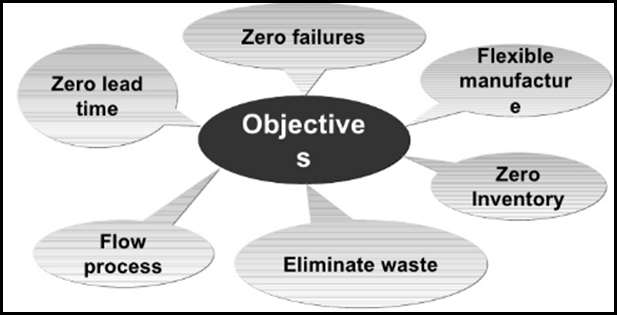
Figure 2.6: Model of JIT
(Source:
Oluwaseyi, Onifade & Odeyinka 2017, pp.1-11)
Achievement
of quality products is carried out by JIT, which aims to develop new project.
This would contain zero defects that are absence of risks can be seen.
Inventory logistics is controlled by JIT, which helps to contain information
between origin point and consumption point to meet requirements of customers.
Through this model, physical distribution among new project workers is
achievable by enforcing movement of products from end of assembly line (Dudek-Burlikowska,
2015, pp.229-236). Inventory of raw materials like cash, work-in-progress and
finished products are accessible through means of this concept, which helps to
maintain coordination between production of new project and workers of new
project. Apart from inventory management, scheduling helps to improve
investment return (ROI) by minimizing carrying amount of costs. Thus, flexible
flow of work operations without any risks like huge costs is achieved when JIT
is used in new project.
In
perspectives of management of total quality (TOM), lead-time production is
produced by improving technical and behavioral aspects in cost-effective
manner. However, Shewart's cycle is beneficial one in this condition to detect
and determine whether TOM is initiating in new project to attain success or
not. This cycle would identify causes of detection and would provide support by
regulating effectiveness in relation to costs of new project. Moreover,
teamwork, commitment of management are enabled by JIT and TOM which help to
solve issues of new project thereby mitigating them (Oluwaseyi, Onifade &
Odeyinka 2017, pp.1-11). Hence, indicators of key performance, as well as
elements of JIT, is outlined properly in this way which includes
standardization of new project, commitment of top management, total maintenance
of production, employee training and much more.
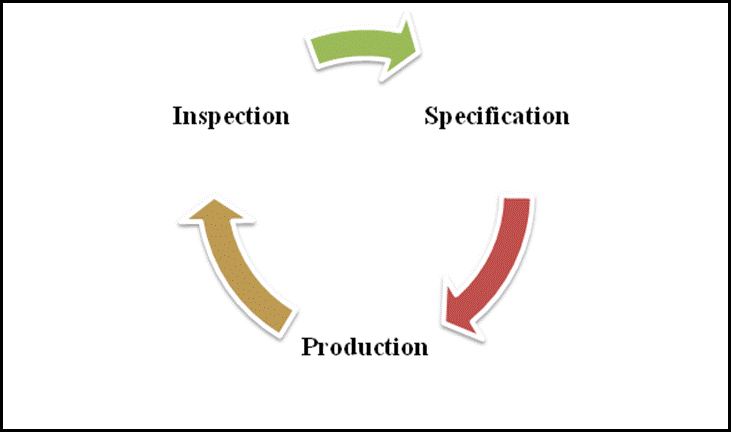
Figure 2.7: Shewart s Cycle of Total
Quality Management
(Source:
Dudek-Burlikowska 2015, pp.229-236)
2.8. Gap in Literature
While
analyzing for risk management with an approach of knowledge management system
to focus on new projects, various journals and books have been researched. It
is found that certain journals have shed light on risk management wherein
certain has influenced analysis of logistics of JIT. Besides these two
concepts, some articles have provided importance on TOM, Fuzzy model whereas
very few include analysis of Shewart cycle. Hence, lack in literature review is
found that create gap because no new journal has shed a little impact on new
product development with its importance to tackle risks. Therefore, this is the
gap and necessity of this research to review essentially of knowledge
management concerning new project development. Researcher has
discussed how to reduce risk in a business or in a project by using knowledge
management. They have covered different type of theory and method like they
have used deductive research approach and post positivism research philosophy.
They then used descriptive research design for this project and secondary data
collection method. Though researcher has covered all most everything, some
details how to implement was needed.
2.9. Conceptual Framework
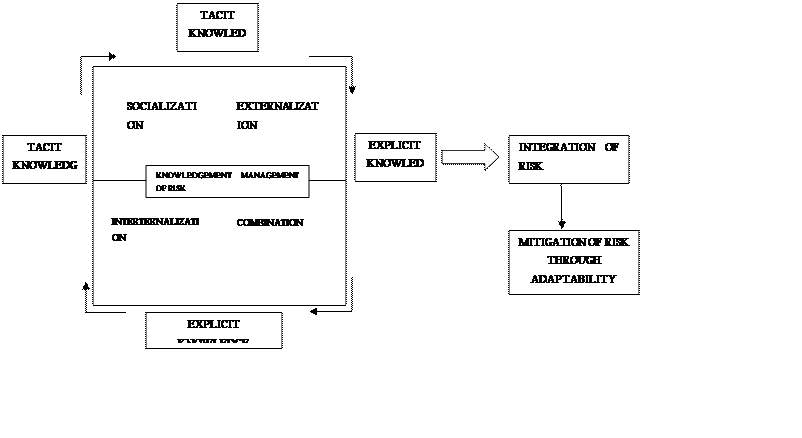

Figure
2.8: Conceptual Framework
(Source: Created by author)
There are TACIT knowledge and explicit
knowledge in knowledge management which are the combination of socialization,
externalization and internalization. TACIT knowledge is converted into explicit
knowledge which can be called integration risk which may convert to mitigation
of risk through adaptability.
2.10. Conclusion
From the above analysis, it can be
said that this research has briefly discussed various concepts, and models,
which are necessary to manage risks while undertaking a new project. Initially,
the concept of new product development is analyzed to figure out its benefits
and characteristics along with strategies that are aidful to mitigate risks.
Fuzzy model analysis is done which provide supportive background to cope up
with uncertainties in a new project to meet required targets.
Concept of breakdown structure of
risk and model of AHP has been mentioned by marking out the advantages of them
to use it in a new project. Knowledge management systems are analyzed to know
importance of it in order to devise a new project without any risks. Finally,
JIT and TOM concepts are discussed to reduce risks and improve services and
products in a new project.
Chapter
3: Methodology
3.1 Overview on the research
In
the overview of the research it is associated that the
knowledge management helps in promotion of the things in the right way. In
respect to this while promoting there can be many types of risks such as many
the use of the article may not be better as per the perception. As per Bromiley et al (2015, p. 266), the article cannot
be received by the people because of the low demand as well as low marketing.
As per Stark (2015, p. 19), incensement in price
can be there as it there is low demand in the market. The pros can be less in
respect to cons of that article..
3.2 Research Hypothesis
H1:
Risk management plan impacts in the business and technology
H0:
Risk management plan does not impact in the business and technology
H2:
The new process of building is helpful for the business
H0:
The new process of building is not helpful for the business
|
Hypothesis |
Research Questions |
Utilization of Instruments |
|
1. Impact of risk management plan in business and
technology 1.1. Positive impact of
risk management plan in the business and technology 1.2. Negative impact of Risk management plan in the business and technology 2. Impact of new process in business 2.1. Positive impact of new process to build the business 2.2. Negative impact of
new process to build the business |
1.
How
much risk management plan is important in business and technology? 2.
Why new process is needed by new business
and technology? |
Questionnaires are designed to identify the uses of
knowledge management in a new business and management to reduce risk of the
project. Knowledge management is a process to create, use and share the
information among people to get better and innovative result. In this
research project researcher has used deductive research approach and post
positivism research philosophy in this project. They also used descriptive
research approach in research design and secondary data collection method and
then they analyzed the data for this project. |
3.3 Analysis on research design
3.3.1. Research philosophy
In
the research philosophy, positivism has to be acknowledged in a brief way.
Positivism brings various collection and settings that are being introduced in
the interpretation of the data collection and can be approved in the various
ways. Positive study brings the upliftment in the field of business awareness.
In positivism philosophy, certain observations and limitations are to be
interpreted along with the data. However Engert and Baumgartner (2016, p. 834), stated that positivism
philosophy is applicable for determination of fact based information from other
sources. Using this mode, it is possible for the researcher to bring philosophy
and findings that become very quantifiable and very much observable for the
research philosophy.
3.3.2. Research approach
In
this assignment, deductive approach helps in maintaining to do the researches
that are being concerned in the development of hypothesis on the existing
theory. Apart from all this, it can be concluded that the researcher helps in
the modification of designing the approach for the proper theory while testing
the hypothesis. Deductive approach has been taken under consideration in this
study. Apart from all the design in the deductive approach, it helps to explain
the means of hypothesis. According to Estrin et al. (2016, p. 480), in the simple way it can be varied that
the deduction helps in the involvement of the conclusion of the various
preposition. It can be approached that high volume of resources helps in the
needfulness of resources that can be achieved through short period of time that
helps in the completion of the study. As per Bell
et al (2018, p.
50), risk
management helps in the deterioration of the business management because there
can be various unfavourable circumstances that leads in the upbringing of the
organisation.
3.3.3. Research design
In
the research design, the explanatory rules are being carried out by the
researcher. This can be conducted with the fact that the risk has to be
determined for the specification of the issues. This can be conducted on the
various topics. In research design, there are usefulness for the better
understanding of the of the research topic that need to be concluded. However, Fraser et al (2015,
p. 75), in the directional way, it provides the conclusive and exclusive design
that is being implemented on the basis of the evidence. In the research design
it has been concluded that the research design provides the final conclusion
that it explores significantly in the different way with the varying depth.
3.4 Instrumentation
In
carry forwarding the research, the researcher needs to follow the Google
scholar and Proquest for their better source of instrumentation. As per George et
al (2016, p. 1980),
Google scholar gives the wide range of options for choosing the research
articles, books and journals that are easily accessible. In Proquest this is
the better site for the selection of the journals according to the time scale,
peer review and place.
3.5. Secondary data collection
In
secondary data collection researcher has to search and choose for the secondary
data to sustain the collected data for the research. In this secondary
collection, it is collected from the Google scholar and proudest as it has
humus amount of data that get be collected. According to Hazen et al (2018, p. 210), this type of instrumentation helps in
the various data ranges that are being selected. Institutional library has been
used in the additional way for the collection of the secondary data.
3.6. Inclusion and exclusion criteria
In
respect to this job it can be concluded that inclusion
and various exclusion play a major and vital role in the required desired data
practice that helps in the designing of the high level in the research
protocol. However, Lolich
and Lynch (2016, p. 17-30),
in the research project, it can be concluded that essential criteria have to be
maintained. In various other kind the researcher have
to find the off track journals that are being denied. In the respect to
secondary data the selection is done after 2015 and the focus is given on the
recent journals.
3.7. Ethical considerations
At
the time of the research, various ethical considerations are to be maintained
such as data protection acts 1998 are being ensured. According to McConnell (2016, p. 667-684), indifferent to research participants, there are
certain managing confidentiality that are used in the research. As per the act,
no data collected is to be used in any unlawful manner without permission from
the source.
3.8. Methodology limitation
In the research methodology, there are there are various and certain
limitations that are being observed while accessing the data without buying the
lack of authority. However, Serrao-Neumann et
al (2015, p. 46-61), it can be created on the basis on the basis of lack of
issues that are being researched in the limited budget or having the monetary
problem.
3.9. Conclusion
In the above mentioned form of methodology, it
can be summarised in the form of positive philosophy that helps in the
explanatory design that are used in the deductive approach that are to be
chosen. In the way it is helpful that in the researcher hypothesis while
formulating and implementing the research. Secondary data collection is to be
followed in instrumentation that is used in the Google scholar and Proquest.
In the research to the ethical considerations it can
be followed that are maintained. In this case the certain limitations are to be
posed for the lacking of the monetary issues and insufficient accessing of
important resources.
Chapter 4: Analysis of the Research Data
4.1 Introduction
Managing project in an
organization can help to reduce the possibilities of risk in terms of project
budget, resource management. Successful project can effectively achieve its
goals with the association of efficient team members and leader who manage
every task. On that note, an organization deals with large project such as new
product development so that the large projects need proper planning to manage
entire work within specified time. Project manager takes the responsibility to
segregate each task on the basis of priority and necessity. In this way,
project goals can be achieved in an effective way. This chapter highlights several
aspects of project development through its life cycle.
Project development consists
of various procedures in terms of risk identification, amazing every task,
quality management. This chapter would describe the methods of recognizing risk
with the help of knowledge management in an effective way. In order to organize
entre work and reduce the possibility of arising risks, knowledge management is
necessary to take important decisions and it helps to learn from previous
mistakes in project management. Therefore, all the imperative factors and
elements would reflect the context of reducing risk using knowledge management
concept through this chapter as well as thematic
analysis.
4.2 Data
This study has focused on
knowledge management in terms of reducing risk during project development
whereas new product development in an organization has been considered as a
project. Based on collected data, researcher has tried to construct the concept
of knowledge management, identifying possible risk during product life cycle,
barriers in project management and benefits of knowledge managing to take
important decisions (Alcaraz-Corona, Cant -Mata &
Torres-Castillo 2019, p. 95).
In this case, researcher has gathered data from several secondary resources
such as peer reviewed journals, articles
to obtain data regarding topic using the concept of thematic analysis.
This type of data analysis
helps to find accurate data in qualitative research. It also figures out the
examined data along with recording patterns within collected data set. In order
to construct dataset, several themes have been designed on the basis of
research questions as well as objectives so that research problems can be
addressed in a proper way. Researcher can provide effective solution through
these data analysis techniques in order to establish the concept of knowledge
management and its importance in product development life cycle. Themes are
associated with description of individual, phenomenon so that it can be linked
with research questions specifically. This study highlights knowledge
management concept and its utility during project development process.
An individual project has to
follow few segments such as project initiation, planning, project execution
along with project closure. All those steps have belonged to numerous tasks and
those activities need knowledge management concept in order to understand the
priority as well as necessity for achieving project goals in an effective
way. In this study, each theme has been
developed to provide information regarding benefits of knowledge management
during project life cycle. Project development needs proper identification of
targeted customer s expectation and markets current trends. Based on that
particular information, product development initiation can be done through a
detailed data analysis and investigation. An organization considers these
factors in order to develop a new product through proper screening,
devaluation, developing, testing along with business analysis (Bhardwaj
& Rana 2016, p. 245).
On that note, researcher has
chosen new product development as a project to describe entire project
development life cycle. Thematic analysis is used qualitative data from
secondary resources using cluster of procedures that have focused on
identifying several patterned meaning with the help of
huge dataset. The main purpose of thematic analysis is to recognize various
patterns of meaning through huge dataset that can provide appropriate solution
to entire research problems.
4.3 Findings
The identification of
processes and methods through a detailed investigation from secondary resources
are accumulated in order to demonstrate accurate information using properly
collected dataset using thematic analysis
(Chen
et al. 2016, p. 245). For this,
researcher has constructed few themes on the basis of research objectives so
that research goals can be addressed with accurate information.
4.3.1 Project
Difficulties during Product Development
Product development consists
of entire methods of conceptualizing ideas, planning, designing, market
analysis, product development, testing along with launching final protectors.
In this case, marketing analysis is required and it is very crucial because
product development is done the basis of customer expectation as well as
current market demand. The major issue in product development is that
manufacturing a product takes huge time in order to introduce in current
competitive market. In the meantime, market trends and customer demand can be
changed so that developed new products cannot fulfil the requirements.
The final product can face
difficulties in terms of promoting. After developing each product, it needs
maintenance because several organizations have launched new product including
new as well as attractive features in rapidly changing market (Dandage
et al. 2018, p. 159). Product
developer needs to think beyond current market trends and developing product
would be introduced on the basis of assumption for future demand. In order to
establish the idea regarding difficulties identified during project development
life cycle, a software designing and development has been considered so that
researcher can easily demonstrate the issues found in product development in an
effective way.
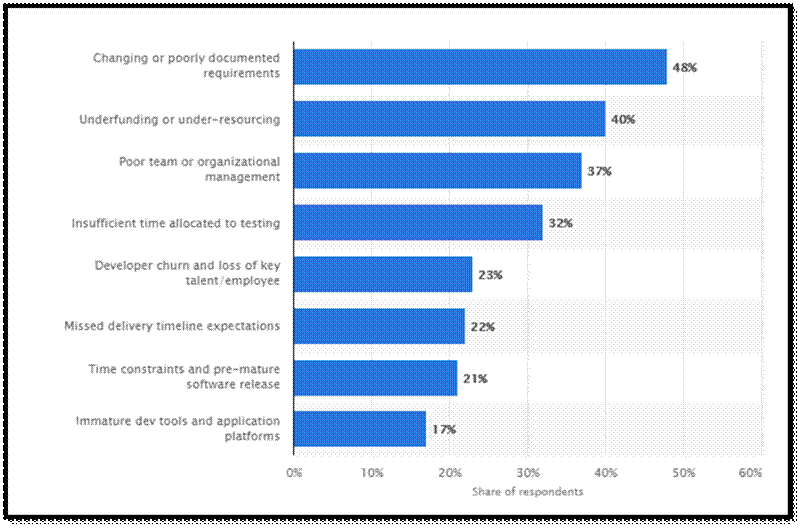
Figure 4.3.1: Software Project Failure
(Source:
Statista.com, 2015)
Analysis
Software development is
considered as a project to evaluate difficulties during project life cycle.
Software can be modified or developed to provide benefits to the targeted
audience so that specifics work can be done faster than previous work. For
this, testing is required to understand problems which are evaluated on the
basis of pre-decided requirements. Software has touched few versions for
gathered customer s feedback before launching. Based on the experts as well as
customer feedback, software developer has launched final version of particular
software and provided maintained by incorporating few additional features (Emmons
et al. 2018, p. 66). However; a
product can face difficulties due to obtain less chance of testing of
particular products. In this case, project goals cannot be achieved in an
effective way.
Project leader has crucial
responsibility to divide each team on the basis of task requirements and its
priority. Based on that particular knowledge, project leader has divided every
task after analyzing team member s capabilities, skills, knowledge on specific
field. In this case, project leader needs to guide each team member and manage
them properly so that they can easily overcome any difficulties (Eslami
& Lakemond 2016, p. 889).
Otherwise, project would be failure because of poor team management. Another
aspect of project failure is to resource allocation because most of the
respondents have described that a project can fulfil all requirements if
resources utilization can be done properly presented in aforementioned graph.
In order to initiate project, documentation in every project development stage
is required in order to figure out any complication during project life cycle.
However, team member could not understand process of product development and
they cannot resolve problems by following risk register. Various project
activities have not completed within specified times.
4.3.2
Identification of Risks In
Terms Of Project Development
Project management consists
of several project management activities that involve measuring, identifying,
communicating, mitigating, controlling, documenting as well as managing the
entire risks during project life cycles. The procedures of identifying risks
are intuitive and project leader can manage using strategies along with
methods.
Analysis
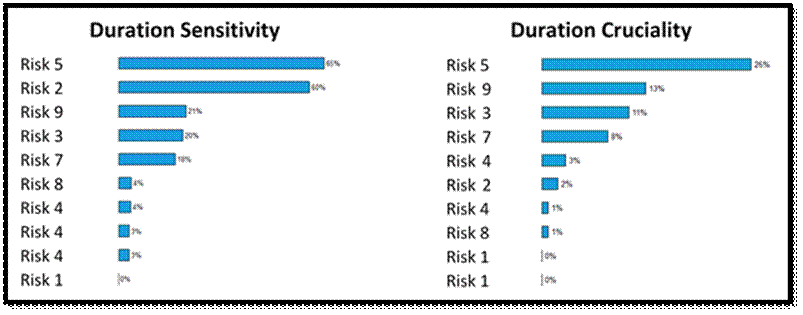
Figure 4.3.2.1: Percentage of Potential Risk in
Project Development Life Cycle
(Source: Fatima,
Ali & Ashraf 2015, p. 25)
Organizational project
requires considering several aspects in terms of data security of those people
who are associated with that particular project and project related
information. Therefore, data safety procedure can secure entire data set
recorded during project development so that stakeholders can get access to
those data set using authentic security codes.
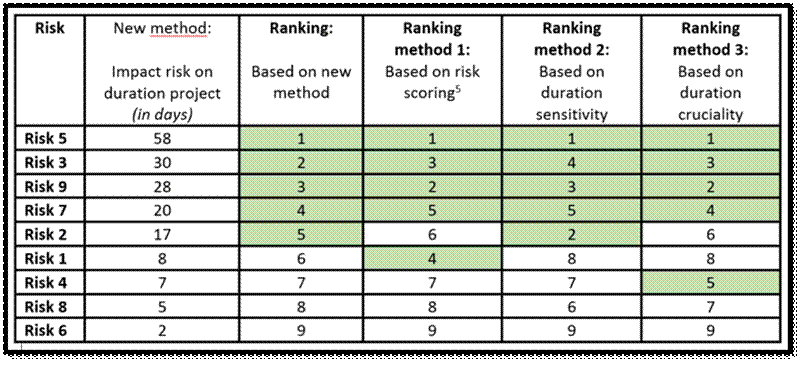
Table 4.3.2.1: List of Potential Risk Ranks
(Source: Irapuan
Gl ria J nior & Marcirio 2017, p. 15)
In order to achieve project
goals, risk management is required to manage entire tasks sop that project can
be finished within specified time. Cost estimation is essential for every
project because financial support can help to provide better outcomes as per
targeted audience s outcomes.
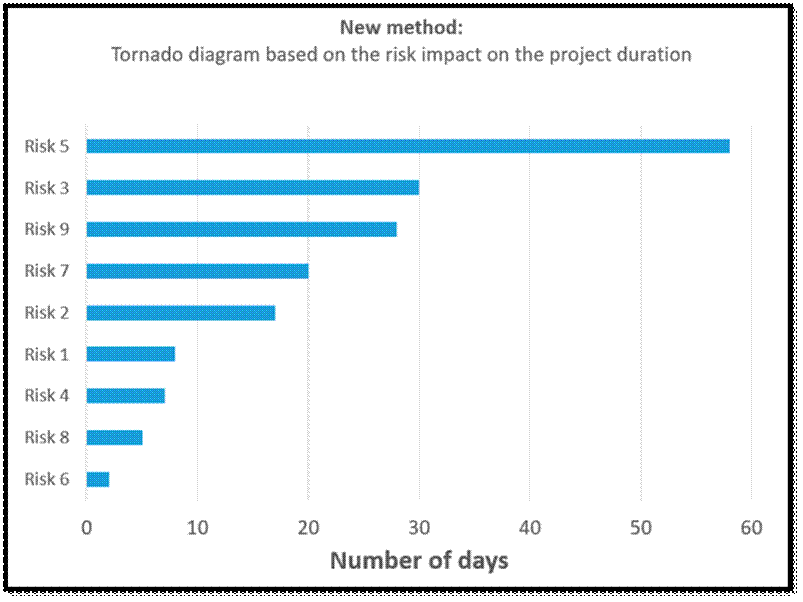 Figure
4.3.2.2: List of Potential Risk in Project Development Life Cycle
Figure
4.3.2.2: List of Potential Risk in Project Development Life Cycle
(Source: Jain,
Chandrasekaran & Castro 2015, p. 54)
Those aforementioned graphs
are designed on the basis of identified risks during product development. In
this case, risk are marked using numbers however; each
risk has individual implications in project development life cycle. This study
has emphasized on new product development and this project has several risks in
terms of following marketing trends, customer expectation, budget estimation,
time management, team management, etc.
|
Risk Identification |
Potential Risk |
|
Risk 1 |
Budget estimation |
|
Risk 2 |
Resource Allocation |
|
Risk 3 |
Team Management |
|
Risk 4 |
Operational Risk |
|
Risk 5 |
Time Management |
|
Risk 6 |
Stakeholders |
|
Risk 7 |
Legal Risk |
|
Risk 8 |
Security Risk |
Table 4.3.2.2: List of Potential Risk in Project
Development Life Cycle
(Source: Javani
& Pantaleo Mutajwaa 2016, p. 401)
Researcher has developed
this list on the basis of observation through secondary analysis and listed
down on the basis of their effectiveness in a project. On that note, successful
project can be defined of that particular project has been completed within
specified time using proper team management strategy. For this, project manager
needs to modify project planning on the basis of current requirements and
appointed efficient team members for accomplishing responsible works.
On the other hand,
stakeholders demand and expectation during project can hamper the motivation of
work and they include more specifications which can change entire produce
designing process. Hence, purpose of product development can be lost due to
excessive interference of stakeholders during project development life cycle (Katsikeas,
Leonidou & Zeriti 2016, p. 665).
As a consequence, proposed products are entirely changed after project
completion so that it can hamper team motivation and project goals cannot be
achieved.
4.3.3 Utilization
of Knowledge Management in Product Development
Effective use of knowledge
management in product development can improve the entire work and project
objectives can be achieved in an effective way (Ahimbisibwe,
Cavana & Daellenbach 2015, p. 19).
In modern days, everything is based on emerging technology as well as software
application tools which make entire work faster towards project completion (Kulkarni
et al. 2017, p. 1279). Knowledge
management is method of sharing, managing, using skills, information as well as
knowledge of a company. It also helps to manage information regarding organization
in an effective way so that proper utilization of information within an
organization can deliver through a secure communication network to targeted
people for employee motivation, project dataset.
Analysis
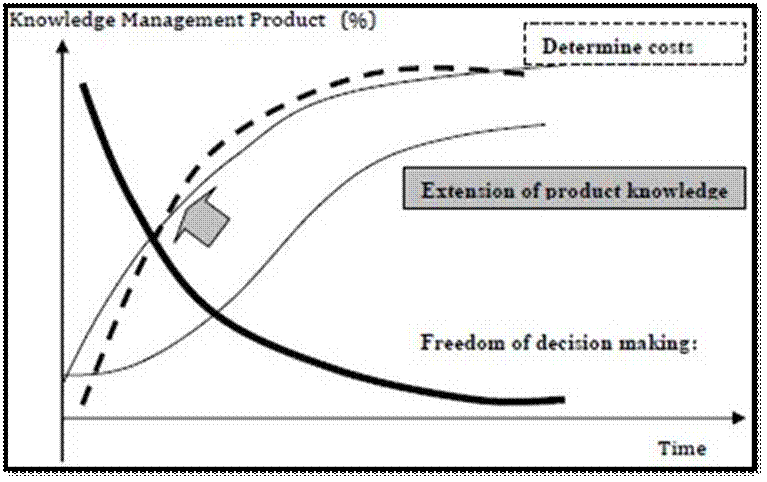
Figure 4.3.3.1: Utilization of Knowledge management
during Project Development Life Cycle
(Source: Yamin
& Sim. 2016, p. 485)
Knowledge management helps
to identify potential risk during project life cycles so that project leader
can recognize all those risks and address then on the basis of priority. In
this case, new product development has been considered as a project so that new
product has been developed factor analysis market trends as well as customer
requirements (Mazdeh et al. 2016, p. 125). On that note, little organization tries to
incorporate few additional features so that new developed product can compete
with other exhausted products. In order to understand customer expectation,
project developer needs to gather data from targeted customers so that product
design can be easier in an effective way. Another aspect of knowledge
management is to provide necessary details regarding project as well as product
development. Hence, project developer accumulates that information to
manufacture new product including all those features in order to attract more
customers as well as brand image.
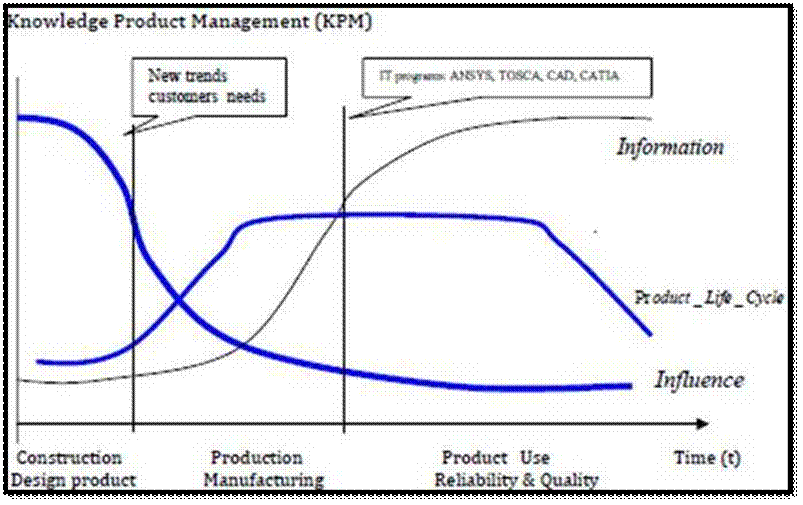
Figure 4.3.3.2: Project Development Life Cycle using
Knowledge Management
(Source: Lee et
al. 2017, p. 20)
Product quality is mandatory
in product development because customers always prefer to have better quality
of product at lowest price. Knowledge management helps to take decision in
terms of managing critical situations. Product developer can collect necessary
detailed information from several secondary sources such as journals, books,
web published data. In this way, project developer can easily identify
potential risks and determine to take necessary action on the basis of criteria
(Merikoski,
Savolainen & Ahonen, 2017, p. 875).
The major issue is to estimate budget of developing a project so that project
manager can easily determine the cost and expected outcome using knowledge
management that can make easier to allocate possible resources.
4.3.4 Mitigation of Risk Using Knowledge
Management during Project
Risk management is important
process in project planning which helps to determine potential risks in project
and its characteristics. Project developer has used several techniques to
identify risks during project development life cycles and those methods are
interviewing, expert judgement, Delphi techniques, Monte Carlo Evaluation,
Decision Tree, historical records, cost as well a time estimation (Nagendra
& Sharan 2017, p. 25).
In this case, risk identification is the initial stage then risk evaluation is most
critical steps to manage every risk on the basis of its priority. Later on,
identified risks are monitored as well as reviewed in an effective process by
adopting risk mitigation methods.
Analysis
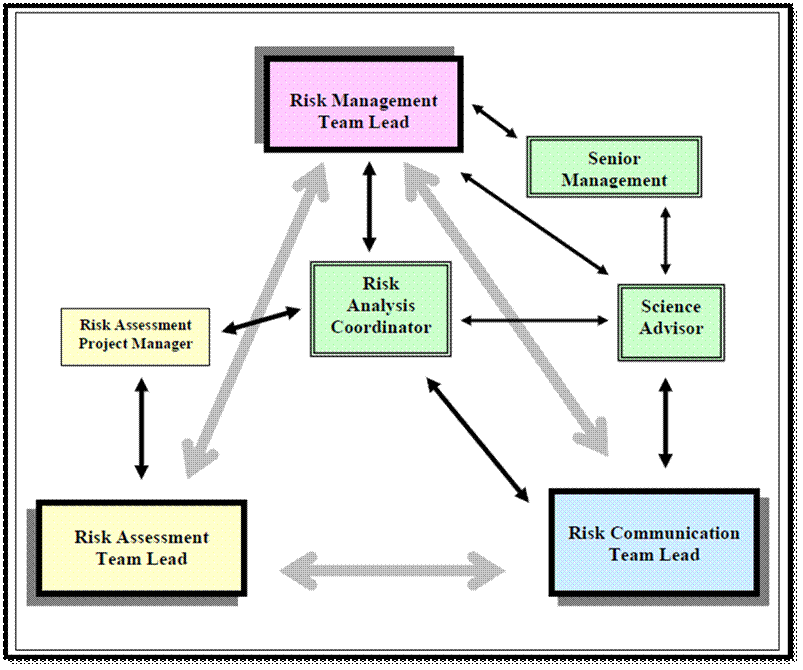
Figure 4.3.4.1: Risk Identification during Project
Development Life Cycle
(Source: Wu et
al. 2017, p. 860)
A product development
project may consist of several risks such as market, inflation, liquidity, concentration
risk. An organization wants to manufacture product for capturing current market
and that particular company can make few profits. In order to launch a new
product, organizations need to obtain necessary details regarding market
current trends. Based on that, product designing has been made (Stentoft
Arlbj rn, Freytag & Thoms 2015, p. 25). Developed products can face risk if developer does
not have knowledge of current market trends so that customers do not prefer to
purchase that developed new product despite of its product quality. This can be
a risk for an organization. On that note, product developer wants to develop
better quality of products and the cost estimation is high so that stakeholders
do not take any interest to invest in this project. Knowledge management helps
to understand possibility of marketing as well as promoting that particulate
new product.
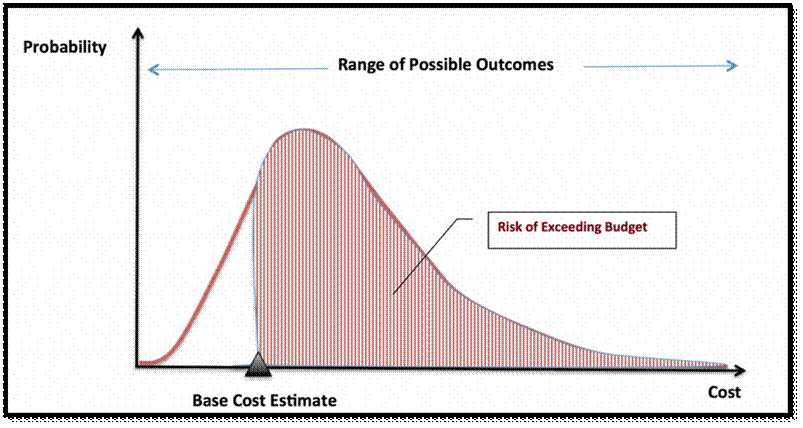
Figure 4.3.4.2: Cost Estimation
(Source: Webb
2016, p. 35)
On the other hand, product
goals can be achieved effectively if budget allocation can be done in a proper
way. Resource allocation can make better to develop a new product and high
quality of product can attract more customers. Budget estimation has to be done
in initial stage in project development life cycle (Thom-Manuel,
Ugwu & Onyejegbu 2017, p. 310).
In many projects, stakeholders interfere between middle of the project so that
product specification is changed and new additional features require to be incorporated.
Therefore, cost estimation is changed and project developer has identified a
huge difference between estimated costs along with final cost. This can
consider as a huge risk for a project and this can be a reason for project
failure. Most of the projects do not allow shareholders in between project and
project developers have developed on the basis of initial product
specification. Project team changes after final launching on the basis of
further requirements.
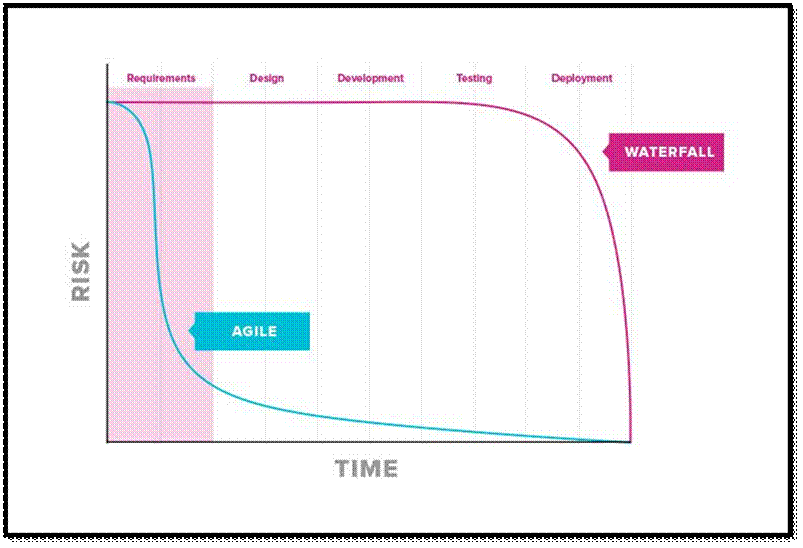
Figure 4.3.4.3: Agile Techniques
(Source: Walters
& Ece 2017, p. 33)
Agile technique is a process
of software development and it is used for advanced software application tools development
(Utarsih
2017, p. 371). As mentioned
in above figure, possibility of potential risk is decreased in respect of
project development life cycle for agile technique whereas possibility of
potential risks is constant in respect of project development life cycle for
waterfall model. The main reason behind it is that project developer has used
knowledge management to recognize potential risks at initial stage of product
development. Therefore, possibility of potential risks is reduced with the help
of decision making along with gathered information, knowledge.
4.4 Discussion
This project is based on
discovering different aspects of knowledge management in order to identify
potential risks during project management life cycles. In this case, project
developer needs to acquire knowledge from several secondary sources such as journals,
books along with web published internet sources regarding risk factors in
organizational projects and process of mitigating risks using knowledge
management (Wahyudin & Santoso 2016, p. 101). Researcher has incorporated
data in this study so that this study can provide necessary details of risk and
difficulties in product development. On that note, stakeholder s influences can
hamper a purpose of entire projects and it can be a reason of increasing
project budget and project failure because project team member does not get
motivated due to influences of stakeholders in between projects. In this case,
a proposed product can be developed on the basis of initial requirements and
final modification would be done after product launching in order to achieve
project objectives.
4.5 Conclusion
Knowledge management is used to establish
communication through a secure network between participants who are associated
with project development life cycle within an organization. In this case,
project developer has used several technologies to develop a product on the
basis of following current market trends as well as targeted audience
requirements. Most of projects are failure due to improper project planning,
cost estimation and resource allocation. This chapter has covered all aspects
of product development life cycle and effectiveness of knowledge management
during product development. In this case, project manager has gathered
information and knowledge from several secondary resources on the basis of
product development and risk identification. Therefore, potential risk can be
indebted and necessary solutions can help to overcome all those identified
risks.
On the other hand, solutions have derived from
knowledge management tools and techniques because project developer has adopted
risk mitigation technologies from historical records. In many projects,
stakeholders influence to change features of proposed between projects so that
this is one of the main reasons of project risk as well as project failure.
Team management and time management are other reasons for project failure
because a project can be successful if all requirements are fulfilled within
specified times and estimated cost. In order to attract more customers, project
manager needs to gather information regarding current market trends and
customer expectation. Knowledge manager helps to take decision for giving
responsibility to each team member on the basis of individual skills,
knowledge, talent so that project goals can be achieved in an effective way.
Chapter
5: Conclusion and recommendations
5.1 Introduction
Knowledge
management is a business plan or strategy which is implied in the hope to
develop the organizational benefits and reducing benefits. A strategy always
helps to achieve the plans or a goal which is made by the company. The knowledge
management authorization of a company deals with the overall company's
directions, imply major goals of the company, provide needed plans, and
sometimes develop new policies. In today's world, the major impacting business
scale is none other than tourism and hospitality 3 percentage of any country s
economic need is fulfilled by this business section. In addition, to manage the
huge business performances the company applies a strategy which helps the
company to achieve their goal faster. The knowledge management is totally
dependent on consumer relation; these strategies help the companies to maintain
this relationship and reducing risks in the projects.
5.2 Motivation and significance of the thesis
Knowledge
management in project delivery platforms has become a key consideration for
scholarly as well in the business practices. As project environments are
changing to a more complex and diversifying approach, mitigation of risk is
becoming more paramount for the organizations. Firm strategies are now delving
towards an approach where management is more concerned with eliminating the
risks of project failure rather than reducing them. In this aspect, the
concerned topic has become of paramount importance to identify the ways through
which knowledge management can reduce risk or trying to eliminate them. Use of knowledge based tools to support the firms is imminent so
that it can balance the benefits and risks properly. Application of
models like the fuzzy model or the HRBS framework will be suitable for
categorizing risks and this will, in turn lead towards the development of a
better framework or structure for assessing risks. The AHP model, in addition
to the fuzzy model will aid in determining levels of risks based on their
priorities, costs required to handle risks and so on.
5.3 Findings and discussion of the research questions
Knowledge Management
distinguishes potential hazard amid task life cycles with the goal that venture
chief can perceive each one of those dangers and address then based on need.
For this situation, new item advancement has been considered as an undertaking
with the goal that new item has been created factor examination showcase
inclines just as client prerequisites (Mazdeh et al. 2016, p. 125). On that
note, little association attempts to consolidate couple of extra highlights so
new created item can contend with other depleted items. So as to comprehend
client desire, project engineer needs to assemble information from focused
clients with the goal that item configuration can be simpler in a compelling
manner. Another part of information the board is to give essential insights
about venture just as item improvement. Henceforth, project engineer aggregates
that data to make new item incorporating each one of those highlights so as to
draw in more clients just as brand picture.
Knowledge
management is utilized to build up correspondence through a protected system
between members who are related with venture improvement life cycle inside an
association. For this situation, venture engineer has utilized a few
innovations to build up an item based on following current market inclines just
as focused group of onlookers prerequisites. The vast
majority of tasks are disappointment because of ill-advised venture arranging,
cost estimation and asset designation. This section has secured all parts of
item improvement life cycle and adequacy of information the board amid item
advancement. For this situation, venture chief has assembled data and
information from a few optional assets based on item advancement and hazard
recognizable proof. Hence, potential hazard can be obliged and fundamental
arrangements can defeat every one of those recognized dangers.
Compelling
utilization of knowledge management in item advancement can improve the whole
work and venture targets can be accomplished in a viable manner (Ahimbisibwe,
Cavana and Daellenbach 2015, p. 19). In present day days, everything depends on
rising innovation just as programming application devices which make whole work
quicker towards undertaking fulfillment (Kulkarni et al. 2017, p. 1279).
Learning the executives is strategy for sharing, overseeing, utilizing
abilities, data just as information of an organization. It likewise oversees
data in regards to association in a viable manner so appropriate use of data
inside an association can convey through a protected correspondence system to
focused individuals for worker inspiration, venture dataset.
5.4 The contributions of the study
Knowledge management strategies which are implied by
the company are regarding reducing and eliminating the threats in multiverse
project environment. Business strategies are taken In
order to value all the services which are being provided to consumers. This
strategy is mainly concerned with the company's position in the market,
relation with the competitors. The consumers are the basic level of any
business level strategy which is being implied by any any industry in company. This
process monitors all the strategies that have been implied in the company and
then evaluate all of them in a way that provides the company more work in the
market. This also controls all the objectives of the company and provides plans
or actions to achieve all the goals. Knowledge management also focuses on the
individual performances of the business entity. Globalization is a process in
which the companies are interacted and integrated with people and government
from different countries. In existing business platforms, globalization made an
important change in terms of profit rising and expanding the business. Leadership
is a key factor for any company. A good leader runs the company. In addition,
leadership in knowledge management needs to be more patients to run the whole
employee section and motivates them to provide a good service to the consumers
in the big competitive market. In any business especially in the service
industry, maintaining a balance to the constant change is necessary in order to
achieve a sustainable position in the market. This sustainability also helps to
maintain a company consumer relationship. The concluding statement of the study
suggests that the importance of knowledge management in project environment
lies in giving a robust strategic choice to manage in a peripheral environment.
As to provide a good service to the consumers or maintaining the relationship
with the consumer is need strategy or plans, and this theory of strategy
management helps to achieve stability in the market area.
5.5 Future research and limitations of the study
The areas of knowledge management and project environment
dealings are severe as well there are requirements for further insight in the
subject. A focus on primary research approach could have been better and we
could interact with the relationship between different variables. Similarly,
focus on a particular industry would be helpful to gather about evidence on a
specific platform, which might narrow down the findings. For future direction,
a primary research approach would be subtle as well I suggest a specific
industrial sector will be helpful to achieve more potential results.
Reference List
Books
Flick, U 2018, An
introduction to qualitative research. London: Sage Publications Limited,.
Lai,
KH. & Cheng, TE 2016, Just-in-time logistics. Abingdon: Routledge,
Walliman, N 2017, Research
methods: The basics. Abingdon: Routledge,
Journals
Ahimbisibwe, A., Cavana, R.Y. & Daellenbach, U. 2015, "A contingency fit model of critical success factors for software development projects", Journal of Enterprise Information Management, vol. 28, no. 1, pp. 7-33.
Alcaraz-Corona, S., Cant -Mata, J.L. & Torres-Castillo, F. 2019, "Exploratory Factor Analysis for Software Development Projects in Mexico", Statistics, Optimization & Information Computing, vol. 7, no. 1, pp. 85-96.
Asri,
M., Nawi, M.N.M., Nadarajan, S., Osman, WN. & Harun, AN 2016, Success
factors of JIT integration with IBS construction projects A literature review. Int.
J Sup. Chain. Mgt Vol.
5, no. 2, p.71
Bhardwaj, M. & Rana, A. 2016, "Key Software Metrics and its Impact on each other for Software Development Projects", International Journal of Electrical and Computer Engineering, vol. 6, no. 1, pp. 242-248.
Bromiley, P., McShane, M.,
Nair, A. and Rustambekov, E., 2015. Enterprise risk management: Review,
critique, and research directions. Long range planning, vol 48,
no 4, pp.265-276.
Cagliano,
AC., Grimaldi, S. & Rafele, C 2015, Choosing project risk management
techniques. A theoretical framework. Journal of Risk Research, vol. 18, no. 2, pp.232-248
Carvalho, MM. and
Rabechini Jr,R 2017, Can project sustainability
management impact project success? An empirical study applying a contingent
approach . International Journal of Project Management, vol. 35,
no. 6, pp.1120-1132.
Chen,
D., Chu, X., Sun, X. & Li, Y 2015, A new product service system concept
evaluation approach based on Information Axiom in a fuzzy-stochastic
environment. International Journal of Computer
Integrated Manufacturing,
vol. 28, no. 11, pp.1123-1141.
Chen, Y., Chang, T., Lin, C., Lai, P. & Wang, K. 2016, "The Influence of Proactive Green Innovation and Reactive Green Innovation on Green Product Development Performance: The Mediation Role of Green Creativity", Sustainability, vol. 8, no. 10, pp. 966.
Dandage, R.V., Mantha, S.S., Rane, S.B. & Bhoola, V. 2018, "Analysis of interactions among barriers in project risk management", Journal of Industrial Engineering International, vol. 14, no. 1, pp. 153-169.
Darko,
A., Chan, APC., Ameyaw, EE., Owusu, EK., P rn, E. & Edwards, DJ 2018,
Review of application of analytic hierarchy process (AHP) in construction. International
journal of construction management, pp.1-17.
Dudek-Burlikowska,
M 2015, The concept of Total Quality Management and the contemporary
entrepreneurship in practice. J. Achiev. Mater. Manuf. Eng, vol. 73, no. 2, pp.229-236.
Emmons, D.L., Mazzuchi, T.A., Sarkani, S. & Larsen, C.E. 2018, "Mitigating Cognitive Biases In Risk Identification: Practitioner Checklist for the AEROSPACE SECTOR", Defense AR Journal, vol. 25, no. 1, pp. 52-93.
Engert, S. and
Baumgartner, R.J., 2016. Corporate sustainability strategy bridging the gap
between formulation and implementation. Journal of cleaner production, vol
113, pp.822-834.
Eslami, M.H. & Lakemond, N. 2016, "Knowledge integration with customers in collaborative product development projects", The Journal of Business & Industrial Marketing, vol. 31, no. 7, pp. 889-900.
Estrin, S., Mickiewicz, T.
and Stephan, U., 2016. Human capital in social and commercial
entrepreneurship. Journal of Business Venturing, vol 31, no 4, pp.449-467.
Fatima, F., Ali, S. & Ashraf, M.U. 2017, "Risk Reduction Activities Identification in Software Component Integration for Component Based Software Development (CBSD)", International Journal of Modern Education and Computer Science, vol. 9, no. 4, pp. 19-29.
Fraser, S., Bhaumik, S.K.
and Wright, M., 2015. What do we know about entrepreneurial finance and its
relationship with growth?. International Small
Business Journal, vol 33,
no 1, pp.70-88.
George, G.,
Howard-Grenville, J., Joshi, A. and Tihanyi, L., 2016. Understanding and
tackling societal grand challenges through management research. Academy
of Management Journal, vol 59, no 6, pp.1880-1895.
Gutierrez-Gutierrez,
LJ., Barrales-Molina, V. & Kaynak, H 2018, The role of human
resource-related quality management practices in new product development: A
dynamic capability perspective. International Journal of Operations
& Production Management,
vol. 38, no. 1, pp.43-66.
Hazen, B.T., Skipper,
J.B., Boone, C.A. and Hill, R.R., 2018. Back in business: Operations research
in support of big data analytics for operations and supply chain
management. Annals of Operations Research, vol 270, no
1-2, pp.201-211.
Ika, LA. and Donnelly J
2017, Success conditions for international development capacity building projects . International Journal of Project
Management, vol. 35, no. 1, pp.44-63.
Irapuan Gl ria J nior & Marcirio, S.C. 2017, "Identification And Mitigation Of Risks In It Projects: A Case Study During The Merger Period In The Telecommunications Industry", Revista de Gest o e Projetos, vol. 8, no. 3, pp. 1-17.
Jain, R., Chandrasekaran, A. & Castro, L. 2015, "Identifying Suitable Projects For Rapid Development: Some Proposed Selection Criteria", International Journal of Management & Information Systems (Online), vol. 19, no. 2, pp. 51-55.
Javani, B. & Pantaleo Mutajwaa, D.R. 2016, "Risk management in IT projects a case of the South African public sector", International Journal of Managing Projects in Business, vol. 9, no. 2, pp. 389-413.
Katsikeas, C.S., Leonidou, C.N. & Zeriti, A. 2016, "Eco-friendly product development strategy: antecedents, outcomes, and contingent effects", Journal of the Academy of Marketing Science, vol. 44, no. 6, pp. 660-684.
Kulkarni, R.H., Padmanabham, P., Harshe, M., Baseer, K.K. & Patil, P. 2017, "Investigating Agile Adaptation for Project Development", International Journal of Electrical and Computer Engineering, vol. 7, no. 3, pp. 1278-1285.
Linnenluecke, MK 2017,
Resilience in business and management research: A review of influential
publications and a research agenda . International Journal of
Management Reviews, vol. 19,
no.1, pp.4-30.
Lolich, L. and Lynch, K.,
2016. The affective imaginary: students as affective consumers of risk. Higher
Education Research & Development, vol 35, no 1, pp.17-30.
Maylor, H and Turner, N
2017, Understand, reduce, respond: project complexity management theory and
practice . International Journal of Operations & Production
Management, vol. 37, no.
8, pp.1076-1093.
Mazdeh, M.M., Jafari, M., Akhaven, P. & Mousavi, S.J. 2016, "Improving Product Development Performance Through Knowledge Outsourcing: A Study Of The Automotive Industry In Iran", South African Journal of Industrial Engineering, vol. 27, no. 2, pp. 120-131.
McConnell, A., 2016. A
public policy approach to understanding the nature and causes of foreign policy
failure. Journal of European Public Policy, vol 23, no
5, pp.667-684.
Merikoski, H., Savolainen, P. & Ahonen, J.J. 2017, "Suppliers software development project start-up practices", International Journal of Managing Projects in Business, vol. 10, no. 4, pp. 880-896.
N rland, K, M ller-Bloch
C, Beck, R and Palmund, S 2017, Blockchain to Rule the Waves-Nascent Design
Principles for Reducing Risk and Uncertainty in Decentralized Environments .
Nagendra, A. & Sharan, A. 2017, "Risk Analysis for Project Management", Journal of Applied Management - Jidnyasa, vol. 9, no. 2, pp. 22-31.
Niknejad,
A. and Petrovic, D 2016, A fuzzy dynamic inoperability input output model for
strategic risk management in global production networks. International
Journal of Production Economics, vol. 179, pp.44-58.
Oluwaseyi,
JA., Onifade, MK. & Odeyinka, OF 2017, Evaluation of the Role of Inventory
Management in Logistics Chain of an Organisation. LOGI Scientific Journal on Transport
and Logistics,
vol. 8, no. 2, pp.1-11
Serrao-Neumann, S., Crick,
F., Harman, B., Schuch, G. and Choy, D.L., 2015. Maximising synergies between
disaster risk reduction and climate change adaptation: Potential enablers for
improved planning outcomes. Environmental Science & Policy, vol
50, pp.46-61.
Spring, M, Hughes A,
Mason, K and McCaffrey, P 2017, Creating the competitive edge: A new
relationship between operations management and industrial policy . Journal
of Operations Management, vol. 49, pp.6-19.
Stark, J., 2015. Product
lifecycle management. In Product lifecycle management (Volume 1) (pp.
1-29). Springer, Cham. United States
Stentoft Arlbj rn, J., Freytag, P.V. & Thoms, L. 2015, "Portfolio management of development projects in Danish municipalities", The International Journal of Public Sector Management, vol. 28, no. 1, pp. 11-28.
Thom-Manuel, O., Ugwu, C. & Onyejegbu, L. 2017, "An Extended Agile Software Development Project Budget Model", International Journal of Computer Science and Software Engineering, vol. 6, no. 12, pp. 306-314.
Todorović,
M.L., Petrović, DČ., Mihić, MM., Obradović, VL. &
Bushuyev, SD 2015, Project success analysis framework: A knowledge-based
approach in project management. International Journal of Project
Management, vol. 33,
no. 4, pp.772-783.
Utarsih, H. 2017, "The Effects of Product Development and Quality on Brand Repositioning", Journal of Economic & Management Perspectives, vol. 11, no. 4, pp. 369-374.
Wahyudin, N.E. & Santoso, I. 2016, "Modelling of Risk Management for Product Development of Yogurt Drink Using House of Risk (HOR) Method", The Asian Journal of Technology Management, vol. 9, no. 2, pp. 98-108.
Walters, G. & Ece, M. 2017, "Getting ready for REDD+: Recognition and Donor-country Project Development Dynamics in Central Africa", Conservation and Society, vol. 15, no. 4, pp. 21-44.
Ward, V, 2017, Why,
whose, what and how? A framework for knowledge mobilisers, Evidence &
Policy: A Journal of Research, Debate and Practice, vol. 13, no.3,
pp. 477-497.
Webb, J.R. 2016, "Scrapping new product development efforts: when to keep going, when to fold", The Journal of business strategy, vol. 37, no. 4, pp. 32-40.
Winch,
G. and Leiringer, R 2016 Owner project capabilities for infrastructure
development: A review and development of the strong owner concept. International
Journal of Project Management, vol. 34, no. 2, pp.271-281
Wu, Z., Nisar, T., Kapletia, D. & Prabhakar, G. 2017, "Risk factors for project success in the Chinese construction industry", Journal of Manufacturing Technology Management, vol. 28, no. 7, pp. 850-866.
Yamin, M. & Sim, A.K.S. 2016, "Critical success factors for international development projects in Maldives", International Journal of Managing Projects in Business, vol. 9, no. 3, pp. 481-504.
Yoo, W.S., Yang, J., Kang, S. & Lee, S. 2017, "Development of a computerized risk management system for international NPP EPC projects", KSCE Journal of Civil Engineering, vol. 21, no. 1, pp. 11-26.
Online
articles
Dings yr, T, Moe, NB,
F gri, TE, and Seim, EA, 2018, Exploring software development at the very
large-scale: a revelatory case study and research agenda for agile method
adaptation . Empirical Software Engineering, vol.23,no. 1, pp.490-520,
Deligianni, I, Voudouris,
I and Lioukas, S 2017, Do effectuation processes shape the relationship
between product diversification and performance in new ventures? Entrepreneurship
Theory and Practice, vol.41, no.3, pp.349-377,
Fran a, CL, Broman, G,
Rob rt, KH, Basile, G, and Trygg, L 2017, An approach to business model
innovation and design for strategic sustainable development Journal of
Cleaner Production, vol. 140, pp.155-166
Trieu, VH, 2017, Getting
value from Business Intelligence systems: A review and research agenda Decision
Support Systems, vol. 93, pp.111-124,
Websites
Business.qld.gov.au.
2019, New product development, viewed
on 19/03/2019
https://www.business.qld.gov.au/running-business/growing-business/becoming-innovative/developing-products/new-products
Statista.com 2015, Leading reasons for software project failure according to developers
worldwide, as of 2015, viewed 15th April 2019, <https://www.statista.com/statistics/627648/worldwide-software-developer-survey-project-failure/>
Voxeu.org, 2019, Financing for development: The policy and
research agenda, Viewed : 1st March
2019
<https://voxeu.org/article/financing-development-policy-and-research-agenda>
www.risktools.com.au. 2018, The importance of a Risk Breakdown Structure
(RBS), viewed on 19/03/2019
https://www.risktools.com.au/blog/risk-identification-management-RBS/
Appendices
Appendix
1: Conceptual Framework of PSS evaluation by Fuzzy Model
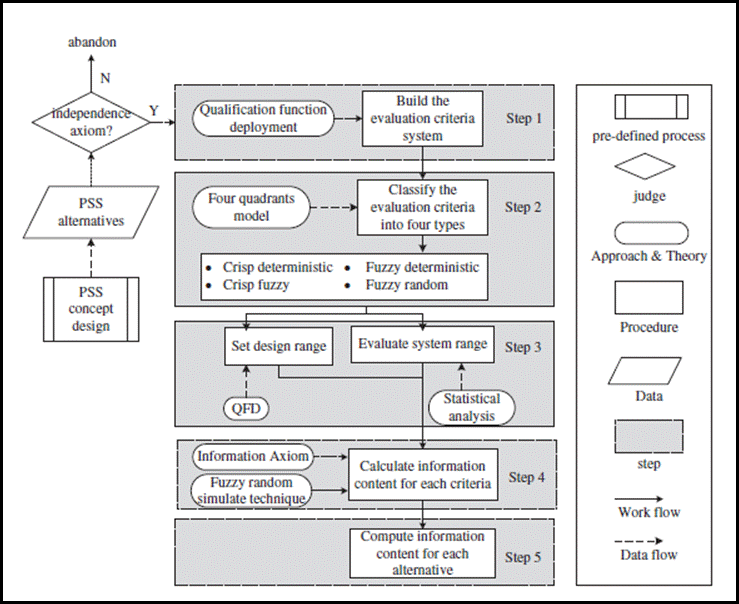
(Source: Chen et al. 2015, pp.1123-1141)
Appendix 2: Literature Review Matrix
|
Article |
Author |
Year |
Major Findings |
|
This
article has provided adequate process of risk management and has evaluated
strategies, which are necessary to eliminate risks in a new project. For
instance, process of risk knowledge. |
Cagliano, Grimaldi
& Rafele |
2015 |
Techniques
of risk management are gained in a form of theoretical framework to analyze
concept of risk breakdown structure. |
|
This
article has found out benefits of total quality management, which is
beneficial to reduce risks and attain success while undertaking a project. |
Dudek-Burlikowska
|
2015 |
Importance
and benefits of total quality management concept is known in managing risks
of new project |
|
Importance
of JIT and integrating it in constructing project is analyzed in this
article. |
Asri
et al. |
2016 |
Integration
of JIT concept in construction projects |
|
Benefit
of inventory management is outlined in this article, which is necessary to
reduce risks like waste elimination in new project. |
Oluwaseyi,
Onifade & Odeyinka |
2017 |
Concept
of inventory management with value of logistics supply chain |
|
Fuzziness
and randomness are evaluated to maintain cost effective products and services
in a new project. |
Chen et al. pp.1123-1141 |
2015 |
Fuzzy
model in presence of stochastic work environment |
|
Fuzzy
model is analyzed along with benefits and characteristics in assessing new
project |
Niknejad
& Petrovic |
2016 |
Concept
of fuzzy model with input output operational findings. |
|
Project
capabilities and essentials are known and strategies are find
out to develop new project |
Winch
& Leiringer |
2016 |
Concept
of project development is known |
|
Knowledge
of AHP model is known along with its application in new project |
Darko
et al. |
2018 |
Model
of AHP |
|
Role
and benefits of knowledge management systems is addressed concerning
development of new project |
Todorović
et al. |
2015 |
Approach
of knowledge systems of management |
|
Role
of quality management is known from this article. Benefits of it are also
gained in perspective of dynamic capability. |
Gutierrez-Gutierrez,
Barrales-Molina & Kaynak |
2018 |
Quality
management approach in practicing new development of project |
(Source:
Created by author)