 : 498
: 498
Table of Contents
Chapter 1: Research Introduction
1.4. Aims and objectives of the study
Chapter 2: Specific Literature review
Chapter 3: Research Methodology
3.61 Primary Data Collection Process
3.6.2 Secondary Data Collection Process
Chapter 5: Conclusion and Recommendation
Protect
the server from data theft
Protection
from online payment
Cybercrime
divisions around the world
Cybercrime
through social media
5.3 Future Scope of the research:
Chapter 1:
Research Introduction
1.1. Background of
the study
Cybercrime has
become the growing concern in the recent times. With the growth and development
of internet use in the world, the people have become so very much internet
savvy that they have somehow done things on their own (Belleflamme&Peitz,
2014). Always they take the help of internet for getting their personal things
done. Hence it can be said that the use of internet has increased to a great
considerable extent. But with the increase in internet use, the probability of
internet piracy has also increased. The internet piracy is regarded as the
software piracy that takes place when software is obtained on an illegal basis
through different Internet channels (Li, et.
al., 2014). Usually, internet piracy is found when the peer-to-peer files
are being transferred or shared from one system to another. Moreover, it also
takes place when files are being downloaded through different pirate websites.
This internet piracy leads to cause cybercrimes. The recent studies have
evaluated all the fundamental cyber threats in the scenario of internet
security.
Internet piracy
leads the third party to get access to several private data and information.
This process is called hacking which affects the confidentiality and anonymity
of the important data. Hacking is considered to be the most important form of cybercrime
that usually takes place within the organisations thereby losing their efficacy
(Dahlberg &Siapera, (2007). For example in the case of multinational companies, all sorts of
important information about the works, strategies, implementations, etc. are collected
and gathered effectively. A slight mismanagement of the data and information
will lead to their exposure to the third party thereby hampering the
confidentiality. In most of the MNCs, exchange of information between different
departments is encouraged through the transfer of various files and networks.
Moreover, software installations are also done by free websites (Yar, 2007).
All these encourage piracy within the organisations, and thus the privacy is
hampered thereby leading to cybercrimes.
1.2. Problem
statement
This study is
highlighting the issues of internet piracy in the multinational companies. It
has been evaluated that in such organisational domains, business interactions,
conferences or meetings are often held by involving the Board of Directors of
all the organisational branches across the globe where it is not possible to
directly meet with each other (Wang, 2015). Hence these meetings are being held
on the online basis in terms video calling, file transferring or any software
update policy which might lead to certain illegal documentation and piracy
(Danaher, et. al., 2010). As the
growth of technology and internet is taking place at a quick pace, the issue of
cybercrime is on the utmost verge. Since files are being downloaded or shared
across the globe between various multinational companies and from one website
or computer to another, illegal data might be transferred thereby corrupting
the files. Hence many business deals have been perceived to have been severely
blocked or hampered, and in turn, the business operations are being highly
affected (Hinduja, 2001). It can be said that the selection of this particular
research topic is very much well justified as the overall study will identify
the underlying issues regarding the extensive use of internet resulting in cybercrimes
which are usually concerned with the concept of internet piracy. Also, the
motto of this study is to evaluate how these cybercrimes impacted upon a wide
range of internet users all over the world.
1.3. Rationale of
the study
The internet has
opened up all the doors of communication and bridged the interaction gap by
sharing different types of information and data with each other (Rekha&Pillai, 2014). In the case of the multinational
companies, information is exchanged through various web channels from one
department to the other or from one company to another. While transferring
these files, sometimes, transfer of illegal files carrying unprotected and
pirate data causes cybercrimes (Broadhurst, et.
al., 2014). This research study is being conducted with a purpose of
identifying different issues related to internet piracy that significantly
involves the areas of unauthorised piracy and data access along with hacking,
therefore, influencing the internet users worldwide. The growth and rapid
advancement in the digital technology have made internet one of the major
platforms through which different kinds of activities can be effectively
carried out (Chaudhry, 2017). In the recent times, the business organisations
aim at using the internet for carrying out their business activities and
operations in an effective way so that fruitful outcomes can be obtained. The
Internet has served the basic needs of the people by forming several useful
mediums or way-outs through which people can easily and smoothly interact with
each other all over the world.
1.4. Aims and
objectives of the study
Before the
execution of a particular research study, it is of immense significance that
the researchers should set some important aims and objectives that they will
accomplish in the due course of the study. Unless and until specific goals are
set, it is impossible for the researchers to carry out a research analysis. In
this research study as well, the researchers associated with this study have
formulated certain significant aims and objectives which they have intended to
achieve by the end of the analysis.
The prime aim
of this study is to analyse and evaluate the actual impacts of the cybercrimes
over the multinational business organisations by focussing widely upon the
issues of internet piracy. In the view of achieving this principal aim, the
researchers have broken down this aim into certain objectives which are
highlighted as follows:
To
measure the impact of the issues of internet piracy that lead to cybercrimes
To
analyse different ways in which the internet piracy issues can be mitigated so
as to ensure proper protection and safety of the information databases
available on the internet
To
explore the various ways of security concerns of the different nations of the
world that can ensure protection of the information databases
To
identify the data security measures that can help to secure the information of
the internet users by emphasising upon the impact of cybercrime
To
derive several ways in which the internet piracy impacts the Information and
Communication Technology (ICT) services
To
assess the different possible effective ways through which the internet piracy
and cybercrimes can be reduced
All the
above-cited objectives are likely to be fulfilled or achieved by the
researchers associated with this particular study for delivering the expected
effective outcomes from the research paper.
1.5. Research
questions
Citing the aims
and objectives is not enough for the researchers to carry out a particular
research analysis effectively. In this particular research analysis as well,
the researchers associated have highlighted certain important and specific
questions whose answers they intend to derive by the end of the study. These
research questions have been cited as follows:
v
What
is the impact of the issues of internet piracy that lead to cybercrimes?
v
What
are the different ways in which the internet piracy issues can be mitigated so
as to ensure proper protection and safety of the information databases
available on the internet?
v
Cite
the various ways of security concerns of the different nations of the world
that can ensure the protection of the information databases?
v
What
are the effective data security measures that can help to secure the
information of the internet users by emphasising upon the impact of cybercrime?
v
How
internet piracy impacts upon the Information and Communication Technology (ICT)
services?
1.6. Research
hypotheses
The researchers
have also embraced their understanding over choosing appropriate hypotheses
which are a set of assumptions that they will interpret in this study. For this
research analysis, the research hypotheses are as follows:
H0: The issues of
internet piracy leading to cybercrimes cannot be avoided
H1: There are
various ways in which the internet piracy issues resulting in cybercrimes can
be effectively reduced
1.7. Research
structure
A research study
needs to undergo through various steps and stages that help the associated
researchers to carry out the overall analysis in an effective manner. In every
stage, the researchers try to interpret or depict their opinions and findings
effectively so as to provide a clear-cut overview of every detail related to
the particular research topic. Every research study takes place in five
different chapters as depicted below:
Chapter 1: Introduction
This the first and
foremost chapter of the research study. The introduction chapter provides a
broad overview of the purpose and background of the research topic which can
also be termed as the brief narrative of the overall research analysis.This chapter serves the
readers with a perfect understanding about the actual quotient of the study
material in a brief manner that will be broadly discussed in the other
following chapters later. In this particular research analysis, the
introduction chapter has been divided into six main segments or sub-sections
namely, the background of the study, the rationale of the study, research aims
and objectives, research questions, research hypotheses and research structure.
In each of these segments, theoutline of the subject
matter to be discussed in the other chapters has been provided.
Chapter 2: Specific literature review
A literature
review is the second most important chapter in the entire research study where
the researchers mainly pay attention to all the relevant and appropriate data
and information from the secondary sources. Various opinions and diverse
perspectives of different researchers, scholars, authors, etc. who have done
similar researches in the past have been considered and acknowledged in this
particular chapter so as to derive an in-depth analysis of the overall content
of the study. This chapter is not just a broad, diversified study rather it is
a systematic analysis of the findings and evaluations made by the others in the
past regarding the same topic. In this research paper, several sub-sections
have been made describing the issues of internet piracy, its effects on the
business organisations and also how they can be reduced to ensure the data
security and confidentiality in business.
Chapter 3: Research processes and methods
This chapter is
called as the utmost essential and necessary segment in the overall research
analysis. In this chapter, a broad overview of all the methods, processes,
strategies and techniques that are used in this research analysis have been
provided thereby giving a better understanding of the research execution. Data
are collected from various useful sources so that effective outcomes can be
generated. Respondents are selected, and through interviews, surveys, etc. the
researchers collect necessary data and information regarding how internet
piracy leads to cybercrimes thereby affecting the business efficacy. Also, this
chapter highlights the collection of data from different secondary and
published sources for deriving appropriate details of the topic.
Chapter 4: Data interpretation
The findings that
are generated for the research study are being analysed with utmost special
care and concentration so as to check if there is any error or
misrepresentation. Later on, these analysed data are interpreted and presented
effectively through the due course of the study. With the help of graphs,
charts, etc. the analysed data are interpreted and presented in this research
paper depicting the opinions and perspectives of the chosen respondents
regarding how internet piracy issues lead to cybercrimes thereby affecting the
business prospects of the multinational companies.
Chapter 5: Findings and Conclusion
This is the last
and final chapter of the research paper where a summarised overview of all the
findings and information described in all the other chapters is being provided.
In this chapter, the researchers mainly conclude with their own findings and evaluations
that they have made in the other chapters. For this study, the researchers have
briefed their findings in this final chapter regarding the issues of the
internet piracy and how they affect the business operations of the
multinational companies by causing cybercrimes. Moreover, the ways in which
these issues can be mitigated by ensuring proper data security have also been
narrated in this chapter. Also, certain recommendations have been highlighted
as to how the study can be improved and facilitated in the future for
extracting more fruitful outcomes.
Chapter 2:
Specific Literature review
Introduction
In
the recent years, we have learnt a lot about the concept of hacking and its
assets in many national and multinational companies. The major part of
Cybercrime is dependent upon the way through which the information is being
stolen by the various hacking communities around the globe. This literature
review full focus upon all the necessary things that influence the cause of cybercrime
(Gralla, 2006). We will also discuss the number of ways in which a cybercrime
can be accomplished, and it s of these activities on the Global Security
System.
Modes of cybercrime
Internet
piracy and cybercrime are interrelated between each other. From the very basic
well if someone is downloading any files from the Internet or sending a mail or
even listening to songs each and every part of the system can be infected with
malicious codes. These codes are forcefully inserted into the system so that
whenever someone is using these websites than these codes are automatically
injected into the system. In the world of cybercrime, hackers are working day
and night to make these codes look professional. In most of the cases, it has
been seen that the programmers who are creating these malicious programs are
highly trained in IT security systems. Hackers have to gain a lot of
information about servers and networks and Systems protocols. Without the
proper information on these things, hackers cannot have control over the
security system of the user. There are wide range of modes or manners are used
by the hackers for committing cybercrime through computer system and the
internet which are Trojan attacks or logic bomb, email bombing, web jacking or
thefts of internet time, unauthorized or illegal accessing of data through
networks, denial of
service attack, worm or virus attacks, salami attacks and stealing of
information from the restricted electronic form.
Types of hackers
In
the world of cybercrime, there are a few times of hackers who are the dominant
worldwide.
Script
kiddies - these hackers are specifically trained to copy and
paste viruses from one source file to the other destination file within this
server. Their job is to overwrite command that already exists on the website.
Their initial job is to overwrite in a system with a huge number of IP
conflicts.
White hat - they are also termed
as ethical hackers. They are the good guys in the world of hacking. They help
many companies to establish a good security system so that it does not get
affected with viruses and protect your system (Bosco, 2014). Most of the IT professionals
who work in ethical hacking have got good certified degrees.
Black hat - these are the main
troublemakers in cybercrime. These guys are specialising in breaking security
protocols of multinational companies and getting into the security system of
valuable information. They specialise in stealing money from banks and
extracting credit card information from potential accounts.
Steps of hacking
Step 1
The
initial step of hacking starts with the tracking of proper loopholes within a
system. Planning the weak points of the network and generating proper codes to
break them.
Step 2
After
that, this can affect the overall internal security system of the website
before extracting and information.
Step 3
Once
the scanning is completed, they target the networks and start footprinting these systems.
There
are many hacking communities around the world who are involved in many serious
activities. Most of the multinational companies store their information and data
in their dedicated or shared servers. The prime objectives of these hackers are
to extract these data and information from their servers. In some cases, they
might sell this information to other company, or in other cases, they might
place certain viruses into the server so that the data gets lost and the
company loses valuable information.
In multinational
companies
In
multinational companies, one of the most common hacking techniques that have
been used in the recent years can be stated as email social engineering or mail
piracy. Email is one of the most confidential documentation processes that have
a lot of information about any particular individual. If this information of
the entire mailbox is hacked and transferred to someone else, then this
information can be used against that particular individual.
Files
are always downloaded from system servers or drives. Cyber spies or hackers can
also infect the servers with viruses that collect the data from the drives and
make copies of them to the other person who is hacking the system. The transfer
of viruses from one system to the other is also very much common with the help
of USB devices. Most of the small and hacking and Virus transfers are now done
with the help of USB devices and flash drive.
Hacking into
private systems
According
to, Hinduja, (2011), hackers can also enter into private systems and get
passwords and user IDs. These passwords can be used to access their personal
drive spaces and mailboxes. They can have access to the company emails and also
a certain portion of Private data that are within the system of the user. One
of the most commonly used hacking techniques is to get help from third party
sites from various social media communities. These third parties usually have a
very weak security protocol within themselves, but they have valuable
credentials that can prove to be very much vulnerable. It is a common tendency
for most of the users to use the same password in multiple profiles. The
hackers aim to steal these passwords.Most
of the people download songs and films from the Internet with the help of
various websites. It is often seen that these websites and the files carry a
lot of virus affected files that cannot be transferred
from one system to the other. So whenever someone is
downloading any files from this website, the viruses are also being transferred
to the personal system of the user. This is the very initial stage of inserting
a virus into your personal system. This can be checked with the following steps
that are discussed in the section below.
The
very first step that we are going to discuss is always to update the software
and the system. No one is supposed to discuss the password of the accounts to
anybody. And each and every individual should always change the password once
or twice a month. This will help the system to be stronger because the hackers
will not get any idea about the pattern of password changing. A highly secured
wireless network is also necessary to protect the system from malicious
viruses. The users are requested to always log out of the system whenever there
leaving their work.In most
of the multinational companies, there is a special department of people who are
specialised in IT security and protocols.Their main
job is to secure the system from inside and also configure proper antivirus
into the system before using the server for any particular use. There ismuch software that can help IT security whenever they are
experiencing any unwanted programs into the system.
Hacking in banking
Cybercrime
in the banking sector is very much popular, and most of the major crimes can
prove we had in stealing money from the bank with the help of many security
breaches in the system of the bank. In most of the cases, the payment system of
the banks is not very much updated. The hackers take advantage of these
securities flaws and try to extract money from thousands of accounts in small
quantities so that they don't get caught easily (Schwartz, 2011). This is not
the scenario in private banks. Most of the private banks have their security
professionals, or in some cases, they also have specific companies who are
specialised in strengthening the various system protocols within the database
of the bank. The security professionals use specific backlink techniques which
keep track of all the transactions from any account to the other. These
backlink systems send information to the security system whenever they find any
legal transaction. With the help of these backlink systems, security
professionals can track the hackers.
The
major aim and objective of this literature review are to identify the specific
causes and steps through which the cybercrime is affecting the international
security systems. Large numbers of companies have also dedicated a number of
the employees in order to fight against the crime. Government policies are also
incorporated in many sectors of the private industry in order to keep track of
all the information flow.
Education in Ethical hacking
There
are many universities and institutions that provide education to the students
who are interested in learning ethical hacking techniques and presenting
themselves to the multinational companies so that they can help them in order
to fight cybercrime.
In the research paper
Rekha, (2014), cited that there are a number of processes and methods that we
have discussed in order to gain our knowledge regarding the concept of
security. The numbers of data connections are also being processed in order to
identify the proper method through which the security of a database can be
enhanced. Finding the problems and their respecting solutions is also a part of
this research paper. So in order to fight against cybercrime,
it is our responsibility to gain proper knowledge (Bhasin, 2003).
Software
to prevent hacking
There
is much software that can be used to restrict the privacy of any system. Some
of this software is also used by multinational companies in order to protect
the information about the employees and the financial transactions. This
software is responsible for interacting with the admin of the system which is
monitored by the IT security professionals. The job of the IT security
professionals is to protect the database of the company, and we regulate a
proper balance between the flow of information and its security. Piracy is
another form of Cybercrime that creates an urge among the users to get any software
all information without proper access to the database. The use of social media
is very much important to restrict these unauthorised accesses into the
websites. There are a wide number anti-hacking
software system have been introduced by various software companies to prevent
hacking in computing system which is windows defender advanced threat
protection, reason core security, enhanced mitigation experience toolkit, SUPER
antispyware, anti-hacker, Trojan remover, malware bytes anti malware, hitman
pro and McAfee security scan plus and spyboat search
and destroy.
Piracy
In
accordance to, Shim, (2010), there are many open source
software all over the Internet which provides free installations to the users.
In most cases, this software is the careers of the most
number of viruses through the Internet. The use of generally download the
software to save their money. In return, they are negotiating with their
privacy over the Internet.To fight against piracy, it
is our first initiative to discourage any downloads of software from open source websites. Apart from these downloads of Music
and entertainment packages are also needed to avoid to prevent piracy. There
are many websites that encourage popup advertisements through some specific
contents (Siegel, 2000). Please, popup also carries a lot of viruses with them.
If we can avoid using these popup advertisements, then we can accomplish a
great deal of prevention over piracy. Government officials are taking necessary
steps to prevent piracy from entering into our world.Software piracy either be ethical or
non-ethical which depends upon the user and type of software. According to
Vacca, (2010)software piracy is ethical because the
user has a right to the information on software. The user can share or
distribute the software to others for fair use regarding copyright law. The
users have right to amend the software from its original version. Some users
think that piracy is unethical because the illegal copies made by the person
may contribute to losses of money due to piracy of the software. It has been
seen that due to piracy of software a wide number of employees in different
sectors have lost their job.
Chapter 3:
Research Methodology
3.1 Introduction
The research
methodology has explained and identified all the valuable research processes
that have been used to complete the analysis of the influences and impacts
which cybercrime can have especially in the context of internet piracy. The
different research methods which have been used to serve the research purpose
have been clearly mentioned in the research methodology. The processes used to
collect information and data has been explained with the sampling procedures
used to sample the participants and respondents. Towards the end of the
research, the focus has been upon explaining the reliability of the research
study and the ethical considerations on selected study area or topic (Jha, 2012).
3.2 Research Onion
The implementation
and application of the research procedures and methods for analysing the
impacts of cybercrime and internet piracy have been done through following the
research onion. Each layer of the research onion indicates different research
approaches and methods in sequential order of implementation. Therefore following the research onion have proven to be
beneficial to the research context, because it enabled the correct and
sequential execution of the research methods and procedures.
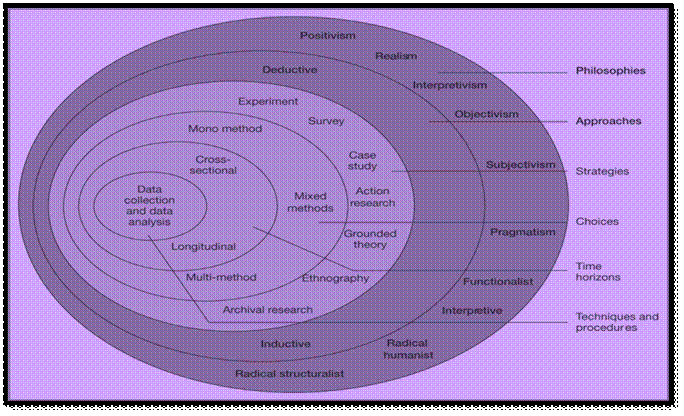
Fig: Research Onion
3.3 Research
Philosophy
Research
philosophy is said to be the mind map of research. In general, the research philosophies depend
upon the different research paradigms. These paradigms are said to be
phenomenology, axiology and epistemology. The key research philosophies derived
from such paradigm and wide research acceptance are the philosophies of
realism, post-positivism, positivism and interpretivism. To analyse and assess the influences and
impacts which cybercrime can have especially in the context of internet piracy,
the application of post-positivism was made. This can be justified as it
befitted the completion of the research topic or study with higher levels of
precision and accuracy. Postpositivism is derived or
obtained from positivism (Creswell, 2013 ). Thus
it has proved as beneficial in a research context. Post-positivism philosophy
was successful in ensuring the valid comparisons, as well as cross-checking,
can be done on different available concepts, theories and ideas. Therefore by use and implementing this specific
post-positivism, high accuracy and precision were obtained on research through
exploration and evaluation of different psychological research aspects. This,
in turn, improved the authenticity and precision of outcomes and findings.
3.4 Research
Approach
Quantitative
research and qualitative research was used to
successfully analyse and investigate the influences and impacts which cybercrime
can have especially in the context of internet piracy. While considering
quantitative research use, data has been collected from a comprehensive survey
among nearly 50 sampled participants. The participants were carefully sampled
from the active internet users in Australia. The responses thus collected from
the survey was analysed or evaluated by using quantitative research analysis. Therefore the application of the software of Microsoft Excel
was used in the research. The findings obtained were then showcased in proper
and well maintained graphical representation. The justification for using quantitative
approach has been described below;
This
approach resulted in validation of a range of different sets of concepts,
hypotheses and theories.
It
also ensured that a properly structured and detailed assessment or
investigation of the research area was possible. It also ensured the findings
of the research to be properly generalised.
Accurate
information or data was obtained, which in successfully triggered precise
quantitative research investigations and predictions.
This
research also ensured precise analysis or observing a larger group of sampled
participants.
Besides
the approach also ensured that research was completed in the given time frame
or limit.
On another hand,
while using a qualitative approach, the data or information was collected by
using different secondary sources. Therefore deductive
methodological process was used. Information obtained from journals, articles
and case studies were analysed qualitatively as explained regarding journal
analysis. H Under all means the reliability and authenticity of selected
secondary databases or sources were checked so that accurate data was obtained
for better research accuracy. The justification of the use of this approach is
outlined below;
Through
this approach, it was beneficial to accurately measure as well as compare a
wider range of the existing or present ideas, concepts and theories that had a
direct relation to research context.
This
approach also ensured the correct analysis of research theories and the
hypotheses.
Thus using this mixed approach proved to be highly
beneficial considering the research context.
3.5 Research
Design
The research
design has been made both exploratory as well as descriptive by nature.
Regarding exploratory, the focus was on conducting a specific longitudinal
study. Therefore the focus was on the use of the
inductive approach. On the other hand, in the context of descriptive design,
the research made the use or incorporation of deductive methodological
approach. Therefore the research design is highly
justified towards successful completion and investigation of the influences and
impacts which cybercrime can have especially in the context of internet piracy.
Through inductive approach, primary sources or primary data collection has been
utilised. While through deductive approach, secondary data gathering or
collection has been significantly utilised to serve the research purpose.
3.6 Data
Collection Process
The techniques of
data collection used have benefitted the gathering of highly reliable as well
as valuable information relating to the respective research area. To gather
information for investigating the influences and impacts which cybercrime can
have especially in the context of internet piracy, secondary and primary data
collection or gathering techniques were significantly used. The application of
the processes of data collection has been explained below;
3.61 Primary Data
Collection Process
It is that
technique of data collection, which emphasises upon gathering information
related to chosen area of the research from authentic as well as reliable
primary sources. To collect precise
research information a survey was initiated between selected sample of 50
participants or respondents. The selection of the participants has been made
amongst the active Internet users based in the nation of Australia. For the
survey process, a specific questionnaire was designed (Sapsford
and Jupp, 2012). The questionnaire
effective consisted of sets of specific close ended queries. These queries and
questions were asked to respective respondents during the process of the
conducted or initiated survey. During the design and formulation, the
questionnaire was segmented into two sections.
One of the sections or divisions held the question sets and the other of
the section consisting of the variables. A Likert scale was utilised for
measurement of the obtained respondent feedbacks from the survey. This numeric
information thereby achieved was quantitatively analysed by using the software
of Microsoft excels. The results were then displayed graphically.
3.6.2 Secondary
Data Collection Process
Considering a
collection of data from secondary data sources, that is secondary data
collection or gathering technique the implementation of a well
crafted deductive methodological approach was done. In this regards the
secondary information or data was collected from secondary sources related to
the field or area of respective research. The different secondary sources
considered in this regards are the articles, case
studies, related journals which are related to the chosen research topic or
area. The information gathered was then assessed qualitatively so as to obtain
valid results and findings on influences and impacts which cybercrime can have
especially in the context of internet piracy. The analysis will be done in the
form of journal analysis so valuable findings can be obtained.
3.7 Data Sampling
Process
The use of
techniques of data sampling is seen to be holding high research significance.
It is by virtue of the data sampling technique that precise respondents can be
sampled for the accuracy of the research survey and precision of the gathered
information and data. In the research context, there are two kinds of sampling
techniques that can be used or utilised. It includes non-probability technique
and probability technique of sampling. In the investigation of influences and
impacts which cybercrime can have especially in the context of internet piracy,
probability technique for sampling was used so as to ensure selection of random
samples. Therefore simple random sampling procedure
was implemented for respondents' selection for the survey (Kothari, 2013).
In this sampling kind, the required size of the respondent sample is
selected from a significantly bigger sample size or in other words sample
population. This sampling technique has offered high benefits in a research
context, and therefore the implementation is highly justified. In regards to
advantages, simple random sampling ensures that each and every individual
participant within the population sample enjoy equal sets of opportunities
about getting chosen for research survey. Also, through this specific
technique, random samples can be obtained thereby enhancing the precision of
the collected feedbacks resulting in high findings accuracy and precision. It also enables the survey to be complete
within the limited frame of time. This technique was used, and 50 respondents
were chosen for survey purpose. The participants or respondents were the active
users of internet-based in Australia.
3.8 Pilot Study
Before initiation
of the original research survey, the questionnaire significance and validity of
the generated questionnaire was tested. This was done by initiation of the
small scaled kind of survey known by the name of the pilot study. This study
was initiated among 5 participants who are the active users of the internet and
are based in Australia. This pilot study was successful in obtaining precise
feedbacks which in turn showcases the overall authenticity and reliability of
the respective questionnaire. After completing the respective pilot study
successfully, original survey was started or commenced for the collection of
information and data from the respondent's groups.
3.9 Research
Validity
Necessary
procedures and steps were significantly applied for the purpose of making the
overall research appreciably reliable and valid. In this
regards, the overall and specific research procedures and approaches
which have been implemented were repeatedly checked and properly monitored and
evaluated so as to minimise or in other terms mitigate the occurrence of
mistakes and errors which could have impacted the accuracy of the research.
Also, the overall authenticity, reliability and validity of the secondary data
sources from where the secondary information has been collected have been
thoroughly checked so as to reject the secondary data and information that are
vague, inaccurate and unreliable. In this context, it can also be said that the
ratio analysis has been performed with high accuracy so as to obtain a detailed
and in-depth understanding and investigation of influences and impacts which cybercrime
can have especially in the context of internet piracy. After several steps of
analysis and calculation, similar results were achieved. This significantly
proves the overall reliability and validity of the overall undertaken
research. Also
while conducting the survey, necessary precautions were taken to make the study
highly reliable as well as valid. The respondents were carefully sampled as
well as the questionnaire was correctly analysed. Also
to the quantitative analysis, precautions have been taken in minimization of
calculation errors at this moment resulting in higher research accuracy and
reliability.
3.10 Research
Ethics
Regarding research
ethics, the study on analysis and investigation of investigation of influences
and impacts which cybercrime can have especially in the context of internet
piracy, have strictly followed the specific codes of research ethics. The
survey was conducted strictly complying with the ethical norms and regulations.
Permissions were taken before commencing the survey. No respondents or
participants were forced towards having active research participation (Oliver, 2010 ).
Under no means no personal or initiated questions that can make the respondents
uncomfortable was asked. The privacy, as well as confidentiality of the
information and data, has constantly been maintained throughout the survey.
There has been no leakage of information and data.
Chapter 4
4.1 Introduction
The crucial task
while undertaking the research project can be considered as analysing the data.
The rigour, as well as integrity of the research, is completely based on
achieving the analysis properly and that is supposed to be scrutinised by the
readers as well.
It can be
considered this way, which the researcher started with a series of research
questions as well as phenomena that were wanted to be explored. Then the
researcher decided on the methodology as well as the methods of research that
is supposed to be most effectual for the purpose.
The researcher has
collected the information as per that and now should undertake the analysis for
producing the results that would be contributing to the new knowledge within
the present requirement. If the researcher has it right then, the methodology would
also be proven exact for the purpose. On the other hand, if the initial process
is wrong then the competency towards planning as well as executing a research a high-level project will be facing several
questions.
4.2 Analysis of
the Data
In this respective
section, the overall analysis regarding the data gathered by the researcher has
been entailed. Here two types of data have been gathered from which the overall
analysis has pertained, and in accordance to this, the overall perception of
qualitative and quantitative analysis has been significantly portrayed.
4.2.1 Quantitative
Analysis
To pertain a
quantitative analysis, selection of the participants have
been accustomed. Thus, the overall participants have been distinguished by the
fact that has revealed through the instances regarding the challenges of cybercrime
and its overall security when they have been asked. Thus, the demographic
variables have been distinguished in accordance to the standpoint that is as
follows:
Age:
25
to 30 years
30
to 35 years
35
to 40 years
40
to 45 years
Above
45years
Here the
participants have been distinguished in accordance to their respective ages.
The participants vary from different age group starting from 25 years to above
45 years. They have revealed their responses in according to the survey
questionnaire and their responses are gathered with utter importance.
Gender:
Male
Female
The overall
participants of the survey are differentiated in accordance with their
respective gender, which is either, male or female.
Industry experience:
0
to 5 years
5
to 10 years
10
to 15 years
Above
15 years
Apart from this,
the respective participants are selected from the industry, which possesses
service expense in this information technological domain. It has been perceived
that the participants have an effective experience in this industry starting
from 0 to 5 years and above 15 years. Thus, they have significantly reflected
about all the survey questions asked to complete the overall research
successfully.
Analysis From of the Data gathered from the Survey:
1. How far do you
believe that cybercrime is one of the key challenges faced by the internet
users in the 21st century?
|
|
No.
Of Participants |
Percentage
(%) |
|
Strongly
Agree |
25 |
50 |
|
Agree |
16 |
32 |
|
Neutral |
4 |
8 |
|
Disagree |
2 |
4 |
|
Strongly
Disagree |
3 |
6 |
|
Total |
50 |
100 |
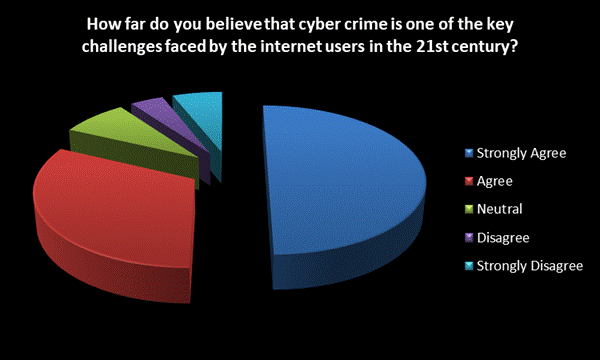
The
above-represented graphs and charts have been represented after asking the
respondent regarding the reality of believing that cybercrime is one of the key
challenges faced by the internet users in the 21st century. Then
only 6% participants have uttered a strong disagreement regarding the reality
of believing that cybercrime is one of the key challenges faced by the internet
users in the 21st century. On the other hand, only 4% has reflected
disagreement regarding the reality of believing that cybercrime is one of the
key challenges faced by the internet users in the 21st century.
Nevertheless, 8% has denoted neutrally regarding the reality of believing that cybercrime
is one of the key challenges faced by the internet users in the 21st
century. Moreover, 32% participants have depicted strong agreement regarding
the reality of believing that cybercrime is one of the key challenges faced by
the internet users in the 21st century. However, 50% of the
participant has responded with a strong agreement regarding the reality of
believing that cybercrime is one of the key challenges faced by the internet
users in the 21st century.
2. Do you believe
that cybercrimes possess a threat to the internet users?
|
|
No.
Of Participants |
Percentage
(%) |
|
Strongly
Agree |
29 |
58 |
|
Agree |
16 |
32 |
|
Neutral |
1 |
2 |
|
Disagree |
2 |
4 |
|
Strongly
Disagree |
2 |
4 |
|
Total |
50 |
100 |
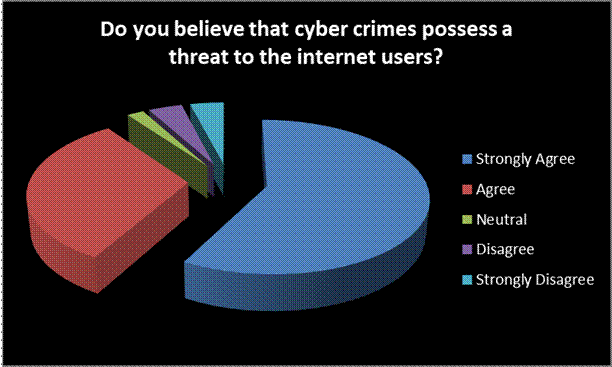
The graph and the
charts portrayed above has been represented after asking the participants
whether they believe that cybercrimes possess a threat to the internet users
than 58% participants have strongly agreed the fact that cybercrimes possess a
threat to the internet users. While 32% of the participants agreed that cybercrimes
possess a threat to the internet users. Moreover, 2% of the participants
responded neutral views regarding the fact. However, 4% and 4% participants respectively had
strongly disagreed and disagreed the fact that believe that cybercrimes possess
a threat to the internet users.
3. Do you agree
that internet piracy can result in loss of valuable data and information of the
internet users?
|
|
No.
Of Participants |
Percentage
(%) |
|
Strongly
Agree |
32 |
64 |
|
Agree |
12 |
24 |
|
Neutral |
4 |
8 |
|
Disagree |
1 |
2 |
|
Strongly
Disagree |
1 |
2 |
|
Total |
50 |
100 |
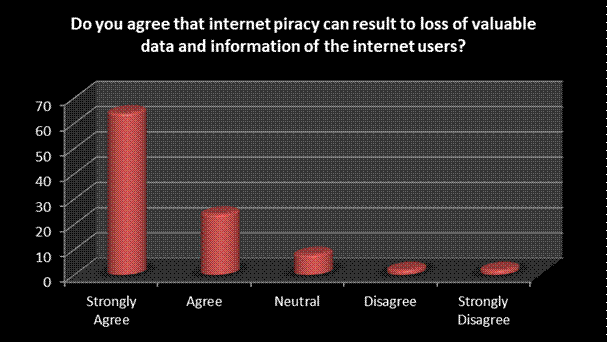
The above-analyzed chart and graph are represented by asking the
participants about the fact that internet piracy can result in loss of valuable
data and information of the internet users. Then only 2% participants have
uttered a strong disagreement regarding the reality of believing that internet
piracy can result in loss of valuable data and information of the internet
users. On the other hand, only 2% has reflected disagreement regarding the
reality of believing that internet piracy can result in loss of valuable data
and information of the internet users. Nevertheless, 8% has denoted neutrally
regarding the reality of believing that internet piracy can result in loss of
valuable data and information of the internet users. Moreover, 64% participants
have depicted strong agreement regarding the reality of believing that internet
piracy can result in loss of valuable data and information of the internet
users. However, 24% of the participant has responded with an agreement
regarding the reality of believing that internet piracy can result in loss of
valuable data and information of the internet users.
4. Do you agree
that cybercrimes and Internet piracy impact the information and communication
technology (ICT) services?
|
|
No.
Of Participants |
Percentage
(%) |
|
Strongly
Agree |
28 |
56 |
|
Agree |
16 |
32 |
|
Neutral |
2 |
4 |
|
Disagree |
3 |
6 |
|
Strongly
Disagree |
1 |
2 |
|
Total |
50 |
100 |
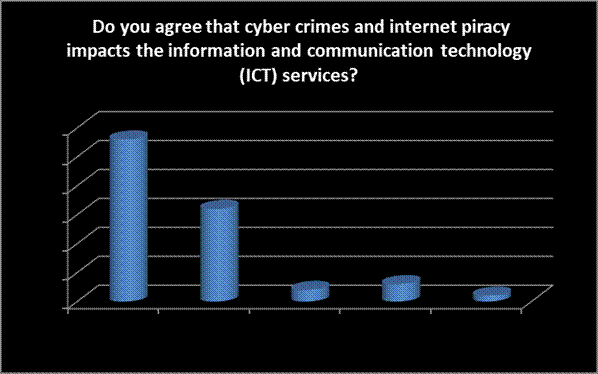
The graph and
chart highlighted above have been showcased when the participants have been
asked regarding the question that cybercrimes and Internet piracy impact the
information and communication technology (ICT) services than 56% participants
have strongly agreed the fact that cybercrimes and Internet piracy affect the
information and communication technology (ICT) services. While 32% of the
participants agreed that cybercrimes and Internet piracy impact the information
and communication technology (ICT) services. Moreover, 4% of the participants
responded neutral views regarding the fact. However, 2% and 6% participants respectively had
strongly disagreed and disagreed the fact that cybercrimes and Internet piracy
impact the information and communication technology (ICT) services.
5. How far do you
believe that data security techniques can be used to limit cybercrimes and
Internet piracy?
|
|
No.
Of Participants |
Percentage
(%) |
|
Strongly
Agree |
27 |
54 |
|
Agree |
16 |
32 |
|
Neutral |
2 |
4 |
|
Disagree |
3 |
6 |
|
Strongly
Disagree |
2 |
0 |
|
Total |
50 |
96 |
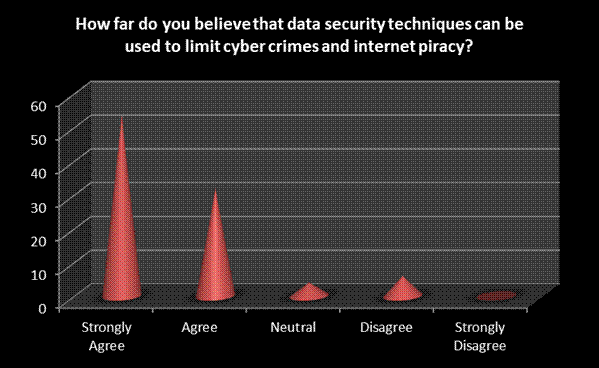
The
above-represented graphs and charts have been represented after asking the
respondent regarding the data security techniques can be used to limit cybercrimes
and Internet piracy. Then only 0% participants have uttered a strong
disagreement regarding the reality of believing that data security techniques
can be used to limit cybercrimes and Internet piracy. On the other hand, only
6% has reflected disagreement regarding the reality of believing that data
security techniques can be used to limit cybercrimes and Internet piracy.
Nevertheless, 4% has denoted neutrally regarding the reality of believing that
data security techniques can be used to limit cybercrimes and Internet piracy.
Moreover, 54% participants have depicted strong agreement regarding the reality
of believing that data security techniques can be used to limit cybercrimes and
Internet piracy. However, 32% of the participant has responded with an
agreement regarding the reality of believing that data security techniques can
be used to limit cybercrimes and Internet piracy.
6. Are the
information databases available on internet faces high threats from internet
piracy?
|
|
No.
Of Participants |
Percentage
(%) |
|
Strongly
Agree |
30 |
60 |
|
Agree |
14 |
28 |
|
Neutral |
3 |
6 |
|
Disagree |
2 |
4 |
|
Strongly
Disagree |
1 |
2 |
|
Total |
50 |
100 |
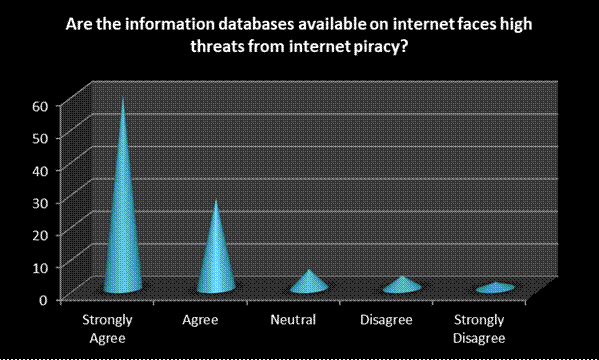
The
above-highlighted graph and chart represent when the respondent have been asked
regarding the fact that information databases available on the internet face
high threats from internet piracy then 60% participants have agreed the fact
that information databases available on the internet face high threats from
internet piracy. While 28% of the participants agreed that information
databases available on internet face high threats from internet piracy.
Moreover, 6% of the participants responded neutral views regarding the fact.
However, 2% and
4% participants respectively had strongly disagreed and disagreed the fact that
information databases available on the internet face high threats from internet
piracy.
7. Do you agree
that implementation of security measures have been able to reduce the issues of
cybercrimes?
|
|
No.
Of Participants |
Percentage
(%) |
|
Strongly
Agree |
30 |
60 |
|
Agree |
16 |
32 |
|
Neutral |
1 |
2 |
|
Disagree |
2 |
4 |
|
Strongly
Disagree |
1 |
2 |
|
Total |
50 |
100 |
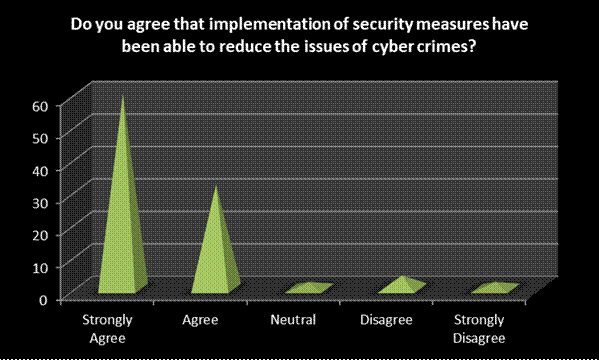
The above-analyzed chart and graph are represented by asking the
participants about the fact that implementation of security measures have been
able to reduce the issues of cybercrimes. Then only 2% participants have
uttered a strong disagreement regarding the reality of believing that
implementation of security measures have been able to reduce the issues of cybercrimes.
On the other hand, only 4% has reflected disagreement regarding the reality of
believing that implementation of security measures have
been able to reduce the issues of cybercrimes. Nevertheless, 2% has denoted
neutrally regarding the reality of believing that implementation of security
measures have been able to reduce the issues of cybercrimes.
Moreover, 60% participants have depicted strong agreement regarding the reality
of believing that implementation of security measures have been able to reduce
the issues of cybercrimes. However, 32% of the participant has responded with
agreement regarding the reality of believing that implementation of security
measures have been able to reduce the issues of cybercrimes
8. Do you think
that cybercrime may impact on the overall system of an organisation?
|
|
No.
Of Participants |
Percentage
(%) |
|
Strongly
Agree |
34 |
68 |
|
Agree |
12 |
24 |
|
Neutral |
2 |
4 |
|
Disagree |
1 |
2 |
|
Strongly
Disagree |
1 |
2 |
|
Total |
50 |
100 |
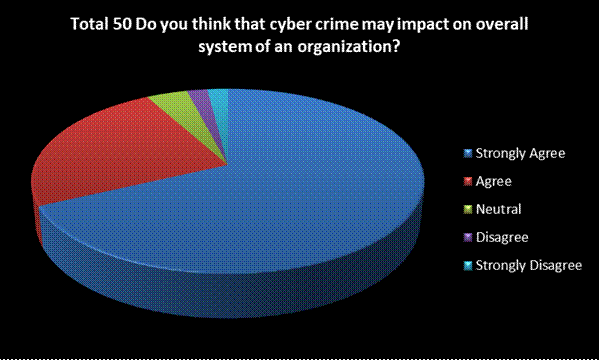
The graph and
chart highlighted above shows when the participants had been asked regarding
the question that cybercrime might impact on the overall system of an
organisation than 68% participants have strongly agreed the fact that cybercrime
may impact on the overall system of an organisation. While 24% of the
participants agreed that cybercrime might impact on the overall system of an
organisation. Moreover, 4% of the participants responded neutral views
regarding the fact. However, 2% and 2% participants respectively had strongly
disagreed and disagreed the fact that cybercrime may influence the overall
system of an organisation.
9. Do you believe
that different kinds of software available in the market for prevention of
hacking can prevent the hacking in the computing system of the organisation?
|
|
No.
Of Participants |
Percentage
(%) |
|
Strongly
Agree |
33 |
66 |
|
Agree |
14 |
28 |
|
Neutral |
1 |
2 |
|
Disagree |
1 |
2 |
|
Strongly
Disagree |
1 |
2 |
|
Total |
50 |
100 |
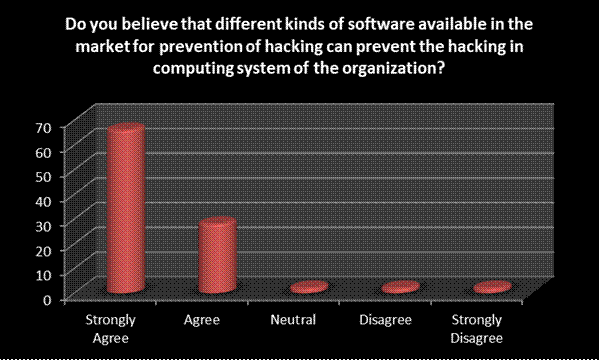
The above-analyzed chart and graph are represented by asking the
participants about the fact that different kinds of software available in the
market for prevention of hacking can prevent the hacking in the computing
system of the organisation. Then only 2% participants have uttered a
substantial disagreement regarding the reality of believing that different
kinds of software available in the market for prevention of hacking can prevent
the hacking in the computing system of the organisation. On the other hand,
only 2% has reflected disagreement regarding the reality of believing that
different kinds of software available in the market for prevention of hacking
can prevent the hacking in the computing system of the organisation.
Nevertheless, 2% has denoted neutrally regarding the reality of believing that
different kinds of software available in the market for prevention of hacking
can prevent the hacking in the computing system of the organisation. Moreover,
66% participants have depicted strong agreement regarding the reality of
believing that different kinds of software available in the market for
prevention of hacking can prevent the hacking in the computing system of the
organisation. However, 28% of the participant has responded with an agreement
regarding the reality of believing that different kinds of software available
in the market for prevention of hacking can prevent the hacking in the
computing system of the organisation.
10. Do you think
technical infrastructure of the computing system may be an important part of
preventing hacking or cybercrimes?
|
|
No.
Of Participants |
Percentage
(%) |
|
Strongly
Agree |
36 |
72 |
|
Agree |
10 |
20 |
|
Neutral |
2 |
4 |
|
Disagree |
1 |
2 |
|
Strongly
Disagree |
1 |
2 |
|
Total |
50 |
100 |
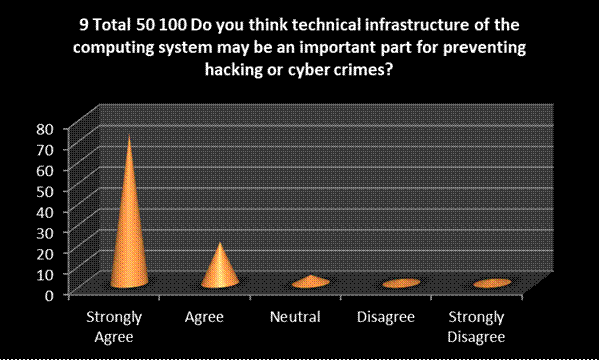
The graph and the
charts portrayed above has been represented after asking the participants
whether they believe that technical infrastructure of the computing system may
be an important part of preventing hacking or cybercrimes. Then 72%
participants have strongly agreed the fact that technical infrastructure of the
computing system may be an important part of preventing hacking or cybercrimes.
While 20% of the participants agreed that technical infrastructure of the
computing system might be an important part of preventing hacking or cybercrimes.
Moreover, 4% of the participants responded neutral views regarding the fact.
However, only 4 % of the participants had strongly disagreed and disagreed the
fact that believing technical infrastructure of the computing system may be an
important part of preventing hacking or cybercrimes.
4.2.2 Qualitative
Analysis
In this particular
section, the review of the qualitative analysis has been revealed to justify
the significance regarding the peer-reviewed journal which has been entailed to
review the facts ascertained by the past researchers. These respective peers
reviewed researchers has been vividly discussed so as to judge the qualitative
means of the topic in accordance to which the overall research has pertained.
Moreover, justification of what will be the impact of the issues has also been
delineated.
Article:Cyber-Crimes and their Impacts: A Review
Authors:HemrajSainiYerra, Shankar Rao andT.C.Panda
In the present era
where everything is under online processing, the majority of the information
are available online, the probabilities of cyber threats are also increasing.
There a large number of these cyber threats have been observed & it is also
found that their behaviour is something difficult for understanding in the
early stage as thus it is also difficult to restrict this in the very beginning
of cyber attacks. These cyber stacks might be getting
support from something or might be processed mistakenly. Those attacks which
are intentional are supposed to be named as cybercrime& they have also been
observed as seriously impacting over the generation as well as society in the
structure of financial disrupt, psychological as well as an emotional disorder,
a threat towards the nation, etc. Such cybercrimes can be restricted depending
on the proper analysis of the actions as well as getting the impacts on the
environment with the trends of such cybercrimes in future.
This paper has
focused not only on the understanding of the concept of cybercrime but also has
been able to explain the effects on the several levels of the society. This
will also be helpful for the society regarding securing all the information
online that are crucial for the organisations that are not in a safe condition
because of these cybercrimes. The overall concept of the actions of cyber
criminals as well as their contributions towards these cybercrimes can widely
be categorised into three main categories i.e. cyber laws, education as well as
the making of policies. All the methods for handling cybercrime are found as
either very less noticeable or not noticeable at all in several of the
countries. This kind of insufficient work needs to be improved, or new
paradigms should be set for controlling the attacks through Internet.
Article:COUNTRY REPORT ON CYBERCRIME: THE PHILIPPINES
Author: Gilbert C. Sosa
In recent years,cybercrimes ca not even
control through technology or any transnational dimension. Nowadays it is also
involving offenders who are responsible for deliberately fashioning their
attacks for exploiting the probable areas of weaknesses existing in the
transnational regions of the infrastructure. If it is also observed as
threatening the substantial as well as growing dependency of governments,
commerce & the people upon the infrastructure of the information for
conducting business, processing information & carrying messages.
Cybercrime is
known as one of the most rapidly increasing non-violent crimes in the regions
of Asia. It requires a large amount of technical expertise as well as
cooperation, both foreign & local for addressing these problems. This crime
is also affecting several countries in different degrees, based on the extent
of the parliamentary performance of each nation. In the country of Philippines,
as electronic & technical landscapes change, a need has been observed
regarding enacting the laws or amending the present laws for fully removing
these cyber threats.
The challenge
regarding handling these kinds of transnational cybercrime needs a proper
series of responses, inclusive of both the voluntary as well as legally
authorised cooperation. The government is supposed to actively follow the
either transnational initiatives, intended, informal information exchange or
multilateral treaties for establishing the common as well as the substantial
degree of cooperation in the prosecution as well as investigation of the
offences related to cybercrime.As
presently, widespread dissimilarities can be observed among the states, in the
regulatory, legal or policy environment concerning the cybercrime.
With all the
revisions, consolidations & filing the additional of the enhanced version
of the bill as well as trying for aligning these with the national treaty, it
is observed that yet the government need to act on the pending bills aimed at
enacting the law of cybercrime in the country.
Article: A
consideration of the social impact of cybercrime:
Author: Mary Aiken, Ciaran Mc Mahon, Laura O Neill &
Edward O Carroll
The headlines of
contemporary news are supposed to play the role of a regular host for treating
the one form of cybercrime or some other; it could be fraud, malware, hacking,
child abuse, piracy, etc. In the present situation, the meaning of the word is successfully
unpacked, the social impact of cybercrime is also considered & the
potential developments in future are also discussed here. As provided here, the
profound as well as the pervasive impact of the internet, it is crucial for
acknowledging that regarding criminology, what occurs online can also influence
the real world & vice versa. On the other hand, the cyber social, as well
as real world influences about the cybercrime, will also be assessed.
Article:Effects
of cybercrime
Author: Milton Kazmeyer
In the present
paper, it has been described that the criminals are taking advantage of the
technology in several ways. Particularly, the internet has been found as a
great tool for the miscreants as well as scammers, as it enables them to
practise their deal while concealing behind a cover of digital secrecy. Cybercrime
is responsible for affecting the society in few ways, both offline as well as
online world. The cybercrime of piracy has affected the world of entertainment,
software as well as music a lot. The claims towards damages have been proven as
hard to be estimated & harder to be verified, with the estimates that vary
from hundreds of millions to hundreds of billions of dollars each year. As a
result, the holders of copyright have been lobbied for more strict laws against
the logical theft property, getting the results as laws such as the Digital
Millennium Copyright Act. These laws are supposed to allow these copyright
holders for targeting the file sharers as well as sue them for the larger sums
of money for counter-acting the economic damage of their online activities.
Regarding becoming
the victim of a cybercrime having the long-lasting effects on the life of the
people. One general method scammers employ supposed to
Phish, send a false email claiming for coming from either a bank or other
economic institutions are requesting personal information.
Chapter 5:
Conclusion and Recommendation
5.1 Conclusion
In the last few decades
Internet has been an integral part of our various regular day to day
activities. From booking movie tickets to sending emails, from storing data to
gathering information from various downloads internet brings to us the entire
world with a single click. It can be said that he has been very much dependent
on the uses of the Internet in the last few decades. One of the reasons behind
this can be stated as the easy accessibility of Internet in any possible
location or circumstances. This has helped us in keeping our daily schedule
very many actives. In this project paper, we are going to discuss the reasons
and the possible causes that emphasise cybercrimes and the lack of Internet
Security. There are various such circumstances under which we can protect our
cyber security with the help of some basic tools. Availability of knowledge in
the field of cyber security can have a lot more ad advantages (Hooda,
2016).
The research findings have
clearly highlighted and identified the overall issues that are associated with
internet piracy along with identification of the key steps or processes that
can be used or implemented for the purpose of mitigation of the threats or
issues associated with internet piracy. The
main purpose of Cybercrimes lies on the basic principle of gathering data
integral data from confidential sites, stealing money from banks and other
financial organisations, leaking out national security protocols that can lead
to terrorism. Apart from these, there are much more reasons behind the
initiation and the gradual progress of Cybercrimes. The project paper also
mentions that in most of the countries the government invests a lot of
resources behind maintaining the cyber security of the nation. There are
special persons who are responsible for managing and protecting the data of a
nation that can include its security, economic status and the peace of the
nation. In most of the cases, it can be seen that the major breaks off Internet
Security take place in banking sectors and other financial organisations where
a lot of exchanges of currencies takes place. In various sections of the
project report, it has been mentioned that there are some steps that the
hackers use to break into the Internet Security protocol of the database of an
organisation.
The steps that are involved are so much polished and efficient that it becomes
a real challenge for the cyber security specialist to track the break in the
system and fix it in real time.
The basic aim and objectives
of this project report are to find a proper way in which the issues that
concern cyber security can be solved by specific measures (Rishi, 2015). The issues of cyber security are
an international agenda that a lot of countries are concerned with. For this
reason, many nations have also collaborated with each other to build a more
secure and protective internet protocol network that will eventually help in
making a shield of protection to help from cybercrimes. In this project report,
we have accumulated a set of questionnaires with the help of primary and
secondary sources that have to help us in investigating the matters very
closely. The analysis that we have obtained from whole these questionnaires has
helped us in gathering enough knowledge in order to secure data structures for
cyber security.
In this project report,
the different methods that are being obtained in order to
process the hacking mechanism around the world has also been explained and
identified. From the records that the project report has gathered, it can be
said that the only measure that can protect the cybercrime to a certain extent
is why securing the database of the service with the help of multiple
authentication protocols (Cavelty, 2016). Various programmers around the world
are taking the initiative to build more strong and Secure Internet security
systems that can help and get the database in two or more secure position. In
most of the cases, it has seen that the basic cybercrime happen
if the database of the server does not have the appropriate security that it
needs. This leads to help the hackers in accessing the confidential files from
the database and transferring the information to other host networks who
manipulate this data against the database itself.
Many institutes around
the world have started to take the initiative in educating the young generation
the various tips and tricks of ethical hacking. In this way, the young
generation can get a very clear idea about the positive and negative Vibes of
ethical hacking. They can also be trained in a provisional way so that in
future they can provide services for the nation to protect it from various Cybercrimes.
The impact of Cybercrimes has been very much severe when it comes to protecting
the confidentiality of national information that can lead towards terrorism.
5.2 Recommendation
After gathering the analysis from various sources, we
have considered a few numbers of recommendations that can be helpful to protect
the cybercrimes and increase the potential of Internet Security:
The
basic initiative that is made it is to keep the latest versions of all the
files and folders that are available on the system (Jacob, 2014). Regular
backup of all files and folders is compulsory to avoid the chances of data
loss. Is the systems can process updates of the
applications then it should be immediately processed before any security issues
occur.
Check security
keys - At the time of any
software configuration, it is important to check the security keys of the
software before installing it. The validity of the software keys will make sure
that the software is devoid of any malware. After installing special software,
a system check is required to make sure that each and every process that happen
within the application are completely authentic and no disturbance is
experienced (Collins, 2016).
Set specific
password - Each and every file
within the system should be secured by a specific password. This password
should be a unique key to secure the validity of the information that is
present in the files and the folders. The knowledge of the password should not
be disclosed to anyone apart from the person who is handling the security of
the system.
Use of antivirus - The system should be
protected by antivirus software that will keep track of all the activities that
are going on in the Internet system. In case if there happens to me any issues were the security of the system is compromised then the
software will automatically detect the virus and help to eliminate it from the
system.
Email protection - Protection of all the
emails and messages should be kept to secure the leakage of information from
server mails (Yamaguchi, 2016).
Avoid advertisements online - It is necessary to
avoid any online advertisements that appear on the Internet. Just because from
the analysis in the project report we have other information that in most cases
online advertisements is part of cybercrimes.
Protect from online purchases - If there happens to
be any online purchase, then it is required to secure the payment gateway to
avoid any security issues. The credit card numbers and credentials should
always be processed only is the system based completely secured from any
spyware services. The majority of the cybercrimes that happen over the Internet
occur by the hands of financial credibility.
Avoid pop-ups - Most of the Internet
sites are filled with multiple pop-ups that have exercise to most of the cybercrimes
in the world (Mauer, 2016). It is highly recommended that whenever a popup
appears from a specific website no one should click on that pop up unless it is
completely secure from the Internet antivirus services.
Secure the use of USB - The use of USB
devices in multiple systems can also transfer viruses from one system to the
other. If both the systems are secured by antivirus software, then it is much
more authentic to use USB devices to transfer data from one system to the
other.
Protect the server from data theft - to protect the
servers from being attacked by any potential hackers; it is important to the
maintenance of proper networking protocol with the help of a security engineer
who will be responsible for keeping track of all the flow of data from and to
the server of the destination. In most of the cases, the database of any server
is being compromised in the first place.
Avoid unknown websites - It is also highly
recommended to avoid visiting unknown websites in order to protect the Internet
Security protocols. If the system is not secure enough, then the system might
get infected from any malicious is content from the unknown websites (Sandhu,
2014).
Protection from online payment - In the case of online
purchases, it has been seen from various analyses that a lot of financial theft
are being done if the credit card Essentials are stored in the browsing history
of a specific system. In this regard, it is also recommended that the users do
not Store or save their passwords in the browser. This will help them in
avoiding any unnecessary financial theft from their credit or debit cards.
Check spam emails - It is important to
check spam emails in order to avoid the scope of any misleading emails to junk
of the mail body. This will help us in keeping our production from hostile
profiles that are always dominant in gathering mail information from one profile
to the other.
International Security - Cyber division cell
of various nations are growing interest in educating
the professionals of home security in various stages of cyber security. These
stages help in generating have very secure Information about various cyber
security issues apart from just monitoring them (Nair, 2014).
Cybercrime divisions around the world - The international cybercrime
division around the world has started to collaborate with each other with the
prospect of eliminating the issues related to Internet security. For example,
the American government has organised some treaties with other Latin American
countries. This has helped them in the exchange of data regarding serious
crimes, and they can thus help each other against the wall of Cybercrime.
Cybercrimethrough social media - In the last few years
the use of social media has been elevated more rapidly than anything else. This
has caused a lot of opportunities for the cybercrime world. With the help of
various hacking techniques, they are usually extracting data from various
social media sites from different profiles. After collecting these data the company transferring them to other Agencies who
uses these data to process their other activities.
Block certain websites - It is highly
recommended that whenever there happens to be a website from any unknown
sources, then the user immediately blocks that website from repeatedly opening.
This is because many unknown websites carry certain codes that become injurious
for any system is the user accepts to open the website and keep it that way.
Block malicious emails - Whenever someone is
hacking into an email account, it is highly recommended that the other emails
of the same person should be blocked At Once by the user in order to avoid any
kind of security threats or Data loss.
5.3 Future Scope
of the research:
This particular
research study has demonstrated the impact of cybercrime with the internet
pricey on business organisations. From the entire research study, the various
concepts of cybercrime and its impacts on business organisations can be
analysed. The researcher has future scope to extend the study in the field of
internet piracy and how it can be prevented from any kinds of intrusions and
vulnerabilities outside from the system. In this particular research study, the
various strategies have been taken to prevent the cybercrime within the
organization. The researcher has scope to develop an in-depth analysis of the
strategies for preventing the cybercrime that may impact on the overall system
of the organisation. The researcher also has future scope for further
developing of the strategy for preventing the cybercrime and its related
attacks on a system which may harm the overall system of the organisation. The
researcher also has future scope to develop a cyber security awareness program
for the various companies in order to enhance the security awareness among the employees
and staffs of the organisations. The prime objective of the security awareness
program will be to enhance the awareness about security strategies for
protecting the system of the organisation from any kinds of vulnerable attacks.
References
Belleflamme, P., &Peitz, M. (2014).Digital
piracy. Encyclopaedia of Law and Economics, Berlin, Springer.
Broadhurst, R.,
Grabosky, P., Alazab, M., Bouhours,
B., & Chon, S. (2014). An analysis of the nature of groups engaged in cybercrime.
Chaudhry, P. E.
(2017). The looming shadow of illicit trade on the internet. Business Horizons,
60(1), 77-89.
Dahlberg, L.,
&Siapera, E. (Eds.). (2007). Radical
Democracy and the Internet: Interrogating Theory and practice. Springer.
Danaher, B., Dhanasobhon, S., Smith, M. D., &Telang, R. (2010).Converting Pirates without cannibalising purchases: The
impact of digital distribution on physical sales and internet piracy.Marketing Science, 29(6),
1138-1151.
Hinduja, S. (2011).Correlates of Internet software piracy. Journal of
Contemporary Criminal Justice, 17(4), 369-382.
Li, H., Sarathy,
R., Zhang, J., &Luo, X. (2014). Exploring the effects of organisational
justice, personal ethics and sanction on internet use policy compliance. Information
Systems Journal, 24(6), 479-502.
Rekha, A. G.,
&Pillai, R. R. (2014). Piracy in the digital age: Is ethical awareness
turning into action?. In Ethics in Science,
Technology and Engineering, 2014 IEEE International Symposium on (pp.
1-4). IEEE.
Wang, S. Y. K.
(2015). A Review Note of Piracy and Intellectual Property Theft in the Internet
Era.In Encyclopaedia of Information Science
and Technology, Third Edition (pp. 1426-1434).IGI
Global.
Yar, M. (2007).Teenage kicks or virtual villainy?Internet
piracy, moral entrepreneurship, and the social construction of a crime
problem. Crime online, 95-108.
Zolait, A., Ali, N., Hassan, F., Saif, S., &Saddique, M.
(2015, May). Individual's informational readiness towards online piracy
behavioural act. In Information and Communication Technology Research
(ICTRC), 2015 International Conference on (pp. 290-293). IEEE.
Akhgar,
B., Staniforth, A. and Bosco, F. (2014). Cybercrime
and cyber terrorism investigator's handbook. Waltham, MA: Syngress.
Bhasin,
S. (2003). Web security basics.
Cincinnati, Ohio: Premier Press.
Garfinkel,
S., Spafford, G. and Schwartz, A. (2011). Practical
UNIX and Internet Security. Sebastopol: O'Reilly Media, Inc.
Gerdes,
L. (2009). Cybercrime.
Detroit: Greenhaven Press.
Gralla,
P. (2006). How personal &
Internet security works. [Indianapolis, Ind.]: Que Pub.
Hynson,
C. (2012). Cybercrime.Mankato,
Minn.: Smart Apple Media.
Shim,
J., Shim, J., Qureshi, A. and Siegel, J. (2010). The international handbook of
computer security. Chicago, Ill.: Glenlake Pub.
Vacca,
J. (2010). Practical internet
security. New York, NY: Springer.
Mishra, S., Dhir, S., &Hooda, M.
(2016).A Study on Cyber Security, Its Issues and Cybercrime
Rates in India.In Innovations
in Computer Science and Engineering (pp.
249-253).Springer Singapore.
Singh, N., & Rishi, A. (2015).
Pyramid: A Case Study of Cyber Security in India. South Asian Journal of Business and
Management Cases, 4(1),
135-142.
Balzacq, T., &Cavelty, M. D. (2016).A theory of
actor-network for cyber-security. European
Journal of International Security, 1(02),
176-198.
Jacob, J. (2014). Israel offers India
to join new cyber security body. Hindustan
Times, 29.
Collins, A. (2016). Contemporary security studies.Oxford
University Press.
Gupta, B., Agrawal, D. P., &
Yamaguchi, S. (Eds.). (2016). Handbook
of research on modern cryptographic solutions for computer and cyber security.IGI
Global.
Cavelty, M. D., &Mauer, V.
(2016). Power and security in
the information age: Investigating the role of the state in cyberspace.
Routledge.
Sandhu, R. (2014). The future of
access control: attributes, automation, and adaptation. In Computational Intelligence, Cyber
Security and Computational Models (pp.
45-45).Springer India.
Abraham, S., & Nair, S. (2014,
December). Cyber security analytics: a stochastic model for security
quantification using absorbing Markov chains. In 5th International Conference on
Networking and Information Technology, ICNIT.
Booth, W., Colomb, G.
and Williams, J. (2011). The craft of research. Chicago: University of
Chicago Press.
Creswell, J. (2013). Research design. Thousand Oaks, Calif.: Sage Publications.
Jha, N. (2012). Research methodology. Chandigarh: Abhishek Publications.
Johnson, P. and Clark,
M. (2010). Business and management research
methodologies. London: SAGE.
Ketchen, D. and Bergh,
D. (2014). Research methodology in strategy
and management. Amsterdam: Elsevier.
Kothari, C. (2013). Research methodology. New Delhi: New Age International (P) Ltd.
Oliver, P. (2010). The student's guide to research ethics. Maidenhead, Berkshire, England:
McGraw-Hill/Open University Press.
Pimple, K. (2011). Research ethics. Aldershot, England: Ashgate.
Sapsford, R. and Jupp,
V. (2012). Data collection and analysis. London: SAGE
Publications in association with the Open University.
Welman, C., Kruger, F.,
Mitchell, B. and Huysamen, G. (2014). Research methodology. Cape Town: Oxford University Press.
Brown, L. and
Niblock, T. (2010). The Pariah States and Sanctions in the Middle East: Iraq,
Libya, Sudan. Foreign Affairs, 80(5), p.172.
Questionnaire
Age:
25
to 30 years
30
to 35 years
35
to 40 years
40
to 45 years
Above
45years
Gender:
Male
Female
Industry
experience
0
to 5 years
5
to 10 years
10
to 15 years
Above
15 years
1. How far do you
believe that cybercrime is one of the key challenges faced by the internet
users in the 21st century?
Strongly
Disagree
Disagree
Neutral
Agree
Strongly
Agree
2. Do you believe
that cybercrimes possess a threat to the internet users?
Strongly
Disagree
Disagree
Neutral
Agree
Strongly
Agree
3. Do you agree
that internet piracy can result to loss of valuable data and information of the
internet users?
Strongly
Disagree
Disagree
Neutral
Agree
Strongly
Agree
4. Do you agree
that cybercrimes and Internet piracy impact the information and communication
technology (ICT) services?
Strongly
Disagree
Disagree
Neutral
Agree
Strongly
Agree
5. How far do you
believe that data security techniques can be used to limit cybercrimes and
Internet piracy?
Strongly
Disagree
Disagree
Neutral
Agree
Strongly
Agree
6. Are the
information databases available on internet faces high threats from internet
piracy?
Strongly
Disagree
Disagree
Neutral
Agree
Strongly
Agree
7. Do you agree
that implementation of security measures have been able to reduce the issues of
cybercrimes?
Strongly
Disagree
Disagree
Neutral
Agree
Strongly
Agree
8. Do you think
that cybercrime may impact on the overall system of an organisation?
Strongly
Disagree
Disagree
Neutral
Agree
Strongly
Agree
9. Do you believe that different kinds of
software available in the market for prevention of hacking can prevent the
hacking in the computing system of the organisation?
Strongly
Disagree
Disagree
Neutral
Agree
Strongly
Agree
10. Do you think
technical infrastructure of the computing system may be an important part of
preventing hacking or cybercrimes?
Strongly
Disagree
Disagree
Neutral
Agree
Strongly
Agree