 : 651
: 651
DESIGN
AND DEVELOPMENT OF A MOBILE APPLICATION FOR REMOTE MONITORING AND CONTROL OF
INTERNET OF THINGS (IOT) DEVICES USING WIRELESS COMMUNICATION PROTOCOLS
Abstract
The Internet of Things (IoT) devices in this modern generation have impacted all over the world. This project has used the Android Studio software to create a mobile application that allows users to remotely monitor and control Internet of Things (IoT) devices. It has been completed by utilizing wireless communication protocols to establish connectivity. Strong security protocols have been built into the setup to protect data transmission and improve dependable remote monitoring and administration. The application allows users to remotely monitor and control their IOT devices through an easy-to-use interface. The development of a responsive and user-friendly mobile platform has been facilitated by Android Studio . The seamless connectivity with a variety of Internet of Things devices has been assured. This mobile application serves as a centralized hub that facilitates easy access to and management of IoT devices. The wireless system has allowed for efficient and intuitive remote management in a range of situations.
Keywords: Mobile Application, Internet of Things devices, Android Studio, Wireless Communication Protocols, User Interface, MVC Architecture, User-centric Design, and Security Measurement.
Preface
This initiative contributes significantly to MSc program requirements, complying with the National Qualifications Framework. Designing and developing a smartphone app for wireless IoT device management shows theoretical understanding in practice. The project addresses current IoT difficulties and provides a practical solution. Evaluation of the project's achievements against program requirements and national credentials shows its educational and social influence. This preamble introduces the project's academic and practical relevance.
Acknowledgments
I express my sincere gratitude to all those who contributed to the success of this project. Special thanks to my Supervisor for invaluable guidance and support throughout the design and development process. I also extend appreciation to my Colleague for their collaborative efforts and insightful discussions. This project benefited from a supportive environment, and I am thankful for the encouragement from friends and family. Their unwavering support made this endeavor possible and significantly enriched the overall experience.
Table of Contents
1.2 Specification of the
Report
2.2 Overview of the
Internet of Things (IoT) and Wireless Communication Protocols
2.3 Mobile Applications
for IoT Control
2.4 Security in IoT
Applications
2.5 Internet of Things:
Broad Home Control and Monitoring System Using Android-Based Smartphone
Chapter 4: Results and
Analysis
4.2 Android Studio as
Development Environment
4.3 Wireless
Communication Protocols Impact on the Application
4.4 Model View
Controller Architecture
4.5 User-Centric Design
Enhancements
4.6 Backend
Infrastructure Robustness
4.7 Improved Application
Security
4.8 Effective
Application Testing Process
List of Figures
Figure 1.4.1: IoT-based
Wireless Communication System
Figure 2.2.1: IoT
communications protocols process
Figure 2.3.1:
Application of IoT Mobile Features
Figure: 2.4.1:
Security and Privacy in IoT Applications
Figure 2.5.1: Smart
Android-based automation Control and Monitoring System
Figure 3.2.1:
IoT-based Applications
Figure 3.4.1: Wi-Fi
Controlled Home Automation System
Figure 3.4.2:
Wireframe and Prototype of a IoT Application
Figure 3.4.3:
NodeMCU Wi-Fi Controller Board
Figure 4.2.1:
Development Environment
Figure 4.3.1:
Wireless Communication in IoT Devices
Figure 4.5.1:
User-Centric Design Enhancements
Figure 4.6.1:
Backend Infrastructure Robustness Using Firebase
Figure 4.7.1:
Improved Security Through Google Firebase
Figure 4.7.2:
Initializing Google Firebase
Figure 4.8.1:
Checking the Water Level
Figure 4.8.2:
Checking Geyser Configurations
Figure 4.8.3:
Controlling Light and Fan with Temperature Control
Chapter 1: Introduction
1.1 Introduction
The
Internet of Things better known as IOT is a major driver of the new age of home
automation systems that has been ushered in by the widespread use of smart
gadgets in everyday life. The effective and reliable change in the management
of domestic appliances happened with the widespread use of electricity and the
fast development of computer technology. The emergence of mobile devices as key
participants is largely attributable to the proliferation of low-power wireless
technologies like Bluetooth and ZigBee, as well as more robust choices like
Wi-Fi networks and GSM modules. Several sensors measuring such as temperature,
humidity, gas leakage, motion, RFID, and water level are included in IoT-based
homes. These IOT-based systems allow the control of things like lights, fans,
doors, windows, motors, and pumps, complement these sensors.
1.2 Specification of the Report
The
IOT-based
mobile application is proposed and developed in this study for the remote
monitoring and management of Internet of Things devices, to address the
ever-changing environment of home automation systems. The NodeMCU
Wi-Fi controller board acts as a multipurpose microcontroller and network
router at the center of this cutting-edge setup. The main goal is to make it
easy and intuitive for people to keep tabs on and manage their homes' many
electronic systems in real-time (Abdulla et
al. 2020). The system's wireless communication protocols are designed to
provide users with the freedom and convenience for efficient remote monitoring
and management. These protocols include Bluetooth , ZigBee , Wi-Fi
networks , and GSM modules. IoT systems aim to improve not just the ease with
which IoT devices can be monitored and controlled remotely, but also people's
sense of safety, security, and well-being.
1.3 Aim and Objectives
The
ultimate aim of this project is to significantly develop a mobile app that is
automatically linked to IoT devices in order to get all information wirelessly,
allowing for remote monitoring and access.
Objectives
●
To determine the
compatibility, advantages, and security measures of wireless communication
protocols such as Bluetooth, Wi-Fi, and Zigbee for management of Internet of
Things devices.
●
To significantly develop an
effective mobile application with the use of wireframes, prototypes, and
usability testing.
●
To efficiently develop the
backend of the mobile application, choosing suitable backend technology, and
implementing key APIs for communication between IoT devices.
●
To Incorporate real-time
data monitoring, remote access control capabilities, and device detection into
the mobile application on both iOS and Android.
●
To properly test the mobile
app in a variety of scenarios, conduct interviews and surveys with actual users
to figure out how to make the app better for its target audience.
1.4 Research Background
Home
automation systems, especially those based on the Internet of Things, have seen
a spike in popularity because of the increasing prevalence of smart gadgets and
the more linked aspects of contemporary life. This developing industry has the
potential to revolutionize the way people use their homes by increasing their
comfort, security, and savings. Creating a mobile app that can operate and
monitor IoT devices remotely over wireless communication protocols is an
important part of this technological environment. In order to improve device
access and usability for a wider audience, this study is motivated by the
growing need for approachable interactions in IoT administration.

Figure 1.4.1: IoT-based Wireless Communication System
(Source: www.mdpi.com,
2021)
This
research is motivated by the realization that, despite the pervasiveness of
smart devices in everyday life, a significant gap exists when it comes to the
accessibility and effectiveness of IoT administration interfaces (Ahsan et al. 2021). The study considers the
intricate web of protocols for wireless communication that enables
interoperability among IoT devices and aims to use this infrastructure to
create an innovative Android-based mobile application. The purpose of this
research is to address the lack of intuitiveness in existing IoT management
interfaces. The foundation for this research has to be laid with a careful
analysis of wireless communication protocols. Investigating and rating several
protocols including Bluetooth, Wi-Fi, and Zigbee is the primary goal of the
research.
In
order to create a mobile application that works well with a wide variety of IoT
devices, it is needed to have a firm grasp of the advantages and disadvantages
of each protocol. It is needed to perform a thorough evaluation of the security
features of these protocols is also required to guarantee the safety of data
transmission between IoT gadgets and the mobile app. This study effectively
states Internet of Things (IoT) technologies, mobile application development,
and wireless communication protocols. This particular research wants to create
a mobile app that not only meets the rising need for simple IoT administration
but also exemplifies user-centric design in the dynamic field of smart home
systems by delving deeply into these areas (Boursianis
et al. 2022). This study's
overarching goal is to contribute to the continuous development of smart home
settings by providing a comprehensive and user-friendly way to control IoT
devices via the combination of wireless networking, IoT, and cutting-edge
mobile application technologies.
1.5 Research Question
●
How do different
capabilities of wireless communication protocols like Bluetooth, Wi-Fi, and
Zigbee impact the performance of IoT?
●
What factors contribute to
a mobile app's intuitive and user-friendly interface for managing IoT devices?
●
How to establish a secure
connection between all the IoT devices connected to the same network?
●
How can features like
remote data monitoring and control, and device detection affect the overall
performance of the IoT devices?
1.6 Rational
This
research is motivated by the fact that current methods for managing Internet of
Things devices are often too complex and ineffective at the same time. The
existing products do not provide seamless connectivity and integration which is
a big negative. The goal of this work is to effectively develop a mobile app
for managing and monitoring Internet of Things devices via wireless networks.
This study aims to create the way for a user-centric solution that can meet the
growing need for simple, convenient IoT management interactions and contribute
to the advancement of smart home technologies by combining in-depth research
into wireless communication, IoT technology, and mobile application
development,
1.7 Summary
The
purpose of this work is to provide a user-friendly mobile app for controlling
the Internet of Things gadgets via a wireless connection. The effort is a
reaction to the expanding Internet of Things, and it aims to solve problems
associated with safety, security, compatibility, scalability, and
accessibility. The goal of the initiative is to make it easier for customers to
get their hands on Internet of Things devices in a world where technology is
constantly improving.
Chapter 2: Literature Review
2.1 Introduction
The
specialty of the topic design and development of a mobile device application
for remote observing and Control of the Internet of Things (IoT) has
noticed significant improvement and research over the years. This literature
examination will research and analyze the elementary key theme movement and
discoveries in the existing parts of the literature regarding wireless
communication protocols. The capability to observe certain features of an IOT
remote observing is the utilization of the Internet of Things (IoT) systems to
remotely observe and control appliances or machines. It allows near real-time
base tracking and observing of different parameters like temperature, different
voltage, pressure, and humidity. Generally wireless remote monitoring or
observing and manipulation can severely realize real-time and successive
control. IoT devices utilize a particular to communicate wirelessly in the
sequence to perform both. IoT remote sensors are pieces of hardware parts that
are to be detected altered in an environment and gather a database.
2.2 Overview of the Internet of Things (IoT) and Wireless Communication
Protocols
The
Internet
of Things (IoT) defines physical entities embedded with the sensors
parts and actuators that are to be communicated with the machine procedure
through wireless or wire networks permitting the physical world to be online
observed to even organized. The primary purpose of IoT that to connect and
exchange databases with different applications and procedures across the
internet part. As per the view, the mobile device of the IoT is the system that
links physical entities to the internet part using the existing mobile device
network utilized by smartphones (Suma,
2021). The Internet of Things (IoT) is a network base of interaction
appliances that interconnect and swap parts of the database with the different IoT
appliances and the cloud base. IoT appliances share that sensor data which is
gathered by linking to an IoT gateway, that acts as a middle hub where IoT
machines can send the data. The IoT domain involves an immense value
of smart appliances that have multiple constraints.
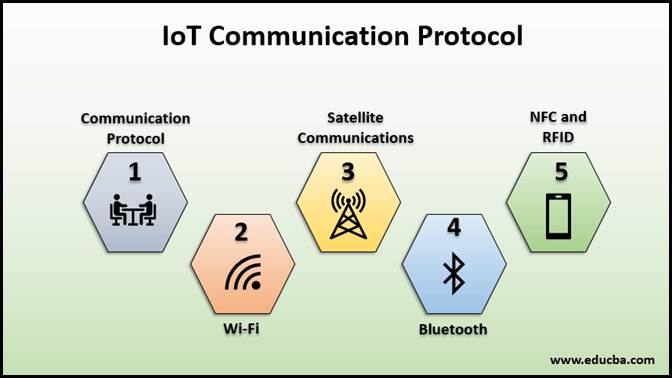
Figure 2.2.1: IoT communications protocols process
(Source:
Educba, 2023)
Processing
ability repository volume, short control life, and the range of the data are
among these constraints. The IoT implementation or execution
requires a transmission protocol that can be essential and efficient in
controlling these circumstances. IoT mobile application evolution
consists of making applications to associate physical objects, like phones and
timepieces, with the internet base. Applications are like engaging and
innovative decorations that describe mobile devices best purposes. These make
the utilization of the procedure feasible and understandable. Designers aim to
maintain the most suitable functionalities in mobile device applications that
humans can access to technique tasks and create amusement. The IoT has
made it possible to automate procedures and connect appliances, leading to
improving essential efficiency in the enterprise. The wireless application protocol (WAP)
is envisaged as a complete and scaleable protocol
developed to utilize with any mobile device application, from those with a one
sequence showing to a smartphone to any existing or designed wireless benefits
like Short
message service , Unstructured Supplementary Services and Circuit
Switched Data . Wireless communications is the communication of tone
and data with cable or wires and the data journey via electromagnetic signals
broadcast from the sending establishments and end-user appliances. The
wireless communication protocol in the Internet of Things is the collection of
rules utilized to interact data in the middle of electronic appliances like Bluetooth ,
Zigbee , and WiFi which are the most commonly
utilized protocols. The wireless gateway identifies the appliances that link to
the internet and the range transmitted to the appliance to correspond to the
display size and type base in utilize (Salman and Jain 2019). WiFi
security protocols utilize encryption procedures to protect the network and
secure the databases of the user. Wireless network bases are frequently small
secure than wired ones, so wireless protection protocol parts are vital for
holding the digital platform. One of the larger threats to the Internet of
Things security is the insufficiency of data encryption on the continuous basis
of transmission.
2.3 Mobile Applications for IoT Control
An IoT
mobile device application that combines a database and serves as the touch
point that creates IoT convenience for the users. The Internet of Things (IoT)
is an ecosystem of physical parts and objects that are linked and
accessible via the Internet. Heart-rate monitoring and automobiles with sensors
built in are a few examples of things in the Internet of Things
goods that have been allocated an IP address and are capable to
gather and send data through a network without the need for human oversight or
intervention. IoT allows appliances to monitor, comprehensively, and analyze
an issue or the environment without mortal intervention. ioT
can make a very smart surrounding utilizing smart appliances
(Ramson et al. 2020). Paired with mobile device applications that
permit to management of these applications remotely, this system is one of the
most outstanding procedures of this generation. Mobile devices play a vital
position in allowing the functionality and mange of the Internet of Things appliances.
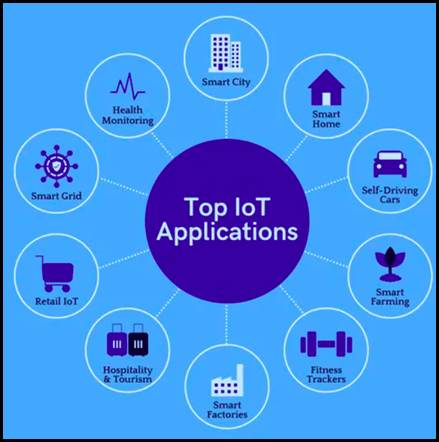
Figure 2.3.1: Application of IoT Mobile Features
(Source:
Stl. tech, 2023)
View,
a few applications of mobile applications for IoT give customers the
ability to manage a number of gadgets for smart homes, like security cameras,
door locks, lighting systems, and thermostats. The home automation systems of
the users can organize tasks, monitor and alter settings remotely, as well as
receive notifications. The popularity of mobile applications part for Internet
of Things (IoT) control is rising along with an increase in IoT
machine adoption. Acting as a link in the middle between the users and the
devices that are connected, these applications give a practical and instinctive
user experience for having an eyesight on and controlling several
characteristics of the Internet of Things. There has never
existed more demand for feature-rich and accessible smartphone apps for the Internet
of Everything control of the rise of connected devices, smart homes,
and industrial automation. These applications' standardization of control and
monitoring operations is one of its main features.
Robust
security components, like remote device administration, data encryption, and
secure authentication, are built into many IoT applications for control. In
these frameworks of the Internet of Things , security is a
major worry, and mobile applications serve as crucial for overcoming these
issues. Users comfortably utilize the Internet of Things devices,
understanding that privacy and data be preserved. Real-time monitoring
functions are frequently included in mobile apps for IoT control. Users to react
quickly to any problems or alterations by obtaining instant information and
alerts on the status of the linked devices. These apps provide users with
current data for a variety of objectives, such as keeping track of a smart
thermostat's temperature, checking the home security cameras, or obtaining
notifications from industrial sensors (Rahaman et al. 2019).
Voice assistant integration has evolved into a standard component for numerous
mobile devices and IoT control apps.
Voice
commands facilitate users to operate and control IoT devices, boosting
natural and hands-free interaction with the IoT ecosystem. This
integration presents accessibility to IoT technology and makes it more
user-friendly to users with a variety of technological proficiency in addition
to offering convenience. IoT control via mobile apps to
facilitate automation and smart practices more straightforward.
Internet
of Things (IoT) devices are seamlessly controlled and monitored thanks in
large part to mobile apps. These programs, which provide an intuitive user
interface, enable users to utilise smartphones or
tablets to remotely control their smart devices. It has integrated mobile
platforms, users may access and operate Internet of Things devices from any
location with an Internet connection, hence improving accessibility. These
kinds of apps often make use of principles of intuitive design, which let users
quickly select settings, monitor data in real-time, and carry out tasks. The
confluence of mobile technology with IoT presents innovative possibilities,
such as smart home automation and industrial IoT solutions. Convenience and
efficiency are fostered in the quickly changing IoT landscape by mobile apps,
which remain the main interface through which consumers interact with and
manage their networked surroundings as demand for IoT-enabled devices surges.
2.4 Security in IoT Applications
Security
of information is one of the main issues with IoT security and
sensitive data is frequently gathered and transmitted by IoT devices. This data
can be anything from meaningful operational data in manufacturing facilities to
confidential data in smart homes. A crucial element in maintaining this data
together during transmission and storage is encryption data. As per view to strong
encryption algorithms ensure that only those with authorization can decrypt and
access the data, preventing eavesdropping and unauthorized access (Nebbione and Calzarossa,
2020). These devices are connected to one another and potential
exposures are to be exploited, security is a crucial component of Internet
of Things applications. Comprehensive security measures in applications
for the Internet of Things are essential to safeguard sensitive data,
uphold user privacy, and stop malevolent or unauthorized access as IoT
extends all over various sectors. The core components that makeup IoT security
are authentication and access control. Robust authentication techniques, like
multi-factor authentication, aid in confirming the identity of those gadgets
engaging with the Internet of Things in the network parts.
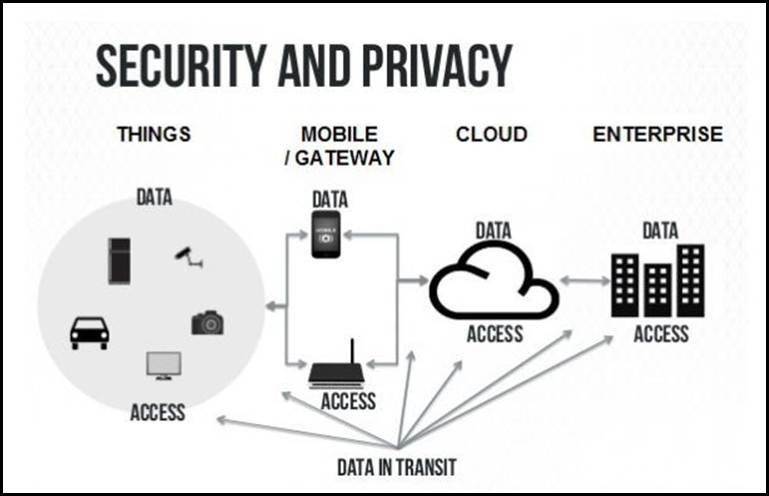
Figure: 2.4.1: Security and Privacy in IoT Applications
(Source:
Medium, 2023)
Access
management is convinced that only individuals with permission can use specific
tools or carry out certain duties. This becomes particularly significant in
situations where a breach in one device may result in a more remarkable number
of safety risks all throughout the network part. IoT applications secure
to the device management and security updates are essential an IoT
network devices to be able to download secure updates in a timely method to
resolve security flaws and boost system security in general part. The risk
generator of unauthorized access or tampering is mitigated by secure device
management protocols, which assure that only authorized parties can change
device settings. A significant consideration in IoT applications is
network security. Securing communication channels between devices and computer
systems is essential given the wide range of devices in an IoT ecosystem.
Encrypted communication is made possible by secure network protocols like Transport
Layer Security (TLS) , which guard against data manipulation and
interception as it is in transit.
Putting
intrusion detection systems and firewalls in place is beneficial in defending
the network from malicious activity and unauthorized access. IoT
applications raise privacy concerns as a consequence of the volume of
subjective data generated by connected devices. Privacy is to be considered of
the most extraordinary importance in the design of IoT devices, and whenever
possible steps to anonymize or pseudonymize data must be taken.
User approval processes and clear, available privacy policies help encourage
user trust and ensure that privacy is secured. A productive IoT
security method includes both incident response and routine monitoring (Hassija et al. 2019). IoT networks that are continuously
monitored can help to identify unusual activity or achievable security breaches
in real-time. Fast and successful responses to security incidents are made
possible by a distinctly defined incident response plan, which is to be the
effect of any prospective breaches. When implementing IoT applications, the
idea of security by design is essential. Security should not be
implemented as an afterthought but instead, be part of the methods of design
and development from the outset. This includes adherence to industry best
practices for secure coding, conducting routine security assessments, and
reviewing code.
2.5 Internet of Things: Broad Home Control and Monitoring System Using
Android-Based Smartphone
A
creative use of the Internet of Things (IoT) that gives modern homes ease,
efficiency, and increased safety is a Broad Home Control and Monitoring System
that makes use of an Android-based smartphone. This
system makes the most of the Internet of Things to link a
number of intelligent gadgets in a home so that clients are able to easily
monitor and control them with Android smartphones . Its primary
objective is to turn a regular house into a smart home by developing a
centralized platform that controls a combination of smart gadgets. Smart
lights, thermostats, security cameras, door locks, and other electronics may
all be accessed, checked, and commandeered remotely via users utilizing the
robust interface that an Android-based mobile device
provides (Khan et al. 2022). Deploying an Internet
of Things (IoT) enabled device each with sensors and communication
ability all over the house is a typical step in the system.
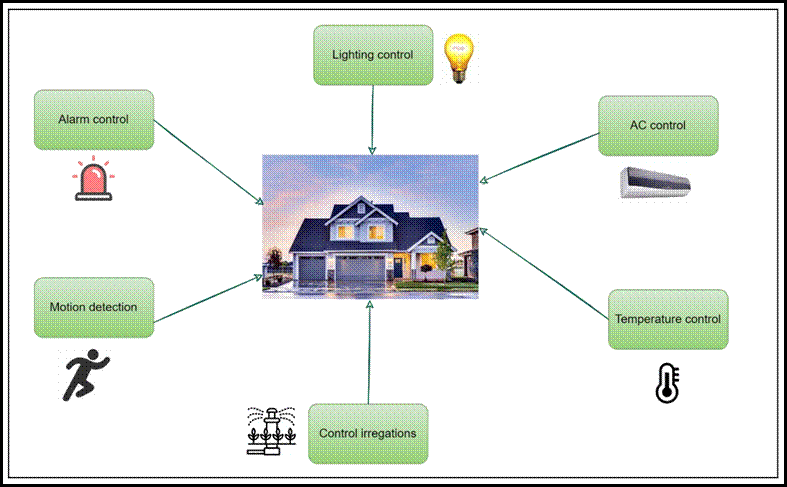
Figure 2.5.1: Smart Android-based automation Control and Monitoring
System
(Source:
Mdpi, 2023)
The
Android
smartphone provides an accessible interface for interacting with this
centralized network, via which these appliances communicate with a main hub or
server. Smartphone displays the users can access and manage different
components of the home environment utilizing a dedicated mobile application. A
vital part of this system is the management of smart lighting and
energy-efficient lighting under certain circumstances, users modify the
brightness and color and even set lighting programs. This permits one to
preserve energy to simultaneously improve the overall consistency in the house.
A key element of the total home control and monitoring system is security
features like security cameras, users can remotely lock or unlock doors,
observe real-time footage on smartphones, nicely receive
notifications for any unexpected action. A higher degree of security is
presented by integration with motion and door sensors, making it possible for
quick notifications in situations of unauthorized entry.
Voice
management features can be integrated into the Android app , permitting
users to make use of voice commands to operate the smart home devices. The user
experience is improved by integration with recognized virtual assistants like
Amazon Alexa , and Google Assistant , making the
system more intuitive and user-friendly. As a result of the
flexible and expandable configuration of this comprehensive home monitoring and
management system, clients can easily add additional Internet of Things (IoT) devices
as desired. For the reason of its flexibility, the smart home ecosystem can
develop in stage with technology consequences, positioning the house at the
fore of IoT innovation. This system's adaptation with regard to
various lifestyles and selections is a big plus (Iskandar et al. 2022).
Users are capable of customizing automation routines and conditions with the Android
app , permitting the smart home to adapt to daily schedules. The system
may configure when residents tend to leave home and set the lighting, thermostat,
and different parameters automatically.
The
integrated home monitoring and control system, in conjunction with an Android-based
mobile app, is a dynamic solution that extends below conventional ideas of home
automation. It is straightforward to build into many aspects of day-to-day
life, providing not just convenience but also a customized and adaptable method
of living.
2.6 Background Research
The
study is primary research since it focuses on learning about managing IoT
devices in the actual world. The study attempts to identify the practical
problems consumers encounter while controlling IoT devices via
interviews with subject matter experts and user surveys. Wireless communication
technologies like Bluetooth , Wi-Fi , and Zigbee are tested in
the lab to see how they work in the wild (Azad et al. 2021).
The secondary research phase entails a thorough review of previously published
materials. It includes a comprehensive literature review on wireless
communication protocol compatibility, benefits, and safety measures. The
findings from this secondary study will be used as a basis for making smart
choices when the mobile app is being created.
2.7 Literature Gap
The
complexity, user experience, and integration difficulties particularly for
mobile applications for remote monitoring and administration of Internet
of Things (IoT) devices are not well covered in current research.
Despite the plethora of IoT and mobile development papers, few cover their
intersection. These two entities have to be linked to identify user demands,
security challenges, and the optimal mobile app design tactics for managing IoT devices.
Further research should close this gap to provide efficient and user-friendly
mobile IoT solutions.
Certain
gaps in the literature suggest parts that deserve additional research and study
in this particular area.
●
Security Conservation - The
Internet of Things that to be more comprehensive exploration needs to
be done to understand security issues when it involves mobile applications that
make it possible for remote observation and control of IoT devices.
●
Scalability
Challenges - Scalability is a vital
factor, especially when there are a greater number of associated devices (Iqbal et
al. 2021). A possible area of
research could be how various wireless communication protocols improve the IoT mobile
applications' scalability.
●
Data
Analytics Part and Predictive Supervision- The topic of integrating predictive maintenance and data
analytics within mobile IoT applications continues to develop.
●
Energy
Efficiency in Wireless Transmission - Considering the energy consumption of protocols for
wireless communications in the context of smartphone applications for the Internet
of Things , varying there could be an interval in the literature.
●
User
Understanding and Interface Configuration - More research needs to be carried out regarding the interface
design and User experience (UX) of mobile applications that handle Internet
of Things devices. Addressing user selections, actions, and problems
with usability will be required for this.
The
wireless communication protocols, the design and development of a mobile
application for remote observation and control of Internet of Things (IoT)
devices is a quickly developing field with important advancements in technology
(Jabbar et al. 2019). The dynamic and quickly expanding
specialization analyzers and practitioners can completely benefit from these
possibilities to develop more dedicated and sufficient solutions.
2.8 Summary
A
rapidly developing field of research and development is the creation and
establishment of a mobile application for wireless transmission protocols-based
control and monitoring from afar of Internet of Things (IoT) appliances.
This new discipline desires to generate user interfaces with mitigation that
enable users to conveniently use mobile applications for controlling and
monitoring the Internet of Things devices. The security implications of
these applications are an important subject that needs to be protected in the
literature. Although current research focuses on a broader spectrum of IoT
security, a more focused examination of susceptibility in protocols that enable
wireless communication and the development of strong security mechanisms are
still needed. This is crucial in preserving private information and maintaining
the safe remote operation of Internet of Things devices. Another
gap in the literature at this point in time is the interoperability challenges.
Considering a wide variety of devices can participate in IoT ecosystems, it is
particularly important to understand how distinct wireless communication
protocols impair interoperability.
Chapter 3: Methodology
3.1 Introduction
Real-time
data monitoring, remote access control capabilities, and device identification
are all a part of this approach's mobile app redesign for Android. Extensive
testing has been done of the mobile app in a variety of situations,
supplemented by interviews and surveys to collect user input for iterative
improvements, all in service of realizing our end objective of offering a
complete and user-centric solution for managing IoT devices. Implementing
features such as real-time data monitoring, remote access management, and
device identification, this strategy updates Android mobile applications with
newer features. Finally, to achieve the goal of providing a comprehensive and
user-centric solution for controlling IoT devices, rigorous testing of the
mobile app has been conducted in a range of settings, fulfilled by real-world
users and surveys to gather user feedback for incremental improvements.
3.2 Research Approach
This
particular project takes a systematic and effective approach to research and
build a properly functional mobile app for remote monitoring and control of IoT
devices. The starting point of the strategy is a methodical investigation of
the available wireless communication technologies, such as Bluetooth, Wi-Fi,
and Zigbee (Huang et al. 2020).
Research into the compatibility, benefits, and security measures of each
protocol in the field of IoT device management is informed by a thorough
literature study conducted at this stage. Analyzing a protocol, the research
methodology moves on to creating a user interface for a mobile application. The
layout, features, and user interactions of an app may be envisioned by creating
wireframes and prototypes. In order to make sure the interface is
user-friendly, aesthetically pleasing, and meets user expectations, usability
testing is then performed.
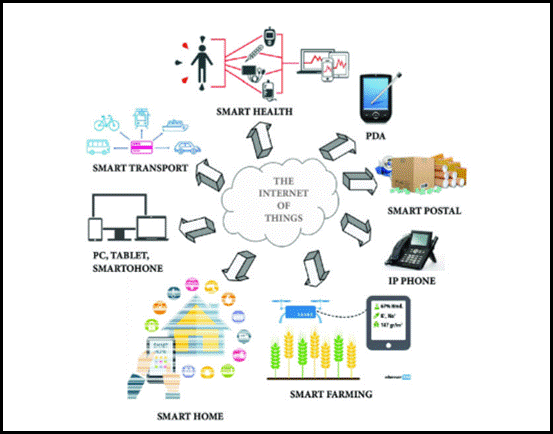
Figure 3.2.1: IoT-based Applications
(Source: www.hindawi.com, 2021)
The
next step of this research is to build the backend for the mobile application
and ensure a smooth connection between IoT devices and the application. It is
very important to choose the right backend technology and implement the right
APIs. Security and command over user and device data are improved by combining
data management methods with authentication and authorization procedures.
Real-time data monitoring, remote access control capabilities, and device
identification are integral parts of the mobile app used in this research
methodology. This process guarantees that the Android versions of the app are
visually attractive and feature-rich enough to satisfy a wide range of user
requirements.
3.3 Data Collection
This
study employs a multipronged strategy for data collection, beginning with an
effective and efficient literature search for background information on
Bluetooth, Wi-Fi, and Zigbee as the technologies have provided advancements to
IoT device management (Jaiswal et al.
2019). A systematic review of these protocols, with an eye toward
compatibility, benefits, and security measures, yields primary data. Usability
testing, where individuals engage with mobile app wireframes and prototypes, is
then used to acquire qualitative data throughout the design and development
process. During this stage, we collect data from users on the ease of use and
aesthetic appeal of the app's front end. Information about appropriate backend
technologies, APIs, and security methods is included in the creation of the
mobile application's backend. Finally, quantitative data is collected during
testing to evaluate the application's performance and responsiveness in a
variety of scenarios, and qualitative insights are gained from user feedback
gathered through interviews and surveys to inform iterative improvements.
3.4 Methods
In
the ever-changing world of Internet of Things application development, a
thorough and iterative approach is essential. Beginning with a comprehensive
analysis of wireless communication technology, this chapter reveals the
in-depth procedure followed.
Effective
Backend Development
Backend
development is the most time-consuming and important part of the entire app
development process since it requires careful consideration of which
technologies to use and which application programming interfaces (APIs) to
build. This is critical for facilitating effective interaction between the app
and different kinds of IoT gadgets (Kim et
al. 2020). The app's usefulness is improved on Android thanks to the
incorporation of a real-time data evaluating system, remote access management
system, and efficient device recognition technologies.
Wireless
Technologies for Communication
The
technique is based on an awareness of the potential and consequences of
wireless communication technology. The technical details and real-world
technologies of Bluetooth, Wi-Fi, and Zigbee on Internet of Things device
management all work seamlessly to provide an advanced experience in the field
of IoT (Marques et al. 2019). This
in-depth analysis guides the choice of appropriate methods, laying the
groundwork for a reliable and future-proof program.
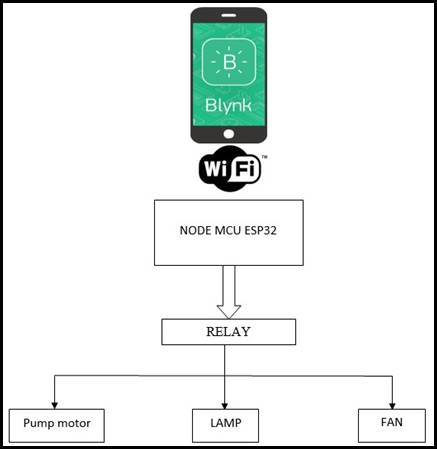
Figure 3.4.1: Wi-Fi Controlled Home Automation System
(Source:
www.researchgate.net, 2021)
The
above snippet shows a clear representation of a simple home automation system
using wireless technology such as a Wi-Fi communication system. Wireless
communication technologies play a pivotal role in properly managing all
IoT-based devices, such as in the above-mentioned snip it is seen that a android based device has been connected to the internet
through the NODE MCU ESP32 module and that the Wi-Fi communication
module effectively relays the commands to the connected IoT devices placed on
the same network such as pump, lamp, and fan.
Wireframes
and Prototypes
The
effective development of wireframes and prototypes is highly dependent on
user-centered design ideas. Wireframes and prototypes are intended to improve
the user experience in the working prototype of the application for IoT devices
(Philip et al. 2021). The interface
is crucial to the application's usability since it ensures that the interface
of the application is simple and easy to use, and it is needed to make sure
that real-world users can use this application with no interface issues.
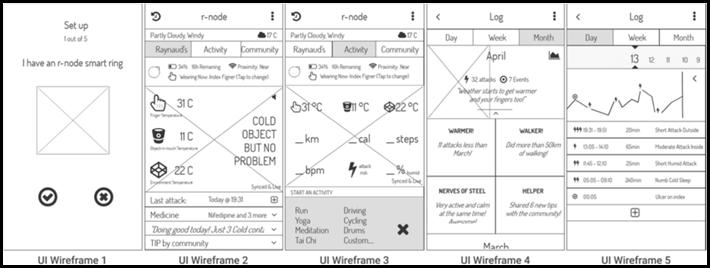
Figure 3.4.2: Wireframe and Prototype of a IoT Application
(Source: www.researchgate.net, 2021)
The
above snippet shows a wireframe and prototype design of an IoT-based
application in action. Wireframes and prototypes significantly state the
initial stage of developing a successful working application on the go. This
stage is very vital for the application developers because in this stage, the
developers get a clear idea about the entire application design from the home
page to the various features.
Wi-Fi
Controller Systems
The
NodeMCU Wi-Fi controller system board becomes a key
element, facilitating communication over the air for the IoT devices. More than
just a microcontroller, it coordinates information flow between the host
application and a wide variety of Internet of Things gadgets. Because of its
versatility, it can serve as the brains of the Internet of Things (IoT)
ecosystem.
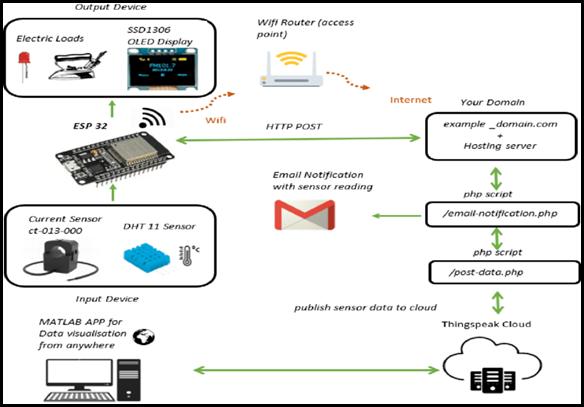
Figure 3.4.3: NodeMCU Wi-Fi Controller Board
(Source: www.researchgate.net, 2021)
The
above snippet clearly shows the NodeMCU Wi-Fi
controller board in action, seamlessly managing all the IoT-based devices
effectively and efficiently at the same time. In order to make the IoT-based
system successful, there is a need for a powerful internet connection always to
build a successful connection between every single IoT-based device in the
network.
Backend
API System
The
complexities of backend development are highlighted, stressing the need to
carefully choose the appropriate technology. The backend system is the system's
brain, and using the right application programming interfaces (APIs) allows for
smooth communication between the app and different kinds of IoT gadgets. The
application's responsiveness and efficiency depend on this complex network of
connections (Sasikala et al. 2022).
The Android application is entirely based and developed with the help of
Android Studio to meet all the recent advanced technologies and requirements of
this particular application.
Data
Monitoring System
Controlling
and monitoring the application data in real-time is essential to the Internet
of Things. These features are not inbuilt features of the application but these
features ensure that how the application works. The real-time features of the
program provide customers with a greater feeling of mastery over the IoT
environment, whether the real-world users setting the thermostat, reviewing
security cameras, or controlling smart appliances. This app is a cross-platform
application and this particular project work uses Android Studio for the
Android app development cause Android Studio is so efficient in designing and
developing such applications on the go.
Cross-Platform
Functionality
The
fact that it works on both iOS and Android ensures the app's great
accessibility power in real-world IoT device management. The application can
run on several platforms means that the application can be used effectively and
efficiently by the widest possible audience, regardless of the kind of device
they like to use (Sasikala et al.
2022).
Security
Measures
Due
to the sensitive nature of the data being sent between devices, security is of
the utmost importance in IoT applications. Evaluation and implementation of
effective security measures are given considerable weight in our technique.
Protocols for encrypted data transmission and authentication systems fall under
this category.
Integration
and Deployment
Our
approach includes continuous integration and deployment practices into the
iterative nature of the development process. In order to do this, it is
necessary to merge code changes regularly, run automated tests, and deliver
updates without any interruptions. By ensuring the application's stability via
continuous integration, continuous deployment speeds up the rollout of updates
and patches (Philip et al. 2021).
Using an agile methodology, the app can adapt to the changing requirements of
its users and the rapid pace of technological development.
Feedback
Integration
User
feedback is not a one-time input but a continuous interaction. Through the
utilization of a feedback loop, the technique incorporates user input at every
stage of the design and development process. The application naturally develops
in response to user preferences and developing trends thanks to iterative
enhancements informed by user input from the earliest phases of wireframes up
to the final deployment.
3.5 Ethical Consideration
Protection
of user confidentiality and informed consent are two important ethical issues
for this particular study. Data privacy and security must be top priorities
whenever personal information is being gathered or used in any context,
particularly when it comes to home automation and security systems.
Participants must be kept in the loop about the study's goals and possible
outcomes. The safety and security of the app's users should be a top priority
throughout development and testing, with consideration given to any
vulnerabilities present in the IoT devices. Throughout the study, the
developers must act ethically by supporting truthfulness, integrity, and proper
use of technology. After a period of theoretical exploration, this study shifts
its attention to the construction of a usable interface. Wireframes and
prototypes bridge the conception gap by helping to visualize the structure,
functionality, and user interactions of the mobile app. In this stage, the
interface is refined so that it not only looks good but also functions as the
designer intends and as the user anticipates. Testing the usability of the
interface in real-world settings becomes an essential step in the process.
Qualitative data is obtained via user interactions with wireframes and prototypes,
allowing for iterative refinement and improvement of the user experience. This
procedure guarantees that the finished interface is not only aesthetically
pleasing but also user-friendly, satisfying the requirements of the intended
users.
3.6 Summary
This
study's methodology takes a holistic strategy to fulfill the study's aims.
Firstly, a detailed examination of wireless communication technologies such as
Bluetooth, Wi-Fi, and Zigbee is undertaken to assess their capabilities and
influence on IoT performance. This is used as a guideline for deciding which
treatments are best. The research takes a user-centered user-centered
approach to design by creating wireframes, and prototypes, and doing usability
testing to create a successful mobile app. Central to this setup is the NodeMCU Wi-Fi controller board, which allows for wireless
connection to various Internet of Things gadgets. Backend development includes
picking the right tech and putting in place the right APIs to make sure
everything is talking to each other without a hitch. Real-time data monitoring,
remote access management, and device recognition functions are built into the
mobile app for both iOS and Android platforms. User interviews and extensive
scenario testing help hone the app for maximum convenience. Principles of
openness, honesty, and responsible technology usage are reflected in the
research's attention to safeguarding users' personal information and obtaining
their permission before using their data in any way. In the ever-changing world
of Internet of Things (IoT)-based home automation systems, this technique seeks
to offer a solid basis for developing a user-friendly smartphone app.
Chapter 4: Results and Analysis
4.1 Introduction
The IoT-based smartphone application for remote monitoring and administration of Internet of Things (IoT) devices has been developed thanks to the research and development detailed in the preceding chapters. The program uses the Raspberry Pie Wi-Fi controller and board as its nerve center, allowing for the seamless combination of many wireless communication protocols such as Bluetooth, ZigBee, Wi-Fi networks, and GSM modules. In order to fill the voids in the existing smart home systems, this project's major objective is to improve the usability and effectiveness of IoT administration interfaces significantly. Wireframes, prototypes, and usability testing are all part of the process to guarantee a satisfying end result for the target user. Backend technology is carefully chosen and important APIs are used in the mobile app's architecture to ensure smooth communication between IoT devices with the help of the Google Firebase Database Management System on the go. The application is currently developed for the Android operating system to control home automation gadgets efficiently, and it has real-time data monitoring, remote access management, and device identification.
4.2 Android Studio as Development Environment
The IoT-based home automation mobile app is built using Android Studio, the official integrated development environment (IDE) for Android application development. Android Studio simplifies the process of creating Android applications by providing a full suite of tools for their creation and testing (Sulistyo et al. 2022). Java is the major programming language that is used throughout the development of the app. Java is a popular choice for building Android apps because of its flexibility, portability, and stability. Because of its object-oriented design and robust community, it is often used to create reliable, high-performance Android apps.
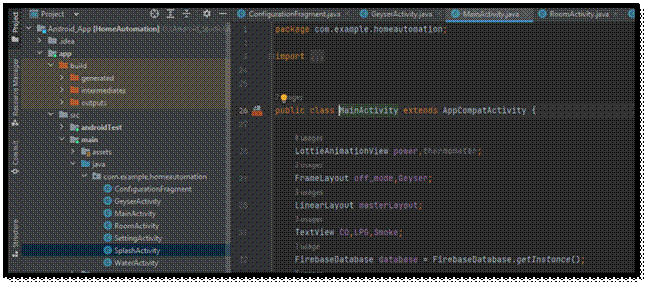
Figure 4.2.1: Development Environment
(Source: Acquired from Android Studio)
The Android Software Development Kit (SDK) contains all the code libraries and compilers needed to create Android apps. It's got the Android API, emulator, and debugging tools you need, and it plays well with Android Studio. In order to improve real-time data synchronization and storage, the Firebase mobile and web application development platform is included. It helped the IoT-based home automation system's dynamic operation by providing capabilities including a real-time database and authentication services. The Android Wi-Fi API is crucial in allowing for data transfer across wireless networks. It made it easier to include Wi-Fi-based features, allowing for the remote monitoring and administration of Internet of Things devices.
4.3 Wireless Communication Protocols Impact on the Application
Comparing three different wireless protocols Bluetooth, Wi-Fi, and Zigbee showed that each had a different effect on the efficiency of Internet of Things (IoT) gadgets in the house. The research dug into the compatibility, benefits, and security measures connected with each protocol, offering essential insights for optimal IoT adoption. Bluetooth evolved as a flexible solution, appropriate for short-range communication, allowing smooth connection for devices like sensors. Wi-Fi's fast throughput and extensive range made it ideal for data-intensive tasks like real-time monitoring. Zigbee, because to its low power requirements, has proven useful for effective communication between Internet of Things devices.
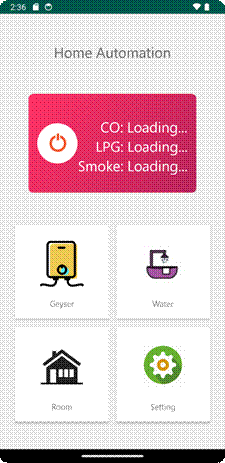
Figure 4.3.1: Wireless Communication in IoT Devices
(Source: Acquired from Android Studio)
The results highlight the need to gain a nuanced comprehension of these wireless protocols so that choices can be made with full knowledge of the many use cases, security needs, and IoT device functionality involved in home automation. In order to manage and control IoT devices with ease, nothing beats the rich software architecture provided by Android, which includes APIs for everything from Bluetooth to Wi-Fi.
4.4 Model View Controller Architecture
The Model-View-Controller (MVC) architecture, a common framework for developing extensible and easily maintained programs, is used in the development of the mobile app. The Controller oversees how the Model and View communicate with one another, while the View is responsible for presenting information to the user. The development process may be broken down into manageable modules because of this clear demarcation (Zhao et al. 2019). The Model includes the logic for interacting with IoT devices and processing data, providing a solid basis for the app's features. The View emphasizes providing a user-friendly interface by using wireframes and prototypes. The Controller coordinates the exchange of information between the Model and the View and processes user input. The MVC framework improves code reusability, lessens maintenance burdens, and facilitates expansion. This structural design decision helps the application's flexibility, making it well-suited for the dynamic needs of IoT device management and real-time data monitoring.
4.5 User-Centric Design Enhancements
In-depth wireframing, which maps out the app's architecture and user flow, is the first step in the UI design process. The next step is prototyping, which serves as a physical model of the app's user interface and core features. The UI is significantly shaped by user-centric design concepts, guaranteeing an easy-to-use and pleasurable interface. Visual details are meticulously planned for cohesion and aesthetic appeal. The design of the app emphasizes the user experience, so it is easy to navigate and understand.
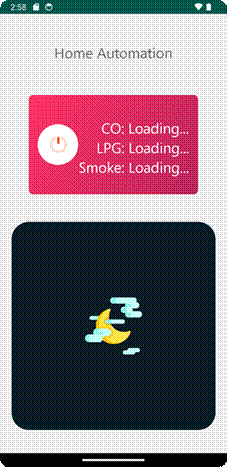
Figure 4.5.1: User-Centric Design Enhancements
(Source: Acquired from Android Studio)
Prototypes are tested with real users, and the valuable input is used to inform further iterations of the design. The aesthetic appeal and practical clarity of the design are the driving forces behind the color palette and iconography. The positioning of the various interactive features is carefully planned to maximize usability for the widest possible audience. Moreover, the UI not only meets the demands of a wide range of users but also improves the experience for everyone by making it easier to use and more interesting to interact with.
4.6 Backend Infrastructure Robustness
Firebase is a crucial part of the mobile application s backend development because of its ability to synchronize and store data in real-time. Users may get real-time information from effective IoT devices with the help of Firebase's real-time database, which allows for rapid changes. Moreover, Firebase Authentication services are included for safe user authentication, and boosting the system's security in real-time. APIs are developed specifically to allow for interaction between the mobile app and Internet of Things gadgets on the go.
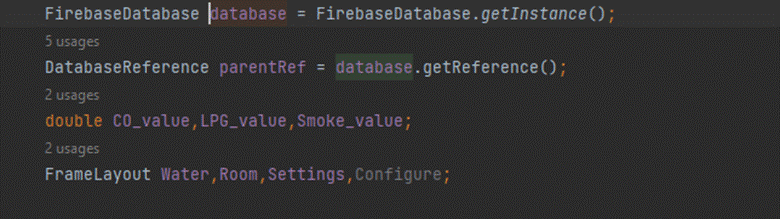
Figure 4.6.1: Backend Infrastructure Robustness Using Firebase
(Source: Acquired from Android Studio)
Connectivity to Bluetooth-enabled IoT devices is made possible by the Android Bluetooth API, while connectivity to Wi-Fi-enabled devices is made possible by the Android Wi-Fi API. The APIs function as key bridges, transforming user instructions from the mobile app into actionable signals for the IoT devices, guaranteeing efficient and dependable two-way communication. The capacity of the application to handle and monitor IoT devices is in large part due to the solid backend architecture made possible by the use of Firebase and the smart deployment of APIs.
4.7 Improved Application Security
Protecting the authenticity and privacy of data sent between the mobile app and the IoT devices was a top priority. The implementation made use of stringent encryption standards, with all data sent between the app and devices encrypted using common techniques in the industry. Firebase Authentication services were used to provide stringent procedures for verifying user identities before granting them access.
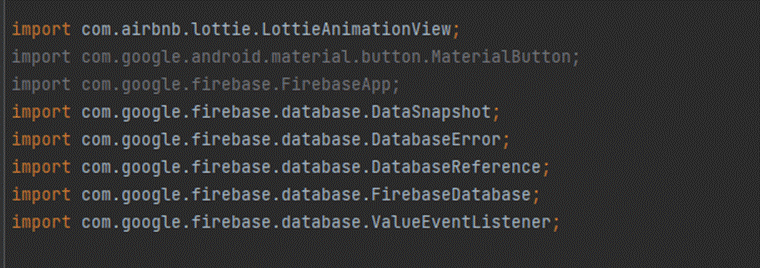
Figure 4.7.1: Improved Security Through Google Firebase
(Source: Acquired from Android Studio)
Also, access control mechanisms were introduced, guaranteeing that only authorized individuals could change or access data from the IoT devices. To reduce the possibility of hacking, the mobile app used token-based authentication. To further fortify the system, regular security audits, and upgrades were implemented to patch any discovered flaws.
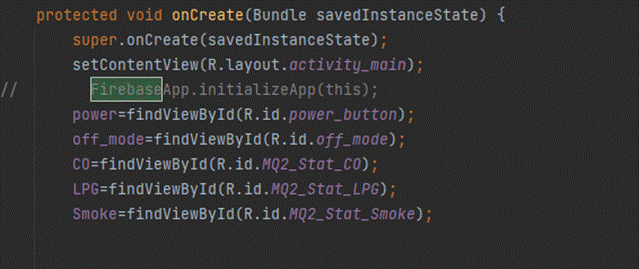
Figure 4.7.2: Initializing Google Firebase
(Source: Acquired from Android Studio)
Protecting user information and providing a risk-free setting for remote monitoring and administration of IoT devices were the primary goals of the security measures, which were implemented by giving top priority to encryption, authentication, and access control.
4.8 Effective Application Testing Process
The Internet of Things home automation software was put through extensive testing to guarantee its performance and durability. Integration testing evaluated how well separate modules worked together, whereas unit testing validated the validity of individual components. Real-time data monitoring, remote access control, and device identification are just a few of the features that have been tested extensively to ensure their reliability in the app. Different devices, network speeds, and data loads were used in various scenarios to ensure the app performed well under a wide range of settings. Both Android and iOS compatibility were tested using emulators and actual devices. The stress testing was performed on the mobile app to see how it would perform under extreme conditions. User acceptability testing involves actual users, obtaining input to optimize the app's usability and responsiveness. This kind of testing confirmed that the application was up to par in terms of functionality, safety, and user experience, making it a solid option for managing IoT gadgets.
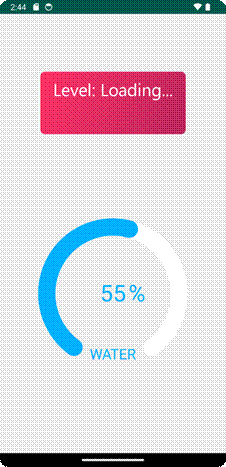
Figure 4.8.1: Checking the Water Level
(Source: Acquired from Android Studio)
The above-mentioned snip shows a screen from the running Android application where the water level indication is seen on the mobile screen. The IoT application is properly connected to the water tanker of a particular house and the water tank works as an IoT device to properly sync with the application in the real world. Different water levels show the different water level percentages inside the app to make the user remember to fill up the water tank again.
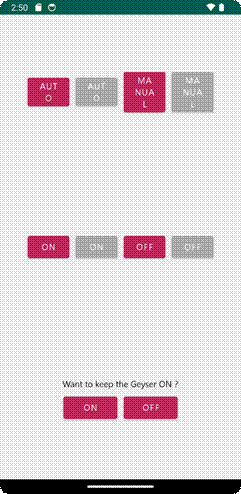
Figure 4.8.2: Checking Geyser Configurations
(Source: Acquired from Android Studio)
The above-mentioned snip clearly shows a screen from the IoT-based Android application where the target users can manage the geysers by using Android phones. This geyser section in the Android application gives the users some effective and useful options to use the geyser efficiently in real life such as setting the geyser mode from manual to auto, to save electricity consumption and make the geyser turn on and off with ease of the user s mobile phone.
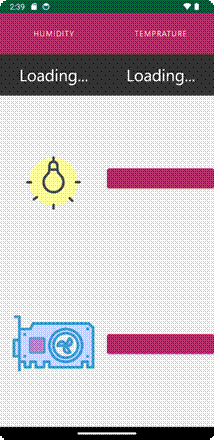
Figure 4.8.3: Controlling Light and Fan with Temperature Control
(Source: Acquired from Android Studio)
The above snip shows a screen from the Android application to present another app feature that controls the light and fan of a particular room with the help of this Android application on the go. The user can turn on and off the light and fan effectively from this particular application and can also control the humidity and temperature of the room efficiently if connected to an IoT-enabled light and fan respectively.
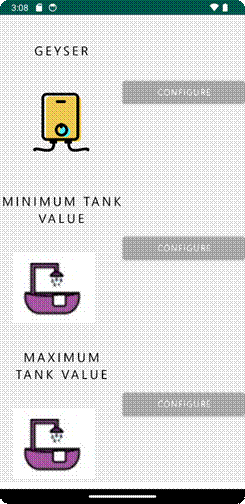
Figure 4.8.4: Configuration Page of the Application
(Source: Acquired from Android Studio)
The above snippet shows the settings page of the Android application to effectively maintain all the IoT-based connected appliances in the house. The user can configure anything in the application such as changing the geyser configuration, changing the minimum and maximum tank value of the watering system, and controlling the brightness of the light and speed of the fan entirely through the Android Application.
4.9 Getting User Feedback
Getting user feedback is a really important step in order to make this application for a mass audience. During the testing rounds, user input is crucial in helping improve the program, and the usability, interface intuitiveness, and overall user experience of the app are all evaluated via user acceptability testing. Users share valuable feedback and thoughts on various aspects, revealing insight into the preferences and problematic spots, such as remote access control and real-time monitoring. The data from this survey is thoroughly analyzed to inform the development of the next edition of the software. Changes to the user interface are motivated by feedback from existing users, leading to an increase in readability and ease of use. Updates are released quickly to fix the user-reported technical concerns, making the overall experience more stable and responsive. The app was able to be fine-tuned to meet the ever-changing requirements of its users by staying in close contact with the user base. Valuable feedback and thoughts can make a more polished and approachable Internet of Things (IoT)-based home automation software in the iterative development process that was informed by input from actual users.
4.10 Summary
The
development of an Internet of Things (IoT) based smartphone application for
remote IoT device administration and monitoring is a significant step toward
bettering smart home systems. Developed for the Android operating system, the
application leverages the capabilities of the Raspberry Pi Wi-Fi controller
to enable the smooth integration of various wireless communication protocols.
The hardware, testing techniques, application architecture, development
environment, user interface design, and backend development have been all
covered in detail in this chapter along with other important project
components. A solid backend architecture, careful planning, extensive testing,
and a rigorous development process enable the IoT-based smartphone application to
accomplish its goals. User-friendly design, and emphasis on efficiency,
security, and dependability, Internet of Things (IoT) devices in smart homes
can be remotely managed for hardware robustness and software integration.
Chapter 5: Conclusion
5.1 Conclusion
The Internet of Things (IoT) devices in this modern generation have impacted all over the world. A mobile app application has been developed in this paper using Android Studio software to remote monitor and control wireless communication protocols. It is a difficult procedure that requires careful consideration of many elements, from demand formulation to deployment and maintenance, to design and construct a mobile application for the Internet of Things (IoT) device. The Internet of Things devices require the appropriate wireless communication protocols and various devices require different protocols. This decision has a big impact on the overall architecture of the system. A three-tier architecture made up of a server, a mobile app, and Internet of Things devices has been used for a scalable and adaptable design.
The success of the program is significantly influenced by the design of the user interface (UI) in this project. It has been designed in a simple way for users to embrace an interface to use and be intuitive. Proactive alerting, real-time monitoring, and effective device control enhance the user experience. Interoperability across a range of screens and devices has been ensured by responsive design. A few of the factors that affect the frameworks and languages have been used to create mobile app developer experience, cross-platform compatibility, and speed of development. Android Studio has helped to integrate these protocols into the development process as Android Studio has integration features. One of the most important parts of the project is developing firmware for Internet of Things devices.
It is essential to ensure its success as it has allowed for efficient communication with the server. Due to Android Studio's flexibility, device-specific features that are required for control and monitoring have been included. It has been assured that the application works with a range of Internet of Things devices. Comprehensive system, integration, and unit testing have been conducted throughout the testing phase in order to identify and address issues at various stages. The emulators and real device testing capabilities of Android Studio s debugging and testing tools have played a major role in ensuring the application's dependability and stability. The app s release on well-known app stores has signaled its transition to a useful tool, and Android Studio has made it easier for the Google Play Store to finish the publication process.
The Android Studio software has been used to create the mobile application for controlling and monitoring Internet of Things devices remotely. The collaboration of technology, user-centric design and strategic decision-making have been demonstrated by this project. The development environment of Android Studio has enhanced the project s scalability, dependability, and efficiency. The culmination of all the efforts to simplify and secure remote communication between users and IoT devices in the app has been prepared for release. It is easier to create visually stunning and intuitive user interfaces with Android Studio layout editor and preview features. It has been determined that the application can comply with the pertinent privacy and data protection requirements. Compliance with the following laws and regulations is necessary for this application.
The latest version of Android Studio has been used which simplifies the implementation of compliance measures. The application has carefully integrated channels for user support and feedback to guarantee ongoing user satisfaction. Security is starting to become an issue with remote control and monitoring. The implementation of robust security measures, such as secure authentication procedures and encrypted communication channels, is the main goal of this project. The protection of user data and device communications against potential threats has been ensured by the help of Android Studio provided in adopting secure practices. This mobile application has been developed that successfully monitors and controls Internet of Thing devices with wireless communication protocols. The integration of this project into the larger Internet of Things ecosystem has also been examined in order to assess the success of the project.
A comprehensive assessment of Android Studio s capability to remotely watch over and manage Internet of Things devices is necessary for this project. The achievements of this study show how technology, strategic decision-making, and user-centric design can work together. Updates and support have been provided long after the initial deployment in order for it to be successful. Frequent updates that incorporate user feedback, add new features, and guarantee compatibility with emerging technologies are what keep the project moving forward.
5.2 Linking with Objectives
This project has targeted to fulfill all the objectives with concern and at last, the project successfully meets all the objectives. The main goal of this project is to determine the compatibility, advantages, and security measures of wireless communication protocols. Security has become a major issue with remote control and monitoring. The protection of user data and device communications against potential threats has been ensured by the help of Android Studio provided in adopting secure practices. The latest version of Android Studio has been used which simplifies the implementation of compliance measures. The second objective has been fulfilled by developing a suitable mobile application.
The third objective has been covered in the methodology section which has mentioned the efficiency of the development of the backend. Backend development is an important part of the entire app development method. The Raspberry Pi Wi-Fi controller system board is a crucial component that makes wireless communication between Internet of Things devices possible. It can coordinate data flow between the host application and various Internet of Things devices, it is more than just a microcontroller. The Android application has been completely designed and developed with Android Studio s assistance to meet all requirements for this specific application and the newest, most advanced technologies.
Users can monitor security cameras, operating smart appliances, and more efficiently adjust the thermostat with the program's real-time features, giving them greater control over the Internet of Things (IoT) . This software has been made with Android Studio , a great mobile tool for designing and developing cross-platform applications. This has been illustrated in the method part of the methodology chapter by covering the fourth objective. The final objective of this study is related to the data collection method which has been covered in the data collection point of the methodology chapter. The quantitative data has been used in this project to develop and design the mobile application monitoring and controlling IOT devices.
5.3 Recommendation
The project can be improved by adding some extra-developed features and enhancing some points that are related to this project. The recommendations of the project place a strong emphasis on an adaptable and user-centric approach. The persistent prosperity and significance of the mobile application for remote monitoring and control of IoT devices, created with Android Studio. This application has been credited to ongoing enhancements, vigilant security measures, incorporation of cutting-edge technologies, and an emphasis on sustainability.
The user can be encouraged to offer feedback regarding the application. It has to be ensured that user feedback can be submitted on the app and other platforms. Some suggestions can be granted for iteratively developed improvements into consideration and the use of user feedback to address issues. Iterative development allows the application to stay true to user expectations while adapting to changing needs. The application has to be updated often to make it more wireless communication protocol compatible and to make it work with a wider variety of IoT devices. The application needs to be sufficiently flexible to accommodate new gadgets and protocols as the IoT landscape shifts to stay relevant and expand its user base.
A robust security posture is a result of regular software updates, security audits, and conformity to the most recent encryption standards. The security features need to be developed to protect user data better. The most recent security best practices and address vulnerabilities can be adhered to as soon as these features are found. It is mandatory to think about how incorporating predictive analytics can enhance the functionality of the application and predict user behavior. Predictive maintenance for Internet of Things devices is one automation feature that can increase user convenience. The program is able to foresee user needs and take proactive steps to address them as sophisticated algorithms that forecast potential user needs. The application requires analyzing the ways in which features of augmented reality (AR) can be combined to enhance user experience.
Augmented reality , can give users a more interesting and intuitive interface for controlling and keeping an eye on Internet of Things devices. Augmented reality (AR) can be utilized by users to perform actions in their real environment or to see the status of their devices. The application feels more futuristic and increases user engagement by doing this. The offline capabilities of this application can be enhanced to ensure that users can still access essential features in scenarios with minimal or no connectivity. This technique can reduce latency and boost application performance when constraints on network bandwidth are present. The information about upcoming devices, firmware updates, and industry standards can be monitored by keeping in close contact with manufacturers. These alliances can benefit all parties and create an ecosystem that supports the application and the devices it supports.
Accessibility features can be prioritized in order to guarantee that users of all abilities can use the application. Some features can be added such as text-to-speech, voice-guided navigation, and screen reader compatibility. Accessibility expands the user base while upholding inclusive and moral design principles.
5.4 Future Work
A mobile application has been designed and developed using Android Studio software to monitor and control IOT devices with wireless communication. Technology continues to evolve and the user shifts to the updated devices and technologies. There are many opportunities to work further with this project to enhance the application. The new functions can take sustained success and take the new position of the application (Liu et al. 2020). The fusing edge computing and fog concepts can be developed. This entails performing local network analysis which is data analysis performed closer to Internet of Things devices. The architectures can be used to lower latency, improve real-time performance, and increase overall application efficiency. The benefit of the 5G connectivity can be utilized to change the application as it has increased bandwidth and lower latency.
This technology can boost the transfer rate and enable quicker and more responsive communication between Internet of Things devices and mobile apps. Predictions can be made with state-of-the-art artificial intelligence (AI) algorithms based on historical data and user behavior. The machine learning models can be utilized to predict user preferences, automate time-consuming tasks, and improve user experience (Al-Hawawreh and Sitnikova, 2020). Predictive analytics powered by AI has the potential to enhance the effectiveness and personalization of interactions with Internet of Things devices. The augmented reality (AR) feature integration of the application can be enhanced as future work. Users can find using Internet of Things (IoT) devices more natural when users can see sensor data superimposed on top of their actual surroundings through augmented reality (AR) .
The using blockchain technology can be used to bolster security and verify the legitimacy of the system. Blockchain technology preserves transaction history in a decentralized, unhackable ledger, increasing users trust in the application s security and ensuring data integrity. Modern features of natural language processing (NLP) can be included in spoken instructions. The voice control features of the application need to be improved so that users can converse naturally with IoT devices. This feature contributes to the trend of more interactive technology interactions. It has to be targeted that this application can make money with popular smart home ecosystems and platforms (Laghari et al. 2021). The interoperability can be promoted and the utility of the application can be increased by assisting users in managing their Internet of Things devices through voice-activated assistants and centralized platforms. It has to be verified that the application seamlessly interacts with these ecosystems. The user-focused research has to be continued to gain more insight into the evolving needs and desires of users.
References
Journals
Abdulla,
A.I., Abdulraheem, A.S., Salih, A.A., Sadeeq, M.A., Ahmed, A.J., Ferzor, B.M., Sardar, O.S. and Mohammed, S.I., 2020. Internet
of things and smart home security. Technol. Rep. Kansai Univ, 62(5),
pp.2465-2476.
Ahsan,
M., Based, M.A., Haider, J. and Rodrigues, E.M., 2021. Smart monitoring and
controlling of appliances using LoRa based IoT system. Designs, 5(1), p.17.
Al-Hawawreh, M. and Sitnikova, E., 2020. Developing a security testbed for industrial internet of things. IEEE Internet of Things Journal, 8(7), pp.5558-5573.
Azad, K.M.S., Hossain, N., Samia, N.A.,
Islam, M.J., Hossain, A. and Kabir, S., 2021, July. A Cost-Effective Internet
of Things Based Smart Home System for Upcoming Technologies. In 2021 International Conference on Automation,
Control and Mechatronics for Industry 4.0 (ACMI) (pp. 1-5). IEEE.
Boursianis, A.D., Papadopoulou, M.S.,
Diamantoulakis, P., Liopa-Tsakalidi,
A., Barouchas, P., Salahas,
G., Karagiannidis, G., Wan, S. and Goudos, S.K.,
2022. Internet of things (IoT) and agricultural unmanned aerial vehicles (UAVs)
in smart farming: A comprehensive review. Internet of Things, 18, p.100187.
Hassija, V., Chamola,
V., Saxena, V., Jain, D., Goyal, P. and Sikdar, B., 2019. A survey on IoT
security: application areas, security threats, and solution architectures. IEEE Access, 7, pp.82721-82743.
Huang,
X., 2020. Intelligent remote monitoring and manufacturing system of production
line based on industrial Internet of Things. Computer Communications, 150,
pp.421-428.
Iqbal, S., Sharif, Z., Shahid, M.A. and
Abbas, M.Z., 2021. Internet-of-Things based Smart Home Automation System using
Android Phone. Sir Syed University
Research Journal of Engineering & Technology (SSURJET), 11(2).
Iskandar, D., Pamungkas,
C.A., Puspitasari, N. and Fathoni,
M.A., 2022. Design and Build Internet of Things Smart Home For Android Based
Electronic Equipment Management System. Jurnal Sisfokom (Sistem Informasi dan Komputer), 11(1), pp.66-72.
Jabbar, W.A., Kian, T.K., Ramli, R.M., Zubir, S.N., Zamrizaman, N.S., Balfaqih, M., Shepelev, V. and Alharbi, S., 2019. Design
and fabrication of smart home with internet of things enabled automation
system. IEEE access, 7, pp.144059-144074.
Jaiswal,
S.P., Bhadoria, V.S., Agrawal, A. and Ahuja, H.,
2019. Internet of Things (IoT) for smart agriculture and farming in developing
nations. International Journal of Scientific & Technology Research, 8(12),
pp.1049-1056.
Khan, M.A., Ahmad, I., Nordin, A.N.,
Ahmed, A.E.S., Mewada, H., Daradkeh,
Y.I., Rasheed, S., Eldin, E.T. and Shafiq, M., 2022. Smart android based home
automation system using internet of things (IoT). Sustainability, 14(17),
p.10717.
Kim,
W.S., Lee, W.S. and Kim, Y.J., 2020. A review of the applications of the
internet of things (IoT) for agricultural automation. Journal of Biosystems
Engineering, 45, pp.385-400.
Laghari, A.A., Wu, K., Laghari, R.A., Ali, M. and Khan, A.A., 2021. A review and state of art of Internet of Things (IoT). Archives of Computational Methods in Engineering, pp.1-19.
Liu, X., Zhang, T., Hu, N., Zhang, P. and Zhang, Y., 2020. The method of Internet of Things access and network communication based on MQTT. Computer Communications, 153, pp.169-176.
Marques,
G., Pitarma, R., M. Garcia, N. and Pombo, N., 2019.
Internet of things architectures, technologies, applications, challenges, and
future directions for enhanced living environments and healthcare systems: a
review. Electronics, 8(10), p.1081.
Nebbione, G. and Calzarossa,
M.C., 2020. Security of IoT application layer protocols: Challenges and
findings. Future Internet, 12(3), p.55.
Philip,
N.Y., Rodrigues, J.J., Wang, H., Fong, S.J. and Chen, J., 2021. Internet of
Things for in-home health monitoring systems: Current advances, challenges and
future directions. IEEE Journal on Selected Areas in Communications, 39(2),
pp.300-310.
Rahaman, A., Islam, M.M., Islam, M.R.,
Sadi, M.S. and Nooruddin, S., 2019. Developing IoT Based Smart Health
Monitoring Systems: A Review. Rev. d'Intelligence Artif., 33(6), pp.435-440.
Ramson, S.J., Vishnu, S. and Shanmugam,
M., 2020, March. Applications of internet of things (iot) an
overview. In 2020 5th international
conference on devices, circuits and systems (ICDCS) (pp. 92-95). IEEE.
Salman, T. and Jain, R., 2019. A survey
of protocols and standards for internet of things. arXiv preprint arXiv:1903.11549.
Sasikala,
K., Sharanya, C., Jothilakshmi, G.R., Vijayalakshmi, A., Sahaai,
M.B. and Ganesh, E.N., 2022, May. Design and implementation of bio signal
platform using Internet of Things. In AIP Conference Proceedings (Vol. 2463,
No. 1). AIP Publishing.
Sulistyo, A.B., Sause, R.R.O., Pramanatha, I.N.A., Ariani, N.W.W.A. and Wijonarko, B., 2022. Android-Based Carriage Calculation Mobile Application Design using the Android Studio Ide (Integrated Development Environment). Jurnal Teknologi Transportasi dan Logistik, 3(2), pp.151-160.
Suma, D.V., 2021. Internet of Things
(IoT) based smart agriculture in India: An overview. Journal of IoT in Social, Mobile, Analytics, and Cloud, 3(1), pp.1-15.
Zhao, L., Wu, W. and Li, S., 2019. Design and implementation of an IoT-based indoor air quality detector with multiple communication interfaces. IEEE Internet of Things Journal, 6(6), pp.9621-9632.
Website
Medium
(2023) Internet Of Things (IoT) security, privacy,
applications & trends. Available
at:https://medium.com/@arindey/internet-of-things-iot-security-privacy-applications-trends-3708953c6200
[Accessed on 12th Nov 2023]
Educba (2023) IoT Communication Protocol.Available at:
https://www.educba.com/iot-communication-protocol/ [Accessed on 12th Nov 2023]
Stl.tech (2023) What is IoT (the
Internet of Things)? Available at: https://stl.tech/blog/what-are-the-applications-of-iot/ [Accessed on 12th Nov 2023]
Mdpi (2023) Smart Android Based
Home Automation System Using Internet of Things (IoT). Available at: https://www.mdpi.com/2071-1050/14/17/10717 [Accessed on 12th Nov 2023]
Pantechsolutions
(2021) Wi-fi Controlled Home Automation using NodeMCU
Available at:
https://www.pantechsolutions.net/wi-fi-controlled-home-automation-using-nodemcu[Accessed
on 12th Nov 2023]
Hindawi (2021) Network Protocols,
Schemes, and Mechanisms for Internet of Things (IoT): Features, Open
Challenges, and Trends Available at:
https://www.hindawi.com/journals/wcmc/2018/5349894/
Researchgate(2019) Wireframe and
Prototype of an IoT Application. Available at:
https://www.researchgate.net/figure/Low-fidelity-prototypes-wireframes-of-user-interfaces-of-the-smartphone-application_fig2_327274986[Accessed
on 12th Nov 2023]
Researchgate(2020)IOT BASED HOUSEHOLD
ELECTRICITY ENERGY MONITORING AND CONTROL. Available at:
https://www.researchgate.net/figure/Configuration-of-IOT-based-Household-Energy-Monitoring-and-Control-System_fig1_348235021[Accessed
on 12th Nov 2023]