DESIGNING
SUSTAINABLE CONSTRUCTION PROCESS TO REDUCE BEACH EROSION
Table of Contents
1.2 Motivations for the
Research
1.3 The Significance of the
Study
1.7 Expected Findings and
Applications
2.4 Impact of Coastal
Erosion on Environment
2.5 Human Causes of Coastal
Erosion
2.6 Different Methods in
Ensuring Coastal Development
2.7 Challenges Face in
Developing Methods Used In Reduction of Beach Erosion
2.8 Present methods used in
ensuring sustainable coastal development
2.9 Sustainable
Construction to Prevent Beach Erosion
3.4 Analysis on research
Design
Utilisation of
Instrumentation
Chapter 4: Analysis of
researched data
4.3.1 Theme 1: Development
of civil infrastructures and use of other artificial methods
4.3.2 Theme 2: Use of
natural resources
Chapter 5: Findings and
Conclusion
5.2 Motivation and
significance of the thesis
5.3 Findings and discussion
of the research question
5.4 The contributions of
this study
5.5 Future research and
limitations of the study
Chapter 1: Introduction
1.1 Introduction
Coastal erosion along with accretion are the natural
process however, they become widespread as well as anomalous in coastal zones.
This chapter is premised on providing the overall, idea regarding the entire
research such as the purpose of this research, expected outcomes, significance,
research design so that structure of this research can be established in an
effective manner.
1.2 Motivations for the Research
The coastal area is considered as a dynamic place and
its dynamism can create susceptible measure to changes and stresses in a
various way. As costal area interacts with sea, so it gives a great opening to
action of waves, wind, currents, tides which not only erode shore but also have
possibility to expand it with sedimentary deposits. Coastal erosion is removal
of beach and wearing a way of land or dune sediments. Therefore
coastal erosion can be assumed as large proportion in present days. Change in
global climate can be coupled with local attributes that is eroding world coast
in alarming proportions.
Maximum number of conventional protection methods is
short lived, hard, friendly and expensive. The trend of protection and
mitigation of coastal erosion has been changing towards novel, eco-friendly and
soft methods. Beach erosion rate is increasing in present days because of
Natural process and anthropogenic activities. Coastal erosion impact on various
arena such as loss of habitat, landscape and beach quality; loss of
infrastructure, building facilities like power lines, roads; increased water
turbidity, coral reef degradation because silt deposition; reduced tolerance to
acclimatize oneself with natural hazards; collapse tourism in area; frequent
flooding in lower land areas. To prevent all this implications, complete
sustainable plan is required and aim of this research study is to identify.
1.3 The Significance of the Study
Good
chunks of the costliness across the world are eroding severely and rates of coastal
erosion may differ with other countries. On that note, rate of coastal; erosion
in USA can vary from 0.3 m to 0.6 m per year and US East Coast barriers can get
the experience several coastal erosion during last 100
years. This study can help to evaluate different factors of coastal erosion and
its impact. In order to reduce coastal erosion, sustainable construction is
required to protect shorelines. Development of coastal area has enhanced to
protect from beach erosions. In this way, it can help to manage the coastal erosion
problems and reduce the coastal capacity. This study would help to analyze different challenges and provide recommendations to
overcome from this issue.
1.4 Research Question
Research Objective
●
To identify effective cause of
coastal erosion
●
To evaluate impact of coastal
erosion
●
To determine the limitations of current
protection and mitigation methods used in reduction of coastal erosion
●
To design sustainable construction process
in order to reduce coastal erosion addresses all the limitations present in
current method.
Research Question
1.
What are the effective causes of
coastal erosion?
2.
How coastal erosion impact on human
and environment?
3.
What are the limitations of current
protection and mitigation methods used in reduction of coastal erosion?
4.
What is new sustainable construction
process to reduce coastal erosion address all the limitations present in
current method?
Sub-question
What are the effective causes of
coastal erosion?
●
What is coastal erosion?
●
How many types of coastal erosion
present till date?
●
How coastal erosion takes place?
●
What are the limitations of current
protection and mitigation methods used in reduction of coastal erosion?
●
What is the
present construction methods used in reduction of coastal erosion?
●
Common challenges in developing
sustainable process to reduce the coastal erosion?
●
What is new sustainable construction
process to reduce coastal erosion address all the limitations present in
current method?
●
How to mitigate the coastal erosion
issue in the existing method?
●
How to design a new coastal erosion
mitigation process?
1.5 Research Design
For this research study research will consider
descriptive design which includes independent and dependent variable at a same
time. This process will help to control the variables during the research
process. Including this design will help the researcher to gather more
statistical data from the resources and interpret the research topic in an
advantageous way. As the research is considered with secondary research the
research will require more relevant data from secondary sources therefore this
research design will be taken for this research. This will help to gather rich
elements of the research study from the relevant sources. For this research
study research is going to select post positivism philosophy because it will
help in enabling the analytical knowledge of research on real life facts of
follows and research in a very logical way in order. For this research study
researcher will use deductive approach as it will provide greater concern in
developing hypothetical knowledge. As this research will require thematic
analysis therefore research needs to consider different theories for the
research study.
1.6 Theoretical Orientation
Coastal erosion can be defined sax several processes
of long terms removal of the sediment along with rocks at coastline that may
lead to loss of lands as well as retreat of coastline landwards. Coastal
erosion happens due to hydraulic action, impact, abrasion, corrosion by water,
wind, and natural. In this case, rocky structures are subjected to erosion of
coastline cause by rocks and sans stirrer up and carried within waves.
1.7 Expected Findings and Applications
Coastal environments make consistent
transitions therefore reshaping is a continuous process in coastal areas by the
natural forces of tides, erosion, storm surges and deposition. In order to make
it sustainable coastal development program requires a clear understanding of
following natural process such as
●
Serves developer and societal need.
●
This needs to provide good internal
functionality in respect to marine elements like lagoons and beaches.
●
This development plan needs to be a
part of an overall development plan for the selected area.
●
Development plan must aims to have very less impact on environment while operating
and construction.
●
This plan must utilize natural
conditions at the site instead of planning against nature.
●
The plan needs to be flexible enough
to adaptation allowance due to climate change consequences
1.8 Structure of the thesis

Figure
1.1: Structure of Thesis
(Source: Created by Learner)
1.9 Conclusion
This chapter was premised on describing entire
overview of research works including expected outcomes. In this case, the purpose
of this research and its appropriate research design helped to establish the
concept of coastal erosion from several secondary resources. On that note,
structure of these has been given to provide an idea about entire research work
so that learner can easily understand about the content.
Chapter 2: Literature Review
2.1 Introduction
Coastal
erosion is a global problem, which affects the sea and coastal line of many
countries. Coastal erosion happens for many reasons; it may be natural reason
or human reason. It also can be prevent by applying
the proper process. Impact of coastal erosion is dangerous; nature as well as
humans suffers this. Different method should be used to prevent beach erosion
and sustainable construction process should be used to reduce beach erosion.
New solution should be invented to prevent this erosion. Countries which are
near coastlines suffer more; they lose their physical properties like road,
house, and school. Countries like United States of America, India, England also
suffers this problem, and they also have found a solution to prevent this beach
erosion (Addo, 2018). Before this lots of people have researched about beach
erosion, but still there are gaps. Proper study should be done and new
technologies should be found out to save human beings, animals and nature.
2.2 Coastal Erosion
Coastal
erosion is sudden or ongoing process which happens on the shoreline. Bedrock or
sediment removes from the shoreline due to many reasons, which cause the loss
of coastal land (Addo and
Addo, 2016). Coastal erosion is mainly two types: rapid onset
hazard and slow onset hazard. In rapid onset hazard process coastal erosion
happens very quickly, a large amount of coastal land just vanish
under a day or under a week. The second type is slow onset hazard which is a
slow process. In this process nature loose coastal land over many years or
decade even sometimes over centuries. Beach erosion is a natural phenomenon
which can be happen by human activity or by natural reason. Beach erosion
removes sand from the beach and the beach becomes narrower. Beach erosion is a
great threat to mankind as well as to the nature. Specially countries like
United States have major issue about coastal erosion because coastal erosion is
a great threat to physical properties like road, house.
2.3 Causes of Coastal Erosion
Coastal
erosion happens mainly for two reasons:
Natural reason and human reason. There are many types of coastal erosion
by nature but main reason is wave. Sometimes wave is a great threat to coastal
land and stronger the wave, more damage it will do to the land. Coastal erosion also depends on sand or the
rock, if the rock has less resistance like clay, it will damage more. Granite
type rock which has more resistance power is safe for coastal land. Waves also carry rock, sand etc with it and
come in contact with coastal land, rock or sand. It makes a sand paper type
effect and it grinds away. Attrition is also a cause of beach erosion; it
happens when small rocks collide with each other and causes abrasion (Alves et al. 2015). Wind is another cause of beach erosion, it damages land along and sometimes it accelerate
the wave and cause beach erosion. Humans are also responsible for beach erosion
and are great threat to the nature and coastal land. Construction of jetties
and harbour, mining seawater is the main reason for beach erosion by human
being.
Natural process of coastal erosion
: High wind
and strong waves play a most important role in beach erosion at the time waves
breaks ground fragments and strike beaches, here sand blows the sand to wash
over and breaking of sand berg. Apart from this offshore loss at the time of
storm and extreme wave surge conditions. Some other natural reasons are loss of
sand canyons, reef collapse and beach rock, long term and seasonal variations
in climate and wind pattern, sea level changes, high floods and rainfall, due
to seismic activities seafloor changes which result long waves.
Anthropogenic
processes of coastal erosion: Mining in beach sand reduces volume of beach
sand, available for littoral process; Inland coral mining affects the
productive land conversion into waterlogged areas; river sand mining reduces
river sand supply to beaches; collection of corals form shore face and beaches
reduces beach material volume, dynamiting and reef breaking for coral mining
can damage the reef and create gap in reef, it increases wave energy and reduce
supply of debris to beaches; infrastructure installations and constructing
building near coastal area reduces coastal stability.
2.4 Impact of Coastal Erosion on Environment
●
Loss of habitat, landscape and beach
quality
●
Loss of infrastructure, building
facilities like power lines, roads
●
Increased water turbidity, coral
reef degradation because silt deposition
●
Reduced tolerance to acclimatize
oneself with natural hazards
●
Collapse tourism in area
●
Frequent flooding in lower land area
Coast can be
defined as land adjacent to sea. On that note, coast can be defined as a land
that drains to sea or the watersheds of the streams that drain to sea directly
in environmental context. In this case, beaches are affected by natural events
such as storms. According to Betzold and Mohamed (2017), coastal erosion is
responsible for the coastal property losses about $500 million every year that
include damages to structures along with losses of lands. In order to mitigate
the coastal erosion, federal government have spent average of $150 million in
every year for the beach nourishment along with shoreline erosion. More than
80,000 acres of the coastal wetlands are disappeared annually due to these
coastal erosions.
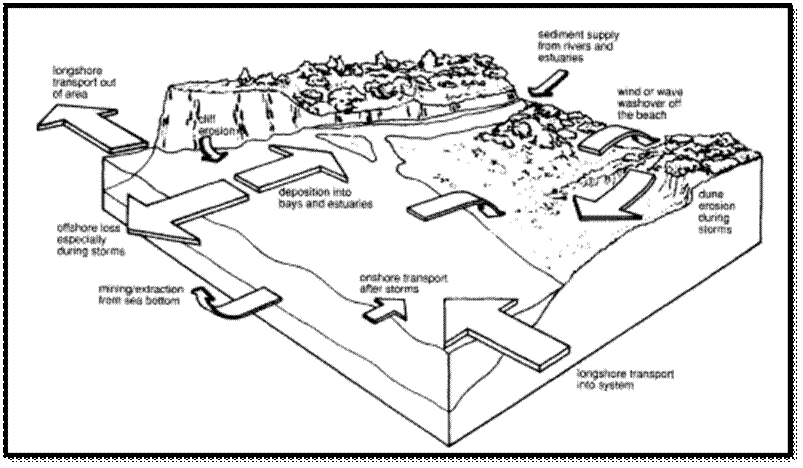
Figure 2.1: Impact on Environment
(Source:
Climate.gov, 2016)
On the other
hand, sea level rising would cause increasing number of coastal erosions. In
this case, heavy or hard structure can keep shoreline positions stable. Coastal
zone is depicted in this aforementioned image to describe important factor for
development of society so that issues and importance of applying solutions can
be understood through this analysis. Hence, international communication has
been originated in coastal fringes. In this case coastal zones are vulnerable
to create impacts on the nature, environment and human beings. Associated loss
and erosion of land is most evident signs of instability. Negative shorelines
trend causes the secondary effects that may affect society via threats to the
human settlements, wetlands, harbours, marshes, coastal recreation area.
According to Jonah et al. (2017),
those impacts can be the reasons of increasing the consequences of several
climate changes, rising sea levels.
2.5 Human Causes of Coastal Erosion
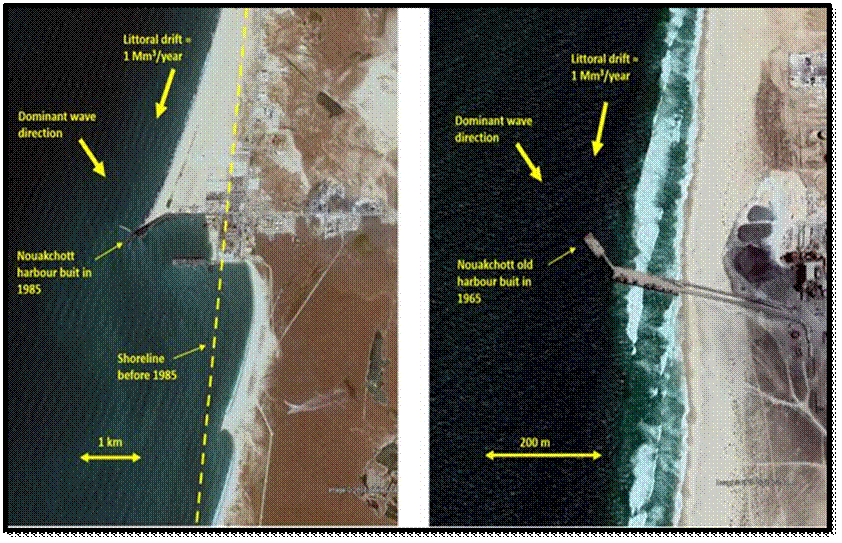
Figure 2.2: Port Blocks
(Source:
Climate.gov, 2016)
Groyne is built perpendicular to shoreline with purpose of
the protection section of shoreline by blocking part of littoral transports
whereby sands are accumulated on upstream sides of groyne.
However, sands trapping can cause deficit in littoral drift budgets along with
the types of coasts protection are associated with the corresponding erosion on
lee side of structure. According to Nguyen, Parnell and Cottrell (2017), port
on coast must be designed in such a way so that coastal impact and
sedimentation is minimal. Sedimentation occurs at harbour entrance in case of
sands bypasses require maintenance deposition of dredged sands. Harbour moles
of port can block littoral transport by the trapping sands at up-drift side
form of accumulating sands sheets.
2.6 Different Methods in Ensuring Coastal Development
Coasts are
the dynamic places along with its dynamism represent it susceptible. On that
note, storm system has energy from ocean along with natural coastal forces with
waves, rains and wind to damage erosive process. This coast is made vulnerable
top natural dynamic forces by the rising sea levels. This entire process is
accelerating due to increasing global warming. According to Obi et al. (2016), entire volume of the
water levels have stored in the glaciers along with
ice caps which is the reason of raising the ea levels
significantly. In this case, water of oceans would expand and push the seal
level higher.
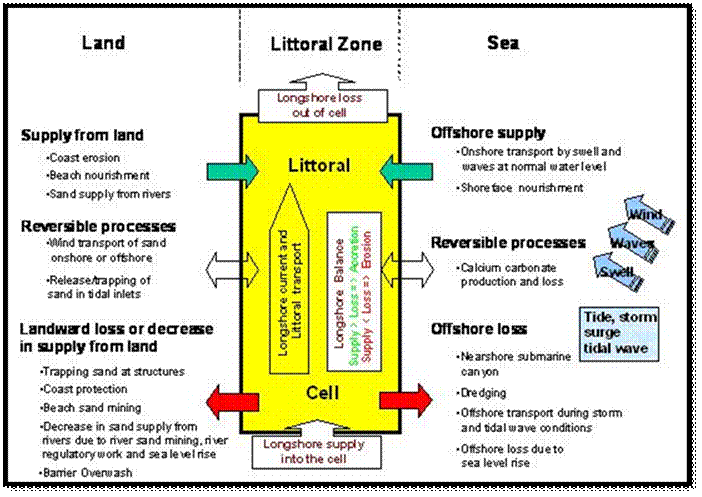
Figure 2.3: Sediment Overview
(Source:
Nguyen, Parnell and Cottrell, 2017)
On the other
hand, population growth, resort development along with land development is the
reasons of damaging the coastal areas which are recognized as a tourist spots.
In order to overcome those damages, government has taken few necessary steps so
that coastal area can be recoverable using advanced methods as well as
technologies. According to Palalane et al. (2016), protecting coastal
property is required because government of several countries have found that it
would a biggest threat to valuable asset and they are trying to adopt stabilize
it. In opinion of Pranzini, Wetzel and Williams
(2015), jetties, ripap, sea walls, along with
sandbags disrupt natural process of coast; exacerbate erosion as well as
habitat destruction. Disturbing, wetland habitats, increasing the impervious
surface, development in the coastal areas degrade ecosystems.
Sustainable Development
Sustainability is a concern that
has been impacting coastal regions since the early 20th century. Rise in
industrialization weight in coastal regions due to their accessible to oceanic
reasons has greatly impacted the environmental health of the regions.
Furthermore, resource exploitation is another one which is why suitable
development is a vital condition for coastal development. The sustainable
development method is intrinsically based on putting restrictions on the amount of oceanic resources uses per year by both private
and public institutions (Ritohardoyoet al. 2017). This can lead to a less exploitable and more
environmentally friendly operations regarding coastal resources.
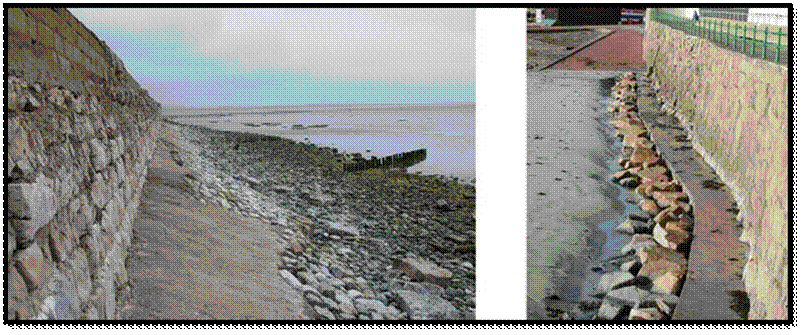
Figure 2.4: Sea Walls
(Source: Ritohardoyo et al.
2017)
Risk Assessment
The risk assessment method of
coastal development is one of the most effective ways for any nation in terms
of ensuring safety and protection from natural calamities. Since coastal
regions are vulnerable to tsunamis and other sea has occurred natural
disasters, it is vital that risk assessment is done in order to effectively
mitigate concerns regarding recovery from natural calamities. In addition, this
method can also help in mitigating risk relating to manmade concerns and
hazards.
2.7 Challenges Face in Developing Methods Used In Reduction of Beach Erosion
There are
different types of methods to prevent coastal erosion such as soft erosions,
monitoring methods and hard erosion method that are globally accepted. In this
case, other methods are non-traditional approaches and all those processes face
few difficulties during implementation. The major reason of facing problem is
emerging growth of the tourism development in the coastal area. People are
fascinating about sea beach and travel and tourism companies develop large
infrastructure to make attractive coastal area. Government of several countries
want to take necessary steps for preventing coastal erosion however, this
process cannot be implemented done because this can affect the burdens as well
as profits of those travel and tourism companies.
On the other
hand, coast is dynamic in nature so that implementing effective solutions
cannot be implemented. According to Yokoo and Udo (2016), reducing sand resale s by the coastal erosion can create an impact on
breach loss due to the large coastal structure. There is a risk of flooding
along with erosion due to the climate changes.
2.8 Present methods used in ensuring sustainable coastal development
There is three globally accepted
erosion control or prevention methods are as follows
1.
Soft erosion control methods:
According to Daron (2015), this strategy considers temporary options of slowing
the erosion effect. Beach replenishment technique is the most popular
techniques for defence management of coastal erosion. An argument raised on
this note by Masria, Iskandern
and Negm, (2015), this technique involves piling and importing beach sand on
top of the existing sand. Sand dune management is another technique used in
coastal erosion protection, it works using various
methods in order to prevent the sediment loss on coastal area.
2.
Monitoring method: this method
involves remote sensing, shoreline mapping, Historical mapping, video analysis,
aerial photographs, and beach profiling surveys. All of the following
attributes would help to gather relevant information of the beach and its
changing flow and monitor that later on.
3.
Hard erosion method: in accordance
with Masria et
al. (2015), this is basically a hard stabilization technique by
construction of groins, construction of sea walls, construction of revetments,
use of rock armour, construction of gabion, construction of offshore
breakwaters, cliff stabilization, construction of floodgates. These infrastructures and constructions
projects help to restrict the water flow towards human communities.
In this context Natale et al. (2017), has commented that, these techniques are presently
using by the Anthropology experts and construction experts. However, these
techniques are failed to control and reduce coastal erosion because of few
strong reasons which are responsible for limitations. New techniques are
expected to be evolved through effective measurements to prevent erosion and
develop a sustainable coastal area.
2.9 Sustainable Construction to Prevent Beach Erosion
Sustainable construction may involve few issues such
as management, design, construction technology along with processes so that a construction
can be implemented with long term monitoring and maintenance (Moore and Davis,
2015). In this case, costal area is the transitional area between seas along with
land that is characterized by high biodiversity. Sustainable coastal management
would require for integrating ecological along with economical productive
dimension of coast. Coastal structure has constructed perpendicular to coastline
from shoreline into sea for trapping long shore
sediments transports or controlling the long shore current.
Beach erosion can become biggest issues in nowadays.
These growing problems on coastlines expand around world. Shore is exposed and
elements such as waves, sea level changes, and current can play significant
roles in the causing erosion. Based on the solutions, erosion controlling mats,
breakwater tubes, geo-textiles, coconut fibre log, earth barriers wall is the
different solutions of sustainable constriction for prevent beach erosion.
According to Yokoo and Udo (2016), erosion controlling mats are
another option for protecting shorelines and it is designed growth of
vegetation by the stabilizing those particular area long fir plants, roots and
trees. In order to establish vegetation, mats are developed from natural fivers
such straw, wood fibres and biodegradable. Breakwater Tubes are used for
demanding, extending shoreline supports. After installing those tubes act like
layer of defence against the waves so that they can beak shore. Geotextile has
implemented using retaining walls, larger structures, and rip rap. On that
note, earth barriers wall can become stabilizer barriers for the coastal
restoration projects. In this case, coconut fibre logs are designed using
erosion controlling along the beaches.
2.10 Literature Gap
Researcher
has gathered essential, information from performing a survey from several
secondary resources related to the topic to acquire important factors which can
highlight the coastal erosions. From these journals, few of them contain causes
of coastal erosion with images so that reader can understand the effectiveness
of coastal erosion and its impact on human being and environment. On that note,
Addo (2018) has described different reasons of generating coastal erosion
whereas Alves et al. (2015) emphasises
on several impacts of coastal erosion on human beings, environments and nature.
According to Betzold and Mohamed (2017), Vegetate,
Marshes, Seagrasses, Vegetated Dunes, Harden, are various methods of
ensuring coast development whereas Kang and An (2018)
opined that Bulkheads, Seawalls,
Revetments, Breakwaters, Sills, Beach Nourishment are different methods of
coastal development. In opinion of Moore and Davis (2015), Groins, Breakwaters, Composite Systems are several approaches of
coastal development.
On the other
hand, this research paper would provide different factor and reasons of coastal
erosions after analyzing information from numerous
secondary resources. All those aforementioned resources have focused on specific
issues regarding coastal erosion however; this research paper would incorporate
every issue with detailed information and statistical data. Therefore, learner
can obtain a clear idea regarding this topic. On that note mote, researcher
would provide few specific recommendations on the basis of technology and
solutions that can be implemented in an effective manner.
Hydraulic
action is sheer power of waves and it can smash against cliff (Moore and Davis,
2015). In this case, air becomes trapped in cracks in rock along with it can
cause rocks to break apart. This is an essential type of coastal erosion
however; many journals have not enough information regarding this. According to
Yokoo and Udo (2016), author does not cover effective solutions of protecting
from coastal erosion whereas Zou (2018) has explained about erosion controlling mats, geo-textiles,
breakwater tubes which help to provide concentrate idea. Based on these
solutions, it can be understood that effective solutions can be implemented to
prevent coastal erosion.
2.11 Conceptual Framework
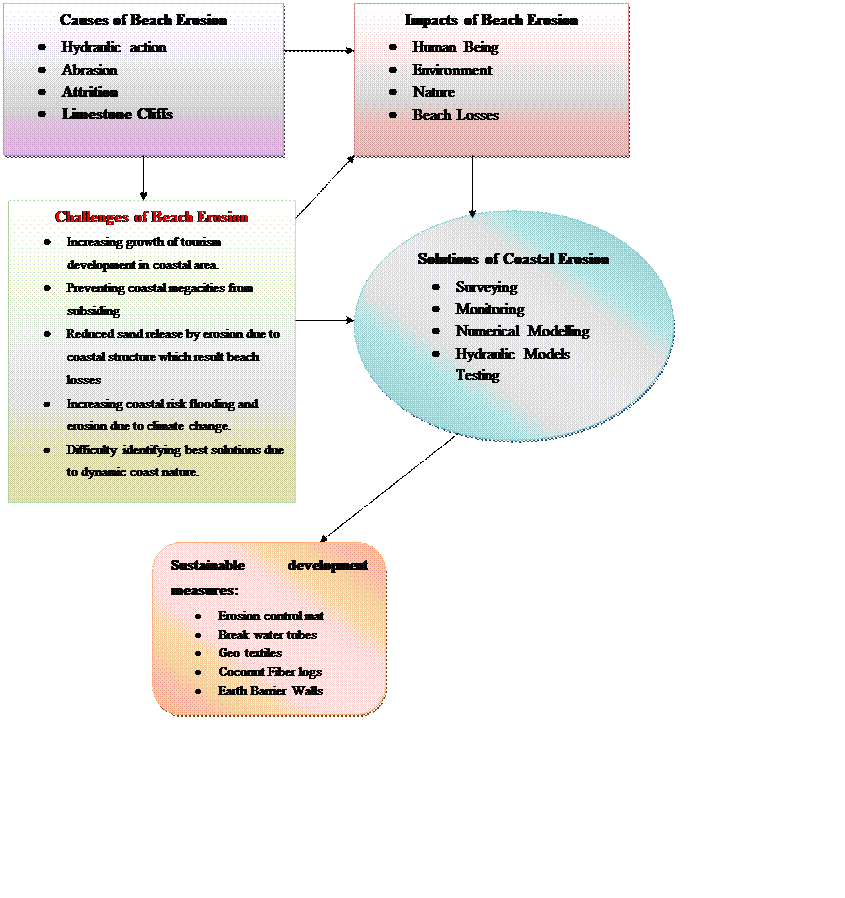
Figure 2.5: Conceptual Framework
(Source:
Created By Researcher)
This conceptual framework has
described different factors of coastal erosion so that leaner can understand
easily the effects, reasons, challenges, impact of coastal erosion due to human
being, environment and nature. Based on that, few solutions have been provided
to protect beach erosion in an effective manner. On that note, different
factors of sustainable development can be measured through few factors such as
earth barriers walls, coconut fiber logs and break
water tubes.
2.12 Conclusion
Erosion
is a process by which strong wave action, flooding, sea level rises, human
activities along with large storms such as nor easters, hurricane wear bluffs
and beaches along the coastlines. This chapter has shown several reasons of
generating coastal erosion and its impact towards human beings, environments.
After analysing several seconds sources, researcher has explained few globally
accept solution that can help to ensure coastal development.
2.13 Summary of References
|
Article |
Author |
Year |
Major Findings |
|
This article explained about different aspects of
the coastal erosion along with protection in Europe |
Pranzini, Wetzel and Williams |
2015 |
Aspects of coastal erosion |
|
This article
explained about ocean wave dynamics, coastal erosion, potential sediment
transports |
Addo |
2018 |
Highlighting concept regarding
ocean wave dynamics, coastal erosion, potential sediment transports |
|
This article explained about erosion management and
cliff instability |
Moore and Davis |
2015 |
erosion management and cliff instability |
|
This article
explained about coastal erosion perceptions and beach management |
Alveset
al. |
2015 |
coastal erosion perceptions and
beach management |
|
This article explained about coastal zones
management issues and challenges including coastal sediment mining |
Jonah et al. |
2017 |
coastal zones management issues and challenges including coastal
sediment mining |
|
This article
explained about development of the new coastal erosion countermeasures with
the help of wave energy controlling methods |
Kang and An |
2018 |
development of the new coastal
erosion countermeasures with the help of wave energy controlling methods |
Table 2.1: Summary of References
(Source:
Created By Researcher)
Chapter 3: Methodology
3.1 Overview on the research
The overview
of this research is associated with designing of sustainable construction In order to minimize the coastal erosion. In maintaining the
sustainable construction process, the reduction of beach erosion has to be
reduced. The coastal areas create susceptible measures in changing the
environment. It is considered as the dynamic process. The interaction process
always goes on with the sea and the coastal areas with the reference to tide,
waves, sedimentary deposits and other things. Coastal erosion has to be removed
from the beaches from preventing and draining away of the land and sand dune
like sediments. In the overview of the natural process and for managing
conventional protection, it is needed to keep in mind for the eco friendly and different other methods.
3.2 Research Hypothesis
H0: coastal
erosion impacts on nature and human
H1: the new
process of construction is helpful in reducing coastal erosion
3.3 Research Question
In research
question various questions can be raised on the basis of the sustainable
deposition in the coastal region.
●
How the erosion in the coastal areas
have impact in the human and environment both?
●
What is the impact of soil erosion
and what are the methods for the reduction of soil erosion?
●
How the new process of construction
aids in reducing coastal erosion?
●
What can be effective and
implemented causes in coastal region for erosion?
Subsection:
●
What is meant by coastal erosion?
●
What and how types of erosion are
there in the present day till date?
●
What is the effective reason for
coastal erosion?
●
What are the objectives and
limitations for the protection of the current situation as well as to mitigate
the process of soil erosion?
3.4 Analysis on research Design
Research philosophy
For this research, positivism
philosophy has been acknowledged in a precise manner. In the various settings
it has been introduced that the data collection and interpretation have to
serve the way in the positivist study (Kaplan 2017, p.31). With the positivism philosophy, factual
knowledge is achieved through observation and measurement. However, in using
this philosophy, the researcher possesses limited collection of data along with
interpretation. With this research philosophy, research findings become
quantifiable and observable. This philosophy will provide better idea to investigate on the
interpreted and accumulated data. This research philosophy will depend on the
quantifiable observations just to implement statistical analysis in respect to
the research area. This philosophy also suggests knowledge which comes from
hypothetical or human knowledge.
Research approach
For this assignment, deductive
approach is taken by the researcher as this is concerned with development of a
hypothesis that is based on the existing theory. Apart from that, with the
deductive approach the researcher can be helpful in designing a proper research
strategy for the purpose of testing the hypothesis (Weber 2017, p. 55). Apart from
that, with the deductive approach, the researcher can be able to explain the
hypotheses means. This simply involves deduction of conclusions from the
propositions. This approach has been is needful as abundance of resources can
be achieved and short time is required for the completion of the study. Risks
can be avoided by using this research approach. Apart from this another reason behind selecting
this research approach is, it will provide an expected pattern which will
examine against the researcher s observations. This research approach will lie
on the fact which elaborates that this approach will provide profound
conclusion at the end of the study.
Research design
In this
research, explanatory research design is carried out by the researcher. This is
conducted for the purpose of determining nature or type of the issues. This
research design is useful in the better understanding of any issues in the
research topic. However, this is not directed for providing any conclusive evidence.
With the use of this research design, it does not provide conclusive and final
conclusion; however, it explores significantly the research topic with the
varying depth level (Bell, Bryman & Harley
2018, p. 120).
Research method
This
research requires only secondary research to meet all the requirements of the
research including the research aim, objectives. This research will focus on
only secondary research primary research is not required for this study as it
is totally technical study Therefore research must obtain relevant data from
authentic sources to complete this study accordingly
All
of the data and information required for this job can be obtained from a
greater source of academic journals and books therefore primary data analysis
is not taken for this study.
3.5 Instrumentation
For carrying
out this research, the researcher has taken the help of Google scholar and ProQuest
as the better instrumentation process. Google scholar has been chosen as wide
range of research articles, journals and books can be accessed easily. Even, ProQuest
is chosen as this is a better place to choose journals according to place, time
scale and peer-review.
Research Hypothesis
|
Research Questions
|
Utilisation of Instrumentation
|
|
H0: coastal erosion impacts on nature and human |
1. How the erosion in the coastal areas have impact in
the human and environment both? 2. What is the impact of soil erosion and what are the
methods for the reduction of soil erosion? 3. How the new process of construction aids in reducing
coastal erosion? 4. What can be effective and implemented causes in
coastal region for erosion? |
In order to accumulate data, researcher has performed detailed
investigation from several secondary resources such as journals, books, web
published sources and articles. Those resources have been found in Google
Scholars, ProQuest and these two places keep authentic data along with
information. However, this paper gathers information from several secondary resources
to accumulate statistical data and information related to research questions. |
|
H1: the
new process of construction is helpful in reducing coastal erosion |
1. What is
meant by coastal erosion? 2. What and
how types of erosion are there in the present day till date? 3. What is
the effective reason for coastal erosion? 4. What are
the objectives and limitations for the protection of the current situation as
well as to mitigate the process of soil erosion? |
In order to establish the
concept of coastal erosion, several secondary resources help to obtain and
construct necessary solution for appropriate type of coastal erosion. In this
case, different websites regarding coastal development contains necessary information
approved by various researchers and that data are very much useful to
describe impact of coastal erosion in an effective manner. |
3.6 Secondary data collection
The researcher has chosen secondary
data collection for gaining data for this research. In this secondary data
collection, data is collected from the secondary sources such as by using
Google Scholar and Proquest due to its vast
collection of data (Fox
& Alldred 2015, p.400). This two
instrumentation tools have been selected as this gives various data
ranges. Not only that, institutional library have been
useful in collection of secondary data. This research study is considering all
the secondary data as the prime information because it depends on secondary
research. In the data collection section this study is going to analyse the
data on the basis of thematic data analysis.
In this section researcher will
create four themes according to the research objective. All of them need to be
relevant with the research objectives in case they are hypothetical. Each data
and information identified in the secondary research process is going to be
analysed in context with the theme and research objective. Starting from the
cause of erosion to developing new method to prevent beach erosion is going to
be analyzed in the following section. In case of
secondary research data findings and analysis each of the data must be
collected from the relevant sources and journals to make an authentic data
analysis by maintaining relevancy of data.
3.8 Ethical considerations
During this
research, ethical considerations such as maintaining data protection act 1998
are ensured. Apart from this, respect to research participants, managing
research confidentiality, maintain anonymity of team members in the research is
carried out. In addition to this, better communication is maintained with
transparency and honesty.
3.9 Methodology limitation
This
research has been fruitful entirely in its form. However, certain limitations
have been observed in the data accessing as there are some useful resources
which cannot be accessed without buying it and lack of authority. Hence, it
created bit of issues due to lack of research budget or monetary problem.
3.10 Conclusion
From the above
mentioned methodology, it can be concluded that the positivism
philology, explanatory research design and deductive approach has been chosen.
This has been helpful to the researcher in formulating the research hypothesis
and implementing those in research. Secondary collection of data is followed
and in instrumentation Google scholar and Proquest
have been used. During the research ethical considerations have been
maintained. However, certain limitation shave been posed in research due to lack
of monetary issues and deficiency in accessing important resources.
Chapter 4: Analysis of researched data
4.1 Introduction
Significant
development in technology is significantly helping human beings in leading
luxurious and comfortable lifestyle. However, negative impacts of technology on
environment can also not be denied. Some of those negative impacts can be
regarded as considerable rise in global temperature. Most important aspects of
manmade technologies and activities leading to significant rise in global
temperature can be regarded as the hydrocarbons beings emitted from vehicles,
factories and cooling systems. As discussed in OECD Environmental Performance Reviews: Korea 2017, 2017, the
hydrocarbon particles usually are very good in absorbing and retaining heat and
hence keeping the heat intact in the lower region of atmosphere. Heated air
generates low pressure and becomes the reason for storms. Coastal areas usually
lack with large green forests and hence remain heated mostly during day time
leading to stormy conditions resulting in erosion of sand from shoreline.
Moreover, heated atmosphere is significantly leading to melting of glacier and
hence significant rise in level of seawater. Stormy conditions near coastal
areas usually make the sea current harsh and hence leading to increase in beach
erosion.
This
assignment focuses on analysis of facts which are leading to beach erosion in
coastal areas near shorelines across the world along with discussion on
different methods which can ensure reduction in beach erosion. Moreover a detailed discussion is needed to be done on
different constructional aspects so that limitations in the research conducted
can be found out and recommendations for future can be suggested according to
discussion on findings.
4.2 Data
Travels and
tourism has become the fastest growing industry
nowadays having a significant proportion of tourists interested in travelling
towards beach destinations. This implies development of infrastructure
facilities near sea beaches in order to accommodate huge amount
of tourists. Moreover, luxurious lifestyles of most of the travellers generate
need of using artificial methods of cooling which emits huge amount of heat
absorbing hydrocarbon particles. Increase in amount of
hydrocarbons in atmosphere is supposed to increase heat of the region and hence
causing stormy weather conditions responsible for erosion of beach sand (Dragulanescu, 2014). It is necessary to prevent such
erosions using sustainable constructions along with monitoring and controlling
amount hydrocarbon emission so that area of beaches does not get so less that
it poses a significant threat not only on environment however also on business
of travels and tourism industry.
In order to
achieve sustainability in construction of different kinds of infrastructures
and different methods implemented, a detailed discussion in needed to be done
each aspects of collected data during research. In the
previous sections it has been discussed that, secondary method of research had
been used in order to gather knowledge on different aspects of infrastructure
development so that erosion of beach sand can be reduced significantly. Primary
method of data collection has not been considered as it was supposed to take
longer time while being unable to provide accurate and authenticate responses
to research questions (Felter and Morris, 2016). On the other hand, discussion
of data acquired from authenticated online resources documented by renowned
environmentalists and researchers are supposed to gather nearly appropriate
data. As per the discussions already cited in previous sections, different
methodologies had been used in order to gather significant information which
upon analysis is supposed to justify sustainability of the beach preserving
construction processes. As per the data gathered through authenticate online
resources, development of artificial infrastructures can be identified to be
implemented across the world in order to ensure reduction of beach erosion.
Moreover, need of natural resource enhancement can also be identified to be an
efficient process for maintaining strength of beaches to keep erosion of sand
reduced and hence helping in attracting more tourists in upcoming years (Nguyen
et al. 2018). Different themes in
context to development of construction and maintenance facilities near beach
areas are needed to be discussed in detail so that the resear5ch questions can
be satisfied along with being able to justify sustainability of construction
processes in terms of reducing beach erosion.
4.3 Findings
Different
aspects of construction in order to ensure sustainability of different methods
for reduction of beach erosions can be discussed into two categories;
construction of civil infrastructures and development of natural resources
which can help in preventing erosion of sand from shoreline to the depth of
seas and oceans.
4.3.1 Theme 1: Development of civil infrastructures and use of other artificial methods
In order to
provide an immediate solution to beach erosion, civil infrastructures and many
artificial methods can be used. Some of the widely used artificial methods for
beach reduction are as follows.
●
Shore
Hardening
It is the
most widely used beach erosion prevention technique all over the world. Usually the force with which waves strike the seashore
decides the extent of beach erosion. This means, more is the force of waves,
more is the extent of erosion. Shore hardening techniques such as construction
of fixed structures like bulkhead, revetment and seawall basically withstand
the force of waves leading to significant reduction in the impact on sand on
the beach and hence resulting in less erosion.
Bulkheads usually are
vertically constructed barriers which prevent waves with high force to go
beyond and erode sand and soil. Even if this method helps in preventing beach
erosion, it is not done completely as the sand towards the face of bulkhead
gets eroded and dragged into the sea (Sneath, 2015). In order to minimize the
erosion, bulkheads are usually constructed near shoreline and stones or riprap
are placed at toe of the bulkhead so that some of the energy carried by wave
can be absorbed. The bulkheads can be made of wood, vinyl concrete or steel.
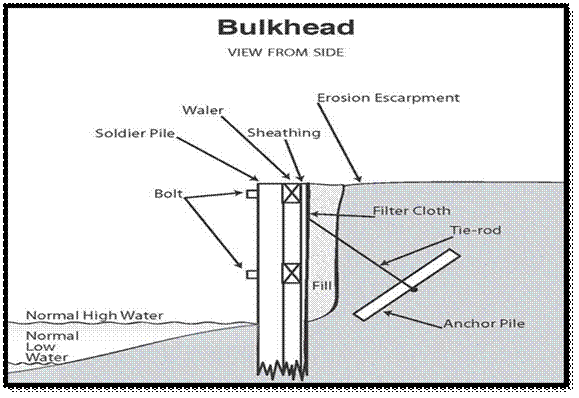
Figure 4.3.1 (a): Side view of
Bulkhead formation
(Source:
Shahid and Colwell, 2018)
Seawalls usually are
constructed in order to withstand wave energy more than that is absorbed by
bulkheads. Cast-in-place concrete or timbers are used mostly in order to
construct sea walls of vertical, curved or stepped structure.
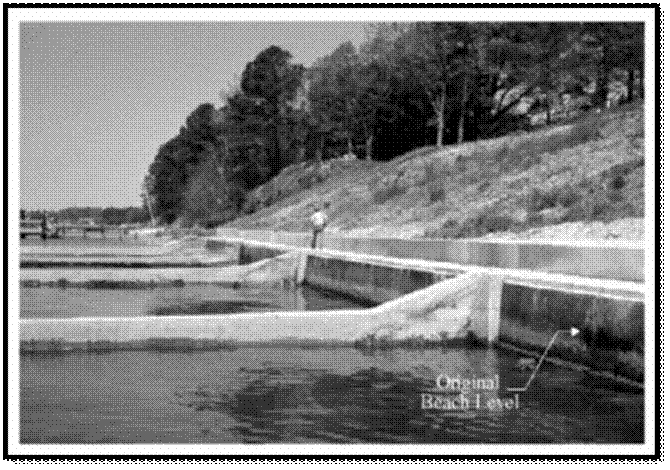
Figure 4.3.1 (b): Seawall
(Source:
Shahid and Colwell, 2018)
Revetments usually
behave as armour of the slope faced seawalls. One or more layers of graded
riprap are used in order to construct revetments. However, alternative
materials for construction of revetments can be timber, precast concrete mats
or gabions etc.
Even if
these are good and widely used methods of reducing beach erosion, less and
improper planning and monitoring is supposed to get erosions continued (Dirks,
2017). Hence, proper planning is needed to be done in context to calculation of
energy carried by waves and the height it covers on regular basis near the site
of construction.
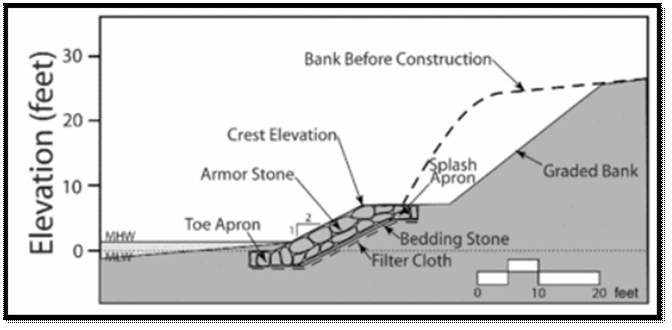
Figure 4.3.1 (c): Stone revetment
(Source:
Dirks, 2017)
●
Breakwaters
This method
of beach erosion prevention employs a single structure or series of units
placed near the shore in order to break the energy of wave so that it cannot
hit the sand with more force and drag it into the sea. Rocks are usually used
in order to break the energy however tires, formed concrete or broken concrete
may also be used (Scyphers, Powers and Heck, 2015). Use of any of the
aforementioned materials for making breakwater depends upon availability near
the region of breakwater construction.
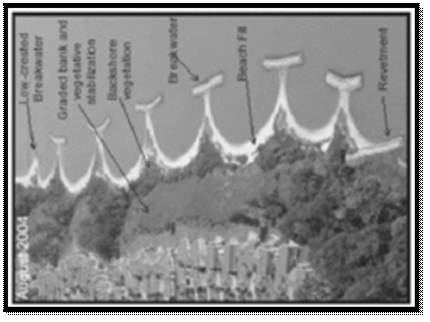
Figure 4.3.1 (d): Breakwaters
(Source:
Scyphers, Powers and Heck, 2015)
●
Sills
Sills are
semi continuous structures and help in reducing wave energy in each stage.
Continuous energy reduction of sea waves help sand in beach getting hit with a
very low energy wave and hence it becomes impossible for the wave to drag a
significant amount of sand with it. Even if sills fail in reducing wave energy
because of having very high
energy content, sands being dragged in returning phase of the
wave get stuck in the semi continuous structure (Kroon et al. 2017). Moreover, the next phase of wave hitting the shores
repels the stuck sand towards the sore. Sill structures usually get constructed
using stone, treated wood or other materials. As building skills needs
encroachment bayward or riverward beyond Mean High
Water, acquiring permits for installation becomes complicated.
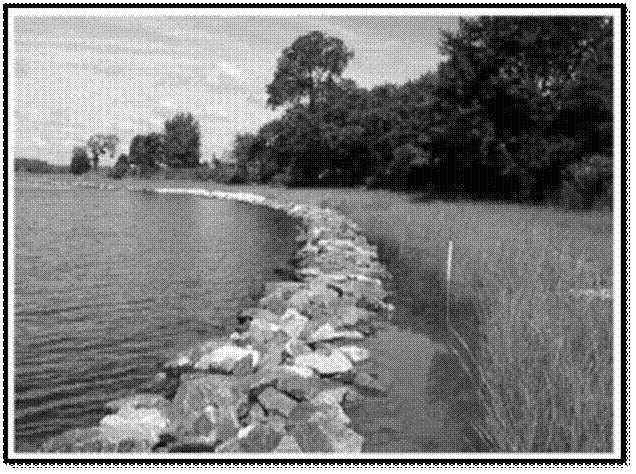
Figure 4.3.1 (e): Sills
(Source:
Kroon et al. 2017)
●
Beach
nourishment
It is
referred to the concept of adding additional sand on a shoreline in order to
enhance beach area. It is basically the concept of filling an area where beach
erosion has already replenished most of the sands. In order to retain the
amount of nourished sand, other beach erosion protection methods are needed to
be adopted. As it is impossible to recover the eroded beach sand, this method
is usually used to restore the beach strength (Gopalakrishnan et al. 2017). Being artificial ways of
sand storage, nourished beaches can be identified to be highly susceptible
towards re-erosion and hence proper care is needed to be taken in order to
construct an efficient shoreline hardening structure so that the sand cannot be
retracted towards the sea.
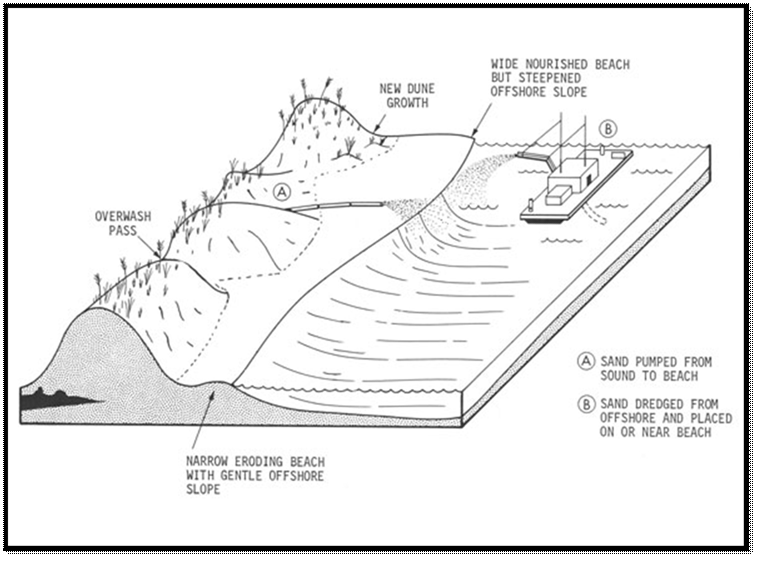
Figure 4.3.1 (f): Beach Nourishment
(Source:
Gopalakrishnan et al. 2017)
●
Groin
construction
Groins are
barriers constructed perpendicular to the shoreline using concrete, steel, rock
or timber. These also behave as wave energy breakers as the waves are supposed
to hit the constructed groin first before reaching the shoreline. Moreover,
sand getting retracted from shoreline is supposed to be trapped between the
shoreline and groin and hence helping in prevention of beach erosion (Anfuso et al. 2016). Deposited soil and sand on
the constructed groin sometimes help in growing of trees and eventually the
groin formed looks like small and beautiful islands.
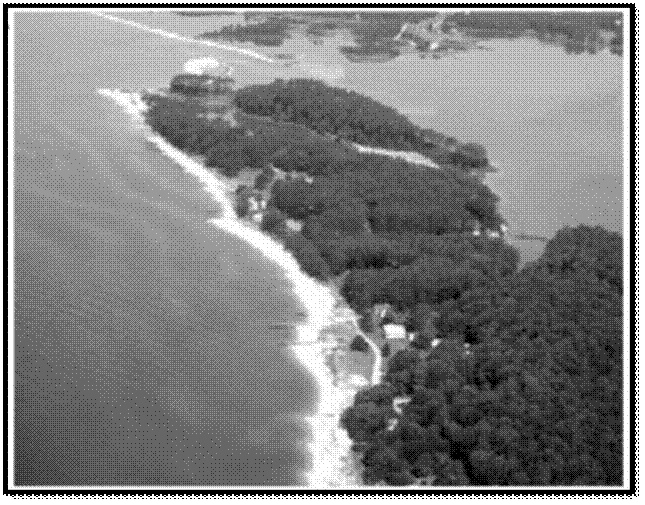
Figure 4.3.1 (g): Groin Construction
(Source:
Anfuso et al. 2016)
●
Composite
system development
Development
of a composite beach erosion prevention system refers to use of more than one methods discussed above in order to break the wave energy
and prevent the beach sand from dragged into the sea by high energy waves.
Decision on use of any combination of aforementioned strategies for prevention
of beach erosion is taken considering the usual height and energy of wave.
Apart from using a combination of artificial beach erosion prevention methods
only, the composite system also considers use of natural means of beach erosion
prevention along with artificial means.
4.3.2 Theme 2: Use of natural resources
While
construction of civil infrastructures near shorelines can be regarded as
immediate solutions, use of natural resources can be identified to be nature
friendly and in some cases long lasting solutions.
Some of the efficient modes of using natural resources for maintaining
sustainability of the method in reducing beach erosion are as follows.
●
Vegetation
This concept
requires planting of grasses in existing tidal and supratidal substrate and is
limited to use for sites with limited fetch. At sites with larger fetch, sand
filling is needed for creation of March Fringe. It is necessary so that better
substrate can be generated for planting terrace (De Salvo et al. 2018). Apart from using grass for vegetation, roots of
plants, trees or bushes can also be used in combination in order to bind soil
and sand lying near shoreline so that it becomes difficult for sea waves to
drag the soil and sand near shoreline. In addition, geotextiles or geomats constructed of natural fibres and straw can also be
used near shoreline in order to trap the soil from getting eroded because of
retraction of high energy of waves.
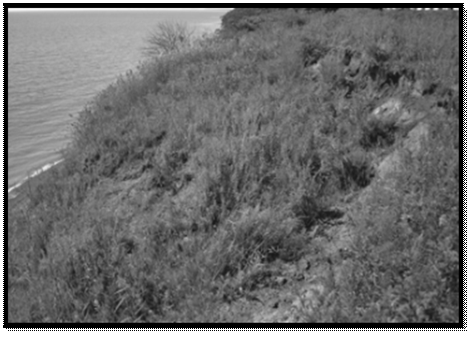
Figure 4.3.2 (a): Coastal vegetation
(Source: De
Salvo et al. 2018)
●
Submerged
vegetation
Submerged
vegetation or use of sea grasses helps in stabilising the sediment and helps in
attenuation of wave during low tides. Generation of sea grass is generally a
natural phenomenon and hence varies with change in season. Usually
sea grasses become less dense during winter season in temperate areas and hence
the region becomes free of any natural obstruction for the tides. Any possible
stormy conditions in such times leads to retention of high energy in the waves
which upon absence of sea grasses retains the entire energy and dashes the sea
shore with the same high energy. In case, other beach protection methods are
unavailable in such conditions, very high extent of beach erosion happens
(Santana and Barroso, 2014). In order to maintain natural resistances in form
of sea grasses, it is necessary for concerned authorities to restore the
habitat after replenishment of sea grasses in the winter. Efficient planting
techniques meeting wave exposure requirements such as ensuring availability of
light with at least 10% of surface irradiance is taken utmost care of so that
sea grasses can survive for long time even in the winter (Donner and Webber,
2014). However, inefficiency of being able to develop such conditions for
longevity of sea grasses has led this concept to be a less interesting subject
of discussion. On the other hand, regular researches on this subject are
supposed to result development of sea grass restoration technologies in near
future.
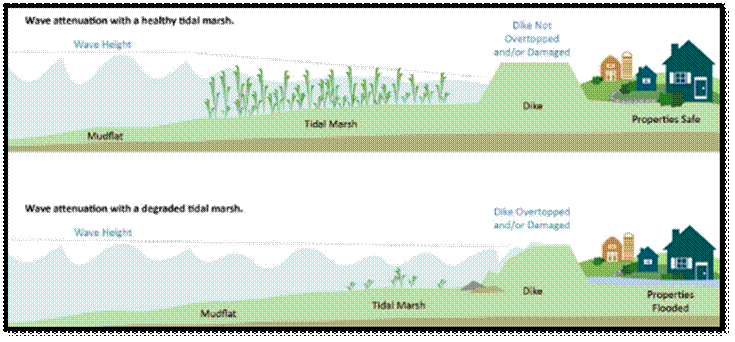
Figure 4.3.2 (b): Coastal submerged vegetation
(Source: Santana
and Barroso, 2014)
●
Vegetated
dune formation
This is
actually a composite system development which employs two methods for
prevention of beach erosion. One among the two is beach nourishment while the
other is plantation of appropriate species of dune grasses in the nourished
sand. Nourishment restores sand strength of beach while planting dune grasses
in the sand ensures ability of the sand to withstand energy of sea wave which
would have dragged the sand into sea in case it had not been reinforced with
root bodings of dune grasses (Bennett, Kadfak
and Dearden, 2016). In order to maintain strength of the composite it is
at first needed for the grass to make bondage with the sand properly and hence
temporary means of wave energy reduction is needed to employed so that high
energy of wave do not drag sand along with dune grasses into the sea.
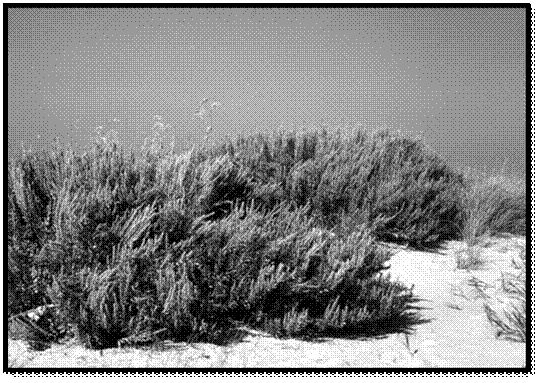
Figure 4.3.2 (c): Vegetated dune
formation
(Source: Bennett,
Kadfak and Dearden, 2016)
●
Marsh
Creation
Marsh
creation allows an individual or a group of individuals concerned with beach
erosion prevention to plant appropriate species of grass, sedges or plants near
the shoreline which can remain alive in salty water. Roots of these greeneries
makes strong bond with the sand in the beach so that even high energy of waves
cannot break the bond between grasses and the sand. Moreover, the grasses in the beach help in
reduction of wave energy upon hitting them because of which high energy waves
become unable to drag sand from shoreline into the sea.
●
Forestation
Apart from
aforementioned erosion prevention strategies there is also another aspect which
might not have direct impact on reducing energy of wave or ensuring strength of
sand so that wave cannot drag a significant amount of sand into the sea however
possess significant indirect impact. It has already been discussed that stormy
conditions in the sea generally generated because of low pressure which can be
identified to be a by-product of global warming. Moreover, it is also known
that, availability of greenery in any region is supposed to make the atmosphere
cool and hence reducing the chances of irregular low pressure
generation (Keijsers et al. 2015).
Forestation near seashores is supposed to maintain temperature of the region
and hence reducing chances of irregular storms in sea. This means reduction in
chances of high energy carrying leaving dashing the seashore and hence
resulting in reduction of beach erosion.
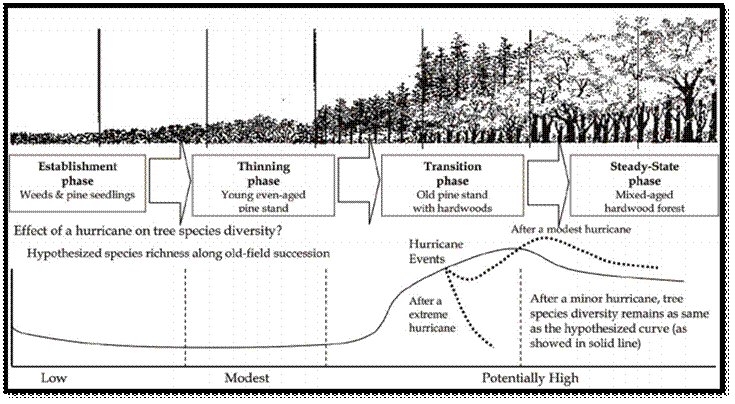
Figure 4.3.2 (d): Coastal forestation
(Source: Keijsers et al. 2015)
4.4 Discussion
In context
to both the themes discussed in above sections it can be identified that,
prevention of beach erosion using artificial means is supposed to provide
immediate solutions while natural means are supposed to provide long lasting
and environment friendly solutions. On the other hand, the most efficient
method for prevention of beach erosion can be found out to be a sound blend of
natural and artificial means (Kousky, 2014). This is
because of the fact that, artificial means are supposed to immediate solution
towards behaving an obstruction responsible for reduction of wave energy and
for not letting sand dragged into the sea. On the other hand, natural methods
such as vegetation, submerged vegetation and vegetate dune formation are
supposed to need long time for their growth and creating bond with sand and
soil near the beach so that not only the wave energy gets reduced, however it
also becomes unable to drag the sand (Anfuso et al. 2016). None of the methods discussed so far can be
identified to be having the ability of attending the prime cause so that high
wave energy on irregular basis can be reduced naturally. The last concept
discussed which is forestation infers that higher amount of energy in waves
irregularly and increase in sea water can be because of global warming which
can only be mitigated by generating greeneries all over. This is because of the
fact that, more green plants in a place especially in touristy spots are
supposed to help in maintenance of temperature by maintaining purity of air. A
cool atmosphere is supposed to reduce the chances of irregular low pressure in
sea and hence reduction in chances of sea storms.
4.5 Conclusion
This chapter
focuses on collection of many important data on acquiring significant knowledge
on different methods which can ensure prevention of beach erosion either alone
or in a combination. Data has been collected on different types of construction
methods and concepts which can ensure sustainability of construction process.
Furthermore, all the acquired data has been analysed in context to different
conditions in beaches. Moreover, the research findings and discussions done
help in meeting the research questions and sub questions developed previously.
Three of the most important aspects
as per the discussions carried out had been found to be use of civil
construction methods, planting appropriate sea grasses following a proper
pattern in order to ensure bonding between sand and grass and natural cooling
of the atmosphere which in natural means is supposed to reduce chances of
increase in sea level and hike in wave energy irregularly. Moreover, discussion
on identified themes also suggests that, a combination of different necessary
aspects is supposed to be beneficial in order to maintain sustainability of
composite system in reducing beach erosion. However, deforestation has been
identified to be given utmost priority irrespective of general weather and
climatic conditions of target area so that it can manage the basic cause behind
generation of sea storms irregularly which is global warming.
Chapter 5: Findings and Conclusion
5.1 Introduction
With
significant growth in world tourism, risks on natural resources have also been
increased significantly. Race in terms of providing better facilities has
increased use of hydrocarbon emitting facilities up to such an extent that
global warming has risen as the most important challenge before living beings.
This chapter focuses on findings of research on sustainable construction
strategies meant for significant reduction of beach erosion in order to
maintain available beach area intact all around the world. In addition,
discussion in this chapter has also been done on contribution of such
technologies on restoration of environment in a broader sense. Furthermore,
limitations of the research conducted have also been discussed along with
identification of future contexts of research.
5.2 Motivation and significance of the thesis
Innovations
in the field of technology have helped human beings to lead a luxurious and
comfortable lifestyle. Moreover, significant inventions has
led to reduction of physical stress on human beings and increment in work
precision up to such an extent that almost everyone nowadays is feeling need of
using different kinds of machines. However, different forms of energy are
needed to run the machines. Most of the machineries used starting from the age
of technological evolution has significantly needed use of hydrocarbon emitting
power sources. Hydrocarbon particles are good absorbers of heat and heavy
because of which atmosphere of earth is being heated day by day. On the other
hand, industrial revolution in the world has generated an intense competition among
industrials all over the world (Noblet and Brisson, 2017). In order to satisfy
increasing ambitions of industrialists, greeneries all around the world is
being reduced day by day and hence putting the natural shield on global warming
down.
This thesis
is significant as it is focused on identification of sustainable construction
strategies so that balance of nature can be restored. Moreover, adequate
discussion on sustainability of nature involved strategies are supposed to help
in reduction of wave energy because of increased water content and increase in
repeated low pressure situations around seas and
oceans (Jayanthi et al. 2018). In
addition, successful development of sustainable civil construction strategies are supposed to help in providing immediate solutions to
adverse impacts of high energy waves and tides on beach erosion and hence
reduction in tourism and nature imbalance.
5.3 Findings and discussion of the research question
Research
conducted using secondary methods of data collection has helped in identifying
various causes of beach erosion. Most important cause of beach erosion has been
identified to be significant rise in hydrocarbon emissions because of human
activities in terms of using vehicles and artificial cooling techniques. It has
been found out from the research that; beach areas usually get huge tourism
opportunities because of which tour operators adopt every possible strategy
such as use of vehicles for transportation leading to increase in amount of
carbon monoxide and particulate matters in atmosphere. In addition, hotel
owners adopt artificial cooling technologies in terms of using refrigerators
and air conditioning of rooms because of which amount of Chlorofluorocarbon
(CFC) increases in the atmosphere. All these identified hydrocarbon particles
are heavy and heat absorbing in nature because of which local atmosphere
becomes so much heated that low pressure situations gets
generated repeatedly and irregularly leading to increase in wave energy (Jerome
and Stakhiv, 2015). Moreover, increase in such
particles in atmosphere all over the world is making the situation of global
warming worse every day leading to melting of glacier resulting in increase in
water level in seas and oceans. In accordance to research outcomes and as
discussed in Forestry for a low-carbon
future: Integrating forests and wood products in climate change strategies. (2016),
increase in sea water and wave energy along with considerable deforestation
leading to beach erosion can be prevented only if multidimensional work is
done. Analysis on outcomes of secondary research has helped in acknowledging to
the fact that, civil constructions alone cannot result in significant reduction
of beach erosion despite of being an immediate solution. Rather, basic causes
of beach erosion such as increased sea water content and wave energy are needed
to be managed using natural means so that a sustainable and long
lasting solution can be implemented. Moreover, analysis of findings of
conducted research helps in answering developed research questions up to a
significant extent. However, it would have been better in case primary research
would have been conducted in order to gather more realistic knowledge on the
context of research.
5.4 The contributions of this study
This
research helps in finding out basic causes of beach erosion along with adequate
justifications. Moreover, this research study also has helped in finding out
sustainability of methods being used currently in mitigation of the situation
which is being seen in almost all beaches around the world because of which
beach area is decreasing significantly. On the other hand, reduction in beach
area can be seen compensated naturally by reducing normal area which is a
bigger concern (Alam and Mohammad, 2018). This is because of the fact that,
increased sea water having high wave energy content is reaching out to normal
areas having populations and ploughable fields and
hence making those areas difficult to live and produce food crops. Findings of
the conducted research is supposed to be efficient in acknowledgement of
sustainable construction methods in reducing beach erosion and finding out
issues in the currently used methods so that suggestions can be devised for
restoring balance of nature.
5.5 Future research and limitations of the study
Even if the
secondary method of research could help in finding out many important aspects
associated with the topic of research in order to meet research objectives and
answer developed research question, utmost authenticity of data gathered cannot
be justified in context to recent conditions. This Is because of the fact that,
secondary research helps in analysing information gathered on past phenomena.
As beach erosion, global warming and environmental deterioration are ongoing
processes and very significant challenged to existence of life on earth,
primary research in terms of interview of environmentalists, people living near
beaches and business persons working is hospitality, travels and tourism
industry could have yielded better and realistic results. Hence, a primary data
collection method is needed to be employed efficiently and necessarily in case a research is supposed to be carried out on this topic in
future so that present conditions of constructions for prevention of beach
erosion can be analysed.
5.6 Conclusion
This section provides overview on
basic motivation behind execution of the research project. Moreover,
contribution of research findings towards development of efficient strategies
for environmental restoration has also been discussed along with limitations of
the research carried out. Furthermore, need and context of future research have
also been suggested so that better outcomes can be gained. Following
suggestions on future research is supposed to help in finding out more
efficient sustainable construction strategies both in terms of using civil
constructions and use of natural resources so that beach erosion can be reduced
along with resulting in reduction of its negative impacts on environmental
stability and life of living beings.
References & Resources
Addo, KA 2018,
"Assessing Ocean Wave Dynamics, Potential Sediment Transport, and Coastal
Erosion along Accra Coast in Ghana", Journal of Coastal
Research, vol. SI, no. 81, pp. 86.
Alam, S. and
Mohammad, S.N., 2018. The Precautionary Principle in Biodiversity and Natural
Resource Management: Institutional and Policy Challenges for a Sustainable
Future. Environmental Policy and Law, 48(3),
pp. 187-203.
Alves, B., Rigall-i-torrent, R., Ballester, R., Benavente, J. and Ferreira,
2015, "Coastal erosion perception and willingness to pay for beach
management (Cadiz, Spain)", Journal of Coastal Conservation, vol.
19, no. 3, pp. 269-280.
Anfuso, G.,
Bowman, D., Danese, C. and Pranzini, E., 2016.
Transect based analysis versus area based analysis to
quantify shoreline displacement: spatial resolution issues. Environmental monitoring and assessment, 188(10),
pp. 1-14.
Anfuso, G.,
Bowman, D., Danese, C. and Pranzini, E., 2016.
Transect based analysis versus area based analysis to
quantify shoreline displacement: spatial resolution issues. Environmental monitoring and assessment, 188(10),
pp. 1-14.
Bell, E, Bryman, A &
Harley, B 2018, Business research methods, Oxford university press,
Oxford, UK.
Bennett, N.J., Kadfak,
A. and Dearden, P., 2016. Community-based scenario planning: a process for
vulnerability analysis and adaptation planning to social-ecological change in
coastal communities. Environment, Development and Sustainability, 18(6), pp. 1771-1799.
Betzold, C. and Mohamed, I
2017, "Seawalls as a response to coastal erosion and flooding: a case
study from Grande Comore, Comoros (West Indian
Ocean)", Regional Environmental Change, vol. 17, no. 4,
pp. 1077-1087.
Daron, J 2015, Challenges in
using a robust decision making approach to guide
climate change adaptation in South Africa. Climatic Change, vol. 132, no. 3, pp. 459-473.
De Salvo,
M., Signorello, G., Cucuzza, G., Begalli, D. and
Agnoli, L., 2018. Estimating preferences for controlling beach erosion in
Sicily. Aestimum, (72), pp. 27.
Dirks, G.,
2017. FIBERTEX GEOSYNTHETIC SAND CONTAINERS FOR COASTAL PROTECTION AND
REHABILITATION. Civil Engineering
: Magazine of the South African Institution of Civil Engineering, 25(7),
pp. 44-45.
Donner, S.D.
and Webber, S., 2014. Obstacles to climate change adaptation decisions: a case
study of sea-level rise and coastal protection measures in Kiribati. Sustainability Science, 9(3), pp.
331-345.
Dragulanescu, I., 2014.
PROTECTION OF THE COASTAL LANDSCAPE FOR TOURISM SUSTAINABILITY. International Journal for Responsible
Tourism, 3(2), pp. 29-46.
Felter, E.
and Morris, M., 2016. PAS REPORT 581: COASTAL ZONE MANAGEMENT. Planning Advisory Service Report, (581),
pp. I,II,2-30,32-83.
Forestry
for a low-carbon future: Integrating forests and wood products in climate
change strategies. 2016. Rome: Food and Agriculture
Organization of the United Nations.
Fox,
NJ &Alldred, P
2015 New materialist social inquiry: Designs, methods and the
research-assemblage . International
Journal of Social Research Methodology, vol. 18, no. 4, pp.399-414.
Gopalakrishnan,
S., Mcnamara, D., Smith, M.D. and Murray, A.B., 2017.
Decentralized Management Hinders Coastal Climate Adaptation: The
Spatial-dynamics of Beach Nourishment. Environmental
and Resource Economics, 67(4), pp. 761-787.
Jayanthi,
M., Thirumurthy, S., Samynathan, M., Duraisamy, M.,
Muralidhar, M., Ashokkumar, J. and Vijayan, K.K., 2018. Shoreline change and
potential sea level rise impacts in a climate hazardous location in southeast
coast of India. Environmental monitoring
and assessment, 190(1), pp. 1-14.
Jerome, D.P.
and Stakhiv, E., 2015. Water-related disaster risk
reduction (DRR) management in the United States: floods and storm surges. Water Policy, 17, pp. 58-88.
Jonah, FE., Adams, O., Aheto, DW., Jonah, RE. andMensah,
EA 2017, "Coastal zone management challenges in Ghana: issues associated
with coastal sediment mining", Journal of Coastal
Conservation, vol. 21, no. 3, pp. 343-353.
Kang, Y. and An, S. 2018,
"Development of New Coastal Erosion Countermeasure Using Wave Energy
Control Method", Journal of Coastal Research, vol. SI,
no. 85, pp. 1516-1520.
Kaplan,
A 2017, The conduct of inquiry:
Methodology for behavioural science, Routledge, Abingdon
Keijsers, J.G., S., Giardino, A., Poortinga, A., Mulder, J.P., M., Riksen, M.J., P., M. and Santinelli, G., 2015. Adaptation strategies to maintain dunes as flexible coastal flood defense in The Netherlands. Mitigation and Adaptation Strategies for Global Change, 20(6), pp. 913-928.
Kousky, C., 2014.
Managing shoreline retreat: a US perspective. Climatic Change, 124(1-2), pp. 9-20.
Kroon, A., Abermann, J., Bendixen, M., Lund, M., Sigsgaard, C., Skov,
K. and Hansen, B.U., 2017. Deltas, freshwater discharge, and waves along the
Young Sound, NE Greenland. Ambio, 46, pp.
132-145.
Lee, YB., Kim, HD. and Kwak,
K 2018, "Verification of Beach Erosion in West Coast of Korea", Journal
of Coastal Research, vol. SI, no. 85, pp. 256-260.
Masria,
A., Iskander, M., and Negm, A 2015, Coastal protection measures, case study
(mediterranean zone, egypt). Journal of
Coastal Conservation, vol.
19, no. 3, pp. 281-294.
Moore, R. and Davis, G. 2015,
"Cliff instability and erosion management in England and
Wales", Journal of Coastal Conservation, vol. 19, no. 6,
pp. 771-784.
Natale, MD., Ronza, SD.,
Eramo, C., Vigliotti, M., and Ruberti, D 2017, A sediment trap to mitigate port
silting due to longshore transport. The case of pinetamare
marina (southern italy). Journal of Coastal
Conservation, vol. 21, no. 6,
pp. 803-812.
Nguyen,
A.T., Nguyen, N.T., Luong, T.T. and Hens, L., 2018. Tourism and beach erosion:
valuing the damage of beach erosion for tourism in the Hoi An
World Heritage site, Vietnam. Environment,
Development and Sustainability, ,
pp. 1-12.
Nguyen, T.P., Parnell, K.E.
and Cottrell, A 2017, "Human activities and coastal erosion on the KienGiang coast, Vietnam", Journal of Coastal
Conservation, vol. 21, no. 6, pp. 967-979.
Noblet, M. and Brisson, G.,
2017. Adaptation to climate change in Quebec s coastal zone: a difficult
transformation of public action. International
Journal of Climate Change Strategies and Management, 9(03), pp. 282-298.
Obu,
J., Lantuit, H., Fritz, M., Pollard, W.H., Sachs, T.
and G nther, F 2016, "Relation between planimetric and volumetric
measurements of permafrost coast erosion: a case study from Herschel Island,
western Canadian Arctic", Polar Research, vol. 35, no. 1,
pp. 1-13.
OECD
Environmental Performance Reviews: Korea 2017, 2017.
Paris: Organisation for Economic Cooperation and Development (OECD).
Palalane,
J., Larson, M., Hanson, H. and J izo, D 2016,
"Coastal Erosion in Mozambique: Governing Processes and Remedial
Measures", Journal of Coastal Research, vol. 32, no. 3,
pp. 700-718.
Pranzini,
E., Wetzel, L., and Williams, AT 2015, Aspects of coastal erosion and
protection in europe. Journal of Coastal
Conservation, vol. 9,
no. 4, pp.445-459
Ritohardoyo,
S., Akbar, AA., Sartohadi, J. and Djohan, TS 2017,
"Public participation in the utilization and rehabilitation of coastal
natural resources (case study of coastal erosion in West
Kalimantan)", Journal of Degraded and Mining Lands
Management, vol. 4, no. 2, pp. 739-747.
Santana,
S.E. and Barroso, G.F., 2014. Integrated Ecosystem Management of River Basins
and the Coastal Zone in Brazil. Water
Resources Management, 28(14), pp. 4927-4942.
Scyphers,
S.B., Powers, S.P. and Heck, K.L., 2015. Ecological Value of Submerged
Breakwaters for Habitat Enhancement on a Residential Scale. Environmental management, 55(2), pp.
383-391.
Shahid, M.D.
and Colwell, A.M., 2018. THE REGULATION OF COASTAL PROPERTIES IN AN ERA OF KING
TIDES. Real Property, Trust, and Estate
Law Journal, 53(1), pp. 101-117.
Sneath, S.,
2015, Sep 01. Coastal residents work to slow beach erosion. TCA Regional News.
Weber,
M 2017, Methodology of social sciences,Routledge,
Abingdon.
Yokoo, Y. and Udo, K 2016,
"Connectivity Between Sediment Storage in Dam Reservoir and Coastal
Erosion: Implications Through Zonal Mappings of Monitoring Data", Journal
of Coastal Research, vol. SI, no. 75, pp. 725-729.
Zou, T 2018, "Modeling and Analysis of the Influence of Costal
Remediation and Repair Management Project on the Coastal Erosion and
Siltation", Journal of Coastal Research, vol. SI, no. 83,
pp. 305-308.