 : 428
: 428
IMPACT OF LOW ENERGY GREEN BUILDING
MATERIALS
Table of contents
2.3 Theoretical analysis of green technology
2.4 Critical analysis of factors governing green technology
2.5 Critical evaluation of the significance of green
building materials
2.6 Critical analysis of the impact of low energy green
building material
Chapter 1: Introduction
1.1 Introduction
The current chapter of the research
project includes the benefits imposed by green building materials on the
reduction of energy consumption. Furthermore brief
discussion related to the motivation of the research project is also included
here. Moreover, the current chapter deals with the significance of this
research project in case of illustration of the relationship between green
building material and energy consumption. It also elaborates the objective and
design of research project. In this chapter, the main questions related to research
topic are also included along with research aim. Finally, dissertation
structure is elaborated with a proper diagram.
1.2 Background
According to Ren, Wang & Wang
(2015), the main issue related to the energy consumption can be reduced
effectively by the adoption of the green building material in the construction
project works. Green building material such as hempcrete, grasscrete
can help to reduce the pollution level and is also helpful for saving the
energy related to the construction project (Kibert, 2016). Basically, natural
resources like wood and bamboo are used to make the proper design of a green
building. With the proper and effective
implementation of design of eco-friendly material in building the aesthetic
value of construction can also be enhanced. As commented by Chew, Conejos & Asmone
(2017) application of eco-friendly and natural
material with the implementation
of internal gardens in construction can help to reduce the level of the pollution and
the greenhouse effect. In modern green buildings, internal gardening is adopted
for reducing the demands of energy consumption. In these buildings, the greenhouse effect is adopted to make proper
harvesting of the vegetables and fruits (Pacheco-Torgal
et al. 2014). Moreover, in these
buildings, renewable energy sources also are included and due to this reason these buildings are quite energy efficient and is
able to make reduce the global energy crisis of the world. Application of the
renewable sources of energy is cost effective and can help to reduce the cost
related to the energy consumption of these buildings effectively (Zuo &
Zhao, 2014). Additionally, application of recycling process in these buildings
related to the water supply of harvesting vegetables and fruits can help to
maintain reduce the cost of excess power supply effectively. Additionally, the
maintenance cost of this green building materials and technologies is also very
low. Simultaneously application of internal
gardening in green building can help to reduce the emission of CFC and CO2 thus can help to mitigate the issue
related to the greenhouse and global warming (Tsai, 2017).
1.3 Motivation
The main issue related to the
building is excess uses of energy to fulfill the basic requirements. This can
impose further energy crisis in the world and can scale down the availability
of natural fuel. This problem must be solved. Otherwise
it can impose energy problem on the future generation of the human being and
can make theme energy blind. In addition, these buildings are producing harmful
greenhouse gases like CFC and CO2 (MacNaughton et al. 2017). These gases are responsible for global warming and thus
modern buildings are mainly responsible for increasing rate of global warming
of this world. Emission of these greenhouse gases must be reduced otherwise
this can meltdown the ice glacier of the polar region and can be the cause of
the devastating event. In addition, these buildings also increase the level of
pollution in the environment. This can increase the diseases of human and can
cause an epidemic (Wang, Toppinen & Juslin, 2014). Thus this must be
controlled. Otherwise it can take several lives of
human being. This research gives the direction by which the way application of
green building material can help to mitigate the issues related to these modern
building can be understood.
1.4 Research aim
The aim of this research is to elaborate the way application
of green building material can help to reduce energy consumption level. Additionally,
this research paper focuses on the impact green building material in the environment.
1.5 Research objective
● To understand the way green building
material can help to lower down the energy consumption level
● To
determine the applicability of green building
materials on the environment
● To understand the application of relevant
technology to reduce the energy consumption in the building
● To understand the way of recycling procedure can mitigate the cost and required
energy for maintenance of the green building
Research questions
● What can be the reason behind the action of green building materials in reducing energy
consumption?
● What can impact on the environment be imposed by green
building material?
● In what way application of relevant
technology help in reducing energy consumption?
● In what way does recycling help in
minimizing cost for green building material?
1.6 Research hypothesis
H0: Inclusion of green building materials will lead to reduced cost of
the construction project
H1: Inclusion of green building
materials will not lead to reduced cost of the construction project
1.7 Research design
In this research, the way green building material can
reduce the energy utilization level is determined by secondary
quantitative-based analysis. Moreover in this
research paper analysis of the effective application of conventions theory and
prospect theory is adopted.
1.8 Implication of the research paper
This research paper can help to determine
a way of application of green building material can help to reduce the energy
consumption level. Furthermore, this research
paper also is helpful to determine the relationship between green building material and reduced level of the pollution on the ecosystem. This research paper also helps to
identify the way recycling process and the application of renewable energy can
help to reduce the energy consumption related to the maintenance of the
building.
1.9 Dissertation structure

Figure
1.1: Dissertation structure
(Source-created by author)
1.10 Summary
In this chapter, the negative effect of
modern building in energy consumption is elaborated. This chapter can help to
identify the way green building material can help to lower down the level of
energy consumption.
Chapter 2: Literature Review
2.1 Introduction
In this chapter of the research paper brief theoretical evaluation
of technologies which are undertaken in the construction of the green building
is included. The factors that
make an impact on these green technologies like photovoltaic cell
based power supply, wind turbine are also elaborated in this chapter. In
addition, critical analysis related to green building material like grasscrete, hempcrete is included. Critical evaluation of
the environmental effects of this green building material has been included
here. Additionally, the usefulness of these materials in case of saving the
energy is illustrated in this chapter. Finally, the flaws related to this
research paper are explained in this chapter.
2.2 Conceptual framework
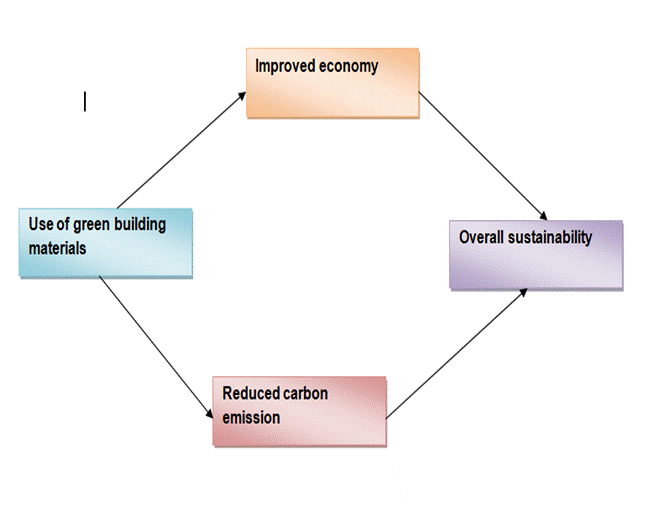
Figure
2.1 Conceptual framework
(Source-created by the researcher)
2.3 Theoretical analysis of green
technology
According to Kibert (2016) application of
green technologies in green building can help to make the environment free from
pollution and can increase the level of saving of energy. As per Conventions
theory, this is due to the application of several
green building technologies application of
solar cell, the wind turbine can help to lower down the level of emission of
the carbon and can allow using natural energies. Also, these kinds of renewable
energies due to their abundance can help to mitigate the energy crisis forever.
Pacheco-Torgal
et al. (2014) added that adoption of eco-friendly technologies can reduce
the expenses related to the energy and this can increase the rate of growth of
countries economy. This also can help to generate the revenue by producing the
energy from natural sources without expending too much money for energy
generation.
On the contrary, Zuo & Zhao (2014)
argued not only economic issues but also eco-friendly technologies can reduce
the greenhouse effects. Due to
this reason application of green technologies in buildings can help to reduce
the level of global warming. This can help to reduce average global temperature
and thus is helpful to mitigate the probability of global disaster. Tsai (2017)
opposed this and commented that implementation cost related to eco-friendly technologies in the green building is very cost effective. As per Prospect theory, due to this reason in small green
building projects, the implementation of eco-friendly technologies is not
possible.
2.4 Critical analysis of factors
governing green technology
According to Wang, Toppinen & Juslin (2014), the
main factors related to the adoption of eco-friendly technology is the quality
and specification of these technologies. Energy specifications related to the adoption of eco-friendly technology is not clear and this can reduce the quality of the insertion of eco-friendly technology in green
building projects. Allen et al. (2016) added that another main
factor related to the insertion of eco-friendly
technology in green building projects for saving energy is the amount of energy produced by
these technologies. This is one
major issue related to the application of the green technologies in green
building project because the inefficient power supply is not able to fulfill
the needs of people.
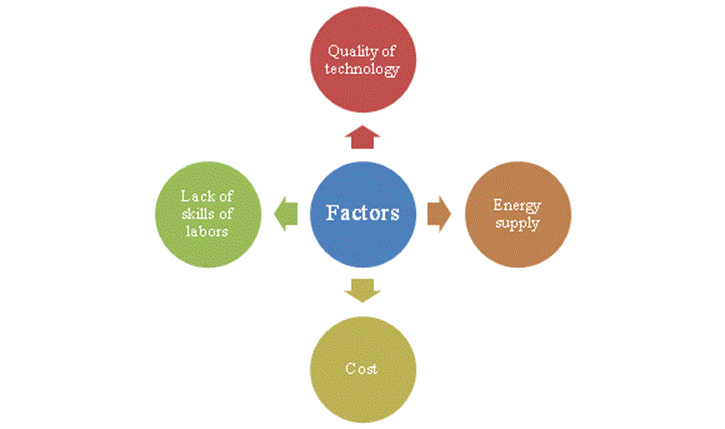
Figure
2.2: Factors affecting green building materials
(Source- Allen et al. 2016)
On the contrary, Pacheco-Torgal (2014) argued that factor that governs the
application of green technologies in a green building project is the cost
related to the implementation of these technologies in green building.
Implementation cost is an important factor related the green building projects
because in small green building projects the application of green technologies
cannot be adopted due to this cost problem. On the other hand, Yang, & Zou
(2014) supported this and added that another factor related to the application
of the green technologies in a green building project is improper human
resource activities and lack of skills of labors related to this application.
This can reduce the quality of green building project and in turn, can make the
project inefficient for reducing the energy consumption.
2.5 Critical evaluation of the
significance of green building materials
As stated by Li & Lin (2016),
application of the green building material can help to reduce the uses of
natural resources and thus is helpful to save the natural resources.
Application of green building materials to make the building can help to
minimize the uses of natural resources at the same time it is helpful to
increase the level of resources. This is because in this era green buildings
have their own garden and natural power sources broader use of this can help to
mitigate the global energy crisis. Kumar & Sahu (2015) supported this and
commented that application of green building material can help to save the
money which is needed for incurring energy supply in the building. This is
beneficial for the economy of a country as well as for a business organization
and it can help to increase the revenue generation by selling excess energy to
other countries. Broader application of green materials thus is able to fulfill
the energy demand of a country. Kumar & Sahu (2015) supported this and
commented that application of the green materials like grasscrete,
woods can also help to maintain a reduced level of pollution due to the
artificial building technologies. Additionally the
application of green building materials like woods, Hempcrete can able to
reduce the accidental issue and issue related to the biohazards. This is
because concrete buildings use cement as the main material and cement and it
can pollute the environment. This can be reduced by the application of grasscrete and hempcrete in place of cement.
Wang et
al. (2014) added that green building materials also can help to retain the
weather condition this is because in green buildings gardens are included and
due to this reason it can help to reduce the level of
CO2. This can help to lower down the effect of the global warming and thus
wider application of green building materials in the construction can help to
reduce the level of global temperature. On the other hand, Santamouris
(2014) opposed it and commented that location is the main disadvantage related
to the green building. This is because in town area basically the materials
which are needed to make green buildings are less available. Thus
importing these materials in the town area is a difficult and cost-effective
factor. Moreover, high rate of pollution in town area can reduce the
sustainability of green building projects.
2.6 Critical analysis of the relation between
energy consumption and green building material
According to Hunag,
Wang & Wang (2015) application of renewable technologies and application of
green building materials can help to reduce the energy uses related to the
livelihood of people. This is because application of green technologies and materials
can help to maintain the energy supply from natural resources at low
maintenance cost. Simultaneously application of green building material can
help to reduce the energy related to the construction project. Ab et al. (2017) added that the maintenance
cost related to green building is much lower and the energy uses for the
maintenance purpose also is lower than the energy produced by green buildings.
This can help to reduce the energy uses of the green building and can help to
mitigate global energy crisis.
Lee (2018) supported this and added that
green building materials could help to save the consumption of energy by using
recycle process of the materials and water supplies. This is due to green
building materials like woods, grasscrete can be
reused after the demolition of green building and garden in green building can
also use the recycle procedure in case of water supply. Thus
the application of green building material can effectively reduce the energy
consumption and able to mitigate global energy crisis.
2.7 Gap analysis
The main drawback related to these
research papers is these research papers do not elaborate the main
disadvantages related to the use of green building technologies and materials.
The main disadvantage of the previous research papers in regards to the green
building materials is that less information is available related to the
application of the green technologies. This can introduce barriers to maintain
the efficiency of the green technologies that can be applied in green building
projects. In turn, this can make the total project of green building
inefficient.
Additionally, application of green
building material in construction projects can make the project cost-effective.
In addition, another main flaw related to these research papers is that these
research papers do not elaborate the drawbacks of the green building materials
in case of saving energy. This is because the implementation procedure related
to the green building material is more complex and needs the effective design.
In order to meet these needs, the huge amount of energy must be applied and this
is the main drawback of the application of green building material in
construction projects. Additionally in these research papers proper and
effective implementation procedure of green building material is not elaborated
thus this is another main drawback of these research papers.
2.8 Conclusion
Thus it can be concluded that application of the green building material and
green building technologies in the construction projects can help to mitigate
the energy crisis of the world. This is because application of the renewable
energy sources in green building project can allow using the natural sources of
energy at low cost. It also can be concluded that in case of reduction of the
pollution green building material and technology can effectively help human.
Green building material and technologies can do this by reducing the level of
the emission of Carbon dioxide gases. Thus the
application of green material can in turn help to reduce the cost and can help
to reduce the energy uses of the world.
Chapter 3: Methodology
3.1 Introduction
The current chapter
illustrates the methods and philosophies that are used in this research
project. The brief explanation of the application of the relevant method is
also included here. Additionally, this chapter elaborates the reason for the
adoption of exploratory research design for this research project. Moreover, in
this chapter, a brief illustration of the data analysis method and data
collection method is included. Finally, in this chapter, the data collection
tool that is used for this research project is also included.
3.2 Research onion
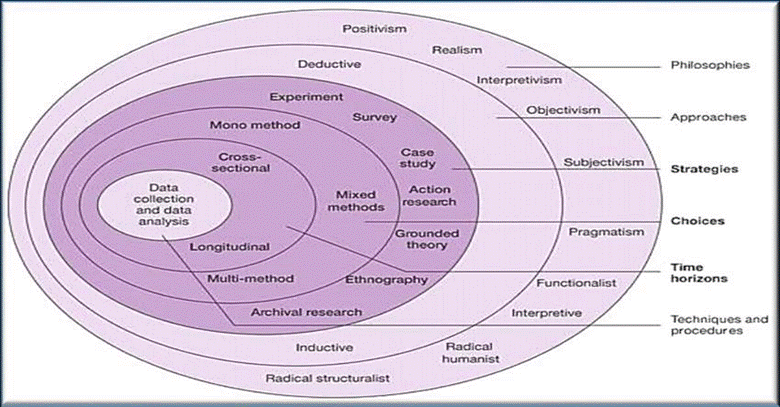
Figure
3.1: Research onion
(Source- Saunders,
Lewis & Thornhill, 2009)
3.3 Research Philosophy
In a research project, different types of
research philosophy can be applied like interpretivism, realism, positivism. In
case of interpretivism, this research philosophy includes natural properties in
a research project. Application of these natural and realistic properties can
make the research project more viable (Flick, 2015).
Furthermore, application of interpretivism can exclude additional assertion of
the researcher which is irrelevant for the research project. Moreover,
interpretivism includes brief and descriptive analysis of the issues related to
the research topic. In case of realism, it includes real-time quantitative
analysis in order to determine the main problems and the solution related to
the issues of the research projects (Kothari, 2004). This
research philosophy mainly deals with the primary method of a research project.
On the other hand positivism, research philosophy
deals with the experimental research works and includes the experimental way to
justify the solution of the issues related to the research topic. Positivism
philosophy mainly includes natural and realistic phenomena in order to check
the effectivity of the relevant solution of the issues related to the research
topic (Saunders, Lewis & Thornhill, 2009). Due to this reason in this research
project, the positivist philosophy is applied.
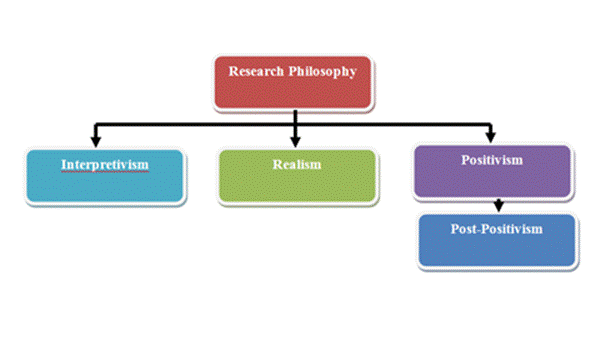
Figure 3.2: Research Philosophy
(Source: Flick, 2015)
3.4 Research approach
In order to maintain the normalcy and the
effective progression of the research works, there are mainly two types of
research approaches are available one is deductive and other is the inductive
approach (Yin, 2013). In case of the deductive approach,
this approach includes the theories to make the proper check of the solution
that is concluded by the research project. On the other hand
in case of the inductive approach, this approach helps to derive new theories
from the conclusion of a research project. To do so inductive approach includes
qualitative assessment in the research project to find out new theories from
the conclusion of the project (Flick,
2015). However deductive approach is based on
the application of the previous hypothesis of different research works in a
research project. This helps to make proper justification of the solution
related to the issues of the research project. Hence in this research paper
application of the deductive approach is included to understand the effectivity
of green building material in case of saving the energy effectively (Kothari, 2004).
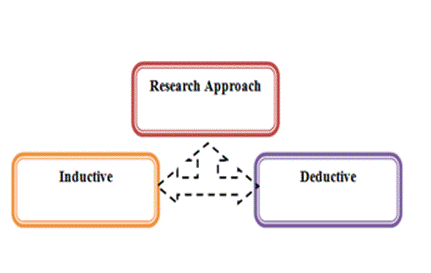
Figure
3.4: a Research approach
(Source: Flick, 2015)
3.5. Research design
Three main types of research design are descriptive research design,
explanatory research design, and exploratory research design. Descriptive
research design mainly uses observational data to justify the solutions of the
research issues. In order to do this descriptive research design applies case study based analysis in the research project (Saunders, Lewis & Thornhill, 2009). Descriptive research design also
includes group based study to maintain the quality of
the analysis of the observational data. On the other hand, explanatory research
design includes the cause and effect procedure to
analyze the solution of the issues related to the research project. In order to
do this explanatory research design applies previous theories and hypotheses for
testing the results of the research project (Yin, 2013).
However, in case of exploratory research design, this research design deals
with the exploration of new possible solution related to the issues of the
research project. In this research project to find proper relationship between
the energy saving and green building material exploratory research design is
used (Flick, 2015).
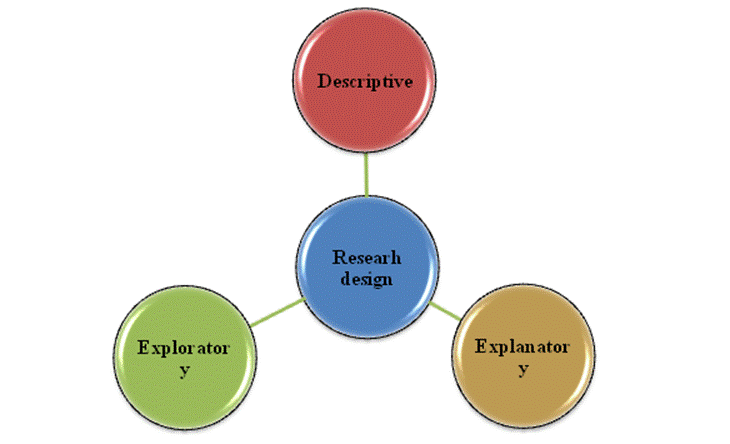
Figure 3.3: Research Design
(Source: Yin, 2013)
3.6 Research method
Research method can be either primary or
it can be secondary depend upon the research work relevant method of the
research work must be adopted. In case of primary research method mainly
interview and survey-based data analysis are taken into the consideration. On
the other hand in case of secondary research method
analysis on the basis of the study of journals and books is conducted (Kothari, 2004). In this research project, the second method of research works is
applied and the analysis is made on the basis of the consideration of
conclusions of different journals and books. The secondary method is chosen in
this research because it allows developing an effective idea about the green
building materials. It also allows the researcher to get in-depth knowledge
about the use of the green building material in the construction and their
impacts (Saunders, Lewis & Thornhill, 2009). Apart from the secondary research does
not involve any response from any individuals thus it is bias-free and is used
for relevant research data.
3.5 Data collection method
The data collection method involved the use
of quantitative data collection through secondary research was in the
researcher used the different reports and journals to collect the data. Data
regarding the use of green building materials and other renewable materials
were collected from project reports of construction in Australia (Yin, 2013). In addition, the carbon emission, the energy utilization as well as
the use of renewable sources of energy along with the greenhouse gas emission
data were collected on the different construction projects in Australia. Such
as the report of Ponds shopping center, the Karratha Project, Stockyard Hill
Wind Farm and the Home of Renewable Project.
3.6 Data analysis technique
The quantitative data collected is analyzed
by SPSS were in the researcher analyzed the data collected from the
construction project reports. It is beneficial in this research because it
allows the use of small sample size to get proper results. In addition, it led
to the establishment of a relationship between variables for better proving of
the hypothesis (Flick,
2015).
3.7 Ethical consideration
The ethics in this research is maintained
by protecting the data as per the Privacy Act 1988 of Australia. As per this
act, the data collected from the research is protected by encoding them and by
keeping them in the safe vault. In addition, the data will not be used for any
commercial purpose and will be used only with the permission of the guide (Kothari, 2004).
3.8 Summary
The chapter clearly highlights that
positivism has been used as the research philosophy along with exploratory
research design and deductive research approach. The research method includes
secondary quantitative data collection method which will be analyzed by SPSS.
Reference
list
Books
Flick, U. (2015). Introducing research methodology: A beginner's guide
to doing a research project. Sage Publication: United States
Kibert, C. J. (2016). Sustainable
construction: green building design and delivery. John Wiley & Sons:
Hoboken, US
Kothari, C. R. (2004). Research Methodology: Methods and techniques. New
Age International: India
Pacheco-Torgal,
F., Cabeza, L. F., Labrincha, J., & De Magalhaes,
A. G. (2014). Eco-efficient construction and building materials: life
cycle assessment (LCA), eco-labeling and case studies. woodhead
Publishing: UK
Saunders, M. L., Lewis, P. &
Thornhill, A.(2009). Research methods for business students, 4.
Yin, R. K. (2013). Case study research: Design and methods. Sage
publications: United States
Journals
Ab. Azis, S. S., Sipan, I., Sapri, M., Abdul Jalil, R., & Mohammad, I. S. (2017).
The effect of green envelope components on green building value. Property
Management, 35(2), 181-201.
Allen, J. G., MacNaughton,
P., Satish, U., Santanam, S., Vallarino, J., & Spengler, J. D. (2016).
Associations of cognitive function scores with carbon dioxide, ventilation, and
volatile organic compound exposures in office workers: a controlled exposure
study of green and conventional office environments. Environmental
health perspectives, 124(6), 805.
Chew, M., Conejos, S., &
Asmone, A. S. (2017). Developing a research framework
for the green maintainability of buildings. Facilities, 35(1),
39-63.
Gou, Z. (2016). Green
building for office interiors: Challenges and opportunities.Facilities, 34(11),
614-629.
Hunag, L. J., Wang, H. Y.,
& Wang, S. Y. (2015). A study of the durability of recycled green building
materials in lightweight aggregate concrete. Construction and Building
Materials, 96, 353-359.
Kumar, H., & Sahu, V.
(2015). Performance and rating of the residential green building. Civil
Engineering and Urban Planning: An International Journal, 2, 1-7.
Lee, T. L. (2018). The Key
Factors Promoting the Use Of Green Building Materials
For The Interior Design And Decoration. International Journal of
Organizational Innovation, 10(3), 144-152.
Li, K., & Lin, B.
(2016). Impact of energy conservation policies on the green productivity in
China s manufacturing sector: Evidence from a three-stage DEA model. Applied
Energy, 168, 351-363.
Li, W. F. (2014). The study
on the promotion of Chinese green energy-saving buildings. Applied
Mechanics and Materials, 672-674, 1847-1850.
Lu, B., & Zhao, Q.
(2014). Development and application of green building design.Applied Mechanics and
Materials, 584-586, 840-844.
MacNaughton, P., Satish, U.,
Laurent, J. G. C., Flanigan, S., Vallarino, J., Coull, B., ... & Allen, J.
G. (2017). The impact of working in a green certified building on cognitive
function and health. Building and environment, 114,
178-186.
Pacheco-Torgal,
F. (2014). Eco-efficient construction and building materials research under the
EU Framework Programme Horizon 2020. Construction
and building materials, 51, 151-162.
Ren, H. Y., Wang, S., &
Wang, C. (2015). General analysis of green building materials and development
in China. Applied Mechanics and Materials, 744-746,
1427-1430.
Santamouris, M. (2014). Cooling the
cities a review of reflective and green roof mitigation technologies to fight
heat island and improve comfort in urban environments. Solar energy, 103,
682-703.
Su, Y. M., & Tsai, Y. P.
(2014). The importance of the appearance image and cognition of green building. Applied
Mechanics and Materials, 496-500, 2544-2548.
Tam, V. W. Y., Le, K. N., Tran,
C. N. N., Wang, X., & Wang, J. (2017). A Review Of
International Green Building Designs. International Journal of
Construction Project Management, 9(1), 3-18.
Tsai, W. T. (2017). Overview
of Green Building Material (GBM) Policies and Guidelines with Relevance to
Indoor Air Quality Management in Taiwan. Environments, 5(1),
4.
Wang, L., Toppinen, A., & Juslin, H.
(2014). Use of wood in green building: a study of expert perspectives from the
UK. Journal of cleaner production, 65, 350-361.
Wang, Y., Bakker, F., De
Groot, R., & W rtche, H. (2014). Effect of
ecosystem services provided by urban green infrastructure on the indoor
environment: A literature review. Building and Environment, 77,
88-100.
Yang, R. J., & Zou, P.
X. (2014). Stakeholder-associated risks and their interactions in complex green
building projects: A social network model. Building and Environment, 73,
208-222.
Yang, R. J., Zou, P. X.,
& Wang, J. (2016). Modeling stakeholder-associated risk networks in green
building projects. International journal of project management, 34(1),
66-81.
Zhou, Y. (2017). 60. An
Optimization Design of Green Building Index Evaluation System based on Low
Carbon and Ecological Planning Model. Bolet n
T cnico,, 55(15), Zhou, Y. (2017). 60. An
Optimization Design of Green Building Index Evaluation System based on Low
Carbon and Ecological Planning Model. Bolet n
T cnico,376-723
Zuo, J., & Zhao, Z. Y.
(2014). Green building research current status and future agenda: A
review. Renewable and sustainable energy reviews, 30,
271-281.
Websites
Green
Building Materials (2018).
repositories.lib.utexas.edu Available from:
https://repositories.lib.utexas.edu/bitstream/handle/2152/13325/9-Fithian_Sheets-Green_Building_Materials
[Accessed on: 10/1/2018]
Green Building Guide (2018). builditbackgreen.org Available from:
http://www.builditbackgreen.org/bushfires/interactive-green-building-guide/building-materials.aspx
[Accessed on: 10/1/2018]