 : 561
: 561
MEASURING AND EVALUATING THE CASUAL RELATIONSHIP BETWEEN CORPORATE
SOCIAL RESPONSIBILITY AND CORPORATE FINANCE
ACKNOWLEDGMENT
This d project is dedicated to my parents, who believed I could pursue
this dream, and to my wife and especially my son P, all have been a great
support during the whole journey of this course and especially this
dissertation. I am truly thankful for having all of you in my life.
ABSTRACT
After the
Doctoral Project is complete, the candidate wrote an abstract that summarizes
the study's purpose, the primary theoretical and conceptual perspective(s)
used, the major ideas developed in the study, and the implications of these
ideas. In order to conform to APA requirements, the abstract should not exceed
250 words. In a well-written abstract, a
reader finds the argument expressed clearly, as well as a statement about the
methodological approach. Although the
candidate writes the abstract after the completion of the study, the abstract
is placed at the beginning of the D Project.
Contents
1. CHAPTER
ONE: OVERVIEW OF THE STUDY
1.6
Theoretical and Conceptual Framework
1.12
Organization and Remaining Chapters
2. CHAPTER
TWO: LITERATURE REVIEW
2.3 The
theoretical basis of CSR
2.4 Critical
Evaluation of theories of CFP.
2.5 Critical
analysis of factors affecting CSR
2.5.1
External factors affecting CSR..
2.5.2
Internal factors affecting CSR..
2.6 Critical
analysis of the benefits of CSR
2.6.1
Impacts on company reputation.
2.6.2
Impacts on shareholders of the company
2.6.3 Impact
on employees of the company
2.6.4 Impact
of CSR on company management
2.6.5 Impact
of CSR on the environment
2.7 Critical
analysis of the factors affecting CFP
2.7.1 Effect
of financial factors on CFP
2.7.2
Effects of non-financial factors on CFP
2.8 Critical
evaluation of the impacts of CFP
2.8.1 Effect
of CFP on the stakeholders
2.8.2 Effect
of CFP on the employees
2.8.3 Effect
of CFP on the Consumers
2.9 Critical
evaluation of the relation between CSR and CFP
2.10
Illustration of the strategies to establish good CSR practice
2.11
Critical evaluation of the methods to establish better CFP
2.12 The gap
in the literature
LIST OF TABLES
LIST OF
FIGURES
Figure 2.1 Conceptual framework
Figure2.2 Carroll's CSR pyramid
Figure 2.3: Factors affecting CSR
Figure 2.5: Factors affecting CFP
Figure 2.7: Relationship between CSR and CFP
Figure 2.8: Strategies to establish good CSR practice
1. CHAPTER
ONE: OVERVIEW OF THE STUDY
1.1 Overview of
the study
Corporate Social
Responsibility has emerged as a factor that influences the financial
performance of an organization (Chuang & Tai, 2014). The present study aims
to:
(a) Provide
the responsibility between CSR and CFP so as to provide importance in relation
to the corporate social responsibility in Dell toward its internal and external
stakeholders and
(b) Determine
its impact on the financial performance of Dell during a given time period.
This study identifies the critical factors of CSR in case of Dell and
determines the importance of these factors in framing the relationship between
Corporate Social Responsibility (CSR) and Corporate Financial Performance
(CFP).
Investors and corporations show an increasing interest
in Corporate Social Responsibility (CSR), as it renders sustainable development
(Chuang & Tai, 2014). Regardless of the underlying uncertainty as to how
CSR affects the financial performance of a firm. As a result, many researchers
have explored the causal relationship between CSR and financial performance,
although they have achieved conflicting results. There is little evidence
showing that CSR and corporate financial performance (CFP) relate positively or
directly. The causal relationship between CSR as well as CFP is based on the
strategies about the usage of Dell in order to meet the social responsibility.
The relationship between the CSR as CFP is based on the factors on either
non-linear or based on the methods used in the non-existent case. The
non-linear relationship is proposed on the increment of the principle of CSR as
the theory is implemented in stakeholder's analysis. This study aims to
establish a causal relationship between the CSR and CFP as well as to measure
and evaluate this relationship. The company chosen for this study is Dell, a
multinational computer technology company based in Texas (USA). Specifically,
CSR effort, taken up by the company was be analyzed and evaluated to determine
the impact on the financial performance of the company.
1.2 Background of the Study
Fomukong (2014) stated that every
business aims to create wealth for their owners by offering products and
services that meet the market demand. However, in recent years, the focus has
shifted from mere financial gains to social responsibilities of the business.
For this study, CSR refers to the actions taken to do some social good, going
beyond the interest of the company as required by law (Sprinkle & Maines,
2010).
The issues related to the methods of implementation of
CSR activities is related to the eco-efficiency of the Dell, the engagement in
relation to the enhancement of the performance of the shareholders to improve
the working condition of the employee. The focus is altered from the financial
gains to the methods implemented in social gains to earn a high level of profit
related to Dell. The environment is to be managed in such a way that the
information technology related company earns a substantial level of profit in
business structure. The working condition of the employee who is working in the
organization associated with Dell must be improved to enhance the level of
productivity which resulted in a competitive advantage over other markets. When
the concepts in relation to CSR have practiced the operational increase in
sales, as well as the profit, is noticed along with an increase in quality and
efficiency.
As stated by (Peloza & Shang, 2011), the CSR
practices, as well as the achievement based on CFP, is interlinked with each
other as they aim to earn a sustainable amount of profit in the long-term
business scenario. The policy which is implemented in case of CSR activities is
interrelated as both these theories are achieved as a business model. On the
other hand, the principle about CFP is related to the purpose of enhancement of
the figures related to sales as well as to enhancement leading to productivity.
The CSR practices vary from country to country, so multinational companies have
to acquire knowledge about the country in which it operates (Chuang & Tai,
2014). Therefore, a multinational organization typically adopts a general CSR
approach that can be applied to the different units of the company in different
countries. As businesses develop a complex relationship with the communities in
which they operate, the direct impact of the business varies from country to
country (Jamali, 2016).
A comprehensive and multidimensional program for CSR
has three major parts: governance, social media, and the environment (Peloza &
Shang, 2011). Within each specific category, there are initiatives of CSR. This
study evaluated these initiatives and determined their impact on the financial
performance of the company.
This is a major threat which can be implemented for
the management of the specified Dell Company to identify, quantify, and unlock
the business value of CSR practices, thereby allowing business to allocate its
resources effectively. The business process helps to implement the CSR
approaches in relation to the performance by evaluating the economic,
environmental as well as the social factors. The profit of the dell is to be
enhanced to provide motivation of the employees as they are inclined to work in
a more balanced way. The profit scale has to be enhanced to increase the level
of sustainability as to implement better performance of the business firm.
1.3 Problem Statement
The measurement and evaluation of the causal
relationship between CFP and CSR change constantly; therefore, it is necessary
to conduct an up-to-date study that underlines the current phenomenon.
According to Brammer et al. (2012), previous scholars of this topic have
achieved varying results. Hence, the problem is that the current causal
relationship that exists between the CSR and CFP is unknown, as is the impact
of CSR practices on the CFP of the company in five years. The interrelation in
between the CSR as well as the CFP is vague study as the different implication
of the methods is not properly evaluated. The three aspirations in relation to
the performance of CSR vision is not properly evaluated as the team leaders did
not follow the rules and regulation appropriately.
1.4 Purpose of the Study
In this study, I propose to measure and evaluate the
causal relationship between CSR programs and CFP. Moreover, I seek to determine
if the implementation of CSR programs causes an increase in long-term sales and
gross margins. Financial performance has been defined in the context of
traditional accounting and measures, which are primarily market-based measures.
Some intervening variables, such as the size, growth, risk, preceding year
performance, and management preference have been controlled statistically in
this report. As commented by (Ghelli, 2013), the
size, growth related to the methods which were used in case of CSR activities
as they are involved in improvement related to the environment structure. The
process of CSR involved different types of finance which is essential for the
maintenance of valuable information on the investors.
This research investigated the potential impact of
Corporate Social Responsibility on the corporate financial performance of the
company. A full picture of the subject was being created by taking from the
previous theoretical research and examining results from previous studies.
Previous researchers have reached inconclusive results regarding the
relationship between CSR and financial performance (Ghelli,
2013). There is little evidence that CSR
and financial performance are related directly. However, companies devote their
resources, money, and efforts toward CSR activities, implying that there are
certain financial benefits for the companies to gain.
Thus, the purpose of this research is to fill the gap
in existing research and to render both the investors and the companies a
better understanding of the CSR efforts. Additionally, this study showed how
CSR efforts add value to the financial performance of the company. The results
which are obtained are useful as well as valuable for investors, the company,
and stakeholders, as they are involved, derive benefit from the CSR activities
of the company. In order to enhance the profitability in case of CSR activities,
the gap of the existing research is to be minimized to maintain long-run
profitability in case of the business organization.
1.5 Methodology
The methodology adopted for this study is a
mixed-methods research design. The company's initiatives during the period of
five years were be analyzed qualitatively, while the financial performance
shall be analyzed quantitatively by measuring the various financial ratios and
then determining the increase in sales and gross profit margin over a period of
five years. The financial performance of the company is to be analyzed in an
appropriate manner to improve the financial sustainability in case of cash flow
statement. The methodology aims to provide significance on the matter
implemented on enhancement used in the process of CSR.
1.6 Theoretical and Conceptual Framework
The business environment which was based on the
strategies which have resulted in enhancement of globalization as well as an
increase in the process of competition within the business organization, in
turn, helps to increase productivity. The business environment has become
challenging in today's era which is beneficial to improve the benefit related
to the stakeholders. The reputation of the business organization can also be
enhanced by adopting socially responsible activities. As stated by Adeleke (2014),
the firm presents their financial principle by CSR activities in their annual
report which has been presented in case of raw materials.
The stakeholder theory which is based on stakeholders
is crucial as it helps to maintain the business structure within the firm as
the theory is based on harmonization with the stakeholders. The stakeholder
theory is important as it helps to maintain the effect of key variables which
affects the financial performance of the company. The theory used six different
methods of the qualitative method which is used to analyze the profitability of
the firm.
The appropriate relationship between the different
employees of the firm results in improvement in productivity. The other methods
are products which are readily available in the market, the community which is
based on diversity of the employees. The methods used in governance are used
for utilization of environment to be implemented appropriately. The advantages
of the stakeholder's theory are that it takes into account the gross profit
margin as well as the total sales which are used for maintenance of economic
performance of the company (Orlitzky, 2013).
As commented by Weber (2008), the stakeholder's theory
is beneficial as the relationship in between the social as well as the
environmental performance of the company is maintained which depicts an inverse
shaped curved. The theory is chosen in the study as it helps in providing
analysis in maintaining the relationship in between the activities based on the
CSR activities as well as success in terms of economic value.
As opined by Orlitzky
(2013), the stakeholder theory is chosen as it was assumed the performance of
the employees in terms of economic values which is considered to be a dependent
variable. This theory is based on the importance of stakeholder which is
beneficial as it helps to produce such goods as well as the services which are environmental friendly in nature as well as which is
demanded by the customer. The theory also takes into consideration the nature
of the technology which is being used in the acquisition of raw materials which
results in enhancement of the scale of profitability within the firm. The
stakeholder's theory is chosen as it helps in evaluation of intensity within
the firm to increase the level of sustainability. The theory is used in this
study as it helps to maintain the pressure from the stakeholders to manage the
rules as well as the regulation of the firm. The rules and the regulation are
to be based in such a way that it helps to maintain the environmental
friendly behavior.
As opined by Orlitzky
(2013), the theory is chosen in this study as it consisted of both the internal
as well as the external stakeholders. The internal stakeholders comprise of
employees, the owners as well as the manager who are linked directly to the
company and are solely responsible for maintaining the image of the company in
its long term. The external stakeholders in case of stakeholder theory are the
suppliers, the government rules and the regulation on which the company
activities are dependent and the creditors.
As opined by Soana (2011), the customers and the
shareholders are responsible for maintaining the profit scale of the company.
The stakeholder s theory is important as it helps to maintain the relationship
in between the business enterprise as well as its internal and external
shareholders.
Thus, the stakeholder's theory is undertaken in the
study as it helps to provide strategy in maintaining the relation of the
company along with its stakeholders effectively and efficiently.
1.7 Significance of the Study
This study has many implications for executives, key
decision-makers, and owners of the business and the beneficiaries of CSR
activities (e.g., consumers, community, environment, stakeholders, and employees).
This study builds a foundation for future research. According to Soana (2011),
there has been an increase in the expenditures for CSR for which the chief
executive must decide how many resources were being allocated to make it
beneficial. Hence, this study is significant for such decision making, as it
provides information about the impact of the CSR activities on the financial
performance. The Dell Company may use the results of this study's implications
regarding contributions to its socially and environmentally-responsible goals.
1.8 Assumptions
It is assumed that the CSR practices being followed by
the company are comparable to industry standards and are easily available to
all the stakeholders. The next assumption is that all components of the CSR
initiative pertain to the CFP measures taken for the study. The most important
assumption is that the socially- and environmentally-responsible activities are
commensurate with the cultural practices of the country in which the company
operates, as the company has offices around the world.
1.9 Limitations
Several factors limit the outcomes of the study.
First, this study focuses on one computer manufacturing company; hence, the
results are unique to the company and are not generalizable for the whole
industry. The second limitation is that only a few variables will be considered
to determine the causal relationship between the CSR and CFP. The omitted
variables may affect the accuracy of the results. The limitation of the
research is that although the research is based on Dell assumptions have
already been taken that the CSR and CFP interrelationship is more relevant in
case of IT companies. However, the results obtained in the research may not
apply to other sector or other IT companies. This is because the research is
solely focused on factors affecting Dell not all IT companies in case of CFP
and CSR. In addition, it can also be seen that not all the factors applied in
case of Dell is applicable for the ethical and CSR index of other companies.
The third limitation is that the data for quantitative analysis is collected
for only five years; however, the company practices CSR activities and has done
so since its inception. In addition, regression analysis of the impact of the
variables of CSR such as the greenhouse emission and the renewable energy use
and the energy consumption with that of the CFP is also analyzed. This is done
based on the last five years report of CFP. The compounding effect of the CSR
activities was not taken into account, as it is seen from previous studies that
CSR activities do not generate results immediately. The fourth limitation is
that the data used in the study is secondary data and they have been generated
for a different purpose from which the implications for the study have been
derived. The secondary research has been used to establish the views of
previous research regarding the relationship between CSR and CFP and link it to
the existing regression analysis data of Dell. The secondary research although
was given a brief overview and was a help to establish the quantitative research.
However, the data from the previous research papers may suffer from lack of
reliability and validity. The fifth limitation is that accuracy and credibility
of the secondary data cannot be guaranteed.
1.10 Delimitations
The study is limited to the company itself, and only
two dimensions of the CFP are considered. The agenda of this research is to
examine and analyze the causal relationship between CSR and CFP in the chosen
company, Dell. The CSR variable is a multidimensional, ethical rating at the
individual component level. One way to measure CSR is the use of
multidimensional and ethical ratings. However, an alternative way was generated
by the researcher for the measurement of the CSR, which focuses on the perceptions
of the stakeholders. The primary data was collected by means questionnaires
from the stakeholders or by conducting an in-depth interview or as an
information disclosure that was related to the social conduct or was given as a
uni-dimensional social measure like, the reputation
of the company, environmental footprint, expenditure done on charitable
purposes or investment made for socially responsible activities. The
delimitation of the study is that the study clearly establishes the relation of
CFP with CSR and does not establish any relation with the operation and
production value of the company. It is not generalized and is very much
inclined to IT companies especially Dell. The study is confined only to the
analysis of the relationship between CSR and CFP and not in establishing the
relationship with other factors such as the employment relation and employee
turnover or the leadership practices. These factors although may affect the CSR
and CFP but are not considered in eth study.
1.11 Definition of Key Terms
External stakeholders: according to Orlitzky (2013), these are the groups of organizations or
people that are impacted by the firm or have an impact on the firm like
government, suppliers, customers, community, and trade unions.
Internal stakeholders: according to Orlitzky (2013), there are the sub-groups or the people
within the firm that can directly or indirectly influence the production and
the policies of the organization.
Management
discretion/preference: Soana (2011) stated that these are decisions related to the
spending by firms, which are entirely discretionary in nature.
Corporate governance: the means by which
any company is operated, controlled and managed to keep in focus the benefits
of the stakeholders, as defined by OECD (2008).
Environmental conduct: the behavior of the
business entity and how it treats the environment is an important resource in a
way that is sustainable and causes minimum or least harm as was proposed by
Idemudia, (2011).
As opined by Orlitzky,
(2013), the environmental conduct helps to maintain the behavior with respect
to the enhancement of the business organization which results in increasing the
sustainability. The enhancement in sustainability helps to achieve the required
treatment which was provided in case of the environment.
The main aim or objective of the business unit is
concerned with the business structure is to use the resources of the
environment in such way that it can be recycled and reused. The structure of
the environment is to be properly evaluated to maintain the sustainability so
that the resources which are non-renewable in nature are saved for the use of
future.
Environment footprint: The harmful or
adverse effects on society and the environment by the operations of the
business for which the corporations have social and environmental obligations
to reduce it to a level which is safe for the entire community.
Ethical conduct: The ethical consideration
of the business organization is used when the stakeholders undertake the true
as well as the fair value in case of preparation of financial terms. The
financial terms are to be prepared in accordance with the rules as well as the
regulation which is used in the enhancement of the profitability of the
organization. The main purpose of ethical consideration in case of business
enterprise is to maintain the confidentiality during the recording of data. The
internal control is also maintained within the organization to possess smooth
functioning in case of ethical consideration.
Financial reporting: Soana (2011) proposed
that these are the rules that govern the maintenance of the company s records
used in the preparation of the financial statements to be used by the
stakeholders of the company.
Greenwashing: As commented by Sun &
Cui (2014), the term greenwashing' is usually a practice which is based on
claiming the environmental benefits which are based on the products as well as
the final goods and services. This process as used by the company helps to be
more reliable in case of maintaining the products which are based on environmental friendly.
As opined by Soana (2011), the methods undertaken by
the company on the basis of greenwashing use the cost reduction method by
making the competitor more environmentally friendly. The process of green
manufacturing in case of changing the packaging system of finished goods as
well as on the method used in recycling process is beneficial.
Ozone layer: a layer in the atmosphere of
the earth; ozone depletion causes adverse effects on the plants and animals.
The ozone layer contains a high amount of ozone (O3) which is found in the
lower part of the stratosphere from about 20 to 30 kilometer above Earth.
Risk
management: the practice of identifying business risks, analyzing these risks
for comprehending them, assessing them to give them priority, and addressing
them by taking appropriate strategic actions. Risk management also implies
monitoring them for ensuring that remain within the limits of tolerance and
control, as given by Sprinkle and Maines (2010).
Social conduct: The concern of the
business firms for the working conditions of its workers and the living
conditions of all its stakeholders.
Social responsibility: It is defined as
the role of the business firm in supporting and improving society while
simultaneously pursuing the legitimate purposes of the business, profit and
shareholders wealth maximization.
Stakeholders: It is defined them as those
parties who are impacted by the operations of the firms and those who can
potentially influence the behavior of the firm.
Stakeholder theory: This theory states
that in the long-term, it is advantageous for firms to keep their stakeholders
happy with the operations of the firm.
As opined by Sprinkle and Maines (2010), the
stakeholder theory is based on improving the performance on the basis of both
the internal as well as the external stakeholders.
Sustainability: As commented by Sprinkle and Maines (2010),
the term sustainability' signifies the usage of the resources in such a way
the needs of the present generation are met without compromising the proper usage
in case of the future generation. The practice which is based on the economic
values, as well as the method implemented in social responsibility, is used in
case of protection done on the basis of environmental factors.
1.12 Organization and
Remaining Chapters
This doctoral project is well organized into five
chapters. The first chapters consist of introduction where the problem
statement, the purpose of the study along with the nature of study, definitions
and research questions are mentioned. The attempts were being made towards
measuring and evaluating a casual relationship
between corporate social responsibility and corporate finance. Chapter two
includes literature review which consists of the background information about
the research. The full range of theory related to the corporate social
responsibility, corporate finance, and relationship between the two was being
depicted. Chapter three was include the research methodology where the information on
the research design, number of participants and instrumentation used for
collecting data was be identified. This chapter also consisted of data
collection process, assumptions, limitations, delimitation and also the ethical
considerations related to the project. Chapter four consisted of the analysis
of the data collected. The data analysis
was being made and the conclusion was being drawn. Chapter five was follow the evaluation of the data collected followed by a
list of recommendations that are required to be followed for the purpose of
attaining high-end gains and profits from the corporate finance and corporate
social responsibility.
2. CHAPTER
TWO: LITERATURE REVIEW
2.1 Introduction
The current chapter on literature review takes into
account the theoretical basis of the Corporate Social Responsibility (CSR) and
the critical analysis of the factors affecting it. It also takes into
consideration the evaluation of the theories in regards to CFP and the critical
analysis of the factors affecting it. It takes into consideration the critical
evaluation of the impact of CSR on the company's financial statement as well as
the benefit of the stakeholders of using CSR. Apart from that, it evaluates the
impacts of CFP on the employees as well as the stakeholders. The dissertation
assesses the relationship between CSR and CFP on the basis of critical
evaluation. Lastly, it provides the strategies to implement a good CSR practice
as well as the gap in the present literature review.
2.2 Conceptual framework
Figure 2.1 Conceptual framework
Less cash flow is slowing down the
purchasing power Small size is giving less opportunity
to engage more staff Less cash flow in the economy
affecting CFP Size of the company affecting CSR The relationship between CSR and CFP The small size of the company is slowing down the CSR Stakeholders are losing interest in
investment
(Source-created by author)
2.3 The
theoretical basis of CSR
As commented by Wang et al. (2015), the Carroll's CSR pyramid signifies the
strategies of the organization to meet the social responsibility as it can be
accomplished by using four stages. The four stages can be the economic, legal,
ethical as well as philanthropic which can be followed by the business
enterprise to ensure that the business complies with rules and regulation or
not. On the contrary Tang et al. (2015), rejected this and commented
that the four stages are not required for ensuring a well establish business
structure, among that the two stages legal and ethical are vital to comply
rules and regulation. The legal structure takes into account the different
types of rules as well as a regulation which is essential for the maintenance
of long-term business. The ethical structure comprises of the rules as well as
regulation based on which a business acts ethically, and the financial
statement in regards to CSR are prepared with following the true and fair view
of GAAP (Korschun, Bhattacharya & Swain, 2014).
As stated by Shaukat, Qiu & Trojanowski (2016),
the CSR is based on the evaluation of economic values in accomplishing the
organizational goals as well as objectives. The economic values are based on
the assessment of the profit motive of the business as profit is the ultimate
source for the achievement of the long-term objectives. The profitability is
the only one way to achieve the long-term benefit which applies to both the
small scale as well as the large scale industries.
However, Saeidi et al. (2015) argued
and commented that philanthropic stages in Carroll's CSR pyramid are essential
for the evaluation of the long-term business objectives apart from the ethical
as well as legal values. The responsibility of the philanthropic stages is to
provide a proper result to the society at the end of an accounting period. The
donation, grants received by the project is vital for the evaluation of the
long-term aims as well as to maintain the upward rising of the profit scale. It
takes into consideration the luxurious things as they focus on strategies for
the improvement of quality life of the employees to provide motivation.
Figure2.2 Carroll's CSR pyramid

(Source-
Flammer, 2015)
As commented by P rez & Bosque (2015), the theory
of strategic leadership signifies that the Chief Executive Officer (CEO) has
the direct impact on the evaluation of CSR as are involved in the implication
of strategic CSR rather in case of average companies. On the contrary Orlitzky et al.
(2017) argued that there is no direct relation between the strategic leadership
as well as the evaluation of the company s growth. The business enterprise
growth can be enhanced by following both the ethical as well as economic
responsibility in Carroll's model of CSR.
As opined by berseder et al. (2014), the key features
related to the implication of Carroll's model of CSR are the evaluation of the
profit scale which is the vital factor for the foundation of any type of
business enterprise. The enterprise both short-term, as well as long-term, is
based on the factors of earning a profit in its long-term business prospects.
On the other hand, Obeidat, Tarhini & Aqqad
(2016), opposed this and commented that the business enterprise must comply
with rules and regulation as per the strategic leadership theory. The
organization can earn a profit when the rules, as well as the regulation, are
compiled, and the business enterprise follows the ethical practices in
Carroll's theory which is based on CSR.
As stated by Saeidi et al. (2015), Carroll's theory is simple to use and understand
as it helps to establish an emphasis on the importance of the profit scale. The
process associated with CSR is more adjustable as the business related to the
stakeholder model helps to evaluate the ethical values. On the contrary
Shaukat, Qiu & Trojanowski (2016), rejected and commented that the
Carroll's CSR model is complex in nature as the profit scale and the evaluation
of the ethics is not easily determined. The interaction of the responsibility,
as well as the social issues, is not determined which is crucial for
maintenance of profit scale in case of business enterprise. The responsibility
is based on an evaluation of both the long-term as well as the short-term
objectives in the evaluation of the profit scale in case of business enterprise
(El Ghoul, Guedhami & Kim, 2017).
Although there is opposition, the four stages in case
of Carroll's CSR model are crucial for the determination of long-term profit
scale and by compliance with ethical values in business enterprise.
2.4 Critical Evaluation of theories of CFP
As commented by Kim, Song & Lee (2016), the
futures of management theory provides the implication
of the future orientation in regards to the achievement of the long-term goals
as well as objectives. It takes into consideration the different types of
theories as it can be applied in case of variables as well as the management
philosophy. On the other hand, Shaukat, Qiu & Trojanowski (2016), argued
and commented that to achieve the high level of profit scale in case of a
business enterprise, the short terms objectives are also vital apart from the
long-term aims as well as the objectives.
As opined by Ba os-Caballero, Garc a-Teruel & Mart nez-Solano
(2014), the business management of the present business trend is notably
adapting the theories of CFP for making the business more sustainable. The
management theory of CFP is helping the business to grow in different technical
ways. This management theory of CSR is remarkably transforming the trends of
the business as it is using the digital platforms for managing the finance. The
management theory is helping in expanding the ways for business development.
Various new development features are adding up to the management theory of CFP.
As for example, artificial intelligence and robotics mechanisms were added up
for the betterment of the CFP in the business management.
On the contrary Brammer, He & Mellahi
(2015), argued that the implementation of an algorithm in the finance has made
the finance management stronger than before. Besides that, the gig economy is
also helping in the development of the business that is providing to be
beneficial for the companies. The CFP also includes the environmental
orientation that is helping it to enhance the acceptability in the business
market. CFP is always upgraded to implement various new features in it thus
this is helping the business to achieve the competitive advantages in the
market. The innovative new feature that includes into CFP is helping the
business to create new ideas for making the finance of the business stronger.
As opined by Cheng, Ioannou & Serafeim (2014), CFP
is expanding the social innovations for the business that is helping the
society to become more developed. The changing techniques for CFP always
support the up-gradation of the business and make the company unique in context
to the other business companies. CFP always adopt new methods that are
providing the companies opportunity to grab more new features into the
business. These enhanced features of CFP theories are helping CFP to evolve the
changing patterns of business. This new feature providing theories are
engraving remarkable milestones to flourish the business.
On the contrary, Dhaliwal (2014) argued that the
circumstantial prudence for the business development and orientation is fully
dependent on the methods that have been adopted by the companies. The
traditional theories of CFP are helping the business to evolve in a certain way
that is providing the business a feature of creating a bridge between new and
old methods. The evolution of theories helped the business to create profound
knowledge in the finance management. Due to this enhanced feature providing methods
the adaptation of CFP is making the performance of the business better. The new
theories of CFP are also helpful in business growth assessment that helps the
business in taking decisions regarding the business growth.
As commented by Ditlev-Simonsen (2015), the
forecasting feature of the CFP is helpful in decision making that helps the
business to adapt the changing pattern according to the need of the business.
The occasional updates helped the business to mitigate the wrong decisions
taken previously for creating the better business environment. Though the
features provided by the CFP is creating positive impacts for enhancing the
financial performance of the business but there have certain risks for this
quick decision-making technique of CFP. Since the decisions are always taken in
short time span thus, they may become error-prone for the business. As for
example, the forecasting of business growth may give wrong results due to the
short period assessment. The management theories that have been incorporated
into the CFP may damage the business orientation as they are not well verified
for their suitability on the business.
On the contrary El Ghoul, Guedhami
& Kim (2017) argued that there are wide ranges of strategies in CFP for the
business development that was helped in reducing the business risks for the
company. Beside that as per the traditional management theories, CFP also
contains topical management theories that provide the business liberty of
finding flaws in the business. The periodic up gradation of the new theories
helps the company to become alert for the upcoming challenges. The theories
that have been constructed on the basis of the business circumstances are
providing wider views regarding the upcoming risks of the business. Thus this helped the companies to assess the risk level of
the challenge correctly, and they can be able to take precaution to stand up to
the challenge.
2.5 Critical analysis of factors affecting CSR
2.5.1
External factors affecting CSR
As stated by Rao & Tilt (2016), the companies in the financial
sectors give more priority to the social measures and the environmental
measures than the commercial sectors. The production companies need to give
more priority to the environmental measurement than the other companies.
Besides that, the companies need to give the same priority to the social
measures. The people and the companies engaged with the real estate enterprises
do not value the social measure and this is a vital factor that is affecting
the society. The transport companies are doing the same thing that the real
estate companies are doing. On the other hand, as per the comment of berseder et al. (2014), it has been observed that the
academic sectors are less interested in giving priority to the environmental
measurement. The public works department of the society and the health and
private sectors are also losing their interest in giving priority to the
measurement of the environment. However, it is a remarkable fact that the
public enterprises, the private organizations and the health and academic
organizations are taking more interest in social measurement. These sectors are
taking a deeper interest in the social measurement.
On the contrary Brammer, He &Mellahi
(2015) argued that many factors are affecting CSR but the first factor that is
affecting CSR is the company size. The size of the company is affecting the
social and the environmental measure in a very positive manner. As per the
research of Orlitzky et al. (2014), it can be
observed that the more the number of employees in a company, the better was the
effect on the CSR and thus the companies need to recruit a number of employees
that made the CSR stronger. Companies those are lagging behind for the less number of employees cannot take an important part
in the social and environmental initiative. Besides that, it is also a fact
that the small enterprises do not take an interest in the social and the
environmental measures due to their lack of financing capability in the
business. P rez & Bosque (2015) commented that the industries with huge
turnover always take an interest in the social, environmental measures due to
their huge cash flows in the business. Though the industries with huge revenue
take an interest in the social measures to make the business more profitable
and sustainable but they never show interest in the environmental measures.
As
opined by Cheng, Ioannou & Serafeim (2014), the main reason behind the
social measurement of the huge industries is that they are getting benefits for
the measurement. On the other hand, the environmental measurement is not
providing such a huge benefit for the companies. Thus
they are not showing any interest in this part of CSR. The companies are not
bounded by any barrier to take the environmental or the social measure. Due to
this reason, the companies are not having any legal issues regarding the
measurements. Besides that, the social and the environmental measure do not
have any effect on the market penetration of the companies. This is another
fact that is affecting the CSR, and thus the companies need to take a step for
the betterment of the environmental measurement. As opined by Obeidat, Tarhini & Aqqad (2016), though most of the companies do
not bother about the effects on CSR, few companies do this for the society and
customer satisfaction. In order to maintain the prospect of the company, all
the companies need to think about the impacts on CSR.
On the
contrary, Dhaliwal et al. (2014) argued that the cash flow in the business has
a significant effect on the CSR as it provides the company's ability to make
decisions. The cash flow in the business provides the ability to the companies
to take decisions independently. Higher the flow of the cash inside the
business, higher was the sustainability of the business. In this way, the
company made better revenue, and thus they can take rigid steps for the
betterment of the CSR. Thus the cash flow is another
factor that is affecting the CSR. Supported this as viewed by Lu et al. (2014),
the activities of the companies are also playing a vital role in the
development of CSR. In order to make more prospects the companies need to
implement specific rules and regulations for the well-being of the company. On
the other hand, increasing membership in the companies gives the companies
opportunity of getting various opinions. This helps the companies in taking
decision for the well-being of the company as well as for the wellbeing of the
CSR.
Figure
2.3: Factors affecting CSR
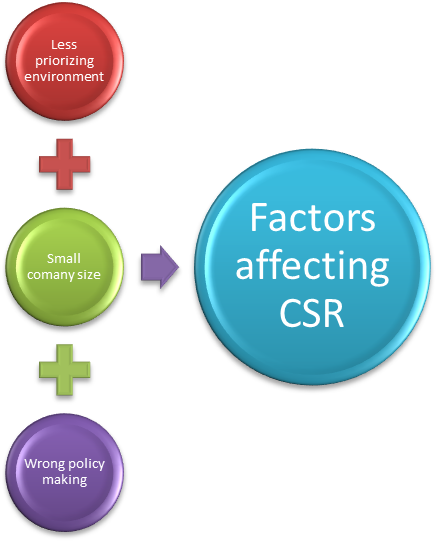
(Source: Malik,
2015)
As commented by Ditlev-Simonsen (2015),
companies need to form different bodies that can mitigate the problems
regarding the effects on CSR. In order to form these groups companies need to
engage people of different race. The companies need to promote the CSR in a
serious manner to mitigate the problems. The companies need huge funds for
promoting CSR and due to this reason; they have to think about the wellbeing of
CSR.
2.5.2
Internal factors affecting CSR
As commented by Kr ger (2015), this key role of the
financial companies can make the situation better for the CSR. The management
of the companies never focuses on the internal factors that are affecting CSR.
The wrong policies taken by the company is making the business more profitable
is also affecting the CSR growth. Thus companies need
to make stricter and more innovative policies and statements regarding the CSR.
Besides that, the internal roles of the employees of a company are also playing
a vital role in CSR.
On
the contrary El Ghoul, Guedhami & Kim (2017),
argued that the perceptions regarding the CSR are also a fact that is
internally affecting the CSR. The human resource management needs to take
decisions for making the CSR better. The governing body is not making rigid
steps for the CSR and due to this reason companies are not bothering about the
proper execution of CSR. Due to this, the companies are not giving proper
knowledge to their employees regarding the CSR which is greatly affecting the
CSR. Thus it is the duty of the companies as well its
employees to maintain proper CSR through effective understanding collaboration
between each-other.
2.6 Critical analysis of the benefits of CSR
2.6.1 Impacts
on company reputation
As commented by Flammer (2015), CSR has a great
contribution to the business as it provides many facilities and advantages to
the companies. CSR has no bindings of providing the features regarding the size
of the company. CSR increases the brand value of the products of the company as
it promotes the products inside the society. Beside that CSR also helps in
distinguishing the products and the qualities of the products distinctly.
Company reputation is a vital thing for the companies. Thus
the companies need to create a good reputation in the market. As stated by
Ditlev-Simonsen (2015) to improve the reputation of the company CSR plays an
important role. The corporate investments, as well as the investments for the
society, make the business company's image better to the mass of the society. Thus CSR can give the companies a competitive advantage and
to achieve the competitive advantage in the business companies need to make
small favors to their clients and the suppliers.
On the contrary Kang et al. (2015) argued that to make
the reputation of the company better inside the market the companies need to
behave well with the clients and the suppliers. This helped the companies in
achieving better position inside the market thus they were able to drag the
business in the global corridor.
2.6.2 Impacts
on shareholders of the company
As opined by Kim, Song & Lee (2016), the adaptation of CSR is
helpful for the company shareholders as it enhances the growth of the company.
The value of shareholders accelerates with the implementation of CSR in the company
and due to this reason; the shareholders of the companies grab more benefits
from the companies. The performance of the companies also upsurges with the
implementation of CSR in the companies thus the stakeholders grab a greater
percentage of benefits due to growth in the revenue. Besides that, the CSR is a
cost saving method and due to this, the company benefits increases.
This increment in the company revenue is added up to the shareholder's benefit.
On the
contrary, Korschun, Bhattacharya & Swain (2014)
argued that CSR increases the sale of the company thus the share value of the
company accordingly boosted up. This increment in the share value helps the
shareholders to increase their reputation. Beside that CSR helps in improving
the organizational growth thus the growth of the company helps the shareholders
to get more profit from the company. The most important benefit of implementing
the CSR inside the business is that helps in accessing the company capital.
Thus, this enhanced accessibility helps the shareholders to take decisions
liberally for the financial growth of the company.
2.6.3 Impact
on employees of the company
As commented by Flammer (2015), CSR helps the company employees in
personal skill development. The dedication of the organization can be increased
by implementing CSR in the business. In this way, the relationship among the
company employees can be enhanced that makes the performance of the employees
better. The CSR helps the company to find out the efficiency of the employee
and due to this feature, the employees get motivated in doing more work for the
wellbeing of the company. Besides that CSR is helpful
in developing the cooperative behaviors among the employees that make the
performance of the business better.
On the
contrary, Jenter & Kanaan (2015) argued that CSR helps in enhancing the
recognition of the staffs of the company. The social responsibilities of the
staffs can be enrooted within the staffs using CSR. This helps the employees to
become the socially responsible person and thus both the organization and the
employees get benefitted. Besides that CSR helps in
enhancement of employee retention that makes them more valuable employees for
the company. This enhanced commitment of the employees helps them to become
trustworthy for the company. Implementation of CSR is also beneficial for the
employees in making their prospects for the company. Thus
it can be seen that the employees work culture evolves due to the
implementation and as a result, the skills of the employees enhances.
2.6.4 Impact
of CSR on company management
As viewed by Kang et al. (2015), the incorporation of the CSR in the
company helps the company to attain more skilled management as CSR helps in
making skilled employees for the company. The betterment of the employee
performance was helpful in expanding the business thus the management
leadership was be appreciated. Lu et al.(2014),
supported this viewed that CSR also helps the company to expand the innovative
ideas regarding the business growth thus it was helped the management of the
company to implement new ideas for the wellbeing of the company. The
enhancement in the employee retention was helped the management to get more
trustworthy employees for the company thus the performance of the business
increased rapidly.
Figure 2.4: Benefits of CSR
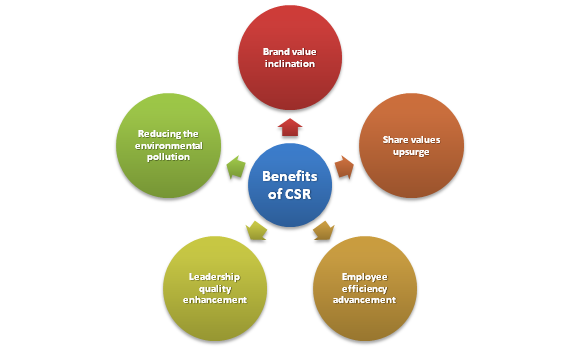
(Source: Luo et
al. 2015)
On the
contrary, Kim, Song & Lee (2016) argued that the leadership quality of the
management can be enhanced using CSR in the business as it provides proper
training and knowledge regarding the business growth. Due to this reason, the
leaders became able to lead their subordinates in the right manner. The work
culture of the company can be improved using the CSR and due to this reason,
the commitment of the management for achieving global competitiveness also increased
accordingly. This helped the management in taking decisions liberally for the
company growth.
2.6.5 Impact
of CSR on the environment
As opined by Korschun, Bhattacharya &
Swain (2014), CSR has a wider impact on the environment as it helps the
business to develop moral values for the society. The implementation of CSR
helps in scaling down catastrophes that are harming the environment. CSR
provides knowledge to the company about the management of waste that helps to
progress the cleanliness of the society. Besides that, the waste management is
also helpful in recycling the wastes that help the companies in energy
management.
On the
contrary, Kr ger (2015) argued that CSR reduces the emissions of greenhouse
gases the companies that are beneficial for reducing the environmental
pollution. The knowledge of building eco-friendly offices helps the companies
to become socially responsible. The business risks can also be mitigated using
the environmental CSR and in this way, business reputation can be improved.
2.7 Critical analysis of the factors affecting
CFP
2.7.1 Effect
of financial factors on CFP
As opined by Lins, Servaes & Tamayo (2017), the CFP is eminently
dependent on the financial management. The enrichment of earning is directly
depending on the capability of earning a company. In order to make better
financial future the company needs to adopt different strategies that benefited
the financial performance. The nature of spending the money is another vital
factor that is affecting the CFP as less expense was make the business
opportunities narrow and spending too much can ruin the business.
On the contrary Luo et al.(2015)
argued that the investment in the business is also affecting the CFP as more
investment helped the company to take the decisions conveniently. Business
bodies need to store at least 10%-15% money for the security purpose that was
acting as the backbone of the business. Besides that
business administration needs to eliminate the unnecessary purchase of things
for the company. This unnecessary costing makes the CFP weak and as a result,
the performance of corporate funding scales down.
Figure 2.5: Factors affecting CFP
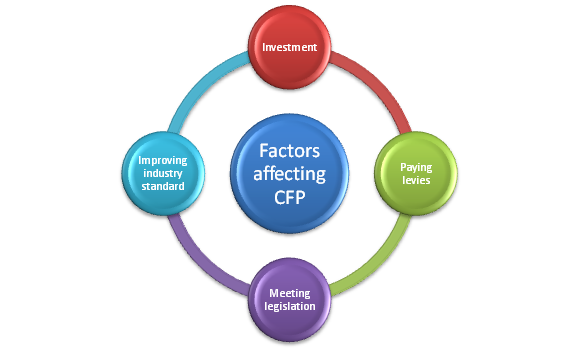
(Source: Post & Byron 2015)
As opined by Aguilera-Caracuel,
Guerrero-Villegas & Morales-Raya (2015), systematic tax payment makes a
business stronger. Thus companies need to pay taxes
periodically according to their earning. This lawfulness in tax payment makes
business more secure thus the sustainability of the CFP escalates. In order to
make the CFP progressive the investments need to be allocated to various
products of the company. This diversification in investment is a factor that
offers the CFP feasibility. Continual cash flow is a vital factor in making the
CFP viable and due to this reason companies need to make the cash flow steady
inside the business.
On
the contrary Friede, Busch & Bassen (2015) argued that the business returns
are playing a vital role in making CFP stable. In addition to this, the savings
for the growth of the business also needs to be verified periodically to make
the savings backbone for the future instabilities in the business. Beside that
rise in the non-performing assets of the companies creates an endangered
situation for the companies. Thus the financial
companies need to verify the customers before lending them to continue the
growth of CFP.
2.7.2 Effects
of non-financial factors on CFP
As stated by Haldar & Rahman (2016), there is a profound effect of
non-financial factors on the CFP. The first factor that influences the CFP most
is decision making. The companies need to organize meetings with the assistance
of administration on the laws and rules to evolve the CFP positively. The
present and the future steps creation for achieving the sustainability of the
CFP is an important factor. In addition, the policy-making of the company for
enhancement of the growth of CFP is a vital factor for the companies.
Hasan
et al. (2016) opposed this and argued that the industry needs to maintain a
good quality of the products to influence the growth of the CFP. Thus quality management of the company is a vital factor for
making the CFP growth stable. The companies need to focus on the standard of
the products that have been fixed by the standard maintenance board. Thus proper monitoring by the standard maintenance board is
a vital factor for the CFP growth of the company. The companies need to pay
attention to the employees' role towards the CFP sustainability achievement.
Employees are the pillars of the company thus their role is observed as an
influential factor in CFP growth.
As
opined by Ilhan-Nas, Koparan & Okan (2015),
employees' dedication to the work is another significant factor for proper
enhancement of the corporate performance. In addition to that employees'
understandability about the work and the work culture is a factor that helps in
improvement of the CFP. The employee retention procedure of the company is
observed as an integral factor for the CFP management. The role of the
relationship management of the company in maintaining the good relationship
between the customer and the company is also an effective factor that controls
the corporate financial performance directly. Thus the
administration needs to observe these relationship management policies very
carefully.
Simionescu
(2015) supported this and added that the business-friendly atmosphere of the
business locality is another vital factor that has a direct impact on the CFP
growth. As for example, the locality needs to have proper resource for the
development of the business. This was helpful for the CFP improvement of the
company and thus the company needs to choose right locality before
investment.
2.8 Critical evaluation of the impacts of CFP
2.8.1 Effect
of CFP on the stakeholders
As stated by Isaksson & Woodside (2016), stakeholders are basically
categorized into two groups. The first group is categorized as internal
stakeholders and the second group is external stakeholders. CFP has a greater
impact on the internal stakeholders of the company as they are directly engaged
with the company. The employees and the management come under the internal
stakeholder's group. The performance of the corporate finance motivates or
de-motivates the stakeholders according to the progress of CFP. The financial
growth enhances the purchasing power of the company. Thus
the stakeholders become more liberal to purchase raw materials for the company.
On the other hand lack, Simionescu (2015) stated that
of purchasing power occur due to a deceleration in the CFP thus the
stakeholders become dependent on the other companies purchasing capability.
Hence companies need to maintain the growth of CFP to motivate the stakeholders
in seeking more investment for the company.
On
the contrary Javed, Rashid & Hussain (2016) argued that the external
stakeholders also get influenced by the corporate financial performance of the
company as they bear the key role in the business investment. The lack of
growth in the CFP prohibits the desires of investment of the stakeholders with
respect to investment in the company. In addition to this, the stakeholders
start searching for other growing corporate financial sectors for more profit.
Hence companies need to maintain stable growth in the CFP for seeking more
investment from the external stakeholders. The media partners are the external
stakeholders of the company. Due to this reason company needs to create
progressive CFP to influence the clients of the company with the media
assistance.
2.8.2 Effect
of CFP on the employees
As viewed by Lam et al. (2016), the size of the company employee is
directly proportional to the progress of CFP. The better progression in the CFP
attracts the number of employee and vice versa. Thus
CFP needs to have superior performance for the employment generation in the
company. CFP helps in the advancement of the salary structure of the employees,
and hence a larger number of people desire to get attached to the company. On
the other hand, Aguilera-Caracuel, Guerrero-Villegas
& Morales-Raya (2015) stated that financial recession makes the CFP weaker
and due to this reason the size of the company gets
reduced rapidly. Hence corporate financial performance needs to be upgraded to
the changing business requirements. Besides that CFP
also helps in employee motivation as employees before engaging with the company
search for the company revenue to get a better idea of the company. Thus employees
always desire to get engaged with the profit-making employers and CFP helps
them in getting proper knowledge about the company revenue.
Figure 2.6: Impacts of CFP
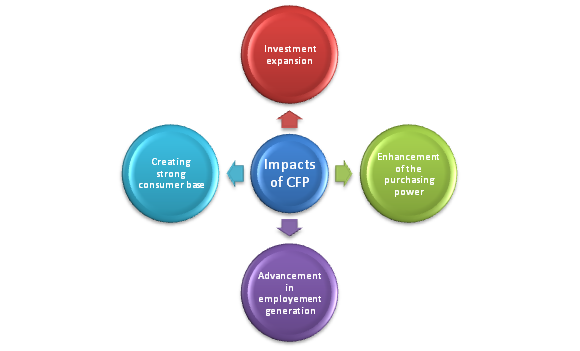
(Source: Rojas
et al. 2017)
On the contrary
Lin et al. (2017) argued that the cash management helps the employees to
release the stress. A healthy CFP provides employees extra motivation in
working more for the company well-being. An improved CFP helps in decision
making for the company, and due to this reason, the employees become efficient
in understanding the vision of the company. Hence the employees work
appropriately and progressively for the company's prosperity. In addition to
this better corporate financial performance supports the company's employee
requirements to create productive results for the company. In this way, the
employees become valuable employees for their employer.
2.8.3 Effect
of CFP on the Consumers
As stated by Linke & Jentoft (2016), CFP of the company works as an
indicator of the company growth for the consumers. CFP provides information
regarding the financial performance of the company that helps the consumers to
choose the right place for investment. In addition to this CFP is working as a financial
advisor to the consumers as unhealthy CFP indicates the deteriorating revenue
of the company, and thereby consumers become aware before investment. Besides that CFP helps in understanding the vision of the company
regarding their financial growth. The financial policies of a company for their
consumers can be easily identified with the assistance of CFP. CFP is helpful
for the consumers in determining the company honesty regarding the business,
and thus consumers can choose the right place for investment.
On the
contrary, Lucas & Noordewier (2016) argued that
CFP makes the companies conscious about the consumer interest. This benefits
the consumers as the companies try to rectify their errors to take more
competitive advantage of the market. On the other hand
not meeting the interest of the consumers makes the business weaker and in this
way, CFP becomes weaker. Due to this reason stability of CFP influences the
consumers in a very profound way. CFP is also advantageous for the consumers as
it increases the ease of doing social works for the society. Healthy CFP helps
the companies to do better service for the society and in this way society gets enriched with the help of CFP.
2.9 Critical evaluation of the relation between
CSR and CFP
As opined by Miroshnychenko, Barontini & Testa
(2017), CSR and the CFP are interdependent and indispensable to each other. In
addition to this, the governance of the company plays a major role in making
the relationship better between CFP and CSR. In order to understand the
relationship between CSR and CFP, the companies need to differentiate the
stakeholders' responsibility for the society and the company responsibility for
the society. The internal issues of a company must need to be distinguished
from the social issues to compose a better relationship between CFP and CSR.
On the
contrary, Muhammad (2015) argued that the administration of the company needs
to be focused on the relationship management among the stakeholders and the
society. Companies and industries manage the stakeholders' relationship with
the assistance of CSR, and the social responsibilities also judged on the basis
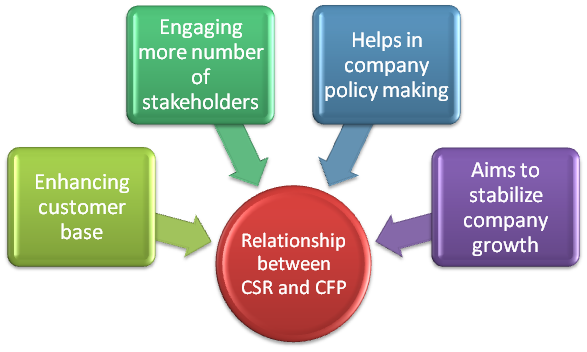
of CSR. Haldar & Rahman (2016) added that the policy-making of the company
is determined by the CSR whereas the CFP helps in deciding financial policies
for the company. CSR is also helpful in improving the reputation of the
company, and thus a large number of consumers can be attracted using CSR. On
the other hand, CFP helps the consumers to know the financial status and
financial performance of the company. Thus healthy CFP
also helps in enhancing the consumer base of the company by providing
information about the company financial health.
As opined by Ortas, lvarez & Garayar
(2015), CSR assists the companies in evaluating the responsibilities for the
environment, and the CFP status of the company helps the companies to decide
the required funding for the environmental benefit. The responsibility of the
employees for the betterment of the company is reflected by the CSR whereas the
CFP helps to determine the growth of the company. Thus
both the CSR and CFP evaluate the needs of the company for company growth.
Besides that, the CFP is determining the net profit of the company that
signifies the company growth and the CSR help the company to decide the amount
they can afford to contribute to the social development.
On
the contrary Park & Ghauri (2015) argued that CSR supports the company to
meet the consumer requirements and the CFP is helpful in accomplishing the
requirements for the consumers. The external stakeholders are also influenced
by CSR and CFP. CSR enhances the reputation of the company. Thus
it helps in seeking investment for the company according to CSR rating. On the
other hand, CFP reflects the financial strength of the company and due to this
better rating of CFP; it also plays a supportive role in bringing more
investment for the company.
Figure
2.7: Relationship between CSR and CFP
(Source:
Simionescu, 2015)
As viewed by
Rojas et al. (2017), the relationship of the CSR and the CFP is judged on the
basis of two theories that are good management and the stakeholder contract
cost. The good management theory supports the skill development of the
employees and the management using the CSR. In addition to this good management
theory also provides guidance on company strategy making. Wang et al. (2016)
supported this and stated that CSR helps the companies to measure the social
responsibility as well as the environmental responsibility. In addition, CFP
helps in money allocation for fulfilling the social and environmental
responsibilities. Besides that, the good rating in CSR indicates the positivity
in the business that attracts more investment of the company. Thus in this way, the revenue of the company becomes higher,
and due to this reason, the CFP also becomes healthier for the company.
On the
contrary, Wang & Berens (2015) argued that the reputations of the companies
can be enhanced using the CSR and thereby company size can be expanded by
engaging more number of employees. This expansion in
the company size helped the company to become productive, and thus the
financial stability of the company can be enhanced. This was help in developing
the CFP of the company. Hasan et al. (2016) supported this and stated that
companies try to achieve a good rating in CSR to motivate their employees as
well as making good reputation inside the market. This can be achieved by
giving proper training to their employees and meeting the employee demands.
Hence the reputation improvement offered the company more work-friendly
atmosphere. This work-friendly atmosphere, in turn, provided more efficient
workers that helped the company to compete at the global level. Thus the CFP rapidly increased due to the global
competitiveness of the company.
As opined by
Ilhan-Nas, Koparan & Okan (2015), the prosperity
in the CSR index of the company enables the company to mitigate the excess
expense for the company stakeholders. Thus the cost
management helped the company in enhancing the production. Due to this reason,
the CFP of the company accordingly increased, and the profit became higher than
before. In order to achieve this goal, the companies need to hear the
stakeholders' views regarding the company welfare. Thus
the stakeholders rely more on the company, and due to this reason, CSR rating
became much higher.
Opposing
this fact Isaksson & Woodside (2016) argued that, companies can take the
competitive advantage by mitigating the external and the internal challenges of
the company. Companies need to handle efficiently the problems between the
company management and the employees to make the company growth sustainable.
The cost transaction related problems need to be mitigated to create a good
reputation. The companies need to be engaged with different NGOs that helped
them in improving social and moral values. These factors helped the company to
improve their CSR and thus their brand value was an increase.
Javed, Rashid & Hussain (2016) supported this and
stated that improved consumer base would help the company to make a higher
profit and hence the CFP was also got increased. The companies need good
governance and need to have a broader view regarding the social and
environmental growth. Opportunistic attitudes may damage the reputation of the
company. This damage to the company reputation has reduced the stakeholders'
interest in investment in the company. Thus the CSR
was get damaged due to reputational damage and CFP was be harmed due to the
reduction in investment.
2.10 Illustration of the strategies to establish
good CSR practice
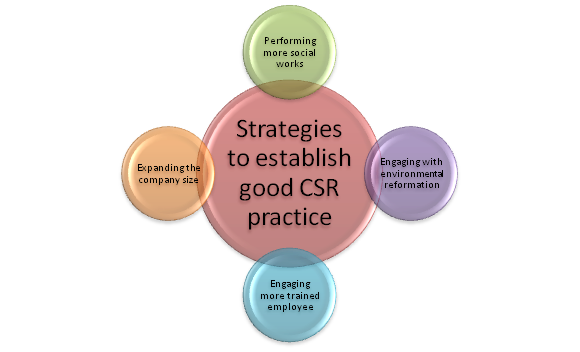
As viewed by Lam et al. (2016), in order to flourish the business in a
positive manner, the companies need to make strategies that helped them to
become socially responsible figures. Companies need to train the employees
about the social values and the way they are abided, for maintaining the social
responsibilities. The leaders of the companies need to establish by themselves
few examples regarding social responsibilities that was motivated the
subordinates to follow the leaders. Lin et al. (2017) supported this and added
that as for example the leaders of the company could organize few charity
programs for supporting the backward classes of the society. This made a
greater impact on the employees as well as in the society regarding the good
initiatives of the company. Hence company can get a large number of consumers
and the employees became socially responsible. Thus by
making this strategic reform inside the company both the company and the
society can become beneficial.
On the
contrary, Linke & Jentoft (2016) argued that the companies need to make
themselves environmentally responsible figures. Companies occasionally need to
host programs regarding the environmental welfare that helped the employees to
turn themselves into environmentally responsible people. This also made the
environment beneficial which in turn help the company to become eco-friendly.
Lucas & Noordewier (2016) supported this and
commented that the companies need to organize few programs that spread a good
message to the mass of the society regarding the environmental reformation.
Companies can host reforestation programs that helped in reducing the pollution
level. Reforestation also helped the company to reduce the greenhouse gas
effect in the environment. Hence this responsible attitude helped the company
to seek positive stakeholders' investment. Thus the
CSR result of the company can be enhanced in this way.
As
opined by Miroshnychenko, Barontini & Testa
(2017), companies need to enhance the size that helped them in penetrating the
market. The enhancement in the number of employees enabled the companies to
create a better quality of services for their clients. In this way, the
companies can make the service improvement and thus the acceptability of the
products also got boost up. Muhammad et al. (2015) supported this and stated
that the enhancement in the employee number would help the company to expand
the business in a sustainable manner. The well-developed size of the employees
made the company enable to become a global company by expanding the
productivity. Thus in this way the company can get the
opportunity to serve more number of people within the society. This increment
in the social service helped the company to improve the CSR level.
On
the contrary Ortas, lvarez & Garayar
(2015) argued that the improvement in the company size helped the company to
get engaged with more number of people from different
communities and cultures. Thus the mixture of
different communities and adaptation of various cultures helped the company to
transform themselves according to the demand of the society. Park & Ghauri
(2015) supported this and stated that the mixture of different community and
culture would help the companies to create a greater impact towards communal harmony
and this was beneficial for the society. Thus the CSR
of the company can be ascended and the people of the society relied more on the
ability of the company.
Figure
2.8: Strategies to establish good CSR practice
(Source:
Simionescu, 2015)
As opined by Aksak, Ferguson
& Duman (2016), in order to make the CSR rating better the companies need
to infuse various new products periodically. Infusion of these new products
helped the company to attract the number of customers and investors due to
their uniqueness in the market. Thus the brand value
of the company also scaled up. The new products need to be introduced in the
society with good quality maintenance. In order to infuse new products in the market companies need to have a steady cash flow and for
achieving this CFP of the company needs to be healthy.
Opposing this fact Andreu, Casado-D az & Mattila
(2015) opined that, to maintain the viability of the CSR the companies need to
realize the product demand inside the company. These concerns of the companies
convey their responsible attitude towards the society and thus the society was
be benefited. The responsible attitude of the company for the society helped
them to raise the customer base. Batty, Cuskelly &
Toohey (2016) supported this and stated that In order
to infuse new products into the market companies need to maintain the
environmental criteria. The new products of the company need to be introduced
into the market after checking their environment friendliness. Thus this helped the company to reduce the environmental
criteria as well as the business can be expanded in this way.
As viewed by
Chung et al. (2015), companies need to learn the talent management procedure to
attain the sustainability of the growth of the CSR. The talent management
techniques of the companies helped them to produce skilled and talented workers
inside the market. Thus accelerating the business the
enhancement of the business grew the CSR rating accordingly, and this made the
company able to maintain the CSR growth. Dias, Rodrigues & Craig (2017)
supported this and stated that companies have to create governing bodies to
support the talent hunt initiative. The talents need to be searched from
different parts of the society, and this helped the company to convey a message
regarding social responsibility. The society come to know about the vision and
mission of the company, and due to this reason, the size of the company was
being expanded. This expansion in the company size helped the company in
creating stable CSR rating.
As
opined by Fernandez-Feijoo, Romero & Ruiz (2014), companies need to promote
their product. This promotion of the products within the market helped the
company to become more familiar with the people of the society. In addition to
this, the promotion was created new business relationships between the society
and the company. Thus the CSR rating of the company
can be enhanced in this way by involving the society and taking the help.
2.11 Critical evaluation of the methods to
establish better CFP
As opined by Gardberg, Symeou
& Zyglidopoulos (2015), to establish better CFP
for the company the cash flow in the business needs to be satisfying. The
favorable cash flow within the business helped the company to enhance the
purchasing power. This enhancement in the purchasing power led the company to
expand the production of the company. Thus the company
revenue can be made higher in this way, and the growth in revenue helped the
company to generate better CFP rating. Helmig, Spraul & Ingenhoff
(2016) supported this and stated that companies need to promote the products in
an exceptional manner that helped the products to become mundane to the
consumers. Thus the sale of the company increased
accordingly, and the turnover increased for the company.
On the contrary
Hond et al. (2014) argued that the security
arrangement for the employees needs to be structured stronger to build better
CFP rating. The enhanced security arrangement for the employees helped the
company to attain the trust of their employees and due to this reason employees
was be motivated. This motivation within the employees generated the dedication
towards the company work. Thus the production of the
company can be expanded in this way. This improvement in production helped the
company to intensify the profit of the company. Thus
the profit, in turn, was helped the CFP to become more viable and the viability
attracted the investors. Husted, Montiel & Christmann (2016) supported this
and commented that companies' enhanced security would help the company to
increase the size of the company. This expansion in the company size helped the
company to create new ideas regarding the product. Besides that, the new
products can be promoted with the help of expanded size of employees in an
enriched manner. Thus the customer base was
intensified accordingly, and the profit was also get enhanced. This enhancement
in the revenue helped the CFP to become more stabilized.
As opined by Kili , Kuzey & Uyar (2015), the
companies need to distinguish the clients in order to form enhanced CFP. The
favorable customer base helped the company to attain enhanced revenue. Thus the growth in the revenue helped the company to enroot
the business within the society in an exceptional manner. This unique business
strategy of the company distinguishes the company from other companies in the
market in a positive manner. Thus the CFP of the
company can be enhanced by mitigating the mischief consumers from the business.
Kim (2014) supported this and stated that the clients need to be distinguished
on the basis of their purchasing capacity. The company needs to be careful with
their deal with the customers. Besides that, the customer management
relationship must be maintained in a satisfying manner. This strengthened the
consumer base, and the revenue also elevated accordingly. The increment in the
revenue caused in an increased CFP rating for the company.
As stated by Oh & Park (2015), the financial
status of the companies needs to be monitored periodically. According to the
financial status of the company, companies need to design their project. As for
example during the shortage in the finance companies need to buy only the
essential commodities that are helpful for the growth of their business. This
well-maintained finance helped the company to achieve more profit, and thus the
CFP was escalated. Pan et al. (2014) supported this and viewed that the companies
need to give proper training to their managers for appropriate maintenance of
the company finance. The cost accountants and cost consultants need to be
engaged with the company as per company objectives to make the growth of
finance more sustainable. Thus the conventional
methods of maintaining the finance enabled the company to generate more
revenue, and hence CFP value can be ascended in this way.
On the other hand, Plewa et al. (2015) argued that
besides the financial management, companies need to focus on the non-financial
matters to accelerate the revenue. Companies need to host meetings regarding
the financial policies of the company to enhance the company prosperity. In
addition to this, the managers of the company need to organize meetings with
their subordinated regarding their visions about the company policies. These
meetings enriched the company with various ideas about the growth policies. Thus by selecting the accurate method companies can enhance
the growth and thus CFP was also got increased due to the rectified policies of
the company.
2.12 The gap in the literature
The significance of the literature is it is based on the understanding
of the relationship between the CFP and the CSR in a company. However, during
the research, many problems regarding the growth of CSR and CFP and their
solutions have been missed out. The research did not shed light on the
implementation procedure of the growth enhancement for the companies. The
literature did not cover the time-requirement for total growth implementation
process. In addition to this, the literature did not focus on the impacts of
CSR on the society deeply. The literature also missed out the effect of CFP on
the environment and the society. The acceptability of the CSR method among the
mass is not analyzed in the literature. The literature did not shed light on
the monetary requirements of the companies to adopt the CSR and CFP inside the
business.
2.13 Conclusion
Thus it can be concluded from the literature that the CSR
and the CFP are co-related in a company. The companies need to make themselves
aware of the growth procedures of the business. The impacts of the CSR on the
society have been discussed in the literature, and the effect on the
stakeholders is also mentioned in this literature. In addition to this,
internal and the external factors that are affecting the growth of the CSR are
also known. The benefits of the CSR implementation in the business focused on
this literature. The impacts on the company due to the adaptation of the CSR
have been well discussed in the literature. Various procedures to develop the
CFP to attain the sustainability in the business growth have been focused
during the research.
REFERENCES
Journals
Adeleke, C. J. (2014). Corporate social responsibility in the
Nigerian banking sector (Doctoral dissertation, Walden University).
Brammer, S., He, H., &Mellahi, K. (2015). Corporate social responsibility,
employee organizational identification, and creative effort: The moderating
impact of corporate ability. Group & Organization Management, 40(3),
323-352.
Chuang, S. H. & Tai, F.
M., (2014).Corporate social responsibility.Ibusiness, 6(03), 117.
Fomukong, J. (2014). Relationship
between corporate social responsibility and economic value added from the oil
and gas industry perspective.[KE54]
Ghelli, C. (2013). Corporate Social
Responsibility and Financial Performance: Empirical Evidence. MSc Finance & Strategic Management.[KE56]
Jamali, D. (Ed.). (2016). Comparative Perspectives on Global Corporate
Social Responsibility. [KE58]
Orlitzky, M., Louche, C., Gond, J. P.,
&Chapple, W. (2017).Unpacking the drivers of
corporate social performance: A multilevel, multistakeholder, and multimethod
analysis. Journal of Business Ethics, 144(1), 21-40.
Peloza, J., & Shang, J.
(2011). How can corporate social responsibility activities create value for
stakeholders? A systematic review.Journal of the Academy of Marketing Science, 39(1), 117-135.
Soana, M. (2011).The relationship between corporate social performance and
corporate financial performance in the banking sector.Journal of Business Ethics.[KE60]
Sprinkle, G. B., &Maines,
L. A. (2010).The benefits and costs of corporate
social responsibility.Business Horizons, 53(5), 445-453.
Sun, W., & Cui, K. (2014).
Linking corporate social responsibility to firm default risk.European Management Journal, 32(2), 275-287.
Aguilera-Caracuel, J., Guerrero-Villegas, J., & Morales-Raya, M.
(2015). Corporate Citizenship of Multinational Enterprises and Financial
Performance: The Moderating Effect of Operating in Developing Countries. Ethical
Perspectives, 22, 437-467.
Aksak,
E. O., Ferguson, M. A., & Duman, S. A. (2016). Corporate social
responsibility and CSR fit as predictors of corporate reputation: A global
perspective. Public Relations Review, 42(1), 79-81.
Andreu,
L., Casado-D az, A. B., & Mattila, A. S. (2015). Effects of message appeal
and service type in CSR communication strategies. Journal of Business
Research, 68(7), 1488-1495.
Ba os-Caballero,
S., Garc a-Teruel, P. J., &Mart nez-Solano, P. (2014).Working
capital management, corporate performance, and financial constraints. Journal
of Business Research, 67(3), 332-338.
Batty,
R. J., Cuskelly, G., & Toohey, K. (2016).
Community sport events and CSR sponsorship: examining the impacts of a public
health agenda. Journal of sport and social issues, 40(6),
545-564.
Brammer,
S., He, H., &Mellahi, K. (2015). Corporate social
responsibility, employee organizational identification, and creative effort:
The moderating impact of corporate ability. Group & Organization
Management, 40(3), 323-352.
Brammer, S.,
Jackson, G., & Matten, D. (2012). Corporate social responsibility and
institutional theory: new perspectives on private governance.Socio-Economic Review[KE52] .
Cheng,
B., Ioannou, I., &Serafeim, G. (2014).Corporate
social responsibility and access to finance. Strategic Management
Journal, 35(1), 1-23.]
Chung,
K. H., Yu, J. E., Choi, M. G., & Shin, J. I. (2015). The effects of CSR on
customer satisfaction and loyalty in China: the moderating role of corporate
image. Journal of Economics, Business and Management, 3(5),
542-547.
Dhaliwal,
D., Li, O. Z., Tsang, A., & Yang, Y. G. (2014). Corporate social
responsibility disclosure and the cost of equity capital: The roles of
stakeholder orientation and financial transparency. Journal of
Accounting and Public Policy, 33(4), 328-355.
Dhaliwal, D., Li,
O. Z., Tsang, A., & Yang, Y. G. (2014). Corporate social responsibility
disclosure and the cost of equity capital: The roles of stakeholder orientation
and financial transparency. Journal of
Accounting and Public Policy, 33(4),
328-355.
Dias,
A., Rodrigues, L. L., & Craig, R. (2017). Corporate governance effects on
social responsibility disclosures. Australasian Accounting Business
& Finance Journal, 11(2).
Ditlev-Simonsen,
C. D. (2015). The relationship between Norwegian and Swedish employees
perception of corporate social responsibility and affective commitment. Business
& Society, 54(2), 229-253.
El
Ghoul, S., Guedhami, O., & Kim, Y. (2017).Country-level institutions, firm value, and the role of
corporate social responsibility initiatives. Journal of International
Business Studies, 48(3), 360-385.
El Ghoul, S., Guedhami, O., Kwok, C. C., & Mishra, D. R. (2011). Does
corporate social responsibility affect the cost of capital? Journal of Banking & Finance, 35(9), 2388-2406.
Fernandez-Feijoo,
B., Romero, S., & Ruiz, S. (2014). Effect of stakeholders' pressure on the
transparency of sustainability reports within the GRI framework. Journal
of business ethics, 122(1), 53-63.
Flammer,
C. (2015). Does corporate social responsibility lead to superior financial
performance? A regression discontinuity approach. Management Science, 61(11),
2549-2568.
Friede,
G., Busch, T., &Bassen, A. (2015). ESG and financial performance:
aggregated evidence from more than 2000 empirical studies. Journal of
Sustainable Finance & Investment, 5(4), 210-233.
Gardberg,
N. A., Symeou, P. C., & Zyglidopoulos,
S. C. (2015, January). Public Trust's Duality in the CSP Reputation-Financial
Performance Relationship across Countries. In Academy of Management
Proceedings (Vol. 2015, No. 1, p. 15705). Academy of Management.
Haldar,
P. K., &Rahman, S. M. (2016).Assessing Impact of
Corporate Social Responsibility on Bank Performance in Bangladesh: A study on
Some Selected Banks. Journal of Business and Technology (Dhaka), 10(2),
57-66.
Hasan,
I., Kobeissi, N., Liu, L., & Wang, H. (2016). Corporate social
responsibility and firm financial performance: The mediating role of
productivity. Journal of Business Ethics, 1-18.
Helmig,
B., Spraul, K., & Ingenhoff, D. (2016). Under
positive pressure: How stakeholder pressure affects corporate social
responsibility implementation. Business & Society, 55(2),
151-187.
Hond,
F., Rehbein, K. A., Bakker, F. G., & Lankveld, H.
K. V. (2014). Playing on two chessboards: Reputation effects between corporate
social responsibility (CSR) and corporate political activity (CPA). Journal
of Management Studies, 51(5), 790-813.
Husted,
B. W., Montiel, I., & Christmann, P. (2016). Effects of local legitimacy on
certification decisions to global and national CSR standards by multinational
subsidiaries and domestic firms. Journal of International Business
Studies, 47(3), 382-397.
Ilhan-Nas,
T., Koparan, E., &Okan, T. (2015).The effects of the CSR isomorphism on both CSP and
CFP. Journal of Asia Business Studies, 9(3), 251-272.
Isaksson,
L. E., & Woodside, A. G. (2016).Modeling firm
heterogeneity in corporate social performance and financial performance. Journal
of Business Research, 69(9), 3285-3314.
Javed,
M., Rashid, M. A., &Hussain, G. (2016). When does it pay to be good A
contingency perspective on corporate social and financial performance: would it
work?. Journal of cleaner production, 133,
1062-1073.
Jenter,
D., &Kanaan, F. (2015).CEO turnover and relative
performance evaluation. The Journal of Finance, 70(5),
2155-2184.
Kang,
J. S., Chiang, C. F., Huangthanapan, K., &
Downing, S. (2015). Corporate social responsibility and sustainability balanced
scorecard: The case study of family-owned hotels. International Journal
of Hospitality Management, 48, 124-134.
Kili ,
M., Kuzey, C., & Uyar, A. (2015). The impact of ownership and board
structure on Corporate Social Responsibility (CSR) reporting in the Turkish
banking industry. Corporate Governance, 15(3), 357-374.
Kim,
J. S., Song, H. J., & Lee, C. K. (2016).Effects of
corporate social responsibility and internal marketing on organizational
commitment and turnover intentions. International Journal of
Hospitality Management, 55, 25-32.
Kim,
Y. (2014). Strategic communication of corporate social responsibility (CSR):
Effects of stated motives and corporate reputation on stakeholder
responses. Public Relations Review, 40(5), 838-840.
Korschun,
D., Bhattacharya, C. B., & Swain, S. D. (2014).Corporate
social responsibility, customer orientation, and the job performance of
frontline employees. Journal of Marketing, 78(3),
20-37.
Kr ger,
P. (2015). Corporate goodness and shareholder wealth. Journal of
financial economics, 115(2), 304-329.
Lam,
H. K., Yeung, A. C., Cheng, T. C. E., & Humphreys, P. K. (2016). Corporate
environmental initiatives in the Chinese context: Performance implications and
contextual factors. International Journal of Production Economics, 180,
48-56.
Lin,
W. L., Ho, J. A., Ng, S. I., & Lee, C. (2017). Impact of Positive and
Negative Corporate Social Responsibility on Corporate Financial Performance and
Idiosyncratic Risk.
Linke,
S., &Jentoft, S. (2016).Ideals, realities and
paradoxes of stakeholder participation in EU fisheries governance. Environmental
Sociology, 2(2), 144-154.
Lins,
K. V., Servaes, H., & Tamayo, A. (2017). Social capital, trust, and firm
performance: The value of corporate social responsibility during the financial
crisis. The Journal of Finance, 72(4), 1785-1824.
Lu,
W., Chau, K. W., Wang, H., & Pan, W. (2014). A decade's debate on the nexus
between corporate social and corporate financial performance: a critical review
of empirical studies 2002 2011. Journal of Cleaner Production, 79,
195-206.
Lucas,
M. T., &Noordewier, T. G. (2016). Environmental
management practices and firm financial performance: The moderating effect of
industry pollution-related factors. International Journal of Production
Economics, 175, 24-34.
Luo,
X., Wang, H., Raithel, S., &Zheng, Q. (2015). Corporate social performance,
analyst stock recommendations, and firm future returns. Strategic
Management Journal, 36(1), 123-136.
Miroshnychenko,
I., Barontini, R., &Testa, F. (2017). Green
practices and financial performance: a global outlook. Journal of
Cleaner Production, 147, 340-351.
Muhammad,
N., Scrimgeour, F., Reddy, K., &Abidin, S. (2015). The relationship between
environmental performance and financial performance in periods of growth and
contraction: evidence from Australian publicly listed companies. Journal
of Cleaner Production, 102, 324-332.
Obeidat,
B. Y., Tarhini, A., &Aqqad, N. (2016). The impact
of transformational leadership on organizational performance via the mediating
role of corporate social responsibility: A structural equation modeling
approach. International Business Research, 10(1), 199.
berseder,
M., Schlegelmilch, B. B., Murphy, P. E., & Gruber, V. (2014). Consumers
perceptions of corporate social responsibility: Scale development and
validation. Journal of Business Ethics, 124(1),
101-115.
Oh,
W., & Park, S. (2015). The relationship between corporate social
responsibility and corporate financial performance in Korea. Emerging
Markets Finance and Trade, 51(sup3), 85-94.
Orlitzky,
M., Louche, C., Gond, J. P., &Chapple, W. (2017).Unpacking
the drivers of corporate social performance: A multilevel, multistakeholder,
and multimethod analysis. Journal of Business Ethics, 144(1),
21-40.
Ortas,
E., lvarez, I., &Garayar, A. (2015). The
environmental, social, governance, and financial performance effects on
companies that adopt the United Nations Global Compact. Sustainability, 7(2),
1932-1956.
Pan,
X., Sha, J., Zhang, H., & Ke, W. (2014). Relationship between corporate
social responsibility and financial performance in the Mineral Industry:
Evidence from Chinese mineral firms. Sustainability, 6(7),
4077-4101.
Park,
B. I., &Ghauri, P. N. (2015). Determinants influencing CSR practices in
small and medium-sized MNE subsidiaries: A stakeholder perspective. Journal
of World Business, 50(1), 192-204.
P rez,
A., & Bosque, I. R. (2015). How customer support for corporate social
responsibility influences the image of companies: Evidence from the banking
industry. Corporate Social Responsibility and Environmental Management, 22(3),
155-168.
Plewa,
C., Conduit, J., Quester, P. G., & Johnson, C. (2015). The impact of
corporate volunteering on CSR image: A consumer perspective. Journal of
Business Ethics, 127(3), 643-659.
Qiu,
Y., Shaukat, A., &Tharyan, R. (2016).
Environmental and social disclosures: Link with corporate financial
performance. The British Accounting Review, 48(1),
102-116.
Rao,
K., & Tilt, C. (2016). Board composition and corporate social
responsibility: The role of diversity, gender, strategy and decision
making. Journal of Business Ethics, 138(2), 327-347.
Rojas,
M., M Zali, B., Turcotte, M. F. T., &Kooli, M.
(2017). Corporate social responsibility, the stakeholder approach and beyond:
in search of theoretical explanations for doing well while doing good . Revista de Investigaci n
en Ciencias de la
Administraci n, 1(1), 27-42.
Saeidi,
S. P., Sofian, S., Saeidi, P., Saeidi, S. P., &Saaeidi,
S. A. (2015). How does corporate social responsibility contribute to firm
financial performance? The mediating role of competitive advantage, reputation,
and customer satisfaction. Journal of Business Research, 68(2),
341-350.
Shaukat,
A., Qiu, Y., &Trojanowski, G. (2016). Board attributes, corporate social
responsibility strategy, and corporate environmental and social
performance. Journal of Business Ethics, 135(3),
569-585.
Simionescu,
L. N. (2015). The stakeholder s
ability to influence the relationship between company s financial performance
(CFP) and corporate social responsibility (CSR). Annals of'ConstantinBrancusi'University of Targu-Jiu.Economy Series, 2(1).
Tang,
Y., Qian, C., Chen, G., &Shen, R. (2015). How CEO hubris affects corporate
social (ir) responsibility. Strategic
Management Journal, 36(9), 1338-1357.
Wang,
D. H. M., Chen, P. H., Yu, T. H. K., & Hsiao, C. Y. (2015). The effects of
corporate social responsibility on brand equity and firm performance. Journal
of business research, 68(11), 2232-2236.
Wang,
H., Lu, W., Ye, M., Chau, K. W., & Zhang, X. (2016). The curvilinear
relationship between corporate social performance and corporate financial
performance: Evidence from the international construction industry. Journal
of cleaner production, 137, 1313-1322.
Wang,
Y., &Berens, G. (2015).The impact of four types of
corporate social performance on reputation and financial performance. Journal
of Business Ethics, 131(2), 337-359.