 : 511
: 511
ORGANIZATIONAL SUCCESS THROUGH
BRAND MARKETING AND PROMOTION STRATEGIES
Acknowledgment
It provides me greatest satisfaction to make the final
submission of the research that focuses on organizational success through
brand marketing and promotion strategies . I am grateful to various fellow
members behind the successful completion of this research.
I would like to express thanks to number of people who have guided me in
preparing this research. I would like to thank my higher authority, since
without their guidance my project work would not have been achievable. I
would also like to thank my peer group members. I would also like to show my
appreciation towards the respondents of the surveys as well as the interviews,
whose co-operation has helped me to incorporate data collection effectively and
efficiently.
Thank you
Abstract
In the Introduction
chapter, a detailed analysis of marketing strategy and product promotion
methods to determine business success has been identified. Background of the
research is also determined in this aspect. There are some objectives
set by the researchers to cover the relevant parts of the researchers. Some
specific research problems and scope of the study have been determined in this
aspect.
In the Literature Review chapter, several
secondary research journals and work has been evaluated. Current marketing
strategy that is used by companies and the reason behind using marketing
strategy has been discussed. This discussion indicated that the organisation
used this strategy to create a goal or objective for a certain period. On other
hand, brand awareness is highly required for an organisation that has been
identified from this chapter because it helps to retain and attract customers.
Brand promotional strategy has been changed after the arrival of the digital
age. It has been identified from various research works. Company used social
media and other digital media to promote their brand. Different theories and models
have been used in this aspect supporting the literature.
The third chapter of the research report is methodology chapter that focuses on the
selected methods of the study. The reason for selecting every research method
was mentioned in this case. The philosophy adopted in this research is
positivism research philosophy . The adopted approach for the research is
deductive approach and the design was descriptive design. All the data used in
this research was collected from secondary sources. The data used in this study
was qualitative data . The research ethics have been followed effectively. All
the journals and articles are taken from authenticated sources.
In the section
of data collection and analysis, ten themes have been developed as this
research has followed secondary qualitative research methods. The major
analyses of those themes have been done for identifying the effective role of
marketing effort and marketing strategies in organizational success. According
to the marketing strategies, promotional strategy along with brand marketing
has a significant role in organizational success. The presentation of qualitative data collected
from secondary sources was done in this chapter. The data was presented by
developing multiple themes. The collection and analysis of the data is focusing
on the relationship between pricing strategies and brand awareness. It was
found that business improvement and engagement of consumers with a brand are
highly dependent on the pricing strategies. Most of the organisations in the
different market set up are using pricing strategy as a tool of business
promotion. The direct relationship between brand awareness and brand loyalty was
also found in this case.
In findings and discussion chapter, some
themes have been developed which are relevant to research objectives and research
questions. This chapter is responsible for meeting research objectives and
answering research questions. A detailed discussion of findings from various
journals and articles has been involved here.
In conclusion chapter, an overall
conclusion of research finings have
been stated. Whether this research met its research objectives have been
examined here. Recommendation for improving strategies is given along with
future prospect analysis.
Table
of Contents
1.3 Research aim and
objectives
2.3 Current marketing strategies residing within
organisation
2.4 Development of brand awareness has been crucial with
marketing strategies
2.5 Organisational strategies towards brand promotion
2.6 The impact of
marketing strategy on the organization's success
2.7 Product pricing
strategies is crucial for meeting organizational goals
2.8 Market planning and
selling forms an integral part of marketing
3.8 Data Sources and Data Types
Chapter 4: Data Collection
and Analysis
4.2 Data collection and
analysis of secondary qualitative research
Chapter 5: Findings and
Discussion
5.2 Discussion on findings
based on secondary qualitative data
List of Figures
Figure 1.9.1: Dissertation
structure
Figure 2.6.1: Marketing
environment and medium
Figure 2.7.1: Product
pricing strategies in market
Figure 2.8.1: Marketing
strategy process
Figure 2.9.1: 4Ps of
marketing
Figure 2.9.2: Maslow s
Hierarchy of needs
Figure 3.5.1: Inductive
Research Approach
Figure 3.5.1: Inductive
Research Approach
Figure 5.2.1: Promotional
strategy type
Figure: 5.2.2: Product
pricing strategy
Figure 5.2.3: Brand
awareness strategies
Figure 5.2.4: Establishing
Brand awareness
List
of Tables
Chapter 1: Introduction
1.1 Introduction
Promotional strategies and marketing
play an important role in developing opportunities for the business. Main focus
of this strategy is to develop public relations to ensure sales promotion . It
is necessary to use social media for promoting the business more efficiently.
It also makes a positive impact on business sustainability. In the present
scenario, the product design and pricing strategy can be evaluated before
product promotion. Most of the organizations in the UK consider brand marketing
as a crucial factor for ensuring organizational success. Major supermarket
chains like Asda Stores Ltd have implemented an effective marketing
strategy to communicate with the consumers.
1.2 Background of the study
The promotion strategy influences
the profitability of a firm. The research has been conducted by evaluating the
role of marketing in organizational sustainability. In the present scenario, it
is detected that the promotional goals of an organization include involvement
of people, creating awareness for a product and retaining the existing
customers to increase profitability. Main focus of the marketing strategy is to
convince the customers to try some specific products to reach a predetermined
target for the business (Dwivedi, Nayeem and Murshed, 2018). The researchers
can also identify the target customers to initiate the research more
efficiently. The integrated marketing communications can play a major role in
this aspect.
1.3 Research aim and objectives
Main aim of the research is to
evaluate the brand awareness strategy implemented by an organization and its
effect on organizational success. To meet the aim of the research, the
researchers have set some relevant research objectives . The major objectives
are:
● To determine the role of marketing
efforts on profitability of an organization
● To ascertain the organizational
growth of an organization by implementing effective promotional strategies
● To evaluate the effectiveness of
online marketing for developing organizational sustainability
● To analyze the effect of product
pricing strategies for achieving organizational goals
● To develop brand awareness for
initiating proper brand promotion and market planning
1.4 Research questions
To meet the goal and objectives of
the research, the researchers have to develop some questions to cover the area
of study. The relevant research questions are:
● What is the role of marketing
efforts on profitability of an organization?
● How can organizational management
ensure business growth by implementing effective promotional strategies?
● Is it effective to implement an
online marketing strategy for developing organizational sustainability?
● What is the effect of product
pricing strategies for achieving organizational goals?
● What is the role of brand awareness
for initiating proper brand promotion and market planning?
1.5 Problem statement
There are some issues regarding the
implementation of effective marketing strategy in major organizations in the
UK. It is a complex process to implement a promotional mix for the
organization like Asda Stores Ltd (asda.com, 2021). However, the marketing
strategy assists the organizational management to identify the areas of the
business affected by the organizational growth. In this case, it is difficult
to determine the customer's needs. It is identified that the business authority
has to make optimum utilization of the resources to develop relevant
strategies for the business (Ansari et
al. 2019). In this scenario, identifying the business problems is also
necessary to build the reputation of the organization. It is a huge
responsibility of the researchers to find the solutions of the research
problems to execute the research more efficiently.
1.6 Rationale
Main focus of this research is to
identify the business opportunities and business issues to develop an effective
strategy for an organization. In this aspect, the product promotion and
marketing strategies justify the aim of the study. The organizational success
can be ensured through identifying proper channels by which the management can
develop profitability of a business. It is easier for the business management
to retain the existing customers by implementing a promotional strategy
(Ahmad et al. 2020). It can provide
all the relevant information of the products to the customers. The stakeholders
of the business can also get proper information about the business in this
process.
In developed countries like the UK,
it is detected that content marketing , email marketing , brand promotion
and influencer marketing play an effective role in developing the
profitability of the organizations (HOANG et
al. 2020). The topic is selected to evaluate the impact of the promotional
strategies for ensuring sustainability of the business. The major factors of
the retail positioning are also evaluated in this aspect. The researchers can
also identify the strategies to get rid of the challenges of the business. It
is also necessary to ensure a simple direction of marketing for organizational
success.
1.7 Scope of the research
Some specific areas of brand
promotion and marketing have been explored in this research. The researchers
also focus on the possible relationship between business sustainability and
brand marketing for a broader aspect of organizational success. The researchers
can also meet the objectives of the study in this aspect. It signifies that the
marketing efforts play a positive role on organizational profitability. There
are some effective elements of the marketing strategies implemented by the
major UK organizations. The elements are segmentation , targeting and
positioning , promotional tactics , monitoring and marketing plan (Vazifehdoost and Negahdari,
2018).
In the present scenario, the
researchers identify the business issues to determine which marketing strategy
is beneficial for the business. There is also a problem regarding changes in
consumer needs of the country. It is necessary for the organizational
management to implement a flexible approach to mitigate the issues. Role of the
economic climate is also considered in this aspect. There is also a scope of
retrieving monetary information of the business from authentic sources to
identify the outcome of marketing strategies . It can also help the
researchers to identify the target customers of the market.
1.8 Significance of Research
Brand awareness is a term of marketing that refers to
recognition of a product by its name, logo or any identical factors (Bilgin,
2018). It helps to promote products and services in the market. It is a key
step to promote old or new products. It can be created by qualities, practice,
taste or any other factor. On the other hand, promotional strategy refers to
the approach that companies take to promote their product and services. It
plays a vital role in marketing mix such as creation of budget, target audience
and plan of action. By using this strategy, a company can sell a large number
of products and increase its market share. As result profitability, position or
profit-earning capacity can be increased by effective marketing strategy.
Creation of brand and product identity, values and
brand communication is also important for a company.
Brand marketing is a method of marketing that can help to highlight or promote
the whole brand and by using this; method organisations can enrich their brand
value position in the market (Dwivedi and McDonald, 2018). Success of an
organisation is dependent on these factors because sales and profitability can
be increased. Financial key performance indicator or index is profit and it can
improve when a company can earn profit. This research aims to evaluate brand
marketing, brand awareness and promotional strategies for companies. Discussion
of these areas can help an organisation to make decisions and enhance their
existing strategy for achieving their goals. Several companies ignore this
factor or strategy due for this reason research can create value for every
organisation.
1.9 Structure of Research

Figure 1.9.1: Dissertation structure
1.10 Summary
In this chapter, a detailed
information of the marketing strategies initiated by the UK organizations has
been done. A brief analysis of content marketing , email marketing , brand
promotion and influencer marketing has been done in this aspect. There are
some objectives set by the researchers to cover the relevant parts of the
researchers. It is also necessary to develop some research questions that can
align with the goal of the study. This chapter also covered major problem areas
of the research. The scope of the research has been identified in this
aspect. The dissertation structure is also provided to evaluate which areas
will be covered in this research. The researchers can identify the significance
of the study in this aspect. This chapter also provides detailed information
regarding the business sustainability of the organization like Asda
Stores Ltd.
2. Literature Review
2.1 Introduction
This chapter will review existing marketing,
promotional strategies. Review of literature can help to identify thinking and
thoughts of researchers in this area. In addition, existing technique and
strategy that is used by various organisations to promote their product will be
discussed in this chapter according to the decided aim and objective of
research.
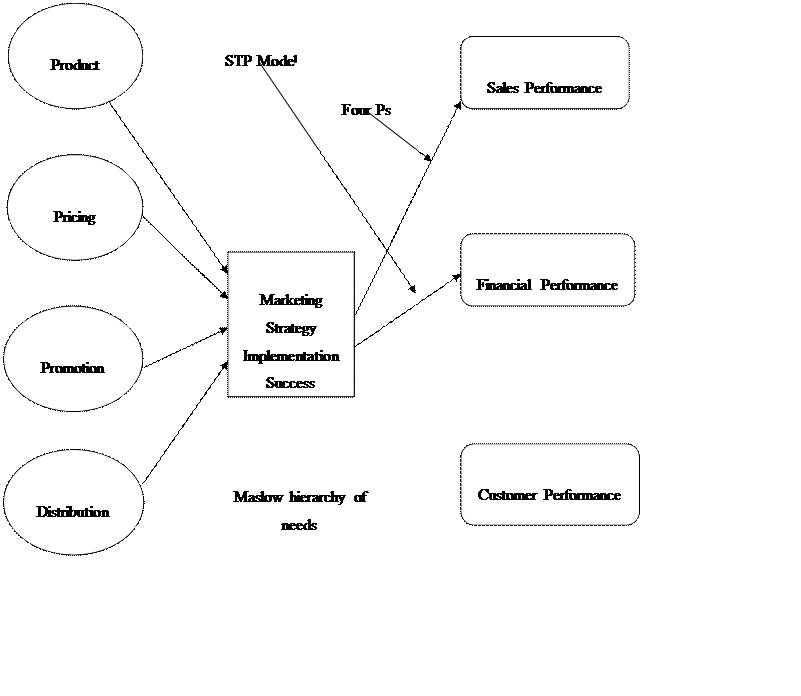 2.2 Conceptual
framework
2.2 Conceptual
framework
2.2.1: Conceptual framework
2.3 Current marketing strategies
residing within organisation
Marketing strategy is a method to plan products,
distribution channels, projection and pricing policy effectively (Agzamov et al.
2021). Several researchers have another opinion and they stated that it is a
unified system for organisation for the entire work of an organisation.
Marketing strategy defines how effectively a company shapes their marketing
activities and plan for achieving its goals. Aim of marketing strategy is to
correctly plan products, distribution channels, promotion and pricing policy.
Marketing strategy is a method to form goals and achieve organisation along
with solving manufacturing problems. According to Philip Kotler, a marketing
strategy is a logical structure that solves the marketing problem of an
organisation (Agzamov et al. 2021). Target marketing, marketing mix and marketing spend
can be included with this. Organisation can start focusing on detailed programs
after preparation of marketing strategy. In addition, marketing strategy can
create responsible executors, set up deadlines and determine level of cost.
Based on the factors management can draw up a budget for a certain period.
Organisations can set up their goals and objectives
after crossing suitable marketing management concepts such as industrial,
commodity, sales, traditional and development strategy such as intensive market
penetration, diversified development and so on (Agzamov
et al. 2021). The goals set by the
organisation are two parts, which consist of external and internal goals. Mission
determines external goal and internal goal is determined following
organisational and legal form of organisation. Marketing targets help to deify
answers of several questions related to goals such as what, when, and how goals
can be achieved. It can solve complex problems of marketing mix tools,
formation and adaptation of marketing tools for various ranges of goods and
services, and pricing related issues. Position, potential and traditions of the
institute can influence the marketing strategy of the organisation (Agzamov et al.
2021). Management of an organisation needs to revise marketing strategy
regularly and make changes according to necessity.
Organisations implement the marketing strategy
according to their need and objective. There are various types of marketing
strategies that can be used by organisations yet they need to align their
strategy with increasing awareness factors, identify responses to drive sales
factor and interest in the proper factor (Hossain, 2018). They can align one of
these factors for organisation. Sales, growth and brand value depend on the
marketing strategy of the company. Effective marketing strategy can help to attract
potential customers to an organisation, which can help to increase sales of a
company. Sales and market growth can be observed by implementation of this
method because marketing strategy helps to complete the objectives and goals of
the company. In addition, companies can expand their business from one country
to another when they effectively use it. According to Mohajer and Khansanami, 2021 there is a relationship between operation
and marketing activities and organisation. Due to this reason, marketing
activities help to improve the competitive strategy of the company.
Operations of a company can be improved when the
marketing target sets a goal such that they set a goal to sell 1000 unit products every day then the operational team needs
to take preparation for a productive 1000 unit product. In this way marketing strategy,
drive their operational forces effectively. Competitive strategy and position
can be improved when organisations improve their production efficiency,
operational approach and financial condition of the company. All of these
factors can change effective marketing strategies. Promotion, pricing,
distribution and standardisation are part of marketing strategy. Sales,
customer and financial performance can be impacted by these factors. According
to Saif, 2021 implementation of marketing strategy will lead to success for the
organisation. Primary reason that he provided is marketing strategy creates
impact on every area of operation of company because marketing is key factor
for sales product and increase number of customer for
organisation. In addition, sustainability of an organisation depends on
marketing strategy because without this organisation may not be able to
generate profit which creates a negative impact on the company.
2.4 Development of brand
awareness has been crucial with marketing strategies
Brand awareness of an organisation is a method to
develop awareness about a brand and create a relationship with a particular
product. Capacity of customers can be increased for recall of a brand and
particular products. That strategy can help customers to recall a product in
any situation (Putri, 2021). They will think about a specific brand when they
want to purchase those categories or classes of products such that customers
can think about BMW when they want to purchase a car. It can help customers to
think about the product and consumer decision-making. In this way, brand
awareness helps the marketing activity of a company. Brand awareness of a new
product can be lower than in an older market. Customers need to introduce a
product and after use, several times they can recognise or recall the brand. On
other hand, products that customers already used earlier time than they can
recall about a brand when they make purchase decisions such as customers can
think about Apple and Samsung when they think about purchase new rather than a
new brand like Oppo or Huawei. Brand awareness method is an important part of
marketing strategy and using this method companies can promote their product in
the market (Putri, 2021). Brand awareness promoting methods have been changed
after the revolution of technology. At present companies, use various
digitalisation methods to improve their awareness. Keyword search, total tag,
description Meta tag, optimised URL, content, title headline and different
titles are methods that are used by companies to increase awareness in
digitally. Several key performance indicators are used by organisations to
masseur their brand awareness activity such as number of audience,
acquisition, behaviour, conversion rate, display advertisement and so on.
Level of consumer recognition, acceptance and recall
of brand are part of brand awareness (Bilgin, 2018). Track of crowd power of consumer's memories
depends on brand awareness. Various types of products and brands can be
available in the market at the time of purchase decision. Power of brand
awareness can be recognized when customers ignore the crowd or influence of
other brands and select specific products by eliminating or ignoring the brand.
It helps to reduce time and risk of consumers that they spend on searching
perfect product according to their needs (Bilgin, 2018). According to some authors,
it consists of four factors, which are recognition of brand, recall of brand,
top mind on brand and domination of brand. Brand recognition prefers
familiarity of product for consumer whereas recall of band refers customer
recall the brand when specific nature of product introduced with him or her.
Awareness of the brand can be called huge or widest when the name of the brand
comes first on the mind of the customer when thinking about the product.
Several times a brand can replace all the products of its category and it is
called brand dominance. It can be created when companies provide the best
quality, price, customer service and effective marketing.
Brand awareness and brand credibility can be created
through external and internal paths (Anees et
al. 2018). Insight of managers can be increased and financial performance
will be improved in business to the business organisation by using brand
awareness. A company can do brand awareness internally and externally. External
brand awareness can be referred brand communication, whereas brand credibility
is part of internal route of organisation. According to several pieces of research,
external route is best for business-to-business organisations. Brand equity is
brand knowledge, which consists of two elements: brand awareness and brand
image (Alexandra and Cerchia, 2018). These two factors can have a high impact
on the marketing strategy of a company. Marketing management team need to take
effective and adequate strategy for improvement of their brand awareness
activity. It is a crucial decision because ineffective or less responding
awareness campaigns can lead to financial loss or infusion of money from organisations.
As a result, companies cannot increase their sales and their brand image can be
affected by ineffective approaches. Companies for large spending on brand
awareness campaigns can face financial loss. Due to all of these reasons,
management needs to make decisions precisely and effectively.
2.5 Organisational strategies
towards brand promotion
Brand promotion is an instrument of marketing mix,
which takes decision and plan about marketing mix for specifying organisation
in certain condition. It is an integrated promotion mix framework for
presenting witty in front of potential customers to communicate with them to
increase sales, which lead them on the path of success (DZIUBA, 2021).
Advertising, personal selling, sales promotion, and allocation of budgeting
resources are part or elementary of promotional activities of an organisation.
Percentage of sales and competitive parity are resources of budgeting and baked
on these resources, organisations can create a budget for a certain year.
Promotional strategy of low-income economics and high-income economics or
market is different. Coupons, premium, samples and other promotional tools can
be used to attract customers who belong to the low-income economy. They can get
products at cheap prices, which can help to increase their loyalty to the
product (DZIUBA, 2021). This method helps to reflect or reduce cost of
business. Companies know that the tools due for this reason they can spend a
low amount to attract customers will easily attract customers.
A strong brand can be created by consistency,
performance quality and pricing of product. In addition, providing trust and
comfort for consumers can lead an organisation in a long way, which makes a
positive impact on the image of the company. Unprofessional, simple and
unreliable approaches can lead to inconsistent activities, which destroy brand
image of organisation. Consistency is a type of promotional activity for
retaining and attracting customers (DZIUBA, 2021). Digital generation changes
promotional activities of organisations such as at present companies promote
their product through various social media influencers. They built their
reputation on a certain subject according to their knowledge and experience. Individual
can attract by their activity and knowledge as a result they can influence a
person to use a certain product in a way an organisation can promote their
product (Thomas, 2020). In addition, companies can use several other methods
for promoting their product such as they can post advertisements on their
social media pages and running advertisements on digital platforms Several
times the government and other organisations promote culture, government goals
through brand promotion (Usmanova et al. 2019). This strategy can be used
by any type and natural organisation because promotion can attract customers to
products, which can increase sales and profit. These two are key parameters to
measure success.
2.6 The impact of marketing strategy on the organization's success
Meeting the customer s expectations
and requirements is important for organizational success. In meeting the
requirements of customers, the organizations form essential marketing
strategies which can be able to meet the expectations. Customer s performance
needs to be accomplished in the varying marketing situations which require
formulating marketing strategies (Thabit and Raewf, 2018).
The marketing strategy enables for determining the attributes and products of
competitors. The marketing strategies including online marketing and product
pricing has been beneficial for the organizations. These marketing strategies
create greater opportunities for the organization that leads to increasing
sales. Furthermore, the organizations in the changing market scenario can have
a sustainable competitive advantage.
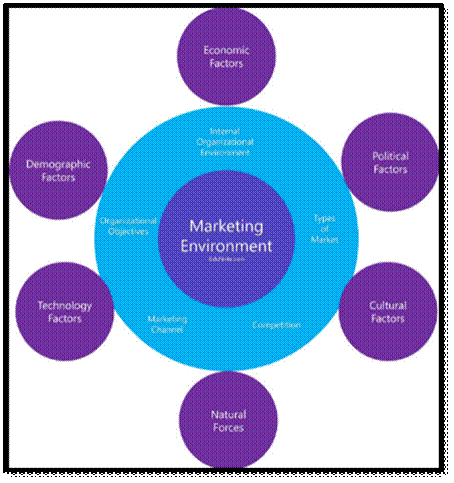
Figure 2.6.1: Marketing environment and medium
(Source: Olanrewaju
et al. 2020)
The marketing strategies enable the
prevention of making the products and services which have the best probability
for making higher profits. The market strategies start with the research pof marketplace and further it also considers the optimal
target customer . Thus, the benefits which can be delivered to the customer can
be analyzed. The ways in which the products or services can be differentiated
can be also assessed with marketing strategies (Papadas et al. 2019). Differentiation of products or
services is highly responsible for sustaining the competitive advantage of a
company. The organization receives higher growth with differentiated products
and services and enables to retain the customers. The customers are satisfied
with differentiated and unique products and thus remain loyal to the company.
The marketing strategies establish
effective distribution of the products and services of the company. Knowing the
target customers and the product features enables for maximizing the marketing
effectiveness. As stated by Morgan et al. (2019),
the technology oriented customers are more likely to
shop from websites while the older customers prefer the retail outlets. Thus,
market research is crucial in this aspect for packing the products on the right
platforms. Customers can have access to the product according to their
convenience. Easy access to products from the platforms increases the sales of
the company which contributes to generating higher revenue.
The departments of the organization
have better coordination in the working environment as all can work for a
target plan. The advertising department can have conversations with the product
development department to determine the benefits of a product which can be
delivered to customers. All the work process can be managed effectively which
helps in sustaining the brand image. The marketing strategies enable the
organization for getting discoverable to a broad range of customers. The
technology advancement made it possible to use the digital platforms for
reaching the target customers and to wider public.
The organizations have been able to
deliver the right message about the product which increases the purchase
window (Anees-ur-Rehman et al. 2018). Therefore, audience can have
trust in the company regarding its services. Thus, the marketing strategy
creates a strong place within the market competition and increases the customer
base. Implementing as well as executing the marketing of the company proves to
be important for growing the customer base. More customers can have the
opportunity to consider purchasing the products or services of the company. The
brand popularity is increased with marketing strategies as more people discover
the business. Right communication with the audience is also stabled with the
implementation of marketing strategies. Interaction with the audience becomes
safer as well as quicker with marketing.
2.7 Product pricing strategies is crucial for meeting organizational goals
The pricing objectives are one
important goal of business for setting the prices of products for the potential
customers. The pricing objective determines the pricing of product and it
also reflects the organizations strategic goals (Garcia-Morales, Mart n-Rojas
and Lard n-L pez, 2018). The product pricing strategies allows the company to
face the competition in the market intense competition is persistent with the
markets. The organizations have been in a continuous process of setting and
modifying the prices for responding to the competitors. Organizations consider
the price as an effective tool for reacting to the strength and level of market
competition.
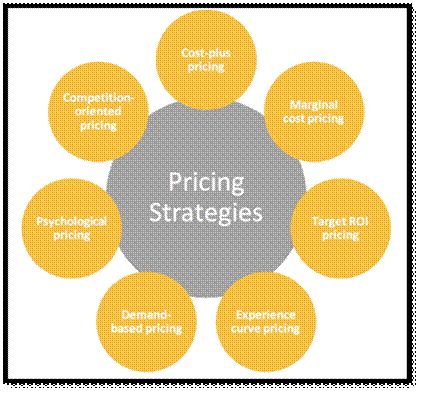
Figure 2.7.1: Product pricing strategies in market
(Source: Thabit
and Raewf, 2018)
The pricing strategies which are set
by the organizations prevent the entry of rival companies. Companies in the
market keep the prices of products on a lower margin for minimizing the profit
attractiveness of service or product. Thus, organizational goal can be met with
preventing the competitors to stay in park competition to the company.
Therefore, customers have less option of switching to other companies and the
potential customers can be retained. The customer has a belief that the product
which has high pricing poses high quality. Considering this fact, the
management of organization trends for developing a positive image within
customers that product is superior in comparison to the competitor s products.
The signaling of product quality also allows the customer to stay consistent to
the company which keeps the customer base sustained (Leijerholt,
Biedenbach and Hult n, 2019).
Pricing of the products have
relevant impact on the purchasing decision of consumers. The pricing of
products matters to the buyers as well as sellers. Higher sales can be
generated with correct pricing by considering the market trends and product
differentiation. Setting of higher prices or low price can affect the sales.
Comparisons of prices are done by the consumers before purchasing the product.
Lowering the price than competitors does not provide market advantage. Thus, in
this aspect differentiating the products has been pondered by the companies in
the market. The processes of the products have been set accordingly with
product quality. Therefore, consumers are willing to pay higher prices for
purchasing the differentiated products. It ultimately contributes to the growth
of the company as well as higher sales.
As opined by Cabrilo and Dahms (2018), expenses is an important factor
which is considered by companies in the market for pricing their products. The
costs of the products are added and further the amounts of profit to be earned
are determined. The lowering prices of products can have an effect of higher
market demand. Furthermore, setting the prices way below the margin creates
difficulty for the organization for handling the demand. Cost based pricing
is most considered by the presentation for setting prices. The strategy enables
the organization to determine the sales level and the company s profit goals
can be evaluated. Thus, the management requires showing the customers about the
value of products for justifying the prices charged. Thus, customers can have
increased trust in the company and profit objectives of the company can be
achieved.
The pricing strategies also enable
the companies to increase their market share. The lower market share can be
improved with changing the pricing. Therefore, the targeted market share can be
carved with the right pricing decision.
2.8 Market planning and selling forms an integral part of marketing
Marketing enables the company to
drive sales. The driving of sales contributes to keeping the business for the
long term. Therefore, marketing plans are crucial and the management devotes
more time to them. The plan allows for taking decisions regarding the selling
of products (Grover et al. 2018). The plan also enables the
organization to focus on the right people that can purchase the products.
Targeting the ideal customers can be important for reducing the costs of
marketing. This further increases the chances of transforming the leads into
sales. In this aspect, the segmentation is also crucial for assessment of the
overall population which is the potential customers of services or products.
The purchasing behavior and the spending habits are considered in this context.
Accordingly, the prices of products can be set considering the purchasing
behavior and spending.
The market planning examines the
future threats and opportunities which helps the management in formulating the
best strategy. The strategic market planning includes all the major decisions
and actions for achieving the objectives of the company (Olanrewaju
et al. 2020). In the fast
changing market environment, challenges are required to be met for which
market planning is essential. The customer services can be enhanced with this
process which in turn leads to higher profits. The revenue generation can be maximized
while the expense can be reduced.
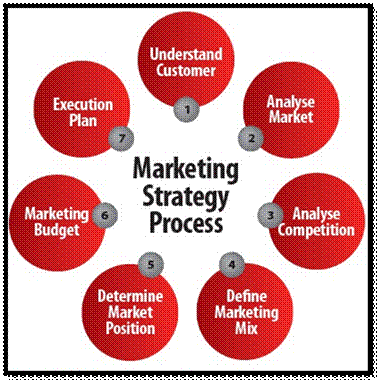
Figure 2.8.1: Marketing strategy process
(Source: Cabrilo and
Dahms, 2018)
ASDA has been able to identify the
priorities which are important for business success. The products include the
drinks, frozen foods, clothing and many more. The organization being
headquartered in Leeds with its expansion across the UK has enabled them to
reach their target customers. The marketing plan of ASDA has allowed them to
set up the supercentres and the superstores. The
position has been perfect for reaching potential customers. The pricing of
therapists are set considering the target customers and
market destination. The organization believes in mass selling with its wide
product portfolio (Elsbach and
Stigliani, 2018). They have adopted a reasonable pricing strategy for
attracting the customer on a larger scale.
The marketing policy which the
organization possesses is aggressive as they believe for their way to success.
Therefore, the planning of the company has enabled them to retain their loyal
customers and further add to the existing customer base.
The marketing plan helped in
determining the advertising budget and further enabled for evaluating the scope
of plan. Thus, the revenue that can be generated from the advertising can be
identified. The resources that are available with the company can be wisely
used. The resources can be balanced in context to the identified market that
can best for selling the products (Leijerholt, Chapleo and O Sullivan, 2019). The framework of operations can be provided accurately
with the plan. This can provide the firm with giving more attention to the
market enlargement instead of market maintenance.
The comprehensive view of the
origination is promoted with the marketing plan. The plan also acts as a
communication method and further coordinates the marketing department. The
marketing plan forms the link within the business direction and delivery of results.
The plan ensures that the right activities can take place at the right time to
target customers. In this process, the right medium channels can be also used
for rescuing the customers.
2.9 Theoretical perspectives
4Ps
of marketing - The
factors that are included in this model includes the product, price, place and
promotion of the goods or services for a company. The model allows for
bringing in clarity to the marketing options. The model enables for increasing
the revenue of an organization and further establishes a balance between the
market and company. Customer oriented marketing can be formed where the
customers are prioritized and thus their needs can be satisfied. The product or
services that can be beneficial for delivering the customer are identified with
this model. Thus, the unnecessary cost can be avoided and high
quality strategies can be formed.
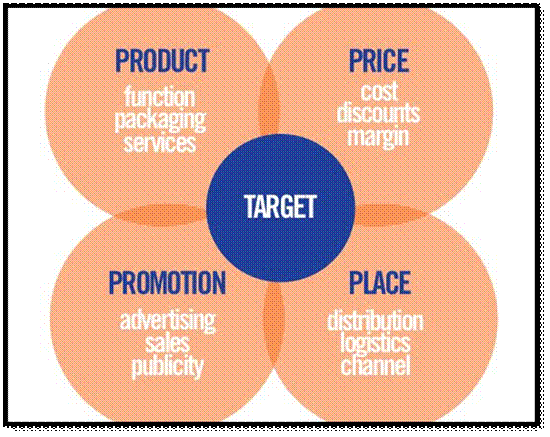
Figure 2.9.1: 4Ps of marketing
(Source: Morgan et
al. (2019)
Maslow s
Hierarchy of needs - The
different human needs are depicted in this theory. It underlines the needs as
per the requirement of the individual progressing towards the higher growth
needs. According to this theory, the needs of the people are psychological,
safety, belonging, esteem and self-actualization . In context to research, the
amount of social media usage by the customers can be determined and their
interests or needs can be evaluated. The level of hierarchy of the customers
can be understood while they are interacting with the brand (Cabrilo and Dahms, 2018). Consumers interest can be
identified for selling the process as per their demand.
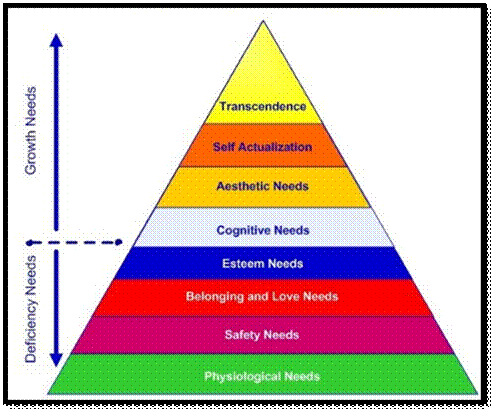
Figure 2.9.2: Maslow s Hierarchy of needs
(Source: Elsbach and
Stigliani, 2018)
STP
marketing model - The
STP model consists of three factors which are segmentation, targeting and
positioning by which the products and the services of a company can be
examined. The communication of benefits can be conveyed to customers
considering this model. The target audience can be defined with this model and
companies can position their products accordingly. In context to research, the
customer acquisition cost can be lowered with this model and thus profitability
of the company can be increased. The right engagement among the customers and
products can be done with this model which contributes to the organizational
success (Thabit and Raewf, 2018).
2.10 Literature gap
In developing this chapter, some
limitation has been observed. One loophole of the research is that factors
influencing the marketing decision contributing to organizational success are
not evaluated. The facts about influences of the marketing decision are not
clear from the research. This forms one gap within the literature review of
research.
2.11 Summary
The chapter has highlighted the
important literature relevant to the research. Various factors have been
discussed by creating themes which justifies the aim and objectives of
research. A conceptual framework has been developed in the chapter with major elements
of the research. Impact of marketing on organizational success has been
determined in this aspect. Furthermore, the chapter also identified the ways in
which the product pricing strategies meet the operational goals. The current
marketing strategies that are being followed by the organizations have been
determined which have led to organizational success. The marketing plans that
have been used by organization are discussed. Theories and models have been
also discussed in this chapter that has been beneficial for the researchers.
The literature gap has been identified considering the analysis. Based on this
analysis of this chapter, the methodology chapter has been discussed.
Chapter
3: Methodology
3.1 Introduction
The methodology segment of a research report focuses on the method
adopted in the study for meeting the research objectives . The chapter of the
research report highlights the reason behind using the methods in this
research. The way data was collected as well as the approach for analyzing the information was mentioned in this case. The
reason for not selecting a method over other methods was also clarified in this
case. Relevant reasons for following a specific research method were
mentioned by highlighting specific comparisons. This is the third chapter of
the research report addressing the philosophy, strategy, approach and design of
the research along with the way of collecting and evaluating the information
required in this case.
3.2 Method Outline
|
Method Elements |
Selected method for the research |
|
Philosophical stance of the study |
Positivism research philosophy
was selected to focus on real-time issue regarding brand awareness and
business success |
|
Approach suitable for the
research |
Deductive approach was
considered as suitable in this case. |
|
Design of the study |
Descriptive research design is
effective for the research as it allows to describe a phenomenon in
real-time context |
|
Source of information |
Secondary source such as
Google Scholar and proquest |
|
Technique used to collect
information |
The data was collected by using
keywords while searching relevant journal as well as articles |
|
Sampling and study population |
11 articles were selected from 30
considered articles to gather information for the research. |
|
Way of analysing information |
As the study collected
qualitative data from secondary sources , the adopted way for information
analysis was Thematic analysis . |
Table 3.2: Method Outline
3.3 Research Onion
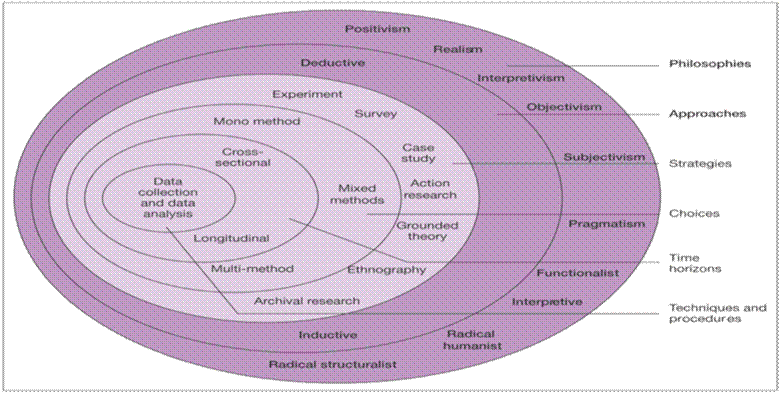
Figure 3.3 Research Onions
(Source: Saunders et al. 2015)
3.4 Research Philosophy
This part of the methodology chapter addresses the
selected philosophical stance for the research. As mentioned by Marsonet (2019), research can be done by adopting any of
the three research philosophies that are realism , positivism and
interpretivism . These three philosophies differ based on the way of
addressing the research scenario . According to Marsonet
(2019), Realism research philosophy is an idea that it no0t dependent
on the reality assumed by the human mind . The assumptions are based on the
scientific approach for developing specific sets of knowledge in the key
aspects of realism philosophy. There are two distinct aspects of realism that
are direct and critical (Ragab
and Arisha, 2018). Direct Realism focuses on the
studied context from a personal viewpoint on an individual whereas critical
realism focuses on the human experience and senses.
Interpretivism refers to the relative and
multiple realities which is based on the meaning of a specific phenomenon. As
mentioned by Basias and Pollalis
(2018). Interpretivism makes it difficult for interpreting a phenomenon based
on fixed realities . The adaptation of rigid structure in research gets
avoided by this philosophical approach. The key way of understanding a
phenomenon in this research philosophy is the consideration of perceived
knowledge (Marsonet, 2019). This philosophy focuses
more on interpretation rather than description.
The selected philosophical approach for this study
is Positivism research philosophy . The reason behind selecting
this philosophy is its consideration of real-world access . This
philosophical approach tends to focus on single external reality rather
than diversifying the study s vision (Marsonet,
2019). A generalisation of a phenomenon also takes place in this case that
helps to describe a research context. (Marsonet,
2019) The reason behind not adopting interpretivism is its poor connection
with the real-world context and more focus on the assumption and experience.
Realism was also not selected in this case as it addresses a present situation
based on the past scenarios. Positivism is suitable in this case as it allows
the researcher to focus on the distinction between the personal experience
and real-time issue .
3.5 Research Approach
This segment of this dissertation report highlights the approach
suitable for the study. As mentioned by Bairagi and Munot
(2019), there are two approaches among which a researcher can select one for
conducting research. These two key research approaches are the inductive
research approach and deductive research approach . This part of the third
chapter compares the research approaches to conclude the suitable approach in
this case.
As mentioned by Bairagi and Munot (2019), in
the inductive
approach of data collection a researcher initially collects the
information based on the research objectives and questions. The second step
of this approach is to get a bird's eye view of the collected data (Bairagi
and Munot, 2019). The reason behind getting the
bird's eye view is to understand the pattern of the information or the
similarities between the patterns. The third step of this research approach
is the development of theory based on analysis of the collected information
(Bairagi and Munot, 2019).

Figure 3.5.1: Inductive Research Approach
(Source: Marsonet,
2019)
According to Marsonet (2019), the inductive
research approach focuses on the development of theory based on the
collected information and its patterns. The goal of this approach is
theoretical development that focuses on specific issues.
The second research approach is the deductive research approach .
Unlike inductive, this research approach initially focuses on the
theorization of hypothecation. As stated by Mohajan
(2018), the deductive research approach focuses on a hypothesis or a theory
associated with a specific situation. The aim of this approach is to collect
information and analyse the information for supporting existing theory. It was
found that the deductive research approach is somehow the reverse of the
inductive research approach .

Figure 3.5.1: Inductive Research Approach
(Source: Marsonet,
2019)
The above figure shows that the deductive approach refers to the
collection of information based on a hypothesis or a theory. Further, the
collected data helps to support the theory (Marsonet,
2019). The selected approach for the research is the Deductive research
approach . The study aims to evaluate the impact of brand awareness strategy
on the success of an organisation. The study is not focusing on the development
of a theory rather it tries to support the theory of brand awareness in terms
of organisational success . This is the reason for preferring the deductive
approach over the inductive approach .
3.6 Research Design
The following design for research is required to
channelize the findings in a specific way that is effective for meeting the
research objectives . This is the research design segment of this report
that has a clear description of the designs and a comparison of the designs.
There are three designs of research that are Exploratory design , explanatory
design and descriptive design . All three designs are effective in specific
forms of research. As mentioned by Nayak and Singh (2021), without adopting a
research design a study can fail to meet its objectives or get the answers to
the research questions .
The selected design for the research is descriptive
design . As mentioned by Nayak and Singh (2021), descriptive research
design focuses on the collection of information in a systematic way that helps
to describe the studied situation, population or phenomenon. This design of
research assists the researcher to get the answers to questions starters with
what, how, where and when. The answer of why questions is quite difficult to
get from descriptive research designs (Nayak and Singh, 2021), As mentioned
by Pandey and Pandey (2021), this design helps to study by adopting a
cross-sectional method . The role of this method lies in evaluating multiple
factors and components of the studied phenomenon in a limited period of time.
Exploratory and explanatory design were not taken into
consideration while doing the research. Exploratory research design is
effective for analysing quantitative data by considering the variables used
in research (Basias and Pollalis,
2018). The key impact of this study can be seen when adopting the inductive
research method (Snyder, 2019). As the study is following a deductive
approach , the adaptation of exploratory design is not suitable Basias and Pollalis, 2018).
Explanatory research designs is appropriate for realism research
philosophy . The study was done by considering positivism research philosophy
which made Explanatory research design non-appropriate in this case.
3.7 Research Strategy
The term Research strategy refers to the specific way that needs to be
followed for conducting research. The study was done by focusing on the
specific issues in the management sector. The aim of the research is to
evaluate brand awareness in terms of organisation success . The study was
done by qualitative data collected from the secondary sources . At the
primary stage, the researcher considered the theories of brand awareness and
organisational success (Zangirolami-Raimundo, Echeimberg and Leone, 2018). The data was then collected
based on the association with the research objectives . The pattern of the
collected data was noticed in this case in order to make a clear assumption of
the key aspect on which the collected data was focussing on (Ruggiano and
Perry, 2019).
After evaluating the information researcher investigates the way
information is supporting the considered theory. The identification of gaps in
the previous research was done in the literature review chapter. The strategy
of the research was to fill the gaps in the study. Multiple themes based on the
objectives of the research were made to represent the information and analyse
the information. Thematic analysis is helpful in order to focus on micro
aspects of a phenomenon (Zangirolami-Raimundo, Echeimberg and Leone, 2018). This strategy was adopted to
address the way previous studies focused on brand awareness and
organisational success .
3.8 Data Sources and Data Types
This segment of the research report addresses the way data was collected
as well as the types of data. The research aims at understanding the role
brand awareness plays in organisational success. The data used in the
research was collected from secondary sources . As mentioned by Renz,
Carrington and Badger (2018), the advantages of secondary research lies in
the reduction of time and gathering information from different aspects. Renz,
Carrington and Badger (2018) mentioned that every researcher studies a
phenomenon from their individual perspective. This is the reason behind the
focus on various viewpoints in secondary research .
The collected data from the secondary sources in this research was
qualitative data . According to Sherif (2018), the consideration of
qualitative data focuses on multiple aspects of a phenomenon. The study
collected the information from two major secondary sources are Google
Scholar and ProQuest . Besides that information from
authentic websites by searching on Google Search Engine was collected in this
case. All the information was presented under the developed themes.
3.9 Population and Sampling
Secondary
sources were considered as the key source for collecting information in this
research. As the study collected information from secondary sources no human
sample was involved in this case. The selection of journals and articles was
done by filtering them with multiple aspects. Initially, 30 articles were
selected that were focusing on a similar study area. After that, the abstract
of the 30 articles were evaluated to understand the context of the research.
Abstract evaluation led to focus on 20 articles and rejection of 10 articles.
Then the content and methodology of the previous research were analyzed. After that 11 articles were selected to find the
answers to research questions.
3.10 Data Collection Process
The data collection process is one
important party for research. The future results often research wholly depends
on the type of data collected. The data collection process acts as a linking
factor within the sampling process (Novikov and Novikov, 2019). In this research work, the
secondary qualitative data analysis has been followed. Therefore, in this
aspect, thematic analysis has been effective. Various themes in relation to the
research topic have been developed. Different journals and online articles have
been selected for conduction of study. The journals and articles which are
selected for the thematic analysis have been collected from authenticated
sources. The sources which have been considered in this aspect include the Proquest and Google scholar. The journals and articles
which are from the current data have been used for the analysis.
All the secondary data are collected
for the thematic analysis. The themes which are developed are ensured that they
include relative information about the research work. Thematic analysis has
made it possible to meet the research questions. All the reliable information
that can be collected from the data sources are used in the themes (Ledford
and Gast, 2018). The theme
includes information about the marketing strategies that promotes the
organizational success. The themes also discuss the impact of online marketing
on organizational performance. The developments of the themes have ensured that
the research proceeds in the right direction and the objectives are met
successfully.
3.11 Data Analysis Plan
The collected data for the research
purpose are required to be analyzed correctly. Therefore, in analyzing the
data, data planes have been developed for the data used in research work. Data
analysis plan has been developed in the research in terms of the data sources.
In the case of the secondary qualitative data , thematic analysis has been
done (Zawacki-Richter et
al. 2020). In this
aspect, different themes are developed. Developing the right themes is
important to the researchers for deriving the right results. The research
objectives and the research questions have been considered for analyzing the
themes. It was ensured that the themes are analyzed considering the objectives
which are crucial for meeting the research goal.
The themes have been analyzed in
detail by using the various journals and articles. The journal and articles
which have been used are in connection to the research topic. The important
information about the marketing of organizations has been extracted from the
sources for discussing the themes. The analysis of the themes is done ensuring
the current scenario can be analyzed. This has helped in understanding the
recent marketing approaches which are used by the organizations for sustaining
in the market. The themes have been discussed with major focus on the marketing
strategies that contribute to organizational success (Eisend and Kuss, 2019). Analyzing the themes have
contributed to the development of correct conclusions.
3.12 Ethical Consideration
Research needs to follow the right
rules and regulations for sustaining the integrity of results. In this reach
for the secondary research , the ethical considerations have been followed. In
converting the thematic analysis, it has been ensured that the journals and
articles which are selected are identified sincerely. Trustable sources have
been taken into account while collecting the journals and articles. Copyrights
acts have been properly implemented in this aspect (legislation.gov.uk, 2022).
Copyright of any sources are not breached while analyzing the themes.
Therefore, referencing has been done appropriately with proper acknowledgement.
The data which are collected for the
research work have not been manipulated under any circumstances. Thus, the
integrity of the data has been maintained as a result. The resources were
accessible to the authorized research personnel only. The researchers have
ensured that the data are safely stored and no breach of data takes place
during research work. No data has been used for any personal purpose. The data
which are used in the research have been deleted after its use.
3.13 Time Plan
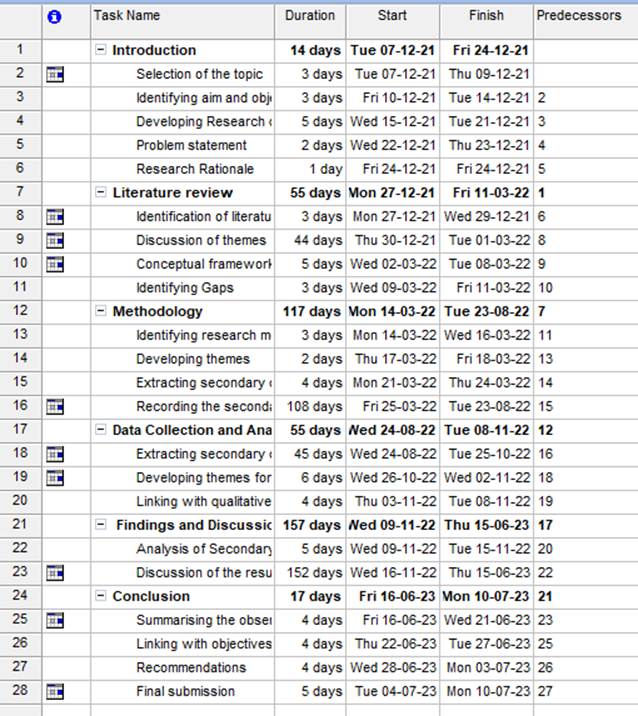
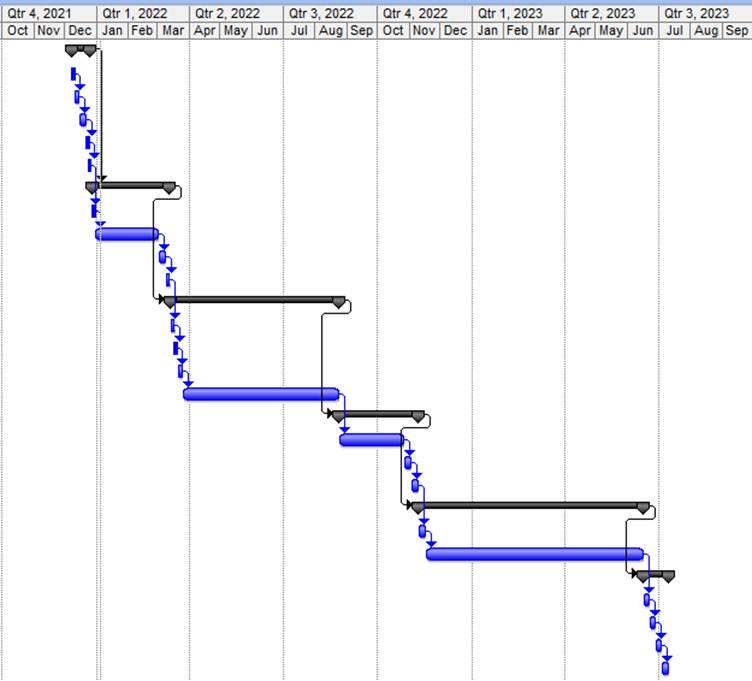
Figure 3.13.1: Time plan
The time plan reflects the various
activities of the research. It portrays the time duration for the competition
of the research. The time which has been consumed by each research activity can
be identified from the time plan. In this aspect, the dependency of the tasks
can be also evaluated.
3.14 Summary
The chapter has highlighted the
important methods which have been followed within research. The research
philosophy, approach and design have been discussed in this context.
Positivism research philosophy has been followed by the researchers for
research purposes. Deductive approach has been followed for reaching
conclusive evidence about research topic. The design which is followed for
research work is descriptive design , which has helped in supporting the
factual aspects.
The chapter has also discussed the research strategy that
has helped in meeting the objective of research. A discussion regarding the
data sources and data types have been stated. The chapter has followed
secondary qualitative research . In this context, thematic analysis has been
done by considering various journals and articles. All the themes are developed
concerning the research topic. Information has been extracted from the journals
and articles for analyzing the themes. All the important ethics have been
followed while conducting the thematic analysis. The journals and articles
which were selected have been taken from authenticated platforms. A time plan
has been presented in this chapter that highlights the research activities and
their completion time. The important findings have been discussed in the next
chapter
Chapter 4:
Data Collection and Analysis
4.1
Introduction
The fourth chapter of the research report is the specific segment where the researcher presents the information collected during the study with a brief analysis of the collected information. As the study was done by collecting qualitative information from secondary sources the researcher was performed thematic analysis to evaluate the collected information. Ten themes were developed in this chapter based on the research questions and objectives of the study. Under each developed theme the researcher presented the information along with the analysis of the information. The themes were effective in critically evaluating the micro components of the studies phenomenon.
4.2 Data
collection and analysis of secondary qualitative research
4.2.1
Theme 1: Marketing efforts play a greater role in increasing profitability of
any organization
Based
on the available information, it can be said that marketing effort impacts the
profit of the organizations. Proper marketing efforts help in developing brand
identifies , by which sales of the organization can be increased in a certain
way. It ensures the profit of the organization through gaining high market
share in the marketplace. This marketing effort can be contemplated as the
effective marketing or promotional tool, which has key impact on the
organizational performances. Marketing effort has a greater role in reinforcing
the organization's position in the marketplace. Through implementing various
kinds of marketing strategies, most of the organization can become profitable (Mariani, Mura and Di Felice, 2018).
Based
on the current analysis, it has been known that marketing efforts indicate the
resources, which has a great role in promoting product and services' '
effectively. It indicates various kinds of marketing activities, for improving
company performance. Depending on the company performances, the product demand
can be created. Not only demand, however, this marketing effort acts as a
catalyst for improving customer interests about the services of the
organization. In simple words, the main
goal of brand marketing is to take care of the brand communication and make a
key bridge between consumers and products. Brand marketing is one kind of
organization's promotional strategy or tool, for gaining potential customers,
which ensures the organization's success in a significant way.
4.2.2
Theme 2: Large and famous organizations follow effective marketing strategies
for increasing profitability of the organization
Marketing
strategy can be contemplated as the effective way for attracting and engaging
customers properly. It is one kind of marketing tool for engaging customers
through pushing some key offers. Based on the available information, it can be
said that social media'' is one kind of effective platform in engaging
customers. Most of the organization utilizes social media for mailing a large
customer base. Those organizations make some short-videos and some humor-laden tricks for attracting
customers. It can be said that most large and famous organizations can maintain
their reputations and increase profit margin in the marketplace through
following some effective marketing strategies (Spyropoulou et al.2018).
This marketing can be used as a communication
channel for informing customers. Through this channel, customers can know
about the product's value, usages and other additional features. This marketing
channel has the great role of developing brand awareness , by which large and
famous organizations can achieve competitive advantages in the marketplace. It
can be known that advertising and ``social media are the key marketing
channels for buying brand awareness and making a positive image of a brand .
Advertising can be considered as the key element of marketing strategy , which
helps in meeting organizational goals (Shen, Dumont and Deng, 2018).
Organizations can follow this marketing strategy at the time of economic
downturns, because ads help in generating or boosting company sales, which have
a high impact on organization profit.
4.2.3
Theme 3: Promotional strategies are an important part of marketing strategies
According
to the promotion strategy, it can be said that promotion indicates discounts
or incentives , which has a different effect than ads . Based on the
assumptions, promotional strategy plays the dominant role in increasing sales,
which may accelerate the profit margin of the organization. Hence, promotional
strategy can be considered as the essential sport of the marketing strategy (Markovic et al.2018). This promotions strategy is suitable for
short-term objectives of the organization. Hence, this strategy or discount has
a tendency to hurt the brand , in case of long-term objectives. Thus, it can
be ensured that promotional strategy is one kind of short-term strategic
tool , which helps in addressing some distinct problems of the organization.
The
issues may be related to the problem of the company's overstock and issues of
end-of-line. In case of long-term objectives, a high negative impact on profit
can be observed. According to the market analysis, it can be said that
promotional strategy is important for boosting customer traffic . It has a
great role in promoting organizational brand, by which interest of customers
can be increased about company products. This strategy has another aim of
informing customers about the product. In this case, organizations need to
follow some effective media tools for finding and targeting customers. Through
following the strategy, organizations can achieve high comparative advantages
and success in the marketplace.
4.2.4
Theme 4: Effective promotional strategies are utilized by various companies for
realizing organizational growth
It
has been observed social media can be used as a promotional strategy, which
helps the company in direct marketing. This social media can be considered as
the relax media'' for promoting products in a significant way. Through this
strategy, most of the companies do not want to try to sell products to the
consumers . Instead of this, they allow social media for keeping customers in
touch with the company products. Hence, social media is an effective
promotional strategy along with content marketing , mail order marketing , Customer Referral Incentive
Program , and branded promotional gifts .
As opined by Carlos and Lewis, (2018), it
has been observed that Unilever uses this kind of promotional strategies for
improving sales of consumer goods, and Rio Tinto follows the strategy for
delivering mining products across the country. The most utilization of these
promotional strategies has been observed in the retail sector or any
supermarket chain of the UK. ASDA is one kind of supermarket chain, which uses
this promotional strategy for boating sales, improving product quality and
customer services effectively. It may help these organizations to achieve
competitive advantage and success in the marketplace.
4.2.5 Theme 5: Product pricing strategies are playing a key role for
boosting improvement in an organization
This specific theme of the study focuses on the way pricing strategy
of an organisation is affecting the business improvement in a positive way.
Pricing strategy of a company is one of the key approaches to increase the
business profit. As mentioned by Collins (2021), an organization ensures the
enhancement of business profit by pricing its products in an effective way.
The author further mentioned that price of products set by an organisation
allows the company to determine its achievement of specific profitability
level . It was also found that the consideration of Optimal price of products
as well as services is effective to adopt the changing requirements of specific
markets.
Collins (2021) mentioned that dynamic policy of pricing is the
real-time pricing strategy or surge pricing that used to change the product
price based on the market demand . This not only helps in the determination
for appropriate product price but also generates profit in different market
situations. Customer value-based strategy of pricing focuses on the product
price based on customer perceptions.
4.2.6 Theme 6: There are effective product pricing strategies to enhance
marketing of an organization 150
The sixth theme was developed to understand the
relationship between pricing strategy and organisational marketing .
According to Nasiri et al. (2021),
the marketing of an organisation is essential to make the company reach more
consumers. Pricing strategy is one of the key tools that attract consumers
towards a brand and enhance profit. As mentioned by Collins (2021), a company
uses its pricing strategy for engaging people with the brand. The delivery of
a product at a competitive price allows a brand to communicate with a new
consumer base. Nasiri et al. (2021)
further mentioned that pricing strategy is not only effective in terms of
enhancing the impact of marketing strategies but also efficient for supply
chain management . Competitive price enhances the sustainability of the
supply chain . Collins (2021) mentioned that customer value-based pricing is
one of the key forms of using the pricing stage form marketing. It allows the
researcher to understand the perception of customers regarding the price set by
the organization.
4.2.7 Theme 7: large and branded organizations follow brand awareness
strategies to keep their brand image strong
This specific theme of the research addresses the
relationship between brand awareness and brand image . As mentioned by Świtała et
al. (2018), the term brand awareness refers to the familiarity of
consumers with the services and products of a brand. Świtała
et al. (2018) mentioned that the more
consumers are aware of a brand it possesses a strong image in the existing
market. Nasiri et al. (2021) stated
that the direct relationship of brand image can be seen with the perceived
quality of a brand. The study done by Świtała
et al. (2018) found that customers
trust in a brand is associated with the awareness regarding the brand among its
customer bases. As mentioned by the author, perceived quality shows a
relationship with brand image . It can be said that the loyalty of customers
to a brand is also associated with brand awareness . It is evident that brand
awareness has a strong impact to strengthen the brand image in every sector.
4.2.8 Theme 8: Enhancing brand awareness works in fostering trust among
customers which results in a loyal customer base
Customer loyalty is one of the key components of any
business market. It ensures the improvement of an organisation or achieves
success in the respective sectors. As mentioned by Phong et al. (2020), brand awareness is making the customers aware of
the services and products that a company is providing to them. The more a
customer gets familiar with the services and products the more the customer
becomes loyal to the brand. Phong et al.
(2020) further state that the maintenance of customer loyalty is one of the
difficult tasks to perform in a competitive market situation. Phong et al. (2020) refer to brand awareness
as an asset of an organisation or brand. The awareness of consumers regarding a
brand enhances brand commitment . The study of the authors found a positive
relationship between customer loyalty and brand awareness . Świtała et
al. (2018) mentioned that the association of customers with a brand
enhances due to brand awareness . It can be said that the association is
effective to make customers loyal to a brand.
4.2.9 Theme 9: In recent days, online marketing has become the most
effective way to do marketing by companies
Marketing is the key aspect that helps an organisation to reach more
customers at a time. The success of a business or a product is highly dependent
on the marketing strategies that an organisation adopts . As mentioned by Setiaboedia, Saria and Prihartonoa
(2018), the growth of small as well as medium companies in the present
situation is dependent on the way the companies are marketing in online
medium . The authors mentioned that online marketing by the majority of the
companies is increasing with time. As online marketing allows the companies
to communicate with a large number of people at a single time it is efficient
to spread the organisational message to more consumers. The impact of online
marketing can be seen in terms of increasing brand awareness (Setiaboedia, Saria and Prihartonoa,
2018).
4.2.10 Theme 10: Concept of online marketing is being evolved day by day
and these are utilized by companies for having effective results
One of the most used marketing strategies of recent time is online
marketing . As mentioned by Kingsnorth (2019), social media platforms are the
widely used areas for continuing online marketing by an organisation.
According to Kingsnorth (2019), the use of web-based channels for spreading
the organisational message to the consumers is known as online marketing .
These marketing channels help to make products, services and brands reach
potential customers . The increasing number of social media users is making
this marketing strategy more effective in the present business situation .
Kingsnorth (2019) further mentioned that the reach of different organizations
irrespective of their operating sectors is getting prone to use online marketing .
It is not only making people aware of a brand but also increasing commitment
towards a brand.
4.3 Summary
The fourth
chapter of the research report has the findings as well as an analysis of
collected data. The study found the relationship between brand awareness and brand
loyalty . In the present situation of different markets, it was found that
competition is increasing exponentially. All the companies operating in
different sectors are getting prone to engage more customers. It was found that
brand awareness has a direct impact on the brand image . In most cases it
was seen that small and medium enterprises are using online marketing to
reach a wide range of customers in a limited time. The development of customer
perception regarding a brand and its services are also in some cases dependent
on online marketing . Different pricing strategies of the organisations are
playing a crucial role in spreading brand awareness . The majority of
companies are using pricing strategy as a tool for promoting business and
engaging customers with them.
Chapter 5:
Findings and Discussion
5.1
Introduction
In this chapter, the findings of the
above chapter have been discussed. In this case, it can be observed that the
research has followed a secondary qualitative research method. Hence, the key
findings of secondary research have been analyzed in a meaningful way. The
discussion has been done based on secondary qualitative research through
performing thematic analysis. It can be contemplated as the important chapter,
which helps researchers to draw great outcomes of the research.
5.2
Discussion on findings based on secondary qualitative data
Theme
1: Marketing efforts play a greater role in increasing profitability of any
organization.
Based on identified findings
regarding marketing strategies; utilized by companies for developing brand
identities , increasing sales and gaining market share. In this aspect
various companies such as Asda, Tesco follow strategic approaches that focus on
promotional tools that have an impact on company performance . As stated by
Bilgin (2018), Based on a research that has been
conducted upon 450 companies and collected information on market strategies
and company performance ; This research declared that there are some specific
strategies and elements that can affect company profits . Companies increase
profitability by having a focused approach within their marketing strategies.
In terms of analyzing important
marketing strategies, it is necessary to identify some factors among which
advertising plays an important role. Sole purpose of marketing is to build
brand awareness and develop a positive image for brand. Advertising helps
in meeting this goal as advertisement helps in generating sales which is
further responsible for influencing profits.
Theme
2: Large and famous organizations follow effective marketing strategies for
increasing profitability of the organization.
In terms of experiencing growth,
marketing strategies are proved to be mostly effective in order to generate
leads as well as driving business. That is why large and branded companies such
as BHP Group Plc, Astrazeneca Plc utilize marketing
tactics so that business performance can be improved. Major strategies in this
aspect are discussed here. As opined by Foroudi (2019), In case of B2B
business, content marketing focuses on education more than selling in terms
of influencing purchasing behavior. This kind of strategic marketing approach
emphasizes on distributing and creating information that are relevant for
attracting customers to buy products and services. Ongoing communication is
tailored for reflecting learning about leads over time . Content marketing focuses
on drawing prospects through sales funnel , growing brand visibility,
desirability and credibility . Inbound marketing is one if the most effective B2B marketing strategies utilized by
various organizations as it leverages strength of majority such as attracting, engaging and
delighting customers. Lesmana,
Widodo and Sunardi (2020) stated that In case of B2C marketing, internet marketing, paid media
advertising are important strategies that are followed by worldwide
organizations.
Theme
3: Promotional strategies are an important part of marketing strategies.
Promotional strategies refer to some
specific methods that are utilized by companies for advertising, promoting and
selling their goods and services . Any organization selects its promotional
strategies based on some factors such as marketing budget, product type,
target audience and many more. Hence, promotional activities are somewhat
critical that are engaged in increasing product awareness and increasing
sales . Hajarian et al. (2021) stated that Effective promotional strategies
can add huge revenue in case of marketing spend. In case of every company,
promotional strategy plays an important role as promotion helps in knowing
about product and services . It is because, after knowing about product and
services , customers make decisions about purchasing. In market, companies
engage in competition and competitors use more and more attractive tools to
influence customers as based on these strategies, each brand is identified and
differentiated.
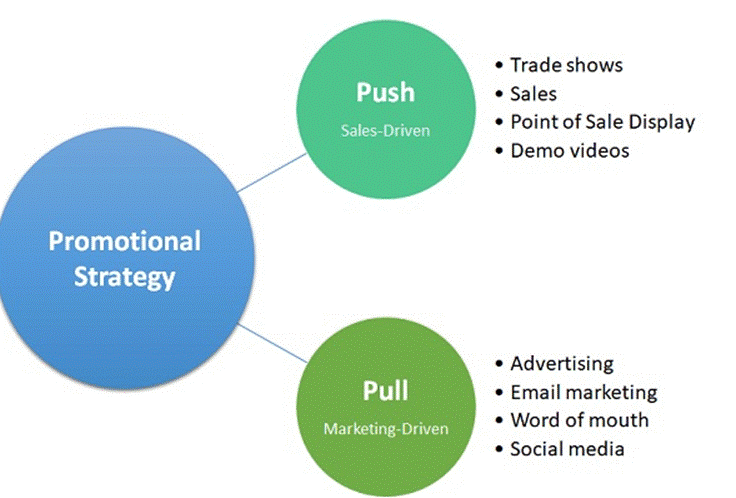
Figure 5.2.1: Promotional strategy type
(Source: Warokka et al. 2020)
Promotional strategies are of two
types such as push strategy and pull strategy . Push strategies are sales
driven whereas pull strategies are termed as marketing driven strategies .
Push strategies are utilized when promotional activities are conducted for
wholesalers, distributors and retailers for pushing the product to consumers.
Some strategies in this case are trade fairs , wholesalers and retailers
and the benefit distributors. Warokka et al. (2020)
stated that in this way, demand is created. In case of pull strategies,
digital campaigns, discounts are offered as promotional activities.
Theme
4: effective promotional strategies are utilized by various companies for
realizing organizational growth.
In the context of UK, it can be found that there are branded
organizations which follow an effective promotional strategy which helps them
create a huge customer base . One of the most;ly
used and common strategies is driving more traffic following content
marketing . In this content marketing, some factors are included such as
infographics, blog posts, videos, podcasts and many more. In case of inbound
marketing, blog posts he;p
in promoting external and internal content involving product and service
information for educating audiences. Infographics help in visualization between
data and images. Kingsnorth
(2019) opined that It helps in easy and engaged
understanding of information. Podcast helps in stimulating mind and serving
informational content results in creation of podcasts within business. Social
media is another important strategy that is followed by companies.
Social media helps in targeting audiences and increasing marketing. Email
marketing also helps in driving engagement along with sales. Email
marketing is a part of inbound promotion . This strategy is focused on
building relationships with readers.
Theme
5: Product pricing strategies are playing a key role for boosting improvement
in an organization.
Setting up prices is an important
step for a business. Price setting does not mean maximizing profit margin. It
helps in competition, changing market share and creating different revenue
scenarios . Price set up affects profit margin as power unit sold . It is
evident that a higher price gives high profit if sales are lost. Since, higher
price outbound capacity of majority buyers, it results in lowering sales
volume . Hence, pricing strategy must be developed crucially. Pricing strategy
has an impact on sales volumes . According to ER et al. (2021),
In this aspect, it is seen that pricing has resulted in decrease and
increase in sales volume . In this aspect, economists studied price
elasticity and consumer purchasing to a price change . Lowering prices can
increase profits by jumping in sales significantly. Market response also needed
to be studied for targeted areas across board price increase . Price setting
sends a message to consumers regarding service and products which creates a
perceived value. It affects image, brand and market place position.
Theme
6: There are effective product pricing strategies to enhance marketing of an
organization
Pricing strategies help in
increasing profit made by companies such as selling price, costs and unit
sales volume . It is stated that pricing strategies and formulas can result in
greatest profit in any condition. Hence, in terms of having maximum profit,
different types of costs need to be understood. Various large companies such as
Asda, Aviva, Unilever always focus on pricing strategy so that they can attract
consumers effectively and can experience a great surge in income. One of the
effective strategies in this case is what will be borne by the market. Mackey et al. (2018) stated that This strategy states that price is
set up based on the maximum price that can be paid by the market. In case of a
new product, highest profit can be realized by recouping the start-up cost . This particular strategy works in case of those
customers who are willing to buy new products and which are not price
sensitive . Desirability and considerable uniqueness are built within product
brand by employing this strategy. Identification of underperformers is alo a part of pricing strategies as rising profit tend
helps in hiding loss making products . Using pricing analytics helps in
identification of what is going to happen in upcoming future for setting up
pricing strategies that can react to these predictions.
Figure: 5.2.2: Product pricing strategy
(Source: Mackey et al. 2018)
Theme
7: large and branded organizations follow brand awareness strategies to keep
their brand image strong.
Large companies such as Tesco, Rio
Tinto strictly focus on brand awareness establishment as they need to occupy a
large marketplace. Some major strategies that are followed by them are
discussed here. Partnering with companies that can emit strong trust signals
is effective in this case. Big name brands worked hard in order to achieve
level of loyalty as well as trust that can make it successful. Various brands
such as Apple, Nivea are market established brands and everyone knows these
brands and finds them trustworthy . Brand awareness can be increased by
arranging brand campaigns . As stated by Santos (2020), making most of influencer
marketing is important as brand targets younger customers . Decision making
by digital influencer is a common trend nowadays which results in increasing
brand awareness. This kind of strategic approach helps in bringing the most
value . In this aspect, authenticity is usually given value in most cases.
Micro influencers are effective in making most relatable content which
influence customers. Harnessing power of content marketing is also important
in this case. This helps in resonating with target audience along with
increased brand awareness . Achieving consistent campaign imagery also helps
in targeting an audience.
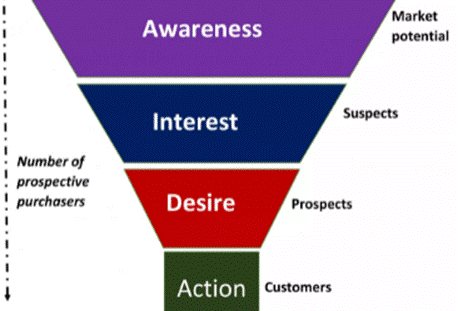
Figure 5.2.3: Brand awareness strategies
(Source: Santos 2020)
Theme
8: Enhancing brand awareness works in fostering trust among customers which
results in a loyal customer base.
Brand awareness refers to
familiarness with targeting audience with brand and how well consumers know
about the brand. Brands that have high brand awareness are referred to as
trending , buzzworthy and are popular. Brand awareness is and its establishment
is valuable in terms of promoting and marketing of company and products.
Establishment is important in case of establishment of brand awareness as
this is valuable for promoting as well as marketing company products in first
stages of business . As stated by Murugan (2019), In case of any
organization, brand awareness is important as it helps in fostering trust. It
has been found that consumers rely on extensive research and others opinion
before making any purchase decisions. It is also found that brand awareness
results in bridging gap between loyalty and trust . Brand awareness also helps
in creating association. Brand awareness helps in associating products and
actions with particular brands that encourages marketing.
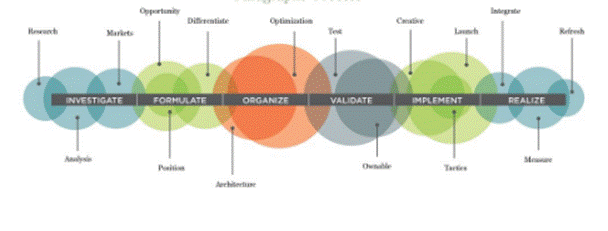
Figure 5.2.4: Establishing Brand awareness
(Source: Murugan, 2019)
Theme
9: In recent days, online marketing has become the most effective way to do
marketing by companies.
Online marketing can be termed as
a practice that can leverage web based channels for
spreading messages about brand image, service and products to potential
consumers. The techniques and methods used in this online marketing mainly
include social media, email, SEO marketing and so on. Major objective in this
case is to reach potential customers via searching, time reading, socializing
and many more. According to De
Giovanni and Zaccour (2019), Adoption of
internet has generated these new channels for marketing and advertising in
terms of engaging consumers. Major benefits of this kind of marketing strategy
are that online marketing channels are mostly cost effective for acquiring
customers. These channels are also useful in driving higher lifetime value
for many customers and it drives repeated purchases to prior customers . Some
important marketing tools are email marketing , social media marketing ,
search engine optimization and many more.
Theme
10: Concept of online marketing is being evolved day by day and these are
utilized by companies for having effective results.
Digital marketing is such a type
of business strategy that is continuing to evolve with invention of new
technology . Keeping up developments for staying in touch with audience is
associated with modern day techniques and strategies . Digital marketing
refers to practice of promoting services and products with the help of
internet (Zhao et al. 2019). Major goal of
online or digital marketing is to create awareness for brands and products
within the general public . From traditional marketing to digital marketing,
entire marketing procedure is getting evolved day by day. Major evolutions in
this type of marketing are search engines came into play, social media
revolution , mobile first marketing , consumer data and targeted campaigns
and many more.
5.3 Summary
A great interpretation of the finding of this
research has been in this section. It is a crucial chapter to draw critical
conclusions for this research. This key area of this research helps to meet the
aim and objectives of the research. The analysis of secondary research methods
has been done in this section. Through following this research method, thematic
analysis has been done. Hence, ten major themes have been developed based on
this research topic, which are effective for meeting research objectives crucially.
Based on this analysis, the importance of brand marketing as well as
promotional strategies in organizational success has been justified.
Chapter 6: Conclusion
6.1
Overall conclusion
In
this dissertation, a detailed research has been done
based on brand marketing and promotional strategies that are utilized in
organizational success. In terms of doing this, research background, research
objectives and research questions have been developed in introduction chapter
so that researchers stay focused on research objectives. In literature review
chapter, various themes have been discussed to develop the actual concept of
readers. Going through this literature review chapter, gainful insights about
brand marketing and promotional strategies and how large branded organizations
utilize these strategies can be identified. In methodology chapter, proper
methods that have been followed to conduct this research and how these methods
meet research objectives by answering research questions have been justified.
This methodology chapter induces secondary qualitative data is appropriate to
understand how various marketing strategy helps in organizational success.
Hence, it meets expectations. In data collection and analysis chapter, a
detailed discussion has been done based on collected data found from various
articles and journals. These journals are developed based on research done in
this similar aspect. Examining the findings have been done by developing some
relevant themes in findings and discussion chapter, since thematic analysis is
appropriate for secondary qualitative data. In conclusion section, it has been
examined whether research objectives are met and research questions are
answered.
6.2
Linking with objectives
Objective
1: to determine the role of marketing efforts on profitability of an
organization
The
2.6 and 2.8 sections of literature review, theme 1 and theme 2 in
findings and discussion chapter, have discussed the content of this objective.
The purpose of this objective was to identify key role played by marketing
efforts in enhancing profitability of an organization. This discussion
represented how marketing efforts are responsible for reaching a lot of
customers which further results in increasing profitability of the
organization. In this aspect, all these sections and themes have discussed entire
concept of marketing efforts and how it can contribute in profitability of an
organization. Hence, this objective has been met.
Objective
2: to ascertain growth of an organization by implementing effective
promotional strategies
The
section 2.5 and 2.3 of literature review, theme
3 and 4 in findings and discussion chapter, have discussed the brief
concept of this objective that is concept of promotional strategies and its
responsibility in growth of an organization. In this aspect, going through
these sections and themes, how promotional strategies act in ascertaining
organizational growth of any organization can be understood. Major roles of
promotional strategies and what strategies are utilized by various brands have
been identified here. Hence, this objective is also met.
Objective
3: to evaluate effectiveness of online marketing for developing organizational
marketing sustainability
Theme
9 and 10 in findings and discussion chapters has
described online marketing and its underlying concept. Effectiveness of online
marketing in case of an organization and its marketing strategies has been
discussed here. These themes have described how online marketing is playing an
exceptional role in marketing of organizations. By the way, how this concept of
online marketing is evolving and how it is enhancing its role as a marketing
strategy and how online marketing is an advanced option for utilizing it as an
organizational marketing strategy.
Objective
4: to analyze the effect of product pricing strategies for achieving
organizational goals
In
literature review chapter, section 2.7, theme 5 and 6 in
findings and discussion chapters have discussed the concept of product pricing
strategies . Product pricing strategy and its importance in achievement of
organizational goals have been identified in these sections and themes. In
case of every organizational product and service, pricing plays an important
role and depending on price of product and service , selling of products
increases or decreases, hence, profitability is directly related to pricing
strategy. These aspects have been discussed in these positions. Hence, this
object has been met.
Objective
5: to develop brand awareness for initiating proper brand promotion and market
planning
In
2.4
sections of literature review and theme 7 and 8 in findings and
discussion chapters are intended in discussing the concept of brand awareness.
Going through these portions, it can be understood that brand awareness and its
importance from organizational perspectives. The ways in which brand awareness works
in reaching a lot of customers and in increasing market acceptance have been
described here. In addition, how brand awareness results in trustworthy ness
also has been represented here. Various important
strategies utilized by large companies increasing their brand awareness have
been also described. Hence, requirements of this objective are met properly.
6.3
Recommendation
Based
on purpose of this research, it is necessary to identify some recommendations
so that organizations can improve their marketing strategy by evolving online
marketing, brand awareness strategies and pricing strategies. Hence, some
recommendations are given as follows:
Guest
blog for other sites: in terms of developing marketing
strategies, blogs are must. There are various companies who run their own
blogs and have built their owned audiences which help them in occupying a
good customer base in market (Chen, Liu and Xu, 2018). In this aspect, a list
of guest posts must be done. In this aspect, brainstorming of ideas for blog
posts can be a way.
Creating
shareable infographics: shares are important in
terms of reaching new audiences and whether these shares are seen by audiences
help in understanding how much customers follow those shares and
advertisements. In this aspect, shares can be done by infographics.
Infographics are visually engaging which helps in more and engagement of
audiences. Hence, it is an effective way for enhancing marketing.
Having
a clear and executive level pricing owner : any
one member within executive team must be empowered and assigned to determine
pricing level as this must be done by an expert. It will help in developing
pricing improvement process and plans.
Optimizing
product range: segmentation of customers and
understanding what will be the best price in the range can meet needs without
any disruption about full product line pricing . Chen, Liu and Xu (2018)
stated that Sales must be aligned with profit growth for having compensation.
Profits and price improvement are useful in this aspect.
Establishing
a cross department workflow : cross department
workflow is important for having any kind of improvement regarding marketing
operations that helps in establishing a project workflow between marketing
and rest of organizations . Internal working positions within individual teams
are influenced by departmental request projects get influenced heavily.
Social
media marketing: this is another important strategy that
needs to be implemented by large organizations in terms of having a good flow
of profits and sales. Social media marketing is the most advanced way in recent
days as it helps in reaching a lot of audiences and it is easier to influence
them greatly. Hence, this strategy will be helpful.
6.4
Future prospect
This
research possesses a lot of future prospects as in future, business and
marketing strategies are going to play an important role. In this post pandemic
era, a great evolution has taken place in business context. Within business
context, marketing plays the most important role and so evolution in business
context will result in changed marketing strategies (Santos, 2020). Since, this
research is developed based on marketing strategies, online marketing and brand
awareness, this research will be effective and important for upcoming business
context. Hence, this research is very much important in this aspect. In which
ways online and digital marketing will play their role in marketing can be
identified from this research. Hence, the future prospect of Thai research is
significant.
Reference List
Agzamov,
A.T., Rakhmatullaeva, F.M. and Giyazova,
N.B., 2021, June. Marketing strategy for the competitiveness of modern
enterprises. In E-Conference Globe (pp. 1-3).
Ahmad, A.H., Malik, I.S.A., Idris, I., Masri, R., XiangWong, J. and Alias, S.S., 2020. Creating brand awareness through YouTube advertisement engagement. Test Engineering & Management, 83(4), pp.7970-7976. Available at https://www.researchgate.net/profile/Arman-Haji-Ahmad/publication/340661250_Creating_Brand_Awareness_through_YouTube_Advertisement_Engagement/links/5e9777924585150839e01f04/Creating-Brand-Awareness-through-YouTube-Advertisement-Engagement.pdf [Accessed on 24 December 2021]
Alexandra, Z.
and Cerchia, A.E., 2018. The Influence of Brand Awareness and Other Dimensions
of Brand Equity in Consumers Behaviour: The Affordable
Luxury Strategy. . Ovidius University Annals,. Ovidius Univ Annal Economic Sci Series, 18(1),
pp.222-427.
Anees-ur-Rehman, M., Wong, H.Y., Sultan, P. and Merrilees, B.,
2018. How brand-oriented strategy affects the financial performance of B2B
SMEs. Journal of Business & Industrial Marketing.
Anees-ur-Rehman, M., Wong, H.Y., Sultan, P. and Merrilees, B.,
2018. How brand-oriented strategy affects the financial performance of B2B
SMEs. Journal of Business & Industrial Marketing.
https://www.researchgate.net/profile/Ho-Yin-Wong-7/publication/323082208_How_brand-oriented_strategy_affects_the_financial_performance_of_B2B_SMEs/links/5ad5a77faca272fdaf7c2757/How-brand-oriented-strategy-affects-the-financial-performance-of-B2B-SMEs.pdf
Ansari, S., Ansari, G., Ghori, M.U. and Kazi, A.G., 2019. Impact of brand awareness and social media content marketing on consumer purchase decision. Journal of Public Value and Administrative Insight, 2(2), pp.5-10. Available at https://readersinsight.net/JPVAI/article/view/896 [Accessed on 21 December 2021]
asda.com (2021), Marketing strategy, Available at https://www.asda.com/ [Accessed on 28 December 2021]
Bairagi, V. and Munot, M.V. eds., 2019. Research methodology: A practical and scientific approach. CRC Press.
Basias, N. and Pollalis, Y., 2018. Quantitative and qualitative research in business & technology: Justifying a suitable research methodology. Review of Integrative Business and Economics Research, 7, pp.91-105. https://sibresearch.org/uploads/3/4/0/9/34097180/riber_7-s1_sp_h17-083_91-105.pdf
Bilgin, Y.,
2018. The effect of social media marketing activities on brand awareness, brand
image and brand loyalty. Business & Management Studies: An
International Journal, 6(1), pp.128-148.
Bilgin, Y.,
2018. The effect of social media marketing activities on brand awareness, brand
image and brand loyalty. Business & Management Studies: An
International Journal, 6(1), pp.128-148.
Bilgin, Y., 2018. The effect of social media marketing
activities on brand awareness, brand image and brand loyalty. Business
& Management Studies: An International Journal, 6(1),
pp.128-148.
Cabrilo, S. and Dahms, S., 2018.
How strategic knowledge management drives intellectual capital to superior
innovation and market performance. Journal of knowledge management.
https://www.emerald.com/insight/content/doi/10.1108/JKM-07-2017-0309/full/
Carlos, W.C. and Lewis, B.W., 2018. Strategic silence: Withholding
certification status as a hypocrisy avoidance tactic. Administrative
Science Quarterly, 63(1), pp.130-169.
Chen, W., Liu, H. and Xu, D., 2018. Dynamic pricing
strategies for perishable product in a competitive multi-agent retailers market. Journal of Artificial Societies
and Social Simulation, 21(2). http://jasss.soc.surrey.ac.uk/21/2/12.html
Collins, T., 2021. Pricing policy and profitability level of an organisation: Case study Finnair. https://www.theseus.fi/bitstream/handle/10024/506404/Collins_Tanyi.pdf?sequence=2
De Giovanni, P. and Zaccour, G.,
2019. Optimal quality improvements and pricing strategies with active and
passive product returns. Omega, 88, pp.248-262.
Dwivedi, A.
and McDonald, R., 2018. Building brand authenticity in fast-moving consumer
goods via consumer perceptions of brand marketing communications. European
Journal of Marketing.
Dwivedi, A., Nayeem, T. and Murshed, F., 2018. Brand experience and consumers willingness-to-pay (WTP) a price premium: Mediating role of brand credibility and perceived uniqueness. Journal of Retailing and Consumer Services, 44, pp.100-107. Available at https://www.sciencedirect.com/science/article/pii/S0969698918302170 [Accessed on 20 December 2021]
DZIUBA, T.,
2021. International Brand Promotion Strategy (Doctoral
dissertation, Masarykova univerzita,
Ekonomicko-spr vn fakulta).
Eisend, M. and Kuss, A.,
2019. Research Methodology in Marketing: Theory Development, Empirical
Approaches and Philosophy of Science Considerations. Springer.
Elsbach, K.D. and Stigliani, I., 2018. Design thinking and organizational
culture: A review and framework for future research. Journal of
Management, 44(6), pp.2274-2306.
https://journals.sagepub.com/doi/pdf/10.1177/0149206317744252
ER, T., Listiawati, M.K., Nurjaya, R.S., Setiawati, N.P.A., Ilham, D., Wulansari, R.,
Sunarsi, D. and Purwanto10, A., 2021. THE EFFECT OF
ONLINE MARKETING AND E-SERVICE QUALITY ON PURCHASE DECISIONS: AN EMPRIRICAL
STUDY ON ONLINE SHOP. Turkish Journal of Physiotherapy and
Rehabilitation, 32(3).
Foroudi, P., 2019. Influence of brand
signature, brand awareness, brand attitude, brand reputation on hotel
industry s brand performance. International journal of hospitality
management, 76, pp.271-285.
Garcia-Morales,
V.J., Mart n-Rojas, R. and Lard n-L pez, M.E., 2018.
Influence of social media technologies on organizational performance through
knowledge and innovation. Baltic Journal of Management.
https://www.researchgate.net/profile/Victor-Garcia-Morales/publication/322464228_Influence_of_social_media_technologies_on_organizational_performance_through_knowledge_and_innovation/links/5d5dd739a6fdcc55e81edffb/Influence-of-social-media-technologies-on-organizational-performance-through-knowledge-and-innovation.pdf
Grover,
V., Chiang, R.H., Liang, T.P. and Zhang, D., 2018. Creating strategic business
value from big data analytics: A research framework. Journal of
Management Information Systems, 35(2), pp.388-423.
https://files.stample.com/stample-1564010096810-2868103_1_bda-2018.pdf
Hajarian, M., Camilleri, M.A., D az, P. and
Aedo, I., 2021. A taxonomy of online marketing methods. In Strategic
corporate communication in the digital age. Emerald Publishing Limited.
HOANG, X.L., NGUYEN, T.K.C., LY, H.M., LUONG, T.T. and NGUYEN, T.T.Q., 2020. The moderating role of CSR associations on the link between brand awareness and purchase intention. The Journal of Asian Finance, Economics, and Business, 7(6), pp.233-240. Available at https://www.koreascience.or.kr/article/JAKO202017764018122.page [Accessed on 22 December 2021]
Hossain, M.,
2018. Marketing Strategies of Ambit Holdings Ltd. INTERNSHIP REPORT (pp. 1-26).
Kingsnorth, S., 2019. Digital marketing strategy: an integrated approach to online marketing. Kogan Page Publishers.
Kingsnorth, S., 2019. Digital marketing strategy: an
integrated approach to online marketing. UK: Kogan Page Publishers.
Ledford,
J.R. and Gast, D.L. eds., 2018. Single case research methodology.
New York, NY: Routledge.
legislation.gov.uk,
2022. Copyright, Designs and Patents Act.
Available at <https://www.legislation.gov.uk/ukpga/1988/48/contents>
Accessed on [03/01/2022]
Leijerholt, U., Biedenbach, G. and
Hult n, P., 2019. Branding in the public sector: A systematic literature review
and directions for future research. Journal of Brand Management, 26(2),
pp.126-140. https://www.diva-portal.org/smash/record.jsf?pid=diva2:1292855
Leijerholt, U., Chapleo,
C. and O Sullivan, H., 2019. A brand within a brand: An integrated
understanding of internal brand management and brand architecture in the public
sector. Journal of Brand Management, 26(3), pp.277-290.
http://eprints.bournemouth.ac.uk/30853/3/Abrandwithinabrandfinalprepublication-1.pdf
Lesmana, R., Widodo, A.S. and Sunardi,
N., 2020. The Formation of Customer Loyalty From Brand
Awareness and Perceived Quality through Brand Equity of Xiaomi Smartphone Users
in South Tangerang. Jurnal Pemasaran Kompetitif, 4(1),
pp.1-12.
Mackey, T., Kalyanam, J., Klugman, J., Kuzmenko, E. and
Gupta, R., 2018. Solution to detect, classify, and report illicit online
marketing and sales of controlled substances via twitter: using machine
learning and web forensics to combat digital opioid access. Journal of
medical Internet research, 20(4), p.e10029.
Mariani, M.M., Mura, M. and Di Felice, M., 2018. The determinants of
Facebook social engagement for national tourism organizations' Facebook pages:
A quantitative approach. Journal of Destination Marketing &
Management, 8, pp.312-325.
Markovic, S., Iglesias, O., Singh, J.J. and Sierra, V., 2018. How does
the perceived ethicality of corporate services brands influence loyalty and
positive word-of-mouth? Analyzing the roles of empathy, affective commitment,
and perceived quality. Journal of Business Ethics, 148(4),
pp.721-740.
Marsonet, M., 2019. Philosophy and logical positivism. Academicus International Scientific Journal, 10(19), pp.32-36. http://dspace.epoka.edu.al/bitstream/handle/1/1829/Academicus-MMXIX-19-032-036.pdf?sequence=1
Mohajan, H.K., 2018. Qualitative research methodology in social sciences and related subjects. Journal of Economic Development, Environment and People, 7(1), pp.23-48. https://mpra.ub.uni-muenchen.de/85654/1/MPRA_paper_85654.pdf
Mohajer, S.M.
and Khansanami, E., 2021. Increase the performance of
the organization by applying competitive marketing strategies. BRANDAFARIN
JOURNAL, 2(16).
Morgan,
N.A., Whitler, K.A., Feng, H. and Chari, S., 2019. Research in marketing
strategy. Journal of the Academy of Marketing Science, 47(1),
pp.4-29. https://eprints.whiterose.ac.uk/136066/1/JAMS%20Final%20Version%20Unblinded.pdf
Murugan, K., 2019. A Study on Customer Perception towards
Online Marketing in Chengalpattu Town. Emperor Journal of Economics and
Social Science Research, 1(4), pp.16-23.
Nasiri, G.R., Deymeh, H., Karimi, B. and Miandoabchi, E., 2021. Incorporating sales and marketing considerations into a competitive multi-echelon distribution network design problem with pricing strategy in a stochastic environment. Journal of Retailing and Consumer Services, 62, p.102646. Available at: https://www.sciencedirect.com/science/article/abs/pii/S0969698921002125 (Accessed on: 3rd January, 2022)
Nayak, J.K. and Singh, P., 2021. Fundamentals of Research Methodology Problems and Prospects. SSDN Publishers & Distributors.
Novikov,
A.M. and Novikov, D.A., 2019. Research methodology: From philosophy of
science to research design. CRC Press.
Olanrewaju,
A.S.T., Hossain, M.A., Whiteside, N. and Mercieca, P., 2020. Social media and
entrepreneurship research: A literature review. International Journal
of Information Management, 50, pp.90-110.
https://fardapaper.ir/mohavaha/uploads/2019/11/Fardapaper-Social-media-and-entrepreneurship-research-A-literature-review.pdf
Pandey, P. and Pandey, M.M., 2021. Research Methodology Tools and Techniques.
Papadas, K.K., Avlonitis,
G.J., Carrigan, M. and Piha, L., 2019. The interplay of strategic and internal
green marketing orientation on competitive advantage. Journal of
Business Research, 104, pp.632-643.
https://pureportal.coventry.ac.uk/files/19910314/Binder1.pdf
Phong, L., Nga, T., Hanh, N. and Minh, N., 2020.
Relationship between brand association and customer loyalty: The case of online
retail industry. Management Science Letters, 10(7), pp.1543-1552.
http://m.growingscience.com/msl/Vol10/msl_2019_371.pdf
Putri, D.R.,
2021. Digital marketing strategy to increase brand awareness and customer
purchase intention (case study: Ailesh green consulting). European
Journal of Business and Management Research, 6(5), pp.87-93.
Ragab, M.A. and Arisha, A., 2018. Research methodology in business: A starter s guide. Management and Organizational Studies, 5(1), pp.1-14. https://www.researchgate.net/profile/Mohamed-Ragab-22/publication/321769066
Renz, S.M., Carrington, J.M. and Badger, T.A., 2018. Two strategies for qualitative content analysis: An intramethod approach to triangulation. Qualitative health research, 28(5), pp.824-831.
Ruggiano, N. and Perry, T.E., 2019. Conducting secondary analysis of qualitative data: Should we, can we, and how?. Qualitative Social Work, 18(1), pp.81-97. https://journals.sagepub.com/doi/pdf/10.1177/1473325017700701
Saif. A, 2021
How does Marketing Strategy Influence
Firm Performance? Implementation of Marketing Strategy for Firm Success
Available at:
https://researchleap.com/how-does-marketing-strategy-influence-firm-performance-implementation-of-marketing-strategy-for-firm-success/
(Accessed on 3rd January 2022)
Santos, K.E.S., 2020. Online Marketing: Benefits and
Difficulties to online Business Sellers. International Journal of
Advanced Engineering Research and Science, 7(3).
Saunders, M.N., Lewis, P., Thornhill, A. and Bristow, A., 2015. Understanding research philosophy and approaches to theory development. http://oro.open.ac.uk/53393/
Setiaboedia, A.P., Saria, H. and Prihartonoa, B., 2018. Conceptual model for online marketing strategy to success in the survival phase of small firms. In Proceedings of the International COnference on Industrial Engineering and Operations Management (Vol. 1877). http://ieomsociety.org/ieom2018/papers/513.pdf
Shen, J., Dumont, J. and Deng, X., 2018. Employees perceptions of green
HRM and non-green employee work outcomes: The social identity and stakeholder
perspectives. Group & Organization Management, 43(4),
pp.594-622.
Sherif, V., 2018, May. Evaluating preexisting qualitative research data for secondary analysis. In Forum: qualitative social research (Vol. 19, No. 2, pp. 26-42). Freie Universit t Berlin. Available at: https://www.qualitative-research.net/index.php/fqs/article/download/2821/4211?inline=1 (Accessed on: 3rd January, 2022)
Snyder, H., 2019. Literature review as a research methodology: An overview and guidelines. Journal of business research, 104, pp.333-339. Available at: https://www.sciencedirect.com/science/article/pii/S0148296319304564 (Accessed on: 3rd January, 2022)
Spyropoulou, S., Katsikeas, C.S., Skarmeas, D. and Morgan, N.A., 2018. Strategic goal
accomplishment in export ventures: the role of capabilities, knowledge, and environment. Journal
of the Academy of Marketing Science, 46(1), pp.109-129.
Świtała, M., Gamrot, W., Reformat, B. and Bilińska-Reformat, K., 2018. The influence of brand awareness and brand image on brand equity an empirical study of logistics service providers. Journal of Economics & Management, 33, pp.96-119. http://cejsh.icm.edu.pl/cejsh/element/bwmeta1.element.cejsh-751d3eb1-92f8-46dc-8a1d-9edeefe4a20f
Thabit,
T. and Raewf, M., 2018. The evaluation of marketing
mix elements: A case study. International Journal of Social Sciences
& Educational Studies, 4(4).
https://www.researchgate.net/profile/Thabit-Thabit/publication/324923406_The_Evaluation_of_Marketing_Mix_Elements_A_Case_Study/links/5aeb827a458515f59981df6e/The-Evaluation-of-Marketing-Mix-Elements-A-Case-Study.pdf
Thomas, T.,
2020. Employee Advocacy as a Marketing Strategy to Power Brand Promotion: an
Employee Perspective.
Usmanova,
K., Wang, D. and Younas, A., 2019, January. Brand Promotion of Confucius
Institute in China from the Perspective of Cultural Recipients. In Proceedings
of the 2019 3rd International Conference on Management Engineering, Software
Engineering and Service Sciences (pp. 102-106).
Vazifehdoost, H. and Negahdari, A., 2018. Relationships of Brand Awareness, Brand Association and Perceived Quality with Brand Loyalty and Repurchase Intention. Case Studies Journal, 7(1), pp.45-51. Available at https://www.casestudiesjournal.com/Volume%207%20Issue%201%20Paper%204.pdf [Accessed on 23 December 2021]
Warokka, A., Sjahruddin,
H., Sriyanto, S., Noerhartati,
E. and Saddhono, K., 2020. Digital marketing support and business development
using online marketing tools: An experimental analysis. International
Journal of Psychosocial Rehabilitation, 24(1), pp.1181-1188.
Zangirolami-Raimundo, J., Echeimberg, J.D.O. and Leone, C., 2018. Research methodology topics: Cross-sectional studies. Journal of Human Growth and Development, 28(3), pp.356-360. http://pepsic.bvsalud.org/pdf/rbcdh/v28n3/pt_17.pdf
Zawacki-Richter,
O., Kerres, M., Bedenlier,
S., Bond, M. and Buntins, K., 2020. Systematic reviews in educational
research: Methodology, perspectives and application (p. 161). Springer
Nature.
Zhao, D., Zhang, X., Ren, T. and Fu, H., 2019. Optimal pricing strategies in a product and service supply chain with extended warranty service competition considering retailer fairness concern. Mathematical Problems in Engineering, 2019.https://www.hindawi.com/journals/mpe/2019/8657463/