PROJECT MANAGER SYSTEM IN COLLABORATIVE PRODUCT
DEVELOPMENT ENVIRONMENT
Table of Contents
1.2. Motivations for the research
1.3. The significance of the study
1.7. Expected findings and
applications
2.3. Production management styles:
2.5.2
Demand and Supply Chain:
2.7 Management Styles in Production
2.7.1
Top management production:
2.7.2
Collaborative management production:
2.7.3
Project manager management in collaborative system:
2.7.4
Systems of Collaboration
2.8 Benefits and Drawbacks of
Collaboration System
2.9. Roles Justification of Project
Manager
2.13. Table of Summarization of
Articles
3.9.1.
Internal data collection:
3.9.2.
External data collection:
3.11. Limitations of the Methodology
4.3.1
Methods of Collaboration
4.3.2
Requirement of Collaboration
4.3.3
Drawbacks of Collaborative System
4.3.4
Roles and Responsibility of a Project Manager
4.3.5
Project Manager Requirement in a Collaborative Business
5.2 Motivation and Significance of
the Thesis
5.3 Discussion of the Research
Questions
5.4 The Contributions of This Study
5.5
Future Research and Limitations of the study
Chapter 1:
1.1. Introduction
In
this project importance of a project manager in collaborative product
development is discussed and the responsibility and role of project manager in
collaborative product development is justified. The scenario of a collaborative
product development environment without a project manager is discussed.
Motivation and significance of the project about collaborative product
development is emphasized (Stark,
2015). Theoretical orientation, finding the application of this research
project has been discussed. A table of hypothesis, research question and
utilization of instrument is created based on this topic.
1.2. Motivations for the research
Collaborative
product development environment is about involving project members in process
of control, planning and networking them to work in a collaborative way. In
this research project, concept of collaborative product development environment
has been discussed and the way to improve the system is also discussed.
1.3. The significance of the study
This
study on collaborative product development environment signifies that the
collaboration of workers, system and management help in creation of innovative
and new idea about the business. Collaborative product development team can be
benefited from this research project as limitation, ethical consideration;
secondary data collection has been done for this research.
1.4. Research question
In case of production, the
operational team go with one respective plan for production. However
to bring the innovation and raise the production rate the collaborative system
is required. On the other hand, a project manager does the same job
individually inits respective organization. Hence
based on the scenario the research question and objective come that,
Objectives:
● To determine the importance is of a project manager.
● To justify the roles and responsibilities are of
project manager in a collaborative system.
● To analyse the scenario will be, without project
manager in a collaborative product development.
● To offer appropriate recommendations on product
development
Questions
● What is the importance of Project manager system in
collaborative product development?
● What are the roles and responsibilities of project
manager in collaborative product development?
● What will be the issues raise if there is no project
manager in a collaborative system?
● What measure should take by the project manager to
enhance the production rate in collaborative system?
● What were the issues rises in a collaborative system
before project manager association?
● How the Project manager system is important to
collaborative product development?
● What are the roles and responsibilities, a project
manager accumulates in the collaborative business environment?
● How does a project manager assist the product rate and
minimize the risk factor around project assessment?
Subsection:
● What is collaborative business system?
● How the collaborative system is different than
previous business management system?
1.5.
Research Design
In
this research project on collaborative product development environment post
positivism research philosophy has been used because this research philosophy
can analyze, gather relevant information to utilize.
Deductive research approach was used in this project as deductive research
approach can give the chance analyze the collected
data and descriptive research design was used in this project. In the
collective product development project secondary data collection was used and
project data has been collected from different academic journal, book and
website.
1.6. Theoretical orientation
In
collaborative product development management two types of theory were used
which are supply chain management theory and investment ratio theory.
Chain
connection between customer and supply is main concept behind supply chain
management and supply chain is used in much different industry. Supply chain
management is responsible for demand market and market value variation (Restuccia, 2016). It figure out market crisis and then supply information about
it to the management level.
Another
theory which was used in this collaborative product development was investment
ratio theory. Investment is very important in any business and collaboration
for investment is based on investment ratio theory. Investment ration theory
has both advantage and advantage and main advantage of investment ration theory
is shared investment divide the market risk between the two parties. Shared
management needs trust, so fraud is the disadvantage.
1.7. Expected findings and applications
This
research project helps to find the solution of a management system;
collaborative product development environment is useful for different
organization to work together. This research project explains collaborative
product development environment which is the work process, strategy of business
and the collection of software to connect different organization to work
together. Literature
1.8 Structure of the thesis

Figure 1.8: structure of thesis
(Source:
Self-Developed)
1.9 Conclusion
This
research project concluded that collaborative product development environment
is a business strategy to collaboratively work with other organization. Post
positivism research philosophy was used in this research project and deductive
research approach was used. Research design used in this research proposal was
descriptive type for this research project. Research used secondary data
collection method for this research they used academic book, journal and
webpage to complete this project.
Chapter 2:
Literature
Review
2.1 Introduction
The main reason behind the business growth is the
growth of demand in the market. This demand and supply chain requires high
amount of production and service management. Thus to
maintain the production and supply chain the base of collaboration between the
companies is necessary to be maintained in a proper way.
2.2. Theory
Today the trend of
market is about mass production and mass consumption. Hence, for maintaining
the long-term production and long-term business the theory of Collaboration has
been inducted. This theory of collaboration totally balanced between demand plans
and supply plans. However, to reduce few drawbacks of having collaboration
system there are several other system has been induced
in this production theory. According to Jussila et al. (2019),
for the marketing of the collaborated product, the theory of chain management
has been induced on the other hand for the production of the collaborated
product the project manager system has been induced.
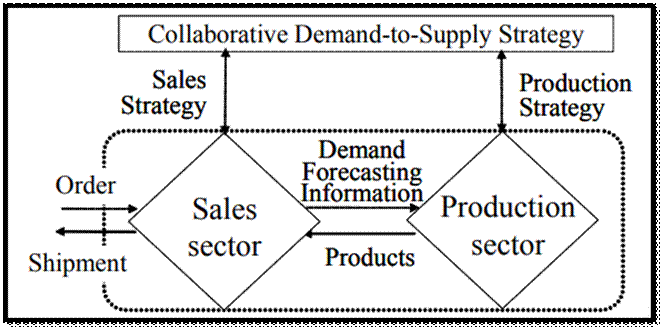
Figure
2.1: A two-sector model of collaborative
Demand-to-supply
problem
(Source: iranarze.ir, 2019)
Here in this
collaborative model it has shown that the two sectors
are equally responsible for collaboration. Here the figure shows that market
sync with the market demands the collaboration system is required to satisfy
consumer need. In this collaborating business strategy two or more company
collaborate to maintain the demand to supply strategy. With the trust of
sharing of market plans, production plans, investment two or more companies can
come to collaboration. This collaboration runs on the demand and supply
strategies and plans. This plans and strategies are
based on market statistics. According to Kemei, Oboko, and Kidombo (2018), the data of previous market demand
can help to accumulate the idea of upcoming market demand the collaborated
companies map their plans of production as,
|
IN=
Investment, SIN= Share of investment by one collaborative company EN=
Earning, SEN= Share of earning by one collaborative company; Hence;
The
overall profit = EN-IN Profit
by the individual collaborative company= SIN-SEN. |
In this scenario, the
induction of project manager system has been done to maximize this map of
demand and supply, and minimize the uncertainty and the risk factors of the
market.
A project manager
always intends to have beneficial decision for the sake of project and profit.
The "demand and
supply" maps and plan are also done by the project manager to have the
proper view of market for the production.
2.3. Production
management styles:
In the starring of
20th century in the western world the several style of
production has been in introduced. As an example, Henry Ford first starts the
system of collaboration in the production of ford cars. According to Bishop, Rowland, and Noteboom
(2018), from the middle of 20th century the market trend was as if the
top management knows a lot the project and gave the instructions. Thus, the
operational body move along with the instruction given to them. On the other
hand, Hoda and Murugesan
(2016) stated that at the end of 20th century the market demand for
complex products and innovative ideas has been increased. Therefore, the
production houses feel the need of collaboration in the market. On the view of Lensges, Kloppenborg and Forte (2018),
these collaboration helps the businessmen bodies to come up with high rate of
production as well as it gives the several ideas and options for innovation.
The top management is the instructor of production was then being an old
concept in production market.
At the starting of
21st century, the whole market was then running on collaborative production
concept. On the other hand,
Bishop, Rowland, and Noteboom (2018) stated, the advantages of
collaboration was high to increase the business but
also it has some drawbacks. The companies who collaborated for a certain
production seemed to disagreeing on some other products and innovation.
2.3.1. Collaborative
system:
Collaboration is a
system where the deep level of learning and understanding is required from each
company who are collaborating with each other. From the middle of 20th century,
the collaborative style of production has been introduced to increase the business
and bring the innovation in the products. As the demand and supply ratio has
been increased with new strategies, the demand of collaborative system has also
increased. According to Noguera,
Guerrero-Rold n, and Mas (2018), the
collaboration stands for the unity of companies to provide the consumer the
best they have. The benefits of the products also divided into the collaborated
bodies. The collaboration was stand on the trust of business market strategy
sharing, production idea sharing, as well as the investment sharing for the
production.
However, this system
also has some drawbacks. Any kind of lack or disagreement can cause the
breaking of collaboration among the companies. On the views of Lensges, Kloppenborg and Forte (2018),
the breaking of collaboration was creating a void of product, which were in
demand at that time. Hence, the business strategy developer comes up with a new
concept of project manager system in collaborative product development.
2.4. Need of Project
manager:
The concept of
project manager was old but to use it in the system of collaboration was new.
There are several purpose was done by the project
manager. According to Reynolds
et al. (2018), the successful
initiation, planning, design, execution, controlling, and closure of a project
with successful monitoring are the jobs done by the project manager. There are
several industries around in construction, petrochemical, information technology,
different steel and other production industries use this job title of project
manager. The project manager plan the production and
minimize the market risk, on the views of Zhang, Cao and Wang (2018), to this jobs the
project manager required some skills.
A project manager
should have the ability to ask the required questions, and drive out the
answers as well. A manager should have the idea of assumption about conflict as
well as how to resolve it. According to Vald z et al. (2018), the key role of project manager in the
collaborative business production is to recognition of risks arising along with
the production time durance. For the successful and long-time collaborative
production, the companies assign the project manager as responsible person for
making decision both in terms of large and small. Therefore, a proposed
approach from collaborative bodies has gone through the project manager to
analyses. Hence, project manager make sure the risk
controlling measures as well as the uncertainty. On the views of Noguera, Guerrero-Rold n, and Mas
(2018), a project manager takes the decision directly beneficial to the
project of production. The role of the project manager has been included with
many activities, as like Activity Planning and Sequencing, Developing
Schedules, time and cost estimating, Risk analysis, Team Leadership, as well as
Strategic Influencing and Business Partnering in the collaborative filed.
Apart from the boundaries of production, collaboration
has been spread to the marketing also. Marketing management also been done
through collaborative methods. A Project manager is the one responsible for the
project productivity assessment. This research has been inducted with the
project manager role in collaboration system. However
in the collaboration system the project planning and assessment is done by the
respective organization collaboratively. Thus the role
of project manager in this system has been researched through this project
assessment. This literature review is about the work and ideas, roles and
responsibility of a project manager in the system of collaboration.
2.5. Definition of Keywords
The key word which has been used is this literature
review those are:
2.5.1 Project
Manager:
Project manager are the main head of project and
production assessment. They take the project assessment as a goal and use their
expertise and skills within the project managing team to done the production
(pmi.org 2019). A project manager can work under pressure and comfortably
handle the complexity in dynamic environment. A project manager uses the board
and the flexible tricks and techniques to solve any problematic area along the
project. According to Bishop, Rowland and Noteboom (2018), a project manager
documented every task and subtask and monitored the whole assessments. Decision
making and specified measures taking is one of the main tasks by the project
manager.
2.5.2 Demand and
Supply Chain:
Demand and supply chain is the chain of relationship
between the supplier (and the manufacturer) and customer. The demand and supply
chain go both side from the customer to the supplier and from the customer to
the supplier. The information of the product and it
requirement and quantity this needs of data flows from the customer to the
manufacturer or to the supplier.
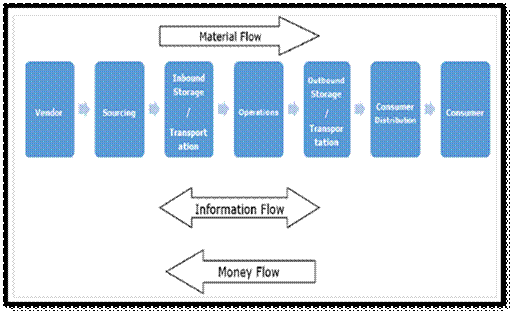
Figure
2.5.2: Supply chain flow
(Source: karrierebibel.de, 2019)
However, the product according to the customer demand
and pricing is been supplied from the supplier to the customer. According to
Hoda and Murugesan (2016), demand and supply chain is the practical formation
of value chain and supply chain.
2.5.3 Collaborative
System:
At
the early of 21st century the market had been demanded innovative and complex
kind of production at very high rate from the suppliers and manufacturers. Thus the suppliers and the manufacturers choose the way of
collaboration in their production and marketing.
In the
collaborative system two or more companies has been coincide with each other
with a goal of respective production and marketing. In collaboration method the
thing they have collaborated, those are production
ideas and business plan along with investment share. However
the profit from the business also been distributed among them. On other hand
some big and Renaud companies collaborated with small companies for their
innovative production and sell the product in the market with the help of own
marketing reputation.
2.6. Application of
Theories
There are two theories has been inducted in the system
of collaboration. These theories are supply chain management theory and the
theory of investment ratio. According to Kemei et al. (2018) the whole concept of being collaborated is started
with the supply chain management issue. And the system of collaboration is
being run on the theory of investment ratio.
2.6.1 Supply chain
theory
The supply
chain is main the chain between the customer and the supplier. When the product
is going from the supplier to customers this is called supply chain. The supply
chain has used in several measures of an organization.
2.6.2 Application
Supply chain determines the production management.
According to Lensges, Kloppenborg and Forte (2018),
the market price and demand of market varies with supply chain management.
Supply chain has been investigated to management the work cycle.
Discussion
As per the application requirement supply chain
applications has been discussed.
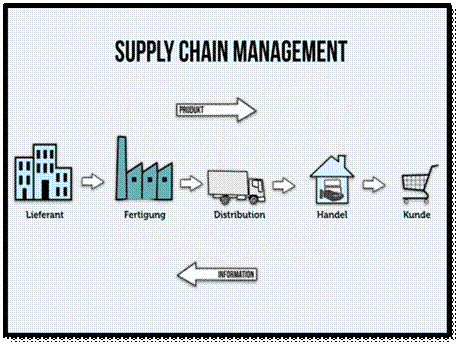
Figure
2.6.2: Supply Chain Management
(Source: karrierebibel.de, 2019)
As per the figure it has seen that supply chain
carries the information about the market crisis, thus supply chain management
helps the organization to have the production management and the production
scale planning. According to Lensges, Kloppenborg and Forte (2018), the quantity of
production, the quality of production, the material to be produce every thing's
been decided upon the Supply chain management.
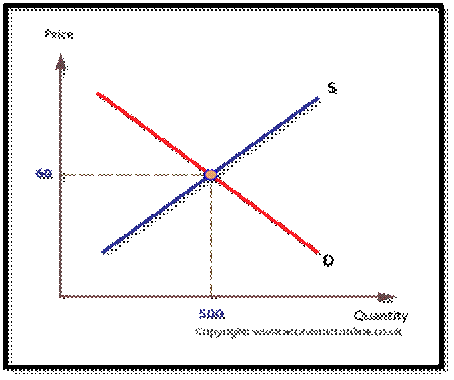
Figure 2.6.2 (II): Supply and Demand Graph
(Source:
economicsonline.co.uk, 2019)
As per the graph it has seen that at the point of
price 60$ and quality amount 500,
both the supplier and the consumer is in equilibrium. According to Noguera,
Guerrero-Rold n, and Mas (2018), the main
application of the supply chain is to help in the maintenance of demand and
price. Without this maintenance there will be an issue of price hike in the
business market.
The work cycle also inducted as per the supply chain
management. According toKemei et al. (2018), the supply
management required managed work cycle. Management of men power, management of
supply of ores, management of pre-production and after production operation
everything is plan along the supply chain theory. On the views of Bishop,
Rowland, and Noteboom (2018), these three applications spark the requirement of
collaboration among the organization. It is been tough for them to manage
supply chain and work cycle along with market balance single handed. Thus the strategy of collaboration is been initiated.
2.6.3
Theory of Investment Ratio
In the business system of collaboration
the main area of interest is the investment part. On the views of Zhang et al. (2018), although the management
and business ideas are important in the collaboration system, but the
collaboration system mainly runs on the shared investment theory.
Application
Here two or more organization has some shared
investment upon some project there are producing collaboratively. In the way of
doing so they required the investment in that project equally of partially.
After having done with business of that collaboration, the production and the
share of profit have also been distributed among the collaborated bodies.
Advantages
and disadvantages
There are some advantages and disadvantages in this
theory application. According to Kemei et al. (2018), the advantage of the
shared investment is the market risk of investment is also divided between the
parties. The amount of investment is high, in shared business. The resource of
investment is also available. On other hand Noguera et al. (2018) stated, there are some disadvantages as well, the
collaborative business required trust management among them. Chances of being
fraud in the collaborative business also have some high probability.
2.7 Management Styles in Production
2.7.1 Top management
production:
In the way of maintaining the demand and the supply
chain there are several types of management styles has been inducted through
years to achieve the market of business. According to Reynolds et al. (2018), at the ending of 20th
century there was a system of top management is the superiors of the
production. In this type of system top management decides and plan and the
production system and the lower management like the project manager and the other
line manager s do as per the top management introduced.
2.7.2 Collaborative
management production:
There after the system of collaboration is been
induced in the system. According to Vald z et al. .(2018), at the start of 21st century the demand of
products were getting high and the innovation was the only thing which solely
required to maintain the line of production. Thus the
business bodies decide to have the collaborative system in their business. On
the views of Bishop et al.
(2018), all the top management of an organization shared their business ideas,
production planning, man powers as well as they had shared investment in
respective production. This new trend in the management and production was
highly effective and appreciated by all business bodies.
2.7.3 Project manager
management in collaborative system:
After this collaborative system the business bodies
were doing well with the market and supply chain management. Zhang et
al. (2018), argued that that there was a conflict had been stared between
the business among their business ideas and management ideas, here the need of
project manager is been sensed by the organization. The project manager is the
one who is responsible for the whole project assessment. He does the
examination and distinguishes the most favourable project proposal among the
collaborative bodies. The project assessment is the goal of a project manages
in the collaborative system. The line of work cycle management, the maintenance
of supply chain, the documentation of every task and sub task these all things
have been done by the project manager. The induction of project manager is been
inducted to do the risk assessment also. According to Reynolds et al. (2018) the project manager also
does the risk assessment. The market risk assessment and minimizing the risk
both these things are done by the project manager.
2.7.4 Systems of
Collaboration
Collaborative system is one of those kinds of business
which required high understanding among the business partners. According to
Kramer and Pfitzer (2016), for the proper collaboration two business parties
are required to have trust and knowledge about each other. As the collaborative
business requires to shares of business plans, required to share investment
mint thus the trust issue among two or more business bodies had been raised
several times. On the views of Leroi-Werelds et al.(2017), the trust issues among
the competitors business bodies is common factor of risk assessment. The main
condition to have the collaboration is to maintain the knowledge business about
each other.
The collaboration system is based on four pillars of
strategies. According to Leroi-Werelds et al.
(2017), modern collaboration has these kinds of strategies to go along with.
2.7.5 Strategic
Alliance
It is the most traditional type of collaboration here
two or more business bodies combine their strategies of production and
investment to bring up something innovative and profitable. As per example, in the middle of 1970s and 1980s
there were multinational IT brands like IBM, Microsoft, Apple and computer chip
brands like Intel they had a crisis of resources internally. Thus
they come up with Alliance collaboration and overcome extreme external goals.
The alliance strategy helps the companies to successfully enter into new
market. Through this they serve the customer with satisfaction. On other hand
alliance strategy reduces the cost of new product and assesses the market risk.
2.7.6 Portfolio
This is also most common types of collaboration. In
most of the pharmaceutical companies this kind of portfolio arrangement has
been seen. In this collaboration the
independent firms are collaborated with one big firm. Here the big firms do the
operation of production centralized ways.
The independent firms just go with the introduction and resource of the
big firm and enhance the rate of production.
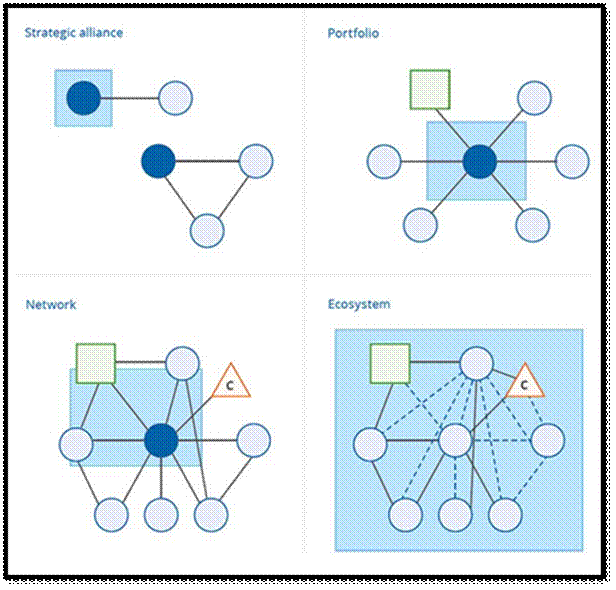
Figure
2.7.6: Collaboration system
(Source: Leroi-Werelds et al.2017)
2.7.7 Network
In this type of collaboration business bodies or
organization doesn't share their business plans or investment. On the other hand they combine each other research and development plans.
This shared goals of research and development come up with innovation in
product, service and business strategies. According to Kramer and Pfitzer
(2016), this Network collaboration has more uses as a collaboration tool for
alliance and portfolio method than a collaboration method itself. As example,
network collaboration helps each party to have an idea about each other
technological advancement. However a shared research
and development plan ensures long term business collaboration.
2.7.8 Ecosystem
Ecosystem is the method of collaboration where
innovation is no longer a requirement. Here the collaboration is for business
sustainability. According to Kramer and Pfitzer (2016), ecosystem in business
is where collaborated parties have the common agenda, and continuous
communication. However in this type of collaboration
the centralized backbone system is dedicated thus this ecosystem runs on
depending each other.
Apart
from all this improvement and advancement collaboration system has some
drawbacks along with its advancements (dpipwe.tas.gov.au, 2019).
2.8 Benefits and
Drawbacks of Collaboration System
In collaborative business the mass production increase the market share for the business bodies. On other
hand these increased share values create several issues in the business market
like fraud, and blunders with share rate.
Collaborative bodies reduce the production price which
has a great impact upon the market of economy of the market. On the other hand,
Kramer and Pfitzer (2016), argued that in order to be in the market and have
the probability ratio raising business bodies only compromise with their
production quality.
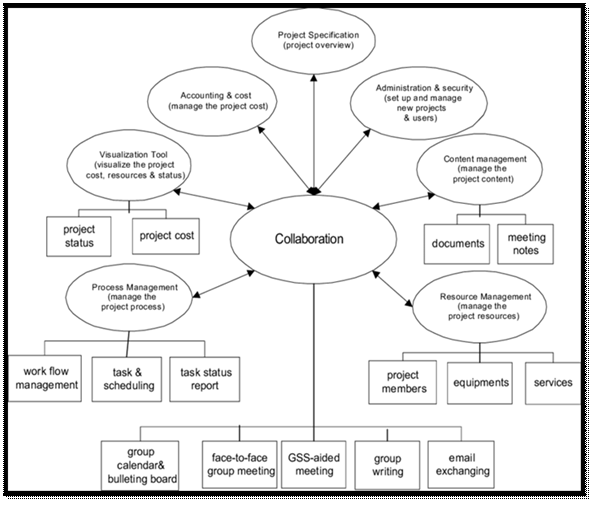
Figure
2.8: Project management interaction system
(Source: Leroi-Werelds et al.2017)
A good collaborative business combination cost a bit
but it ensure the long term profitability in both
sides. Leroi-Werelds et al.(2017)
argued that some independent firm lost their individuality to maintain
collaboration.
Collaboration improves the production quality and
brings the innovation the market trends. On other hand sharing each other
business plan and product diagrams has a risk of unethical fraud in plagiarize
the strategies. However it increases the copy business
bodies in the competition as well.
2.9. Roles Justification of Project Manager
The project manager is the one person who is
responsible for the whole project scenario. The role of project manager is in
every sector of production. According to Kemei et al. (2018), at the earliest of 80s when the top management
instruction was running through the whole work cycle, the role of project manager was just
to examine the work cycle is going as per the instruction or not. After that
when the collaborative system has come the role of project manage goes fade.
The production plans were inducted and accumulated by the communication between
collaborative parties. On the views of Reynolds et al. (2018), the project manager used to document the whole
supply chain, demand chain, and work cycle management for the higher management
at that system. The accumulation of workforce, the management and study of
demand chain and supply was done by the collaborative project management.
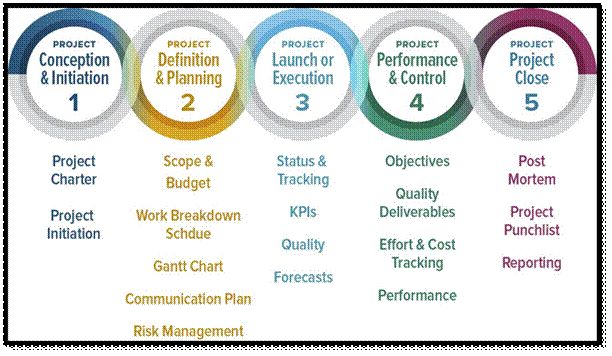
Figure
2.9: Role of project manager
(Source: Leroi-Werelds et al.2017)
Thereafter a conflict has been arises
between the business strategies. According to Kemei et al. (2018) the business bodies are crashing with other with
several plans. Although the companies have been collaborated with each other
but implementation of own plan were the first priority for each one. On the
views of Zhang et al (2018), in this
situation of random conflict and competition even among the collaborated system
the requirement of project manage is been realized among all. At the starting
of 21st century the project manager system has been induction in the system of
the collaboration. According to Reynolds et
al. (2018) the role and the responsibility of the project manage in the
collaborative system is very precious and sincere.
The project manager does the analysis of the project
plan by the respective collaborative bodies. Their
after the decision making in the choice of project plan has been done by the
project manager unbiased in the collaborative system. According to Zhang et al(2018), project manager not only
just Azure the project plan for conductance also he manage the work cycle, done
documentation of every task and subtask along.
For the marketing assessment project manager done the
market study, this market study includes information of recent trends, supply
chain, and demand chain algorithms etc. On the views of Bishop et
al. (2018), in this
process of market study a project manager also has done the risk assessment of
the project. The ratio of profitability and the workforce assessment everything
is measured and planed by the project manager. For a collaborative system of business
assessment a project manager works as anchor between
the collaborative bodies.
2.10.Conceptual framework
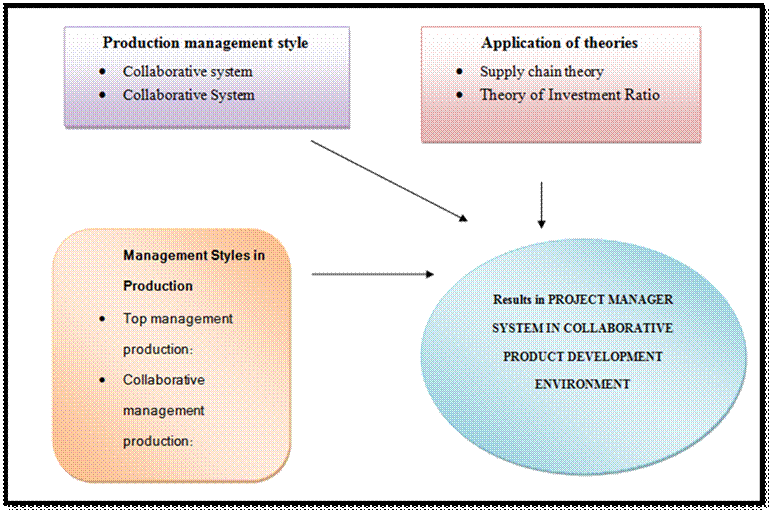
Figure 2.10:
Conceptual framework
(Source: Self-Developed)
The conceptual framework describes about various
production management styles thereby the application of different theories like
that of supply chain theory and Theory of investment ration forms a foundation
part of the this literature review. There are
different management styles which are used in production which are
collaborative management production and top management production. The
application of the theories and the management styles would results
in collaborative system in product development environment.
2.11. Literature Gap
This research is emphasized on product
development system in collaborative product development environment. The
research paper reflects on various theories like that of investment and
management style which was not shown by other articles like Zhang
et al (2018) and Bishop et al. (2018). Similarly Leroi-Werelds
et al.(2017)
have only emphasized on project managers thereby ignoring the various
management concepts which were associated with project management. This Article
has reflected all these concepts which were missing and present them in this
article and provided more in-depth knowledge about project management in
product development environment.
2.12. Conclusion
At last through this research it has seen that collaborative bodies are the new
trend of the market. The high growing market demand and the requirement of the
innovation in the product, bring the companies to the stage of collaboration.
Every business organization is collaborating with each other in several manner
of collaboration. In one hand they are sharing investment and business ideas
with each other, on other hand the collaboration has been done with just
sharing research and development policies with each other. In both case the
innovation has brought to the market. However the
conflict of ideas and plans bring the situation which required the project
manager in the system of collaboration. As per the data analysis of the
research it has seen that project manager ion very important anchor to
accumulate the collaborative production. With the help of project manager assistance the collaborative bodies conflicts between plans
and ideas has been resolved. The ideas which are most preferable of the
production and the market those are undertaken for accomplishment. However risk assessment, market analysis these all task are
done by the project manager in the collaborative system.
2.13. Table of Summarization of Articles
|
Article |
Author |
year |
Major findings |
|
The influence of top management
support on the relationship between project manager leadership competencies
and ERP system project performance: Findings from Kenya energy sector.
International Academic Journal of Innovation, Leadership and Entrepreneurship |
Kemei et al. |
2018 |
In this article the research
has find that the enterprise resource planning has several impact
upon the business data assessment, in global perspective. The enterprise resource planning has an
impact upon the collaboration system in planning the critical success
factors. |
|
The ecosystem of shared value |
Kramer. and Pfitzer |
2016 |
From this article the pillars
of collaborative system has been cleared. The four
segment of collaboration is classified from this journal. Alliance and
portfolio collaboration along with other two tools of collaboration has been discussed in this article. |
|
Understanding Value Creation In Alliance
Ecosystems: Enriching The Strategic Alliance Literature With Insights From
Marketing. |
Leroi-Werelds et al. |
2017 |
In from this journal it has
come to light that how the ecosystem of the collaborative system works. The
application of ecosystem has been also inducted in this article. |
|
The role of systems thinking in
the practice of implementing sustainable development goals |
Reynolds et al. |
2018 |
From this article the
management system in the collaborative business assessment has been
discussed. The role and impact of project manager in the collaborative body
is also been discussed in the article. |
|
The mediation role of
leadership styles in integrated project collaboration: An emotional
intelligence perspective |
Zhang et al. |
2018 |
From this article it has seen
that how the project manager in the collaborative body maintain
his duty. The required leadership quality along with the mentality of project
assessment these all thing are cleared in this
article. |
Chapter 3:
Research methodology
3.1 Research Overview
The overview of the research work is associated
strongly with making improvements in project management in the aspects of collaborative
project development environment. The market of demand has been growing
abruptly. Thus without any innovation in the
production it become very hard for the marketer to maintain the demand and
supply chain in a rhythm. Hence the in the middle of 20th century the
manufacturer and the marketer are decided to come up with a new process of business
assessment. That innovation is collaborative business. In collaboration two or
several business bodies associate with each other with some investment and
bring some new invention to grow the production. However
there are several other kinds so collaboration is now in the market recently.
In the end of 20th century there seems a problem of conflict has been raised
among the collaborative bodies associated to project assessment. Thus to sort this problem business expert has inducted the
role of project manager. The project manage monitor
the whole project assessment, decided the plan of assessment, keep the record
of project action and minimize the risk factor. This research accumulates
secondary data and analyses the requirement of a project manages in the
collaborative business environment.
3.2 Hypotheses
H1: Project manager system plays an important part in
collaborative product development
H0: Project manager system does not play an important
part in collaborative product development
H2: Project manager has important role in planning and
accumulating production in a collaborative business environment.
H0: Project manager has no important role in planning
and accumulating production in a collaborative business environment.
3.3
Research Design Analysis
Summary
|
Research
philosophy |
Positivism |
|
Research
Approach |
Deductive |
|
Research
Design |
Descriptive |
|
Research
Strategy |
Secondary data analysis |
|
Data
collection method |
The data has been collected from several news
reports, industrial journals, and electronic journals about business
management. |
|
Data
sources |
Secondary (journals, industrial reports websites and
government publications) |
Table
3.3: Summary of Research Tool
(Source: Created by researcher)
3.4. Research philosophy
Research philosophy is considered to the way of
gathering data for the research and analysing it. However
there are three types of research philosophy are used in the research work, are
positivism, interpretative and realism. However
positivism method has been selected.
Justification
of research philosophy:
Using the positivism method of research philosophy, it
has been possible for the researcher to obtain factual information. The topic
of project manager importance in the collaborative business environment is a
matter of real time venture in the business market. Positivism method of
research has helped the researcher to accumulate data from the practical market
assessment. Hence the researcher had a taste of real logics of business market
assessment through this philosophy of research. (Bell et al. 2018,
p. 25)
3.5. Research approach
In research work, researcher mainly uses two kinds of
research approach. One is inductive method of research approach; another is
deductive method of research approach. In inductive method researcher has
collected data from certain effective sources and ends up coming in to a
finding. On other hand, in deductive method the research collect data from
several sources and accumulated them to find research objective through it (Etz
and Wagenmakers 2017, p. 10).
Justification
of research approach
Here the researcher has used the deductive method to
find the answers of research question. Through deductive method the research
accumulates several data and analyses it properly. However, the test of
hypothesis has been done through deductive method. The research has got a
chance of implanting strategy in his research through deductive method. (Bell et al. 2018, p. 26)
3.6. Research design
Research work
has been done through three types of research design. Those are exploratory
design, Explanatory design, and Descriptive design. Here for this research the
research has used descriptive design.
Justification
of research design
The project manager role and responsibility in the
collaborative business environment is dependent upon several business
variables. Thus the Descriptive design of research has
been chosen to do the research. It helped the research to have analysis of both
independent and dependent variable of data in the collaborative business
market. (Bell et al. 2018, p. 27)
3.7.
Instrumentation
The research has done the research of project manager
importance in the in the collaborative business environment through secondary
data analysis.
The research has gone through news report, industrial
journals, and business management books from the sources of Google scholar
and Proquest
Justification
of instrumentation:
The sources from the Google scholar and Proquest are very much authentic. However, the authors are
scholars and practitioners from several business management sectors. Thus the resource is collected from there to have authentic
data. (Bell et al. 2018, p. 28)
3.8. Secondary data
As the topic of the research was project manager role
in the collaborative business environment thus the secondary data has used here
are collected on the basis of internal data and external data. The internal
data has been collected from several annual reports of collaborative business
bodies along with business report.
However the external data of collaborative market has been
collected from newspaper and journals of business assessment. (Watts and Casanovas 2018, p. 30)
|
Hypothesis |
Research Questions |
Utilization of Instruments |
|
1. Impact of project management
system 1.1 Positive impact of project management
system in collaborative product development. 1.2 Negative impact of project
management system in collaborative product development. 2 Impact of project manager in
accumulating production 2.1 Positive impact of project
manager on accumulating production. 2.2 Negative impact of project
manager on accumulating production. |
1. Does project manage important in collaborative
product development? 2. What is the significance of project management in
collaborative product development |
Questionnaires are designed to
identify the role of project management in collaborative product development
and in accumulating production. In this project data has been collected
through secondary data collection method. Researcher used Google scholar and Proquest for secondary data collection. Google scholar and Proquest
both are authentic so researcher collected data from these two sources.
Positivism research theory was used and in research approach deductive theory
was used. Researcher used descriptive research design for this research on
collective product development management. |
3.9. Data Collection Method
Here
is to collect the data about the analysis. Secondary data collection has been
proposed. Secondary method of data collection will help to analysis the market
scenario internally and externally.
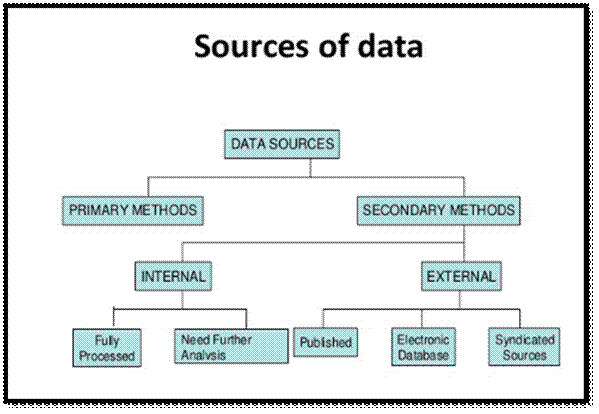
Figure 3.7: source of Data collection
(Source:
iranarze.ir,
2019)
3.9.1. Internal data collection:
The market scenario for the role
and importance of a project manager will be cleared from the internal data
analysis. The internal data are two types, one is fully processed another is
need further analysis. The importance and the role come from the full processed
data analysis, on the other hand the scenario of collaborative business bodies
without a project manager is analysed with the data, which required further
analysis. As example the previous business collaboration and their success and
failure news report, these will help to have the internal data, also the
persons who are working, as an employee of collaborated organization can be the
internal data source.
3.9.2. External data collection:
The external data about any
project production or about any collaboration success or failure come from
several sources. Whether, it can be Published data, like newspaper, business
magazine, and management books. These published sources will help us to have
the clear idea about collaboration of organization as well as gives the proper
idea about it strategies and approaches. There two
other data collection sources, one is electronic database another one is
syndicated source. There several data will be collected from internet about the
market strategies of collaborative organizations, the stories and incidents of
collaboration, marketing plans, project manager details, roles and
responsibilities of project managers etc. On the other hand, syndicated source are those research paper, which are created for the market
studies will also be implemented as well. Syndicated source will give the
quality recommendation and conclusion to the studies.
3.10. Ethical
Considerations
As per the privacy act Australia, 1988 the data
which has been collected are not used in personal gain. The research and
research finding are solely used for academic purpose. (Mayer 2015, p.60)
3.11.
Limitations of the Methodology
As the resources are collected from the Google
scholar and Proquest some of the data cannot be
accessed, due to requirement of paid accessibility. (Padilla-Diaz 2015, p.110)
3.12. Conclusion
As the last it has seems that
in this research the researcher has collected data from the secondary method. However he has used positivism as research philosophy, and
deductive method for research approach. On other hand, descriptive design of
research is used accumulate and strategize the research.
Chapter 4:
Analysis of the Research Data
4.1 Introduction
In this report, the project manager role in a
collaborative business environment has been discussed. Collaborative business
management is a kind of strategy which was implemented in the market scenario
in the middle of the 20th century. The agenda of collaborative business
assessment was to bring the velocity in meeting market demand.
At the end of the 20th century, the market of real
estate, automobile, etc. faced high demand flow that demand flow cannot be met
by any organization individually, thus they required collaborative business
management system in their organization. Business bodies synchronized with
other business bodies to increase production. As production increased, velocity
of service assessment is getting high.
However, in this perfect scenario, business bodies
faced some problem too, like at the end of 20th and at start of 21st, they
start having ethical issues and management issues. Collaborative Business body
starts having conflicts between each other in project assessment task. This
concern project assessment problem required a manager to handle the conflicts
and minimize any risk assessment in market for the project. From the project
manager assessment in a collaborative environment has been induced.
4.2 Collected Data
Here researcher has been used secondary data
collection method for research analysis. Howler the data has been collected
from several secondary sources.
As the topic of the research is project manager
assessment in a collaborative environment, it required both analyses of
collaborative business assessment and project manager assessment in a business.
For analysis of project manager assessment in business several Journals upon
the theme of A project management framework for small- and medium-sized entities ,
Examining the Performance Level of Project Management has been
collected and analysed. As all the data which have been collected is not
directly mentioned any conclusion thus by applying a deductive method for analysing
these data.
On the hands, understanding the collaborative
environment in a business assessment required several data and information
about it. The origin of a collaborative system, functionality of it,
organizational task assessment through collaborative methods, types of
collaboration, everything required specific theme for study. Regarding study of
collaborative system several journals on the theme of Multi-level agile project management
challenges , and The importance of trust and collaboration between companies
has been collected and analysed. Several electronic journals help in
the study of classification of a collaborative system. Hence deductive method
of data analysis helps to find the necessity and efficiency of collaborative
business assessment. As per the research topic, the analyses of product manager
culture in collaborative business assessment journals are not enough to analyse
it. Thus, electronic sources and news articles are taken to analyse these
collaborative systems internally. Through internal analysis with news articles
and journals requirement of project manager system in this collaborative
system, the role of a project manager all are analysed through it.
4.3 Findings of Research
Findings are the purpose of any research. The finding
of this research project manager system in a collaborative environment can be
justified through subtopics as follows,
4.3.1 Methods of Collaboration
|
Theme |
Through this research, are a clear idea of a
collaborative system has been driven |
|
Analysis and Discussion |
From several journals and electronic media, it has
been seen that a collaborative system has been started in the market of
business in the middle of the 20th century. According to
Bishop et al.
(2018, p. 10), in the middle of the 20th century there was a crisis of
production assessment in industry. As per the views of Kwofie
et al. (2018, p. 14), collaboration between two and more bodies
required a ground standard of understanding among them. The agenda of
collaborative bodies is to increase the production rate and spread business.
As per the views of Misopouloset et al.
(2018, p.50), the trusted ground of collaboration is divided into four types
of business assessment. First one is Strategic Alliance ; it is the
most common tradition way for collaboration. From the business report of
several IT brands like IBM, Microsoft, Apple, and computer chip, it has seen that
in the middle of 1970 and 1980 they collaborated to each other market
sustainability. In strategic alliance collaborative bodies divided their work
among them; several parts of task have been assisted by several collaborated
parties. Second system of collaboration is Portfolio . According
to Bishop (2018), it is a very effective way of collaboration. Through this
big organization had done its collaboration with a small organization. This
method is very much centralized; larger industries spread their business
through Portfolio types of collaboration. Apart from these two, there are Network
and Ecosystem these two types of collaborative methods are also
in market assessment. According to Tucker et al. (2017, p. 41), a
network system is not working as a collaborative method; it actually works as
a tool for being collaborated. As collaboration required certain ground of
understanding, network collaboration is very helpful ion bring that ground.
On other hands in the ecosystem of collaboration, collaborative bodies do not
actually collaborate with each other directly, however, business assessment
each collaborative body required other help and development. |
|
Findings |
From this analysis, it has been
seen that collaboration among business bodies can be done in several ways.
However, one thing is very common in each way of collaboration that is all
collaborative bodies requires the same ground of interest and understanding
between each other to do a collaboration. |
4.3.2 Requirement of Collaboration
|
Theme |
Here data has been analysed to determine the
requirement of collaboration |
|
Analysis and Discussion |
To research the project management system in a
collaborative business assessment it is very important to analyse the
requirement of collaboration in business assessment. Thus, here data which
are directly described requirement of the collaborative system are analysed.
According to Kemei et al. (2018, p. 45), the collaborative system has
come to concern in the middle of the 20th century. Nowadays the trend of
business assessment is to do mass production. To maintain contain market
demand and supply the demand with proper velocity is the main requirement business
assessment. This task cannot be fulfilled by an organization single handily.
That is where the requirement of collaboration is induced. According to Mayer
(2015), collaborative business assessment increases the investment, enhance
the resource assessment, develop project plans and increase the velocity of
production. In the middle of the 20th century Henry Ford first induced the
collaboration business assessment in automobile sector. As he faced slackness
in the business assessment. Fulfilling market demand single handed was
getting tough; however, automobile sector required several other automobile
parts manufacturing organization assessments for assembling a product. From
there now several organizations are now is collaborating. In middle of year 1970
and 1980 Microsoft and Intel these IT and chip manufacturing organization get
collaborated for grabbing targeted market. On the views of Hoda and Murugesan (2016,
p. 70), the demand of the market is so high nowadays and constant innovation
product is only way to have sustainable business thus requirement of
collaboration is inhabitable. |
|
Findings |
Finding from this research is
that Henry ford first induced the collaborative system in business assessment
at middle of 20s. Thereafter, several organizations find the way of
collaboration is very effective in business assessment. Collaboration
required raising a high amount of investment, and high velocity to the
production. |
4.3.3 Drawbacks of Collaborative System
|
Theme |
Apart from all the benefits and requirement of
collaboration, there are some drawbacks of a collaborative system. |
|
Analysis and Discussion |
As the market demand required a business
organization to the collaborations, also collaboration brings some conflicts
in the task assessment plan between collaborative bodies. According to Hoda and Murugesan (2016,
p. 10), there are several ethical issues has been seeming in the ways of
collaboration like two organization required to have trust between each other
to do a collaboration. In collaboration, they share development plan,
confidential data, and project assessment plans including investment. Thus ethical break down to success in a business market
venture is a very common issue of collaboration. Sometimes any business
venture of mother organization failed due to fault of collaborative
organization. On the views of Zhang et al. (2018, p. 40), collaboration has the risk
of creating competition. Whenever a mother organization collaborated with
other subordinate bodies it shares all trade secrets with each other. Thus,
it creates a risk of creating future competition. Apart, from all these the
main issues in the collaborative business assessment is that collaborative
bodies had conflicts for business assessment plan some time. As they had
separate approach toward similar job thus, it hampers the workflow of
collaboration and creates conflict. According to Marly Mizue Kaibara et al. (2017, p. 78), innovation is one of
the primary mottos of collaboration. However, conflicts among the
organization sometimes suppress better ideas and chances of innovation. |
|
Findings |
Apart from all benefits
collaboration has one main problem in a business assessment which is
conflicts among the collaborative bodies. This conflict hampered the project
assessment plan; suppress innovative ideas of production and marketing.
However, collaboration has a risk of sharing confidential data and market
position. |
4.3.4 Roles and Responsibility of a Project
Manager
|
Theme |
Here data has been analysed to determine roles and
responsibility project manager. |
|
Analysis and Discussion |
At the staring of the 20th century there
was a system of management in the business assessment. Authority and top
management plan the project assessment, production line, and marketing plans,
etc. According to Mayer (2015, p. 45), a projects manager can Chanel the work
pressure to a creative assessment of task, a project manager can use its
expertise and skills to develop project assessment (pmi.org, 2019). A project
manager can be a leader for the workforce, a project manager have to be a visionary and perfectionist at once. A major
responsibility of a project manager is to keep a record of every task and
subtask oriented to the project. Organize meeting and discuss every detail of
project plan assessment is highly expected from the project manager. On the views of Misopoulos
et al. (2018), important steps like decision making and taking
specific measures for project assessment is done project manager only. A
project manager also minimizes the risk of project assessment. According to
Kemei et al. (2018), as a project manager go through every market details and examine the supply chain in a project
assessment thus risk assumption for the business is a task of a project
manager. On the views of Zhang
et al. (2018, p. 12), there are several qualities should be in a
project manager those are like, expertise in management, a perfectionist in
task assessment, applied intelligence, an expert in documentation, and sharp
in market assessment. From the view of Marly Mizue Kaibara
et al. (2017, p. 40), it can be realized that project manager required
to be a good leader and a visionary also to maintain workforce. |
|
Findings |
From this analysis can be seen
that a project manager is a very important aspect of task assessment. A
business assessment cannot possible without proper leadership. Risk
assumption, assessment of risk factor these things
are done by the project manager in a business body. However, maintenance of
workforce and documentation of every task is purpose project manager s duty. |
4.3.5 Project Manager Requirement in a
Collaborative Business
|
Theme |
From these data analysis project manager role in collaborative
management of a business has been derived. |
|
Analysis and Discussion |
At the middle of the 20th century when
the collaborative system has come then the requirement of the managerial
system gets faded. According to Hoda and Murugesan (2016, p. 41), at end of the 20th century
when issues of conflict had been aroused between the collaborative
organizations then the need of project manager is sensed by business bodies.
The role of a project manager is very important. The responsibility of
project manager in a collaborative business assessment is to minimize the
market risk for project, document and look after every production assessment.
On the view of Marly Mizue Kaibara et al.
(2017, p. 45), a project manager actually selects a project for assessment in
the collaborative business assessment. Through this selection method, project
manager enhances the efficiency of the project plan and bring proper
innovation in the market product. According to Tucker et al. (2017, p.
41), project manager analyses the market details, and examine the supply
chain for the business assessment, through this way a project manager lead the organization toward market success. However, it
has been seen that the project manager in an organization worked as a
selector of a project plan, manager of project assessment, leader of a
workforce and minimiser of assumed risk. On the views of Misopoulos
et al. (2018, p.20), through examination of project plan, and service
line and supply chain a project manager assumed market risk for the project.
On other hands, through rectifying production line, and managing plan
assessment a project manager minimizes the concerned risk. According to
Bishop (2018, p. 40), a project manager worked as the anchor between
collaborative bodies. A project manager brings sustainability to a
collaborative business. |
|
Findings |
It has been derived from the
analysis that collaborative bodies have faced conflicts among them in methods
of project assessment. Thus, it required a leader to assist them with
expertise to select an appropriate project for a task assessment. A project manager
has several roles and responsibilities in a collaborative business
assessment. Selector of a project plan, record keeper of task assessment, a
predictor of risk, minimiser of risk, leader and decision maker theses all
role is played by the project manager in the collaborative assessment of
business. |
4.4 Summary
At last from this data
analysis, it has been seen the origin of collaborative business assessment. The
requirement of collaboration has been Clearfield with this data analysis.
However, the stage of rising conflict between the collaborative bodies has seen
in this data analysis also. As a result of this conflict project manager
requirement in this system has been seen in this data analysis. From the
finding, it has been seen that a project manager can handle the conflict issue
of collaborative bodies through its expertise and decision-making skills. A
project manager can minimize the assumed risk with proper analysis of the
supply chain and also can keep a record of every task which has been assigned
for the project assessment.
Chapter 5:
Findings and Conclusion
5.1 Introduction
Finding and conclusion is
the ultimate result of research. Research is done to come up with and finding
and conclusion. Here the research is about the project manager role and
responsibility in a collaborative business assessment has been done. As per the
research, there are several research questions has been inducted. A finding of
the research helps to derived answer of this questioned. These answers help to
bring the project manager assessment in collaborative business assessment.
Those questions were about, running process of collaborative business and
requirement of a project manager in collaborative business. This research helps
to understand this question and come up with a fruitful answer to this
question.
5.2 Motivation and Significance of the Thesis
5.2.1 Motivations
The collaborative product development environment is
about involving several business bodies along with a mother body business. This
assessment has done to bring innovation and enhancement in production. However,
the conflict of collaborative bodies and as solution project manager assessment
in a collaborative body is the main motivation behind this research.
5.2.2 The significance
Collaboration signifies the advancement of business
assessment. This research on collaborative business development also signifies
that workers, system and management help in creation of innovative and new idea
about the business. Collaborated business is now the new trend of the market.
It signifies a step toward future strategies of business assessment.
5.3 Discussion of the Research Questions
|
What
is the importance of Project manager system in collaborative product
development? |
|
Collaborative product development is done by a
branch of business bodies when accumulated their resources, ideas, and
investment all together to meet market criteria. In middle of the 20th
century when business bodies faced high market demand then the collaborative
business has been come in to trend. However, at the start of the 20th century
the collaborative bodies face several issues among them. They start having
conflicts with job ideas. Innovation strategies got hampered due to this.
According to Stolarska (2016, p. 10), collaborative business bodies required
an anchor to do their business. Project manager system is the anchor between
collaborative bodies. A project manager uses his expertise and skills to analyse
the project plan; a project manager looks after the production line and led
the workforce. A project manager system reduces the conflict among
collaborative bodies. Market risk analysis and risk reduction measure both
thingies are done by a project manager in a collaborative body business.
Project manager chooses the best out project plan by the collaborating
organizations and also bring innovation in production line. |
|
What
are the roles and responsibilities of a project manager in collaborative
product development? |
|
Collaborative production is done with a selective
plan by collaborative bodies. Production line requires a lot of management in
a project assessment. Production plan analysis, 5risk assumption record
keeping of task and subtask there are several works has been done by the
management authority. These tasks in a collaborative body have been done by
the project manager. A project manager has several roles and responsibilities
in collaborative product development. As per the research findings, a project
manager is a selector of a production plan. The production plans which are produced by the
collaborated bodies those are justified, examined and selected by a project
manager to do the product development. On the other hand
a project manager does a risk assessment. According to research findings, a
project manager analyses the market scenario look after the line of
production and assume the production risk. A project manager uses his
expertise and skills and management to minimize the risk which has been
assumed. Legal orientation and workplace health and safety assessment these
things also are done by a project manager in a collaborative business
environment. However, a project plays the role of a leader for the workforce
as well in a collaborative business environment. |
|
What
will be the issues raise if there is no project manager in a collaborative
system? |
|
As per the research findings, there are several
problems can be raised if there is no project manager system in a
collaborative business assessment. As the collaborative business has several
methods to do collaboration thus it required high management in each type of
collaboration. In Strategic Alliance collaboration there are several
production plans has been proposed by each and every collaborated body.
However, the strategies of production have been selected by the project
manager. Without a project manager there will be a lack of strategies in
production line. However, conflicts can be raised among collaborated bodies.
In Portfolio collaboration, as there is a mother body organization
collaborated with several other subordinate organizations, thus it required a
project manager to lead the subordinate bodies. Without a project manager,
there are will no leading or guiding instructions for the subordinate bodies.
In Network collaboration a project manager is responsible for transferring
data from the mother body to collaborated bodies. Without a project manager,
the confidentiality of data and information will be at risk. However,
Ecosystem collaboration a project manager works as an
"Accumulator". Without a project manager in Ecosystem collaboration
each collaborated body will have no sync among each other. |
|
What
measure should take by the project manager to enhance the production rate in
a collaborative system? |
|
There are several task assessment
has been done by the project managers in a collaborative body. However, the
development of a product should be the sole purpose of a project manager in
any scenario of business assessment. As per the research, there are several
measures should be taken by the project manager to enhance the production
rate. First of all, a project manager required to a good
decision maker in a collaborative business environment. According to Shokory And Suradi
(2018, p. 40), a there are several plans for production has been proposed by
the collaborated bodies, thus a project manager required to be a good
decision maker in case of selecting proper production plan, which can enhance
the production rate. Secondly, a project manager required to be a good
leader for the workforce. As the workforce is the main resource for enhancing
the production rate, thus it required proper management and visionary
leadership. A project manager should be a record keeper. A
record keeping strategy can be very useful in a collaborated business
environment. As there are several operations is being done in the production
line. Thus to check record of specific things like
workforce attendance, supply chain management, and resource availability can
enhance rate of production at every time of emergency. |
|
What
were the issues rises in a collaborative system before the project manager
association? |
|
The collaborative business assessment has come in
market trend in middle of the 20th century. However, at start of the 21st
century when collaboration business assessment was in the peak of the market
there aware several problems had been raised then. As per the research
finding those issues are can be reflected as the issues of a collaborative
business system before project manager assessment. In Strategic Alliance
collaboration, there are conflicts between the collaborated business bodies
for project plan. As the collaborated bodies required a high level of
understanding and trust ground among them, thus the whole production line is
depended upon these aspects. According to Kwofie et al. (2018, p. 20), misunderstanding
and conflicts of production plan because the production line hampered. In
Portfolio collaboration there is a chance of creating marketing
competitions as the subordinate bodies are learning business strategies and
trade secrets from mother organization. In Network collaboration there business is associated with others but not in
sustainable measures. Bossiness policies were uncertain in network
collaboration before project manager assessment. In case of Ecosystem
subordinate bodies which are situated around a mother, body organization has
no trust ground to do a business assessment before the project manager
system. All these issues hampered the development of a product in
collaborative business. These issues also cause immense failure of several
collaborated bodies. |
|
How
the Project manager system is important to collaborative product development? |
|
The collaborative business assessment required
strategic measures to have a production plan, a proper plan of risk
assumption and risk assessment. With these aspects of management can rectify
its production line. Apart from all these, a production line development
required for proper leadership and expertise assessment in production plan
development. As per the research findings, it can be seen that a
collaborative business environment can easily acquire all these measures by
including a project manager in their system.
A project
manager plays an important role in product development. These expert skills
of management, a project manager synchronized the line of production in a
collaborative business environment. On other hands a project manager also
very important to bring guidance to the teams which are accumulated for the
production. A project manager examines production line and does the risk
assessment also. A project manager is a very important part among
collaborative bodies as an anchor. A project manager Chanel his/her skills
and do the decision making stuff to enhance the
production rate and increase the profitability of business bodies. A project manager is required to bring innovation in
the products as per the market demand. On other hands, a project manager also
had done an important task of record keeping. Keeping every single report of
a production line, market demand, supply chain assessment, and workforce
attendance are very important in the line of business. Every single specified
thing plays a specified role to develop the production line as a whole. |
|
How
does a project manager assist the product rate and minimize the risk factor
around project assessment? |
|
A project manager uses his expertise and skills to
enhance the production rate. As per the finding of research as has been seen
that there are several factors are used by the project manager to assume
risks around a project. A project manager uses Market analysis to judge the
market value of a product. The market examination also derives market demand
for a product and availability of resources as well. These aspects help the
project manager to come up with a report of supply chain and value chain for
the production. According to Hoda and Murugesan (2016, p.10), a
project manager evaluate the production line, thus
require workforce and quality of the workforce is also assumed by project
manager. Here the recruitment of unnecessary manpower is rectified by a
project manager. A project manager examined the types of machinery and the
resource s to do the production. Through these aspects, a project manager
minimizes workplace hazard and risks. However, a project manager looks after
the laws and legislation recommended by the government to do the production.
Through these, a project manager minimizes unwanted risks in line of
production, like a project manager follows, equipment laws, emplacement laws
in the assessment of production. |
5.4 The Contributions of This Study
As the business assessment
is main part of society thus this study has high contributions in social study
business assessment. Through this study business collaboration became
understandable, on other hands the issues of collaboration and assessment of business
through collaboration has been evaluated in this study. This research has done
an excellent job in identifying roles and responsibilities of project manager.
The process of project manager system in a collaborative business environment
has been reflected through this study. This study has a contribution to
evaluation of project manager system.
5.5
Future Research and Limitations of the study
Due to some non-accessible
sources which required paid registration, some of the segment of this research
has some fewer examples. However, the data has been analysed through several
secondary data of recent time. On other hands, as this study is only for
academic purpose thus it has less scenario assessment on basis of practical
industry.
Future research can be done
in the improvement of project manager skills. Although it has seen that a
project manager required several skills to work in a collaborative organization
thus development of skills is inhabitable.
Bibliography:
Bell, E, Bryman, A
& Harley, B 2018, Business research methods, Oxford university press,
Oxford, UK.
Bishop,
D., Rowland, P., and Noteboom, C 2018, Antecedents of Preference for Agile
Methods: A Project Manager Perspective. vol 10, no 2, pp. 200-410.
Bishop, W.A., 2018. A project
management framework for small- and medium-sized entities: Accounting software
implementation. Journal of Economic and Financial Sciences, vol.11, no.1,.
Etz, A. and Wagenmakers, E.J., 2017. JBS Haldane s contribution to the
Bayes factor hypothesis test. Statistical Science, Vol 32,
no 2, pp.313-329..
Hoda,
R., and Murugesan, LK 2016, Multi-level agile project management challenges: A
self-organizing team perspective. Journal of Systems and Software, vol.
117, pp. 245-257.
Jussila, J.,
Sillanp , V., Lehtonen, T., Helander, N., and Frank, L 2019, January, An activity theory perspective on creating a new digital
government service in Finland. In Proceedings of the 52nd Hawaii International
Conference on System Sciences.
Kemei, D., Oboko, R., and Kidombo, H 2018,
The influence of top management support on the relationship between project
manager leadership competencies and ERP system project performance: Findings
from Kenya energy sector. International Academic Journal of Innovation,
Leadership and Entrepreneurship, vol. 2, no. 2, pp. 195-210.
Kramer, MR. and
Pfitzer, MW 2016, The ecosystem of shared value. Harvard Business Review, vol.
94, no. 10, pp.80-89.
Kwofie,
T.E., Botchway, E.A. and Amos-Abanyie, S., 2018.
Examining the Performance Level of Project Management Competencies of
Architects in Ghana Using Gap Analysis Approach. Journal of
Construction in Developing Countries, vol.23, no.1, pp. 125-147.
Lensges, ML., Kloppenborg,
TJ., and Forte, F 2018, Identifying Key Agile Behaviors
That Enhance Traditional Project Management Methodology. Journal of Strategic
Innovation & Sustainability, vol. 13, no. 2
Leroi-Werelds, S., Pop, O. and Roijakkers, N 2017. Understanding
Value Creation in Alliance Ecosystems: Enriching the Strategic Alliance
Literature with Insights from Marketing.
Marly Mizue Kaibara,
D.A., Silva Marins, F.A., Andr ia Maria, P.S., Almada Santos, F.C. and DA
Silva, S.L., 2017. The importance of trust and collaboration between companies
to mitigate the bullwhip effect in supply chain management. Acta Scientiarum.Technology, vol.39, no.2, pp.
201-210.
Mayer, I., 2015.
Qualitative research with a focus on qualitative data analysis. International
Journal of Sales, Retailing & Marketing, vol.4, no.9, pp.53-67.
Misopoulos,
F., Michaelides, R., Salehuddin, M.A., Manthou, V.
and Michaelides, Z., 2018. Addressing Organisational Pressures as Drivers
towards Sustainability in Manufacturing Projects and Project Management
Methodologies. Sustainability, vol.10, no.6,.
Noguera, I.,
Guerrero-Rold n, AE., and Mas , R 2018, Collaborative
agile learning in online environments: Strategies for improving team regulation
and project management. Computers & Education, 116, pp. 110-129.
Padilla-D az, M.,
2015. Phenomenology in educational qualitative research: Philosophy as science
or philosophical science. International Journal of Educational Excellence,
vol.1, no.2, pp.101-110.
Reynolds, M.,
Blackmore, C., Ison, R., Shah, R., and Wedlock, E 2018, The role of systems
thinking in the practice of implementing sustainable development goals. In Handbook of Sustainability Science and
Research (pp. 677-698).Springer, Cham.
Shokory,
S.M. And Suradi, N.R.M., 2018. Transformational
Leadership And Its Impact On Extra-Role Performance Of
Project Team Members: The Mediating Role Of Work Engagement. Academy of
Strategic Management Journal, vol.17,no.5,
pp. 1-6.
Stolarska, A., 2016. The Role Of The Director In Project Team Management. Acta
Universitatis Nicolai Copernici.Nauki Humanistyczno-Spoleczne.Zarzadzanie, vol.43, no.2, Pp. 103-111.
Tucker, M.P., Masuri, M.R.A. and
Cotgrave, A., 2017. Critical strategic issues for the integration of facilities
management into the development process. Property Management, vol.35, no.4, pp. 380-393.
Vald z, JLC., Contreras, GAV., Medina,
HF., and Gonz lez, AHG 2018, The Role of the Collaborative Integrated Model
(MDSIC) in Agile Software Development-Case Study and Practical Advice. European
Scientific Journal, ESJ, vol.14, no.6
Watts, D. and
Casanovas, P., 2018. Privacy and Data Protection in Australia: a Critical overview.
Zhang, L., Cao, T.,
and Wang, Y 2018, The mediation role of leadership styles in integrated project
collaboration: An emotional intelligence perspective. International Journal of
Project Management, vol. 36, no. 2, pp. 317-330.
Website:
bsr.org 2019, How We Work Collaboration, Viewed
19th March 2019 <https://www.bsr.org/en/collaboration>
dpipwe.tas.gov.au 2019, Collaborative Business Models, Viewed
19th March 2019 <https://dpipwe.tas.gov.au/Documents/Collaborative-Business-Models.pdf>
hbr.org, 2016. The Ecosystem of Shared Value, Viewed
19th March 2019 <https://hbr.org/2016/10/the-ecosystem-of-shared-value>