Explore the final steps in preparing your dissertation for submission, including reviewing your work for errors, ensuring proper formatting, and meeting all submission requirements
 Table of Contents
-
Introduction
-
Final Review of the Entire Dissertation
-
Clarifying Arguments and Strengthening the Narrative
-
Improving Language, Grammar, and Readability
-
Confirming the Accuracy of Citations and References
-
Verifying Adherence to Formatting Guidelines
-
Completing a Comprehensive Plagiarism Check
-
Incorporating Supervisor’s Feedback Effectively
-
Undertaking a Detailed Proofreading Round
-
Organizing Appendices and Supplementary Materials
-
Finalizing Required Institutional Documents and Forms
-
Creating the Submission-Ready Version
-
Meeting Deadlines with Buffer Time
-
Uploading the Dissertation and Receiving Confirmation
-
Post-Submission Preparation and Expectations
-
Mental and Emotional Preparation
-
Leveraging Dissertation Work for Future Opportunities
-
Conclusion
1. Introduction
Submitting your dissertation represents one of the most significant milestones in your academic journey. It is the culminating moment of years of research, analysis, and painstaking revisions. Beyond the intellectual endeavor, the submission phase is a critical final process that requires as much dedication as the writing itself. When you reach this stage, you are not merely handing in a document; you are presenting the embodiment of your scholarly efforts to your academic community.
Throughout the entire process, you have navigated countless challenges—unforeseen obstacles in your research design, moments of self-doubt, and the pressure of deadlines. Now, as you approach the finish line, it becomes imperative to ensure that every element of your dissertation is polished and perfected. Your work deserves the highest standard of presentation, clarity, and accuracy.
This guide will provide you with a detailed walkthrough of the final tasks you must complete to make sure your dissertation is submission-ready. In doing so, you will not only avoid common pitfalls but also reinforce the integrity and quality of your research. Whether your institution requires a digital submission or hard copies, following these guidelines will help you secure a smooth and successful submission process.
2. Final Review of the Entire Dissertation
Before making any additional edits, it is essential to step back and review your dissertation in its entirety. This overall read-through is not simply about correcting errors—it is a holistic evaluation of how your ideas are presented from start to finish.
During this full review, you should:
-
Examine the flow and coherence of your narrative. Does each chapter seamlessly connect to the next?
-
Assess whether your research objectives are clearly stated and consistently addressed.
-
Look for any sections where ideas might be repeated or where clarity is lacking.
-
Identify any inconsistencies or discrepancies in data presentation or argumentation.
Set aside a block of uninterrupted time for this review, preferably after you have taken a brief break from your work. Approaching your dissertation with fresh eyes can help you detect subtle issues that you may have overlooked during the busy editing stages. Jot down notes or mark sections where improvements are needed, so that you have a clear roadmap for final revisions.
Remember, the overall integrity of your dissertation is as important as the content within each section. A clear, cohesive document will not only impress examiners but will also provide a better reading experience.
3. Clarifying Arguments and Strengthening the Narrative
Your dissertation is a scholarly narrative that must convey complex ideas with clarity and precision. After reviewing the entire document, return to the individual sections to refine your arguments and ensure your narrative is both compelling and logically structured.
Consider the following points as you work on strengthening your narrative:
-
Is your central thesis clearly articulated in the introduction? Ensure that your research question or hypothesis is prominently featured and consistently referenced throughout your work.
-
Do your chapters build upon one another to support your main argument? Each section should add value, contributing a piece of evidence or analysis that reinforces your overall conclusion.
-
Have you adequately addressed counterpoints or alternative perspectives? A robust academic argument not only presents evidence but also anticipates and addresses potential criticisms.
-
Is your literature review still relevant and accurately aligned with your findings? Revisit your literature review to ensure that it contextualizes your research within the broader academic debate.
It is essential that every argument is backed by reliable data, sound reasoning, and clear analysis. Your voice and critical thinking should be at the forefront, not lost among excessive quotations or overly technical language. Aim for balance—detailed enough to show expertise but clear enough for readers to follow your line of reasoning without confusion.
4. Improving Language, Grammar, and Readability
High-quality research must be matched by high-quality writing. The clarity and readability of your dissertation are paramount in ensuring that your ideas are effectively communicated. Errors in language, grammar, or syntax can detract from your work, regardless of the quality of your research.
Focus on the following aspects to enhance your writing:
-
Simplify complex sentences without losing academic rigor. Break long sentences into shorter, more digestible segments where necessary.
-
Choose words carefully to avoid ambiguity. Academic writing should be precise; every word should serve a purpose.
-
Ensure consistency in tone and style throughout the document. Whether using technical terms or more accessible language, maintain a uniform style that suits your academic discipline.
-
Eliminate redundant phrases and filler words. Each sentence should add value to your argument or explanation.
-
Read your work aloud. This technique often reveals awkward phrasing or abrupt transitions that may not be evident when reading silently.
If you are not a native English speaker or if you feel unsure about your editing skills, consider enlisting the help of a professional editor who specializes in academic texts. Clear and error-free writing will strengthen your arguments and enhance the overall impact of your research.
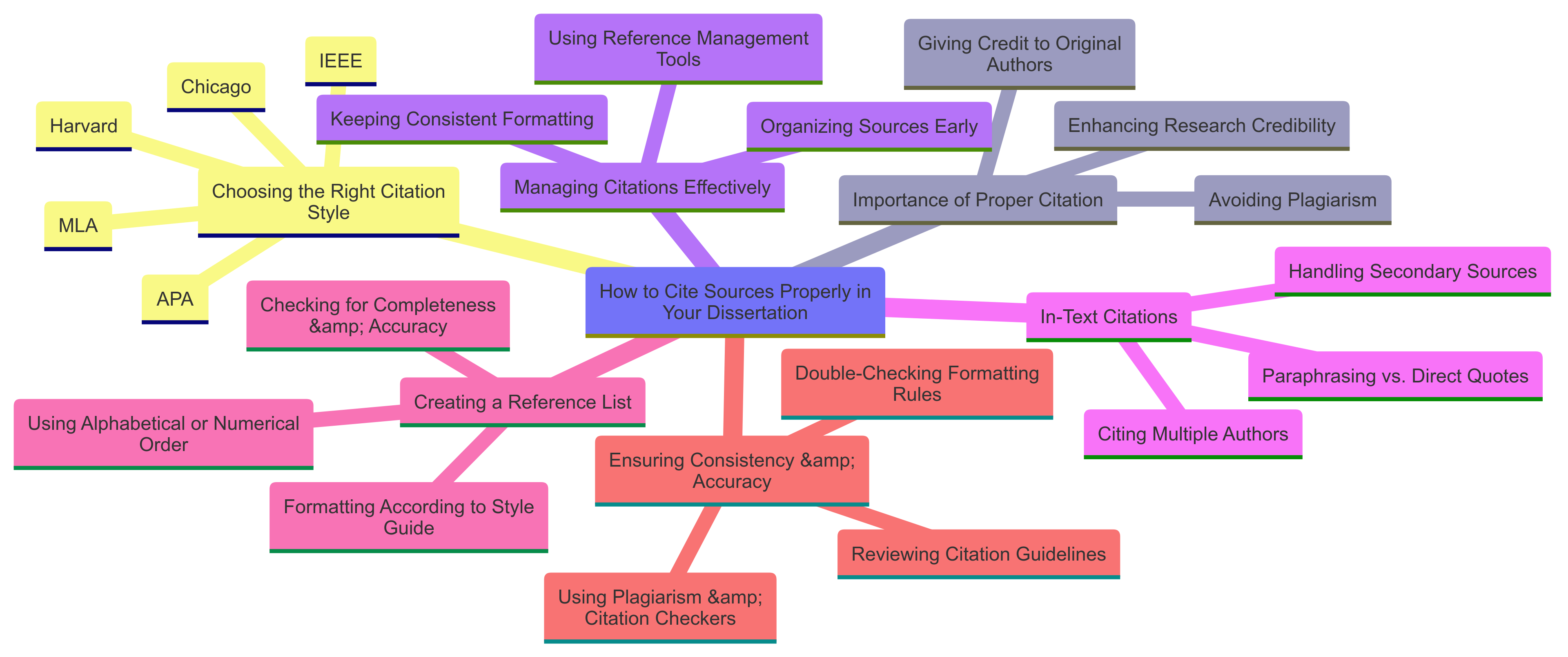
5. Confirming the Accuracy of Citations and References
Accurate citations and a meticulously compiled reference list are essential markers of academic integrity. Failing to correctly attribute sources can lead to accusations of plagiarism, even if unintentional.
Before submitting your dissertation, verify the following:
-
Each in-text citation must correspond to an entry in your reference list. Double-check that every source you mention in your text is fully and accurately listed.
-
Adhere strictly to your institution’s citation style guidelines. Whether you are following APA, MLA, Harvard, or another format, consistency is key.
-
Ensure that details such as author names, publication dates, and titles are correct. Small errors can diminish the credibility of your work.
-
Review all non-traditional sources. This includes websites, conference proceedings, and unpublished materials—these often require extra care in formatting.
-
Use citation management software as an aid, but do not rely solely on it. Manually review the generated bibliography to catch any discrepancies or formatting issues.
Proper referencing not only honors the work of other researchers but also reinforces the foundation upon which your research is built. A flawless reference section is a testament to your diligence and respect for academic standards.
6. Verifying Adherence to Formatting Guidelines
Universities and departments often impose strict formatting requirements that your dissertation must adhere to. Even the best research can be marred by poor formatting, which may cause delays or lead to rejection of your submission.
Key formatting considerations include:
-
Title Page and Abstract: Ensure that the title page follows your institution’s guidelines, with all required details such as your name, department, degree program, and submission date. The abstract should succinctly summarize your research without exceeding any word limits set by your department.
-
Margins, Fonts, and Spacing: Most institutions require specific margins (often one inch on all sides), a particular font type (such as Times New Roman or Arial), and a certain font size (commonly 12 pt). Line spacing is usually double-spaced for readability.
-
Headers and Footers: Make sure page numbers, chapter titles, and other header/footer elements are consistently placed throughout the document.
-
Chapter and Section Headings: Use a consistent style for all headings and subheadings. This not only enhances the visual appeal but also helps generate an accurate Table of Contents.
-
Tables, Figures, and Captions: All visual elements should be clearly labeled and cited in the text. Ensure that tables and figures are of high resolution and that captions are descriptive enough to stand alone.
Utilize the style and formatting tools available in your word processor to maintain consistency. Attention to detail in formatting underscores the professionalism of your dissertation and reflects well on your academic diligence.
7. Completing a Comprehensive Plagiarism Check
Maintaining academic integrity is non-negotiable. Plagiarism—even if accidental—can have severe repercussions on your academic and professional future. Before you submit your dissertation, it is crucial to run it through a comprehensive plagiarism check.
To do so:
-
Use approved plagiarism detection software, such as Turnitin or iThenticate. These tools scan your text against vast databases of published work and online content.
-
Carefully review the similarity report generated by the software. Pay attention to any passages that are flagged and ensure that they are either properly quoted or paraphrased and cited.
-
Adjust any sections with high similarity percentages. Rewrite or expand upon these sections if necessary to ensure originality.
-
Document the plagiarism check. Some institutions require you to submit the report along with your dissertation, so be sure to save a copy.
Thoroughly vetting your work for originality not only safeguards your academic reputation but also reinforces your credibility as a researcher. A low similarity index is an indicator of original thinking and diligent scholarship.
8. Incorporating Supervisor’s Feedback Effectively
Your supervisor is a key resource during the final phase of your dissertation journey. Their insights and suggestions are vital for fine-tuning your work and ensuring that it meets academic standards. Before you finalize your submission, make sure to:
-
Review all feedback provided during earlier reviews and consultations. Consolidate comments and suggestions into a comprehensive list.
-
Address each piece of feedback methodically. Revise sections of your dissertation to incorporate suggestions that improve clarity, structure, and depth.
-
Communicate with your supervisor if any recommendations are unclear or if you need further guidance. A final meeting or email exchange can help clarify outstanding issues.
-
Maintain clear version control. Save drafts of your dissertation before and after implementing changes so you have a record of revisions.
-
Request final approval if required by your department. Some institutions require a formal sign-off from your supervisor before submission.
By engaging fully with your supervisor’s feedback, you are reinforcing the quality and academic rigor of your dissertation. Their guidance can be the difference between a good dissertation and a truly outstanding one.
9. Undertaking a Detailed Proofreading Round
Even after all revisions and formatting checks, a dedicated round of proofreading is essential. This process focuses on the minute details of your text and ensures that every word contributes to the overall clarity and professionalism of your work.
When proofreading, be sure to:
-
Examine each sentence for grammatical accuracy and clarity. Look out for common errors such as misplaced commas, run-on sentences, or improper tense usage.
-
Cross-check figures, tables, and references. Ensure that all elements mentioned in the text match the corresponding visual aids and citations.
-
Read the text aloud or use text-to-speech software. Hearing your dissertation can reveal awkward phrasing or errors that might be missed during silent reading.
-
Consider enlisting a peer or professional editor. A fresh perspective is invaluable in catching errors that you might have overlooked.
-
Review the final version on different devices and in printed form. This helps to ensure that formatting remains consistent across various platforms.
Thorough proofreading transforms a good dissertation into an exceptional one. It is the final polish that brings out the true quality of your work.
10. Organizing Appendices and Supplementary Materials
Supplementary materials often provide critical support to your research and must be organized meticulously. Appendices, data sets, consent forms, and additional documentation should be compiled in a logical order and clearly labeled.
When organizing these materials:
-
Label each appendix clearly (e.g., Appendix A, Appendix B, etc.).
-
Reference each appendix within the main text where relevant.
-
Ensure that all supplementary materials are complete, legible, and well-formatted.
-
Include a list of appendices in your Table of Contents if required by your institution.
This section of your dissertation may also include technical details, raw data, or extended literature reviews that support your analysis. A well-organized appendix not only demonstrates thoroughness but also enhances the overall credibility of your research.
11. Finalizing Required Institutional Documents and Forms
In many cases, submitting your dissertation requires additional administrative documents. These might include declarations, approval forms, and ethics certificates that are essential for a complete submission package.
To finalize these documents:
-
Gather all required forms as specified by your department or institution.
-
Ensure that each form is accurately completed and signed by all necessary parties.
-
Double-check that no document is missing or incorrectly filled out.
-
Organize these documents into a single folder or digital file along with your dissertation.
Being thorough with these administrative details reflects your commitment to academic standards and helps avoid any delays or complications during the review process. Every form you submit is a part of your scholarly record, so ensure they are complete and error-free.
12. Creating the Submission-Ready Version
After all revisions, proofreading, and administrative tasks are complete, it is time to assemble the final version of your dissertation for submission. This version should be a flawless document that reflects all your hard work.
Focus on these key points when creating the submission-ready version:
-
Convert your dissertation to a PDF format. Ensure that all fonts, images, and formatting are preserved exactly as intended.
-
Embed all fonts and graphics to avoid display errors.
-
Name the file according to your institution’s naming conventions.
-
Merge supplementary materials if required (such as the title page, approval forms, and appendices) into a single cohesive document.
-
Verify that the document is accessible and displays correctly on different devices.
A well-prepared final version minimizes the chance of technical issues during submission and reinforces the quality of your academic work.
13. Meeting Deadlines with Buffer Time
Academic deadlines are strict, and missing one can have significant consequences. To avoid last-minute issues, plan to finish your submission well before the official deadline.
To manage your time effectively:
-
Create a reverse timeline that accounts for all final tasks.
-
Set internal deadlines for each section of the process.
-
Allow extra time for unexpected issues such as formatting glitches or technical difficulties with the submission portal.
-
Aim to complete your dissertation at least several days in advance of the deadline.
Building in a buffer not only reduces stress but also gives you the flexibility to address any last-minute challenges without jeopardizing your submission.
14. Uploading the Dissertation and Receiving Confirmation
When your dissertation is complete and ready, the final administrative act is to upload it to the designated submission portal or deliver hard copies as required. It is crucial to follow the submission instructions precisely.
During the upload process, ensure that you:
-
Double-check that the correct file has been selected.
-
Fill in all required metadata fields accurately (such as title, abstract, and keywords).
-
Confirm that the file size and format comply with institutional requirements.
-
Submit the file and immediately verify that a confirmation receipt is generated.
-
Save a copy of the confirmation (screenshot or email) for your records.
This final administrative task is the moment when all your hard work is officially recorded. A confirmation of submission is your assurance that your dissertation is now part of the academic record.
15. Post-Submission Preparation and Expectations
Submitting your dissertation is not the end of the journey—it is the beginning of a new phase. After submission, there are several follow-up actions and expectations that you should be prepared for.
Consider the following after submission:
-
Prepare for the possibility of a viva or oral defense. Some programs require you to defend your work before a panel.
-
Be ready to address any examiner comments or requested revisions.
-
Follow up with your department to confirm that all administrative requirements are met for graduation.
-
Store your dissertation and all related documents securely for future reference or publication opportunities.
-
Reflect on your work and consider writing a brief summary of your research journey for personal or professional use.
Knowing what to expect after submission can help reduce anxiety and ensure that you are fully prepared for the next stage in your academic or professional career.
16. Mental and Emotional Preparation
Beyond the technical tasks, the emotional toll of completing a dissertation is significant. As you near submission, it is important to attend to your mental well-being and prepare emotionally for the transition.
Here are some strategies for managing your emotions during this time:
-
Acknowledge your achievements. You have dedicated countless hours to your research—take time to appreciate the hard work and commitment it took to get here.
-
Allow yourself to feel a mix of emotions. It is normal to experience anxiety, relief, excitement, and even sadness as you leave behind a long chapter of your life.
-
Engage in stress-relief activities. Whether it is exercise, meditation, or spending time with loved ones, make time for activities that rejuvenate you.
-
Set realistic expectations for post-submission feedback. Understand that revisions might be necessary and that this is a normal part of the academic process.
-
Seek support from peers, mentors, or counseling services if needed. Talking about your feelings can help you process the journey and prepare for what lies ahead.
Taking care of your mental and emotional health is just as important as the academic aspects of your dissertation. Embrace this transition with the confidence that you are prepared for future challenges.
17. Leveraging Dissertation Work for Future Opportunities
Your dissertation is not only a requirement for graduation—it is also a valuable asset for your future academic and professional endeavors. The work you have put into your research can open doors in various ways.
Consider the following opportunities:
-
Publication: Explore the possibility of adapting parts of your dissertation for publication in academic journals. This can boost your academic profile and contribute to your field.
-
Conference Presentations: Look for conferences where you can present your findings. Sharing your research with a broader audience can lead to networking and collaboration opportunities.
-
Career Advancement: Your dissertation is a significant achievement that can enhance your CV. Highlight your research, methodology, and conclusions in job applications or further academic pursuits.
-
Further Research: If you plan to continue in academia, your dissertation can serve as a foundation for future research projects, grant proposals, or even a PhD.
-
Intellectual Property: In some cases, aspects of your research may have commercial applications. Consider discussing with your institution’s technology transfer office if your work could lead to innovations or patents.
Leveraging your dissertation work can transform your academic achievement into tangible career benefits. It is a demonstration of your expertise and your ability to conduct rigorous, independent research.
18. Conclusion
The process of finalizing and submitting your dissertation is a multifaceted endeavor that tests your academic, administrative, and personal resilience. Each element—from the final comprehensive review to the detailed proofreading, formatting checks, and emotional preparation—contributes to the overall quality and impact of your work.
As you bring your dissertation to its final form, remember that every detail matters. Your document is not only a record of your research but also a testament to your dedication, expertise, and growth as a scholar. The journey has been long and challenging, but with careful attention to every aspect of the submission process, you can confidently present your dissertation as a polished, well-crafted piece of academic work.
Take a moment to reflect on all that you have accomplished. Celebrate the small victories along the way—the breakthrough insights, the late nights of writing, and the moments of clarity that propelled your work forward. Now is the time to step forward with assurance and pride.
Congratulations on reaching this milestone. Your dissertation is a culmination of years of learning and perseverance, and its submission marks the beginning of an exciting new chapter in your academic and professional life. May your work continue to inspire others and serve as a strong foundation for all your future endeavors.
Thank you for taking the time to carefully prepare your dissertation for submission. By following this detailed guide, you have ensured that every facet of your work is meticulously reviewed, refined, and ready to make a lasting impact. Submit your dissertation with confidence, knowing that you have met every challenge head-on and delivered a document that is truly worthy of your academic achievements.